
Your vet says six months. Your breeder says wait until two and a half years. A friend swears by twelve months. If you’re trying to figure out when to spay a German Shepherd and the conflicting advice is making your head spin, you’re not alone, and you’re right to take this seriously.
Getting the timing wrong carries real costs. Spaying too early is linked to joint disorders that can affect your dog for life. Waiting too long slightly raises the risk of mammary tumors. Neither outcome is inevitable, but both are preventable with the right information.
By the end of this guide, you’ll know the evidence-backed spay window for your German Shepherd, the trade-offs at each age, and the three questions to bring to your vet. We cover the research by age band, the first-heat decision, behavior changes after spaying, and what recovery actually looks like.
⚠️ Medical Disclaimer: This article is for informational purposes only and is not a substitute for advice from your own licensed veterinarian. Spay timing depends on your individual dog’s health, lifestyle, and purpose. Always consult your vet before scheduling surgery.
For most female German Shepherds, the evidence-backed window to spay is 12 to 24 months, waiting until growth plates close reduces joint disorder risk by roughly three times compared to spaying before 12 months (UC Davis, 2016, 1,170 dogs).
- Spaying before 12 months triples the risk of joint disorders such as CCL tears and hip dysplasia, 16% of early-spayed females vs. 5% of intact females in the Hart et al. 2016 study.
- The Spay Window Framework maps three zones, Too Early, Optimal (12-24 months), and Delayed, to help you and your vet decide the right timing for your specific dog.
- First heat timing matters: spaying before the first heat nearly eliminates mammary tumor risk, but waiting until 18-24 months also protects joints, your vet can help you balance both.
- Neutering males follows a similar window: most veterinary researchers recommend waiting until 18-24 months for German Shepherds.
- Always confirm timing with your vet, individual health, lifestyle, and purpose all affect the right decision for your dog.
When Should You Spay a German Shepherd?

Most veterinary researchers now recommend waiting until a female German Shepherd is at least 12 months old before spaying, with 18 to 24 months as the ideal target for most dogs. A UC Davis study of 1,170 German Shepherd Dogs followed over 14.5 years found that spaying before 12 months triples joint disorder risk compared to intact females (Hart et al., 2016). Growth plates in large breeds like the GSD are still soft cartilage until 12-18 months, and sex hormones play a direct role in closing them safely.
“Spaying a female German Shepherd before 12 months of age is associated with a threefold increase in joint disorder risk compared to intact females, based on a UC Davis study of 1,170 German Shepherd Dogs followed over 14.5 years (Hart et al., 2016).”
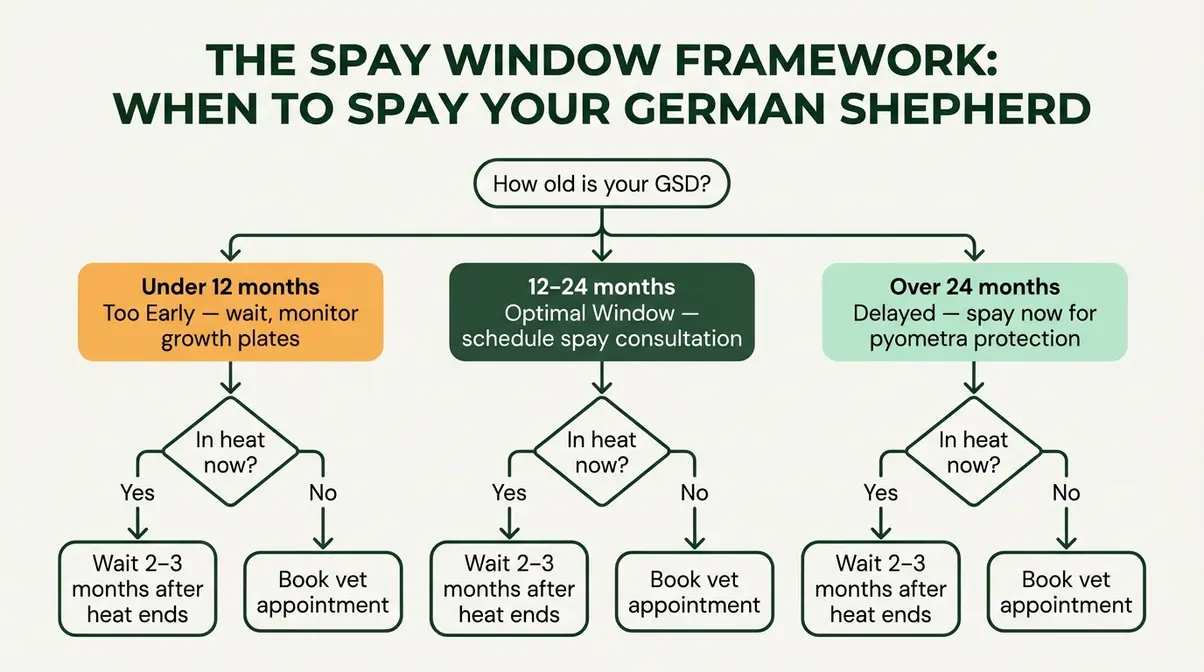
This is where The Spay Window Framework comes in. It maps three zones to help you and your vet make a clear, evidence-backed decision:
- Too Early: Under 12 months. Growth plates are still open. Joint disorder risk is significantly elevated. This is the zone most owners need to avoid.
- Optimal Window: 12-24 months. Growth plates have closed or are closing. Joint risk drops substantially. Mammary tumor risk is still low if you act within this window.
- Delayed: Over 24 months. Joint risk is no longer a primary concern, but mammary tumor risk rises with each additional heat cycle.
Understanding which zone your dog is in makes the timing decision much clearer, and it’s the framework the sections below are built around.
Why the Old 6-Month Rule No Longer Applies
The 6-month spay norm wasn’t developed with breed-specific orthopedic health in mind. It came from shelter medicine, where the priority was preventing unwanted litters before dogs were adopted, not optimizing joint health for a large-breed dog who would live with one family for 12 years. That’s an important distinction no observed competitor page makes explicit.
For small and toy breeds, early spaying carries relatively lower orthopedic risk. For large and giant breeds like the German Shepherd, the calculus is different. The AKC’s size-based guidance recommends waiting until 12-18 months for larger breeds before spaying or neutering, reflecting the same orthopedic concern.
The shift in guidance followed the Hart et al., 2016 study, a UC Davis analysis of 1,170 German Shepherd Dogs over a 14.5-year study period. It was the first large-scale breed-specific analysis to quantify joint disorder risk by age at neutering, and it changed how many veterinarians approach spay timing for this breed specifically.
Consider a companion-female GSD puppy brought in at five months. Her owner was told “the standard is six months.” That standard was designed for a shelter dog in a different situation, not for a large-breed dog whose growth plates won’t close for another six to twelve months. Understanding when a German Shepherd’s growth plates finish closing is the starting point for making an informed timing decision.
It’s also worth noting that in Europe, intact dogs are more common than in the US, and the orthopedic risk data from early neutering is better known among breeders there. The US norm of early spay/neuter reflects different shelter pressures, not superior medical evidence.
To understand why waiting matters, you need to know what sex hormones actually do for a growing German Shepherd’s joints, and what happens when they’re removed too soon.
The 12-to-24-Month Window Explained

German Shepherds are a large breed, and their growth plates typically close between 12 and 18 months. In females, estrogen is one of the hormones that signals the growth plates to harden. Removing the ovaries before those plates close leaves them vulnerable to abnormal loading and injury during the critical final months of development.
When does a German Shepherd reach full size? Most GSDs reach their full skeletal size by 18-24 months, though muscle mass continues developing until around 2-3 years. Growth plates, the soft cartilage zones at the ends of long bones, typically close between 12 and 18 months. Spaying within the 12-24 month window balances joint protection with the mammary risk of waiting indefinitely.
A common search is “when to spay a german shepherd puppy”, and the direct answer is that puppies under 12 months are generally too young for optimal spay timing in this breed. The 6-month norm simply doesn’t apply here.
Some breeders and veterinarians go further:
“Our breeder advises to spay between 2 and 2.5 years, not before.”
This is a reasonable position, particularly for working or sport dogs where musculoskeletal integrity is critical for performance. For companion dogs, waiting past 24 months does slightly increase mammary tumor risk with each additional heat cycle, which is the trade-off to weigh. The University of California guidance on when to neuter or spay a dog confirms that major differences exist among breeds for developing joint disorders when neutered early, and that timing decisions should be breed-specific (University of California, 2020).
A companion female GSD at 14 months is likely within the optimal window, her growth plates are closed or nearly so. A sport female at 18 months whose owner wants to wait until 24 months to ensure full musculoskeletal maturity is making a defensible, research-consistent choice. The window is a range, not a single date.
The numbers behind that window are more specific than most guides let on, here’s what the research actually shows, broken down by age.
What the Research Shows by Age Band
The best age to spay a German Shepherd, according to the available evidence, falls between 12 and 24 months, and the data behind that recommendation is more specific than most guides let on.
The Hart et al. 2016 study (UC Davis, 1,170 German Shepherd Dogs, 14.5-year study period) reported that intact females developed joint disorders at approximately 5%, while females spayed before 12 months developed joint disorders at approximately 16%, roughly three times the rate. CCL rupture and hip dysplasia were the primary conditions driving that gap. The Hart et al., 2020, Frontiers in Veterinary Science multi-breed follow-up confirmed the GSD-specific joint disorder risks by neuter age across a broader population, reinforcing the breed-specific nature of the findings.
One important caveat: the UC Davis data comes from hospital records, it’s an association study, not a controlled trial. That means we can say early spaying is associated with higher joint disorder rates, not that it definitively causes them. That’s still a meaningful signal, but it’s worth stating plainly.
The mammary cancer picture runs in the opposite direction. Intact females in the Hart 2016 data developed mammary cancer at approximately 4%, while neutered females developed it at under 1%. Spaying reduces mammary risk substantially, but the timing of that spay determines whether you’re also protecting joints.
Here is the age-band risk picture for female German Shepherds, drawn from the UC Davis research:
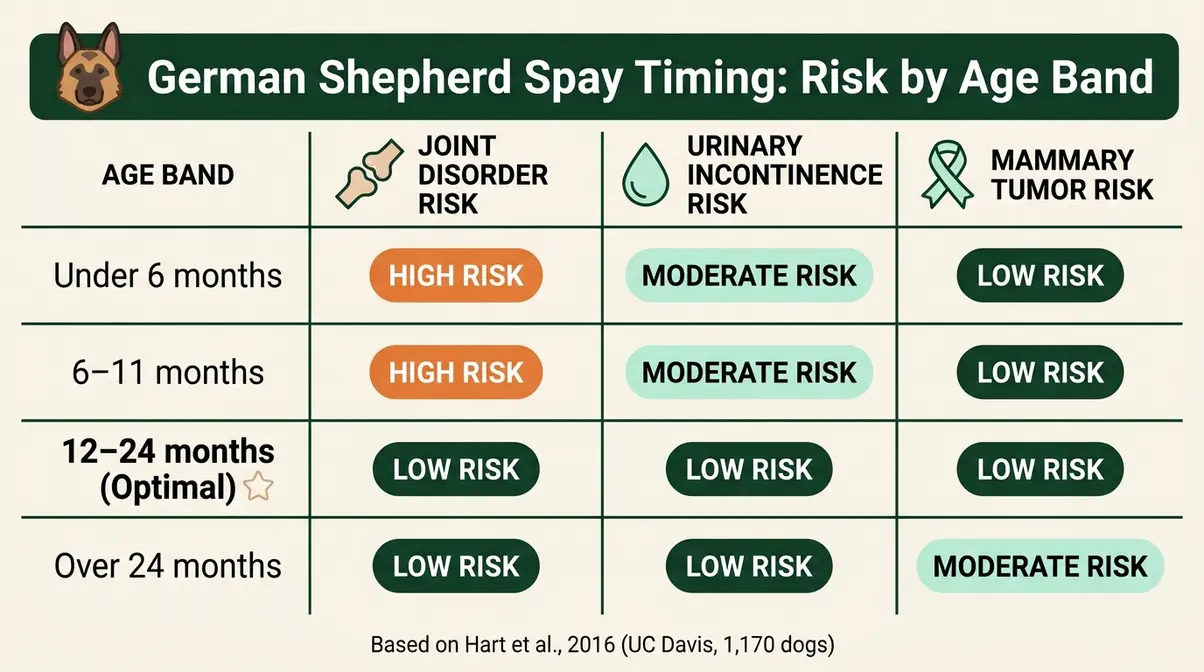
| Age at Spay | Joint Disorder Risk | Urinary Incontinence Risk | Mammary Tumor Risk | Study Source |
|---|---|---|---|---|
| Under 6 months | Highest (~16%+ joint disorders) | Elevated | Near zero | Hart et al., 2016 (PMC 5645870) |
| 6-11 months | Elevated (within the early-spay risk band) | Elevated | Near zero | Hart et al., 2016 (PMC 5645870) |
| 12-24 months (Optimal) | Low (~5%, similar to intact) | Lower | Low | Hart et al., 2016; UC Davis, 2020 |
| Over 24 months | Low | Low | Increases with each heat cycle | PMC 11815721; Hart et al., 2016 |
The timing window looks different depending on what your dog does, here’s how purpose changes the calculation.
Timing by Your Dog’s Purpose
How you use your German Shepherd matters for spay timing, even within the 12-24 month optimal window.
Companion female: The 12-24 month window applies directly. Eighteen months is a reasonable middle ground, growth plates are closed, mammary risk remains low, and you’re not waiting so long that heat cycles accumulate. This is the straightforward case.
Working, sport, or canine athlete female: Veterinarians and breeders who work with sport dogs (agility, Schutzhund, herding) often recommend waiting until 24 months or later. The orthopedic demands of high-intensity sport make joint health especially critical, and full musculoskeletal maturity, not just growth plate closure, is the goal. Waiting until 24 months for a sport female is a defensible choice backed by the same research.
Show female: Timing may be influenced by competition schedules, but the health decision should still lead. Discuss with your vet and handler. Spaying doesn’t affect show eligibility in most contexts, but your dog’s long-term health is the priority.
Male German Shepherds: For male GSDs, the evidence-backed window is similar. Hart et al., 2016 reported joint disorders in males neutered before 12 months at approximately 21%, compared to approximately 7% in intact males (UC Davis, 2016, 1,170 dogs, verify male figures against primary paper before citing). Most veterinary researchers recommend waiting until 18-24 months before neutering a male GSD. The best time to neuter a German Shepherd male follows the same logic as for females: wait for skeletal maturity, then discuss individual factors with your vet.
Consider a working or sport female at 18 months whose owner is thinking about spaying before the next competition season. The key factors to weigh: her growth plates are likely closed (joint maturity achieved), but waiting until 24 months gives more margin for full muscular development. Mammary risk at 18 months is still low. There’s no single right answer, but the framework gives you the variables to discuss with your vet.
Now that you know when to spay, it helps to understand why the timing matters so much for this breed, specifically, what early spaying does to a growing joint.
What Are the Health Risks of Spaying Too Early?
Spaying a female German Shepherd before her growth plates close, typically before 12 months, is linked to significantly higher rates of joint disorders, including cranial cruciate ligament (CCL) tears and hip dysplasia. In a UC Davis study of 1,170 German Shepherd Dogs, females spayed before 12 months showed joint disorders at roughly three times the rate of intact females, 16% versus 5% (Hart et al., 2016). Sex hormones don’t just govern reproduction; they play a structural role in how bones develop and harden.
“In a UC Davis study of 1,170 German Shepherd Dogs, females spayed before 12 months showed joint disorders at roughly three times the rate of intact females, 16% versus 5% (Hart et al., 2016).”
This is the science behind the “Too Early” zone of The Spay Window Framework. The two main risks are joint disorders and urinary incontinence, and both are significantly more common when spaying happens before the first birthday.
How Sex Hormones Protect Growing Joints
Growth plates are areas of soft cartilage at the ends of long bones, the femur, tibia, and humerus, that harden into solid bone as the dog matures. Think of them like scaffolding inside the bone: while they’re soft, they’re doing the work of guiding bone growth. In females, estrogen is one of the hormones that signals this hardening process. Remove the ovaries before the plates close, and you remove a key signal the bones are waiting for.
German Shepherds are a large breed with a longer growth period than small breeds. Their growth plates typically close between 12 and 18 months. This is exactly why the 6-month spay norm, designed for small breeds and shelter logistics, carries higher orthopedic risk for GSDs. You can read more about the UC Davis findings on neutering before one year of age and how they apply to this breed specifically.
A useful analogy: removing scaffolding from a building before the concrete has set. The structure looks intact from the outside, but it’s more vulnerable to stress during the critical hardening period. The same principle applies to a GSD’s joints in those final months before growth plate closure.
The mechanism isn’t fully understood, the Hart et al., 2016 data is associational, not causal. The study design (hospital records over 14.5 years) is strong for an association study, but it cannot prove that early spaying causes joint disorders. What it shows clearly is a consistent pattern: earlier spaying, more joint problems. That pattern is worth taking seriously.
Here’s what that mechanism looks like in practice, the specific joint conditions the research links to early spaying in female German Shepherds.
Joint Disorders Linked to Early Spaying
Joint disorders are the primary risk in the “Too Early” zone, and three conditions stand out in the research.
The cranial cruciate ligament (CCL) is the canine equivalent of the ACL in humans, it stabilizes the knee joint. CCL rupture is the most common joint disorder in the Hart 2016 data for female GSDs spayed early. The age-band gap is significant: females spayed before 12 months showed joint disorders (including CCL rupture) at approximately 16%, compared to 5% in intact females (Hart et al., 2016, PMC 5645870, confirm CCL-specific female percentages against primary paper before publishing). The Hart et al., 2020, Frontiers in Veterinary Science multi-breed follow-up confirmed these GSD-specific findings, including elevated CCL, hip, and elbow dysplasia rates in early-neutered dogs.
Hip dysplasia is an inherited joint condition already common in German Shepherds. Early spaying may compound the genetic risk that’s already present in many GSDs. For a breed where hip dysplasia is a known concern, this is a meaningful additional consideration. You can find detailed condition-level information on hip dysplasia, one of the joint disorders this breed is prone to.
Elbow dysplasia also appears in the Hart 2016 data, though it’s less prominent than CCL rupture and hip dysplasia. It’s worth knowing about, even if it’s a secondary concern.
One additional nuance that most guides skip: body condition score may be a confounder in these findings. Spayed dogs tend to gain weight more easily, and obesity independently stresses joints. This doesn’t negate the timing recommendation, the pattern holds even accounting for this, but it adds nuance. Monitoring your GSD’s weight after spaying is a practical step that protects her joints regardless of when the surgery happens.
Consider a companion female GSD spayed at five months who develops CCL rupture at age three. Her owner wonders if timing was a factor. The research says: possibly, but not certainly. The association is real and consistent across 1,170 dogs. What the vet would consider is the combination of early spay timing, the dog’s genetics, her weight history, and her activity level. The research is a strong signal, not a guarantee.
Fast-growing large-breed puppies are also at elevated risk for osteochondritis dissecans in fast-growing large-breed puppies (OCD) between 6 and 9 months, another reason early spaying during this developmental window compounds orthopedic risk.
There’s a second risk that’s less talked about, and it specifically affects females spayed before their first birthday.
Urinary Incontinence After Early Spaying
Spay-related incontinence (also called hormone-responsive urinary incontinence) is more common in female dogs spayed before 12 months, and large breeds are at higher risk. According to UC Davis veterinary guidance on spaying before the first heat, approximately 7% of females spayed before 12 months may develop urinary incontinence, a figure that warrants primary-paper confirmation against PMC 5645870 before citing as definitive.
The condition is manageable with medication, but it’s a quality-of-life concern for both dog and owner. Waiting until after 12 months significantly reduces this risk, according to the same Hart 2016 data.
As one practical framing: “This is one of the reasons some veterinarians specifically advise against spaying large-breed females before their first birthday.” It’s not a reason to avoid spaying, it’s a reason to time it correctly.
It’s also worth noting the connection to osteochondritis dissecans in fast-growing large-breed puppies, puppies in the 6-9 month window are already navigating an orthopedically sensitive period, making early spaying during this time a compounding risk factor.
So far, we’ve looked at the risks of acting too soon. But there’s a real cost to waiting too long, and it involves cancer.
Does Waiting to Spay Increase Cancer Risk?
Waiting past the optimal 12-24 month window does carry a real risk, specifically, a higher lifetime rate of mammary tumors in intact females. A systematic review found that female dogs admitted for spaying after their third oestrous cycle had a mammary tumor frequency of 27.6%, compared to dogs spayed before their first cycle (systematic review on pre-pubertal spaying and mammary tumours, PMC, 2024). This is the trade-off at the heart of the spay timing decision, and it’s the “Delayed” zone of The Spay Window Framework.
“A systematic review found that female dogs admitted for spaying after their third oestrous cycle had a mammary tumor frequency of 27.6%, compared to dogs spayed before the first cycle (PMC 11815721).”
The mammary tumor risk isn’t linear, it rises sharply after the third heat cycle, not gradually from the first. This nuance is absent from most guides. A female at 14 months who has had one heat cycle faces a very different mammary risk profile than a female at four years who has had six. The decision to wait until 24 months is not the same as the decision to wait indefinitely.
Spaying also eliminates the risk of pyometra, a life-threatening uterine infection that can develop in intact females. According to the Cornell veterinary overview of pyometra prevention through spaying, pyometra is entirely preventable if a dog is spayed before the development of infection in the uterus (Cornell University College of Veterinary Medicine). The risk of pyometra increases with age in intact females, it’s one of the strongest arguments for spaying within the optimal window rather than delaying indefinitely.
Other cancers sometimes discussed alongside spay timing include osteosarcoma, lymphoma, hemangiosarcoma, and mast cell tumors. The evidence linking these to spay timing is less consistent than for mammary tumors, and the direction of risk varies by cancer type and breed. Present these with appropriate qualification, they’re relevant context but shouldn’t drive the timing decision the way mammary tumor risk does.
Is it okay to never spay your dog? It’s a personal decision with real health trade-offs. An intact female GSD faces a higher lifetime risk of mammary tumors (rising sharply after the third heat cycle) and pyometra. She also avoids the joint disorder risks associated with early spaying. Some breeders and working-dog owners choose to keep females intact throughout their career. But the health risks of remaining intact indefinitely are real, discuss the full picture with your veterinarian before making that choice.
Spaying before the first heat nearly eliminates mammary tumor risk. UC Davis notes that “dogs spayed before their first heat are virtually assured of not developing mammary cancer”, a compelling argument for spaying within the optimal window rather than waiting past 24 months without a specific reason.
The trade-off is clear: spay too early and you risk joint disorders; wait too long and mammary risk climbs. The 12-24 month window is designed to minimize both. Which brings us to the question most owners actually face: what do you do when your dog goes into heat before you’ve booked the surgery?
Should You Let Your German Shepherd Go Into Heat First?
For most female German Shepherds, letting her go through one heat cycle before spaying is a reasonable approach, but the decision depends on when that first heat cycle arrives and your dog’s overall maturity. Cornell University College of Veterinary Medicine notes that a spay can be performed when a dog is in heat if needed, but waiting about two months after heat allows hormones to return to baseline, making for an easier surgery. The key distinction: sexual maturity (first heat, typically 6-12 months) and full physical maturity (growth plates closed, typically 12-18 months) are different milestones. The spay timing decision should be based on physical maturity, not sexual maturity.
Here’s how to apply The Spay Window Framework to your dog’s specific heat status. The three scenarios below cover the situations most GSD owners actually face.
What If She Goes Into Heat at 10-11 Months?
If your female GSD enters her first heat cycle at 10-11 months, she is sexually mature but not yet fully physically mature, her growth plates are likely still open. This is not an emergency. You don’t need to rush the surgery.
Most veterinarians recommend waiting approximately 2-3 months after the heat cycle ends before scheduling the spay. During heat, the uterine blood vessels are engorged, which makes surgery more complex and increases bleeding risk. Cornell guidance on spaying during or after a heat cycle confirms: waiting about two months allows the hormones to return to baseline, making for an easier surgery (Cornell University College of Veterinary Medicine). Some vets are reluctant to spay a dog in heat, this is a practical clinical consideration, not a hard rule, but it’s worth knowing.
Use the 2-3 months after heat to schedule surgery for when she is approximately 12-14 months old, squarely within the optimal window. To understand how a female German Shepherd’s first heat cycle unfolds, including typical duration and signs, that guide covers the full picture.
Here’s a concrete action plan for a companion female GSD who goes into heat at 10.5 months:
- Note the start date of the heat cycle.
- Call your vet to flag the heat and discuss scheduling.
- Keep her separated from intact males for the full duration of heat (typically 2-4 weeks).
- Schedule the spay for approximately 2-3 months after heat ends.
- Target surgery at around 13-14 months, within the Optimal Window.
What if you’ve already missed the first heat, or your dog is 2, 3, or even older? Here’s what the research says about later spaying.
Is 3 Years Too Late to Spay a German Shepherd?
No. No veterinary research reviewed here sets a hard cutoff at three years, spaying at 3 years is not contraindicated. The guidance centers on 12-24 months as the optimal window, but an older female can still benefit meaningfully from spaying.
The main consideration for an older female is that she has likely been through multiple heat cycles, which increases her lifetime mammary tumor risk. The systematic review on pre-pubertal spaying and mammary tumours shows the risk rises sharply after the third oestrous cycle, so a three-year-old intact female who has had four or five heat cycles has accumulated meaningful mammary risk. Spaying now won’t undo that accumulated risk, but it stops the clock from running further.
Pyometra risk also increases with age in intact females. Spaying eliminates this risk at any age, and pyometra is a genuine, life-threatening concern in older intact dogs. For a three-year-old female, pyometra prevention alone is a strong argument for spaying.
Two specific scenarios worth addressing:
Adult never-spayed female at 3 years: Discuss with your vet. Spaying is still beneficial for pyometra prevention and reducing further mammary risk accumulation. The surgical risk in a healthy adult dog is generally low, but your vet will assess her individual health status, weight, and prior heat cycles.
Rescue of unknown age: Your vet will assess health status, estimate age from physical exam, and recommend timing. Spaying is almost always appropriate for a rescue female of unknown age unless specific health contraindications exist.
The UC Davis veterinary guidance on spaying before the first heat notes that dogs spayed before their first heat are virtually assured of not developing mammary cancer, which underscores the value of acting within the optimal window, but does not mean that spaying at 3 years is pointless. It’s still protective and still the right call for most intact adult females.
Whether you’re scheduling now or still deciding, these are the questions to bring to your vet appointment.
Questions to Ask Your Vet Before Booking
A good vet appointment is a conversation, not a rubber stamp. These five questions give you the framework to have that conversation productively:
- “Based on my dog’s age and heat history, which zone of the spay timing window are we in, Too Early, Optimal, or Delayed?”
- “Has she had her first heat? If so, how long ago, and is it safe to schedule now?”
- “Are her growth plates fully closed? Can we confirm with an X-ray if needed?”
- “Given her purpose, companion, sport, or working dog, what timing do you recommend?”
- “What are the specific risks I should weigh for her individual health profile?”
Your vet’s discharge instructions after surgery take precedence over any general guidance in this article. These questions are a conversation starter, not a replacement for your vet’s clinical judgment. Your vet knows your dog’s individual health profile, these questions help you make the most of that appointment.
Once the surgery is scheduled and done, the next question most owners have is: will my dog be different? Here’s what the evidence actually shows.
Do Female German Shepherds Change After Being Spayed?
Most female German Shepherds don’t undergo dramatic personality changes after spaying, but some behavioral shifts are possible, and a few are backed by research. A peer-reviewed review of behavioural risks in spayed female dogs found increased possessive aggression and fearful behavior in some spayed females, though individual variation is significant (PMC, 2019). The most common owner-reported change is a reduction in heat-related behaviors, not a change in core personality.
“A peer-reviewed review found that spayed female dogs showed increased possessive aggression and, in some breeds, increased fearful behavior in response to loud noise, though individual variation is significant (PMC 6894801).”
Timing within The Spay Window Framework doesn’t just affect physical health, it may also influence behavioral outcomes. Here’s what the research actually says about the three questions owners ask most often.
Do female German Shepherds calm down after being spayed? Spaying eliminates heat cycles and the associated restlessness, roaming behavior, and attraction of intact males. What it doesn’t change is your dog’s fundamental energy level or drive. A high-energy GSD will still be high-energy after spaying, the hormonal fluctuations of heat cycles are gone, but the dog’s underlying temperament is not. If your dog’s activity level concerns you, that’s a training and enrichment question, not a spay timing question.
Do female dogs change after being spayed? Some changes are expected and predictable: no more heat cycles, reduced roaming behavior, and possible weight gain (monitor diet and adjust portions as needed after surgery). The peer-reviewed review of behavioural risks in spayed female dogs notes increased possessive aggression in some spayed females, present honestly with the caveat that individual variation is significant and this is not the norm. The University of California guidance on when to neuter or spay a dog also notes behavioral considerations alongside the joint and cancer data (University of California, 2020). Core temperament, drive, and bonding behavior are largely unchanged.
Do dogs realize they’ve been spayed? Dogs don’t have the cognitive framework to understand reproductive changes. Your German Shepherd won’t “realize” she’s been spayed the way a person would. She will experience the recovery period, some discomfort, restricted activity, and the unfamiliar sensation of an incision. Heat-cycle behaviors will stop over the following weeks, which she may register as a change in her body’s rhythms. What she notices most is how you care for her during recovery.
What your dog will notice is the recovery period, and how you manage those first two weeks makes a significant difference to her comfort and healing.
What to Expect After Your German Shepherd Is Spayed
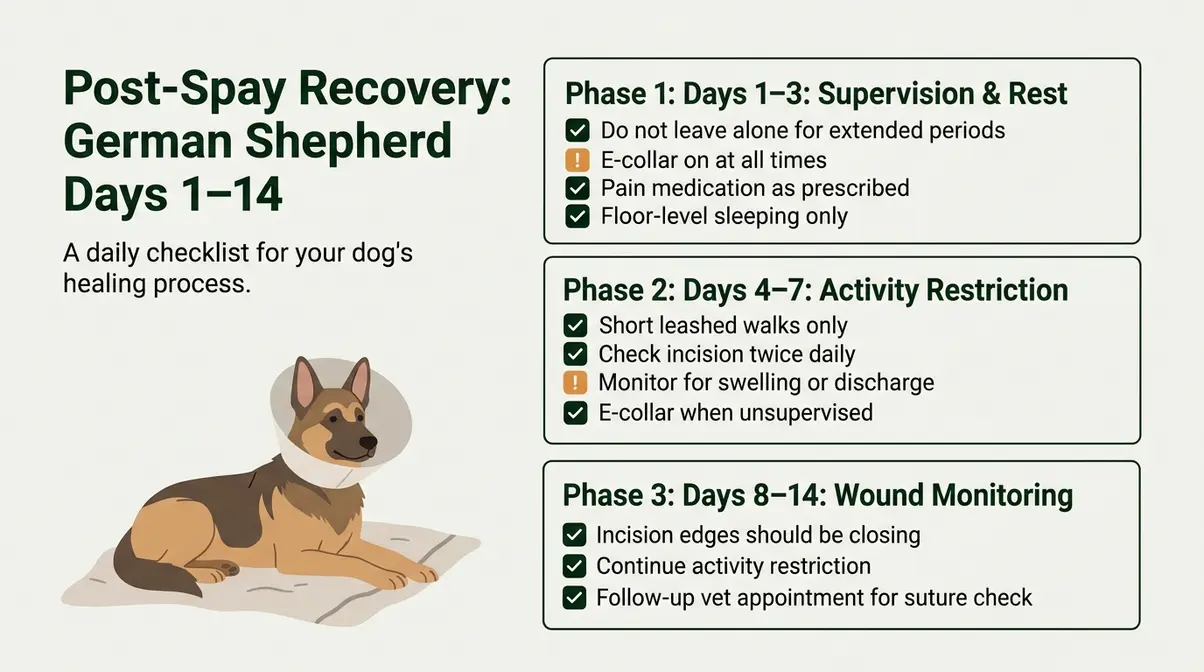
Most female German Shepherds recover from spaying within 10 to 14 days for the external incision, with internal sutures taking approximately 4 to 5 weeks to fully dissolve. The external incision is the visible wound you’ll monitor daily; internal sutures are the stitches inside the body cavity that dissolve on their own over several weeks. The first 72 hours are the most critical period for supervision, this is when your dog is most vulnerable to complications. Activity restrictions during the full recovery period prevent the most common setbacks.
“Most veterinary sources recommend restricting a spayed dog’s activity for 10 to 14 days while the external incision heals, with internal sutures taking approximately 4 to 5 weeks to fully dissolve, always follow your vet’s specific discharge instructions.” (Verify these timelines against vet-school or AVMA sources before publishing.)
The most common mistake owners make is allowing too much activity too soon. A dog that seems fine on Day 3 is still healing internally, the external wound is just the surface. Here’s what recovery looks like day by day.
The First 72 Hours: Supervision and Rest
Can I leave my dog alone 3 days after spay? In the first 72 hours, your dog should not be left alone for extended periods. She may still be groggy from anesthesia, in discomfort, and at risk of licking or chewing the incision. If you must leave, use a crate with an e-collar (Elizabethan collar) in place and limit the time away as much as possible.
Are female dogs in pain after being spayed? Yes, some discomfort is normal and expected. Your vet will prescribe pain medication; follow the dosing schedule exactly, even if she seems comfortable. Signs of excessive pain, crying out when touched, refusing to move, pale gums, or rapid breathing, warrant an immediate call to your vet.
Where should a dog sleep after spaying? On a flat, comfortable surface at floor level. Avoid beds, sofas, or any furniture she might jump off. A crate or a padded floor mat works well for the first week. Keeping her at floor level removes the temptation (and the risk) of jumping.
The Cornell veterinary overview of pyometra prevention through spaying underscores why completing recovery successfully matters, spaying eliminates pyometra risk entirely, but only when the surgery heals without complication (Cornell University College of Veterinary Medicine).
Once the first three days are behind you, the focus shifts to managing activity and watching the incision as it heals.
Days 4 to 14: Activity and Wound Care
The activity restriction period is 10-14 days minimum, no running, jumping, rough play, or off-leash time. Short, leashed walks for bathroom breaks are fine. The external incision is actively healing during this window, and excessive movement can cause it to open or delay healing.
Check the incision daily. A small amount of bruising and mild swelling in the first few days is normal. What warrants a vet call: pus or cloudy discharge, significant swelling that’s increasing, a foul smell, or any opening of the wound edges.
The e-collar stays on whenever you can’t directly supervise. Dogs are remarkably effective at licking incisions the moment you look away, and licking is one of the most common causes of wound complications.
Here’s a day-by-day guide for the recovery window, verified against UC Davis veterinary guidance on spaying and recovery:
- Days 4-7: Short leashed walks only. Monitor incision twice daily. Continue pain medication as prescribed. Keep e-collar on when unsupervised.
- Days 8-10: Incision should be visibly healing, less redness, edges coming together. Activity remains restricted. Check for any late-onset swelling.
- Days 11-14: External sutures (if non-dissolving) may be removed by your vet at the follow-up appointment. Internal sutures continue dissolving for 4-5 weeks. (Confirm suture timelines against your vet’s discharge instructions.)
Consider the GSD owner who lets her dog run in the yard on Day 5 because “she seems fine.” The dog’s energy is back, she’s eating well, and she’s acting like herself. But internally, the tissue is still in the early stages of healing. One hard run, one jump off the couch, and the incision can open or the internal repair can strain. The external wound is not the whole picture.
The most common recovery complication isn’t infection, it’s a dog that jumps before she’s ready. Here’s what to do if that happens.
What If She Jumps or Strains the Incision?
If your dog jumps once, check the incision immediately. If it looks intact (no opening, no excessive swelling, no bleeding), monitor closely for the next 24 hours. One jump is unlikely to cause serious damage, but it’s worth watching carefully.
Call your vet immediately if: the incision opens, you see significant swelling or bleeding, discharge that looks cloudy or smells bad, or your dog is in obvious distress after the jump. Don’t wait and see in these cases.
Prevention is straightforward once you know the risks:
- Use baby gates to block stairs and furniture access during the recovery period.
- Keep her leashed even indoors during the first week, especially when other pets or children are around.
- Use a crate when you can’t directly supervise, this removes the option to jump.
- Remove access to the couch, bed, and any elevated surfaces she normally uses.
Here are the questions GSD owners ask most often about spay timing and recovery, answered directly.
Frequently Asked Questions About Spaying a German Shepherd
When is the best time to spay a German Shepherd?
For most female German Shepherds, the best time to spay is between 12 and 24 months of age, with 18 months as a reasonable middle ground for companion dogs. Spaying before 12 months is linked to significantly higher rates of joint disorders, including CCL tears and hip dysplasia. Waiting past 24 months slightly increases mammary tumor risk. The right timing depends on your dog’s individual health, purpose, and heat history, confirm the specific window with your vet.
Is it better to let your female dog go into heat before spaying?
It depends on when her first heat cycle arrives. Many veterinary experts recommend letting large-breed females pass their first heat or waiting until roughly 18 to 24 months to ensure full physical maturity. Spaying before the first heat nearly eliminates mammary tumor risk, but waiting until after 12 months protects joints. If she comes into heat before 12 months, wait 2-3 months after heat ends, then schedule the surgery for around 12-14 months.
Can I leave my dog alone 3 days after spay?
In the first 72 hours after spaying, your dog should not be left alone for extended periods. She may still be groggy from anesthesia, in discomfort, and at risk of licking the incision. If you must leave, use a crate with an e-collar in place and limit the time away. By Day 4-5, short absences are generally manageable if she’s eating, moving normally, and the incision looks clean. Always follow your vet’s specific discharge instructions.
Is 3 years too late to spay a dog?
No veterinary research reviewed here sets a hard cutoff at 3 years, spaying at 3 years is not contraindicated. The guidance for German Shepherds centers on 12 to 24 months as the optimal window, but an older intact female still benefits from spaying, particularly for pyometra prevention. Waiting longer does increase lifetime mammary tumor risk. Discuss your dog’s individual health profile, heat history, and surgical considerations with your vet before deciding.
Is it okay to never spay your dog?
It’s a personal decision with real health trade-offs. An intact female German Shepherd faces a higher lifetime risk of mammary tumors, rising sharply after the third heat cycle, and pyometra, a life-threatening uterine infection. She also avoids the joint disorder risks associated with early spaying. Some breeders and working-dog owners choose to keep females intact; others spay after the dog’s working career ends. Discuss the full risk picture with your veterinarian before making this choice.
Do female dogs change after being spayed?
Most female German Shepherds don’t undergo dramatic personality changes after spaying. Heat-related behaviors, restlessness, roaming, attracting males, stop. Some research notes a possible increase in possessive aggression or fearful behavior in a small number of spayed females, though individual variation is significant. Core energy level, drive, and temperament are largely unchanged. Weight gain is a common post-spay concern, monitor diet and adjust food portions as needed after surgery.
What are the downsides of spaying a female dog?
For German Shepherds, the main downsides of spaying depend heavily on timing. Spaying before 12 months is linked to roughly three times the rate of joint disorders, including CCL tears and hip dysplasia, compared to intact females. Early spaying before 12 months is also associated with a higher incidence of urinary incontinence. Delaying past 24 months slightly increases mammary tumor risk. Discuss these trade-offs with your veterinarian to find the right window for your individual dog.
Do dogs realize they’ve been spayed?
Dogs don’t have the cognitive framework to understand reproductive changes, your German Shepherd won’t “realize” she’s been spayed the way a human would. She will experience the recovery period: some discomfort, restricted activity, and the unfamiliar sensation of the incision. Heat-cycle behaviors will stop over the following weeks, which she may register as a change in her body’s rhythms. What she notices most is how attentively you care for her during recovery.
When do German Shepherds reach full size?
Most German Shepherds reach their full skeletal size by 18 to 24 months, though muscle mass continues developing until around 2 to 3 years. Growth plates, the soft cartilage at the ends of long bones, typically close between 12 and 18 months. This developmental timeline is why veterinary researchers recommend waiting until at least 12 months before spaying, and ideally 18 to 24 months for most females. Your vet can confirm growth plate closure with an X-ray if needed.
Your Next Step: Booking the Right Spay Appointment
For female German Shepherds, the evidence-backed window to spay is 12 to 24 months, a UC Davis study of 1,170 German Shepherd Dogs found that spaying before 12 months triples joint disorder risk compared to intact females (Hart et al., 2016). PetVR’s Spay Window Framework maps three zones, Too Early, Optimal, and Delayed, to help you and your vet make the right call for your individual dog. The 12-24 month window balances joint protection with mammary tumor prevention, and 18 months is a reasonable middle ground for most companion females.
You’ve now seen the evidence behind each zone, the first-heat decision framework, and the recovery timeline. The breeder who says “2 to 2.5 years” and the vet who says “12 months” are both responding to real trade-offs, The Spay Window Framework shows you exactly where those trade-offs lie, so you can have a specific, informed conversation with your vet instead of choosing between conflicting advice.
Book a spay consultation with your vet in the next 30 days. Bring the five questions from the decision checklist above. If your dog is already in the 12-24 month window, this is the right time to schedule. If she’s younger, set a calendar reminder for her 12-month mark, and use the time to confirm her growth plates are on track. This guide is for informational purposes only, always consult your licensed veterinarian before scheduling surgery.

 Male vs Female German Shepherd: Which Should You Get?