You just brought home a 6-week-old German Shepherd puppy, or you’re about to, and the first night already feels overwhelming. Is 6 weeks too early? What does she actually need right now? These are the right questions, and you’re not alone in asking them.
The SERP is full of forum debates and short replies. You need a schedule, not an argument. This guide gives you a research-backed 24-hour routine, a feeding and weaning plan, a weight reference and a first-night checklist, everything a first-time GSD owner needs in one place.
We cover development milestones, the early-separation question, daily scheduling, training basics, growth benchmarks and the most common mistakes new owners make, so you can stop searching and start settling in.
⚠️ Veterinary Disclaimer: This article is for informational purposes only and does not replace professional veterinary advice. If you have concerns about your puppy’s health, contact your vet immediately.
A 6 week old German Shepherd puppy needs 4 small meals of softened large-breed kibble per day, typically weighs around 8 lbs (treat this as a typical range, as individual puppies vary), and should stay with its mother until at least 8 weeks if at all possible.
- Too early to leave: Ethical breeders keep GSD puppies with their mother until at least 8 weeks, that window teaches bite inhibition and emotional stability.
- Feed 4 times a day: Soften large-breed puppy kibble with warm water into a mush; no adult food, no cow’s milk.
- The 6-Week Playbook: A repeatable 24-hour schedule, not forum guesswork, is the fastest way to survive the first weeks with your new GSD.
- Vet visit this week: Book a deworming check and parvo risk assessment before your puppy meets other dogs.
- Crying at night is normal: A warm crate near your bed, a ticking clock and a worn T-shirt reduce distress without reinforcing demand barking.
What Should a 6-Week-Old German Shepherd Puppy Be Doing?
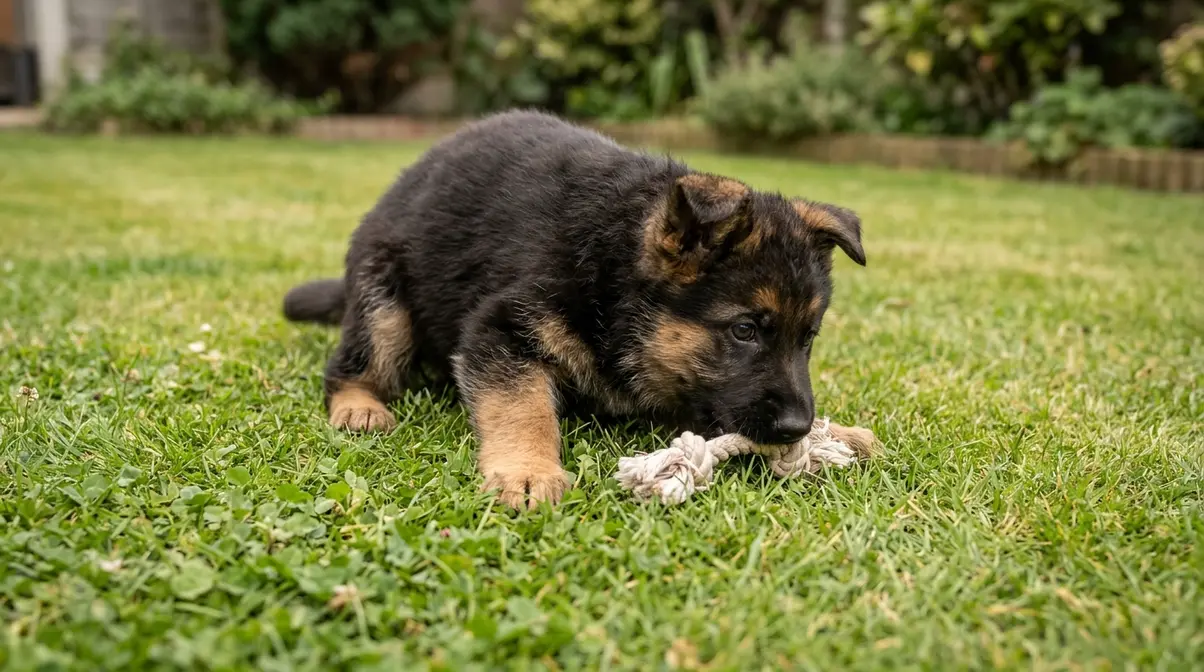
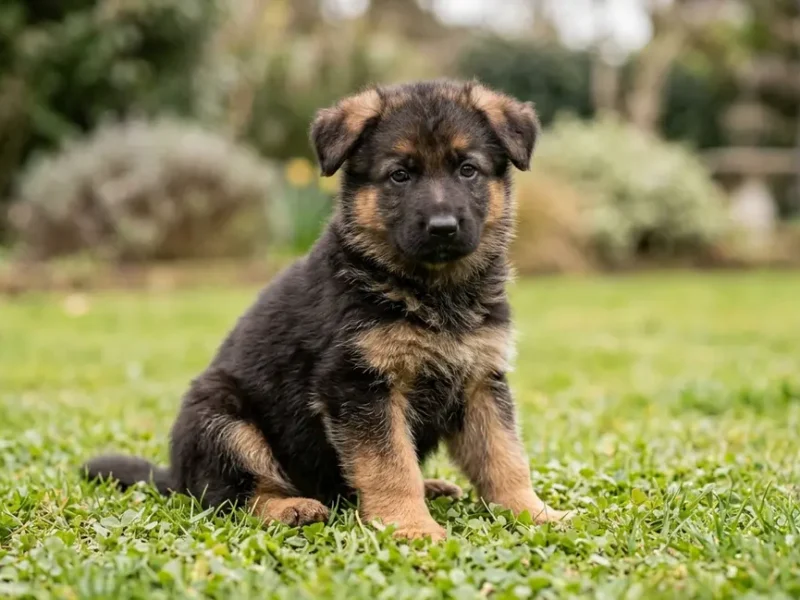
A 6-week-old German Shepherd puppy should be active, playful and curious, playing with littermates, mouthing everything in reach, and beginning to respond to sounds and her own name. Her baby teeth have come in, she’s weaning from mother’s milk onto softened solid food, and she’s entering the most important socialization window of her life. This is also the stage where The 6-Week Playbook begins: a schedule-first approach that replaces forum guesswork with a repeatable daily routine.
Six weeks sits at the exact midpoint of the critical socialization window. Every day of this stage carries disproportionate weight for long-term temperament, which is why a structured routine matters more right now than at almost any other point in your puppy’s development.
Physical Development Milestones at 6 Weeks
A 6-week-old GSD puppy has fully erupted deciduous teeth, the sharp baby teeth that will eventually be replaced by adult teeth around 4 to 6 months. “Deciduous” simply means temporary, and at 6 weeks these teeth are needle-sharp, which is why biting suddenly feels so intense.
Her eyes have been fully open since around 2 weeks. Her ears are a different story: at 6 weeks, GSD ears may still be floppy or just beginning to lift at the base. This is completely normal and not a health concern, ear cartilage strengthens gradually, and most GSD puppies have fully erect ears by 8 to 16 weeks. Don’t worry if one ear stands before the other; that’s typical.
Coordination is improving fast. She can walk, trot and play-fight with littermates, though stumbling is still normal. Picture a small, round-bellied puppy moving with wobbly purpose, ears at half-mast, already trying to herd her siblings. Coat color may also still be changing, particularly in sable puppies, who often appear much darker at 6 weeks than they will at adulthood.
Now that you know what’s happening physically, here’s what’s happening in your puppy’s brain, and why the next two weeks matter more than almost any other period in her life.
Social and Behavioral Development at 6 Weeks
Between roughly 3 and 12 weeks, puppies form their primary social bonds and learn what is safe and what is scary. At 6 weeks, your puppy is right in the middle of this window. A PubMed Central socialization study published in the National Library of Medicine confirms that canine puppies enter this critical period during which primary social bonds are formed, and that what happens during this window shapes adult behavior in lasting ways.
Bite inhibition, the ability to control jaw pressure, is one of the most important skills learned during this period. When a puppy bites a littermate too hard, the littermate yelps and disengages. That feedback teaches jaw control in a way humans find difficult to replicate. Alongside bite inhibition, your puppy is also learning dog-to-dog communication: reading body language, understanding play signals versus threat signals, and developing the emotional regulation that her mother’s presence helps maintain.
For early socialization for a new GSD puppy, you can start safe exposure at home right now: gently handle her paws, ears and mouth; introduce household sounds like the vacuum cleaner, TV and doorbell; and allow calm human contact. But no public areas, dog parks or unvaccinated dogs until your vet clears it. If she flinches at the vacuum, don’t comfort her immediately, let her investigate at her own pace, then reward calm behavior with a treat.
The socialization window closes. This isn’t a scare tactic; it’s practical urgency. Gentle, positive exposure now has an outsized impact on who your adult GSD becomes.
Socialization is one part of the picture. The other is your puppy’s first vet visit, which should happen this week if it hasn’t already.
Early Vet Checklist: Deworming, Health Check and Parvo Risk
6-week-old German Shepherd puppy care starts with a vet visit in the first 48 hours. Here’s what to bring and what to ask:
- Deworming history from your breeder. Responsible breeders deworm at 2 and 4 weeks. Your vet will confirm whether the schedule is current and continue it, ask specifically about roundworms and hookworms, the most common parasites at this age.
- Any vaccination records. Your vet will set the vaccination schedule, which typically begins at 6 to 8 weeks.
- Questions about parvo risk in your area. Parvovirus is a severe, potentially fatal disease. Puppies are not fully protected until the vaccination series is complete, typically around 16 weeks. Avoid public areas, dog parks and contact with unvaccinated dogs until your vet clears it.
The UC Davis Veterinary Genetics Laboratory maintains GSD-specific health screening guidelines that are worth reviewing as your puppy grows, particularly for long-term genetic health planning from puppyhood onward.
Your puppy’s health is the foundation. But before we get to the daily schedule, there’s a harder question most new owners are already asking: was 6 weeks too early to bring her home?
Is 6 Weeks Too Early to Take a German Shepherd Puppy Home?
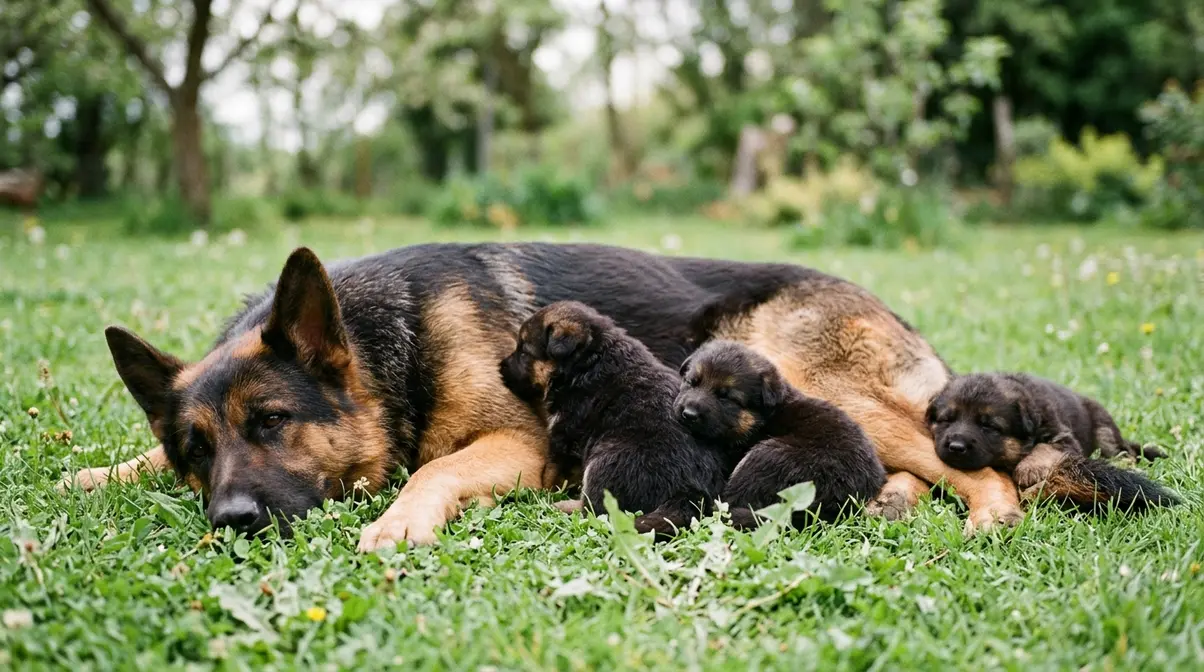
Yes, 6 weeks is generally considered early for a German Shepherd puppy to leave its mother and littermates. Cornell veterinary guidance on puppy separation age from Cornell University’s Riney Canine Health Center recommends that puppies stay with their mother until at least 8 weeks, and sometimes up to 12, because that window teaches skills that are difficult to replicate later. If you’re already home with a 6-week-old GSD, the practical steps below are what matter most now.
The good news: dedicated owners who bring a puppy home at 6 weeks can compensate with structured socialization, a consistent routine and extra patience. The 6-Week Playbook in the next section gives you exactly that.
What Puppies Learn Between 6 and 8 Weeks
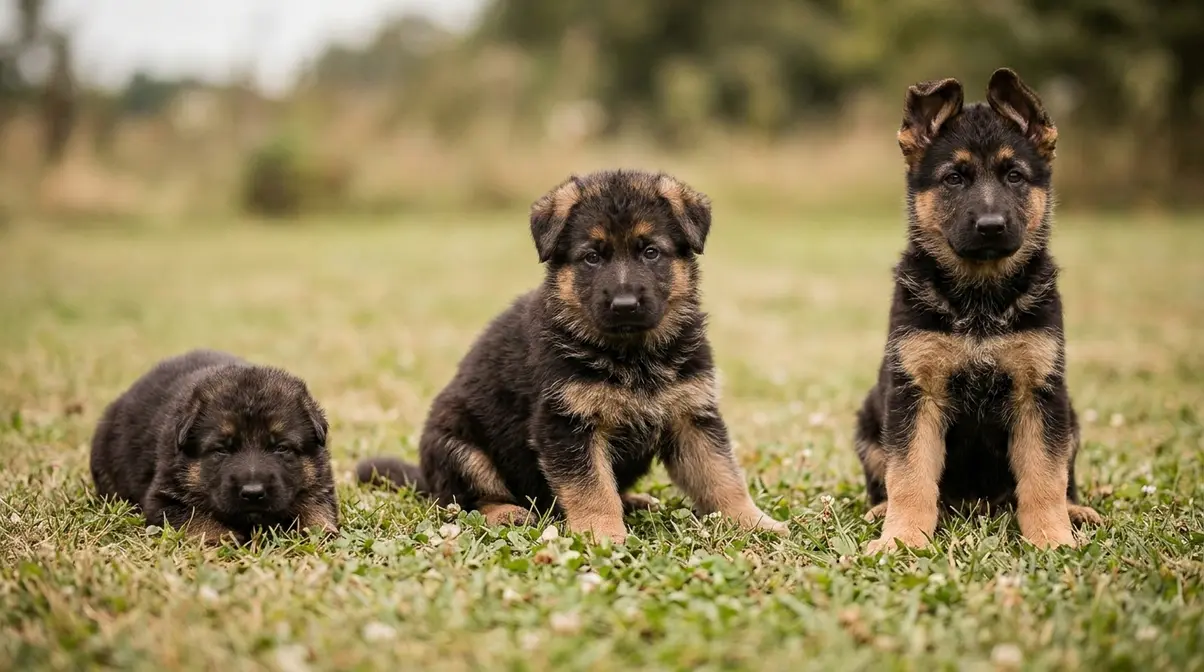
Three specific skills develop during the 6-to-8-week window that are difficult to teach once the window closes.
Bite inhibition is the first. Littermates yelp and disengage when bitten too hard, that’s the primary feedback mechanism for learning jaw pressure control. Without it, puppies bite harder and longer, because no one has taught them where the limit is.
Dog-to-dog communication is the second. Reading body language, understanding play signals versus threat signals, and knowing how to de-escalate, these are social skills your puppy absorbs from her siblings and mother, not from humans.
Emotional regulation is the third. The mother’s presence actively reduces stress hormones. Research published via the PubMed Central study on puppy age at adoption indicates that adoption age influences behavioral development, and that early separation is associated with higher rates of anxiety, fearfulness and aggression in adult dogs. Research suggests a link, but individual outcomes vary widely depending on the owner’s commitment to socialization.
This community sentiment captures what many experienced GSD owners report:
“Yes, it’s too early. A puppy gets a lot of social lessons from its littermates and mother between 6 and 8 weeks old.”
Frame behavioral risks as “associated with”, not inevitable. A committed owner with a structured routine can close much of the gap.
Knowing the risks is step one. Here’s what to do if you’re already in this situation.
What to Do If You Already Brought Her Home at 6 Weeks
This checklist is a starting point, your vet is the best source of individualized guidance for your specific puppy. For context on choosing a puppy from a litter, that guide covers breeder red flags and health markers worth knowing even after you’ve already brought her home.
- Start structured socialization at home. Introduce one new stimulus per day, a new sound, a new person, a new surface. Keep sessions under 5 minutes. Always end on a positive note with a treat and calm praise.
- Practice bite inhibition daily. When she bites too hard, yelp in a high-pitched voice and disengage for 30 seconds, just as a littermate would. Then redirect to a chew toy immediately. Never use hands as toys.
- Build a consistent daily routine. Feeding, play, sleep and potty at the same times every day. Predictability reduces anxiety in early-separated puppies more than almost any other intervention.
- Use redirection, never punishment. At 6 weeks, your puppy has no capacity for deliberate misbehavior. Scolding or tapping increases fear and anxiety, especially in early-separated puppies. Redirection and reward only.
- Book a vet visit this week. Deworming confirmation, health check, parvo risk assessment and vaccination schedule, all of this needs to happen in the first 48 hours.
The first night is often the hardest. Here’s a simple plan that works.
The First Night: A Practical Plan
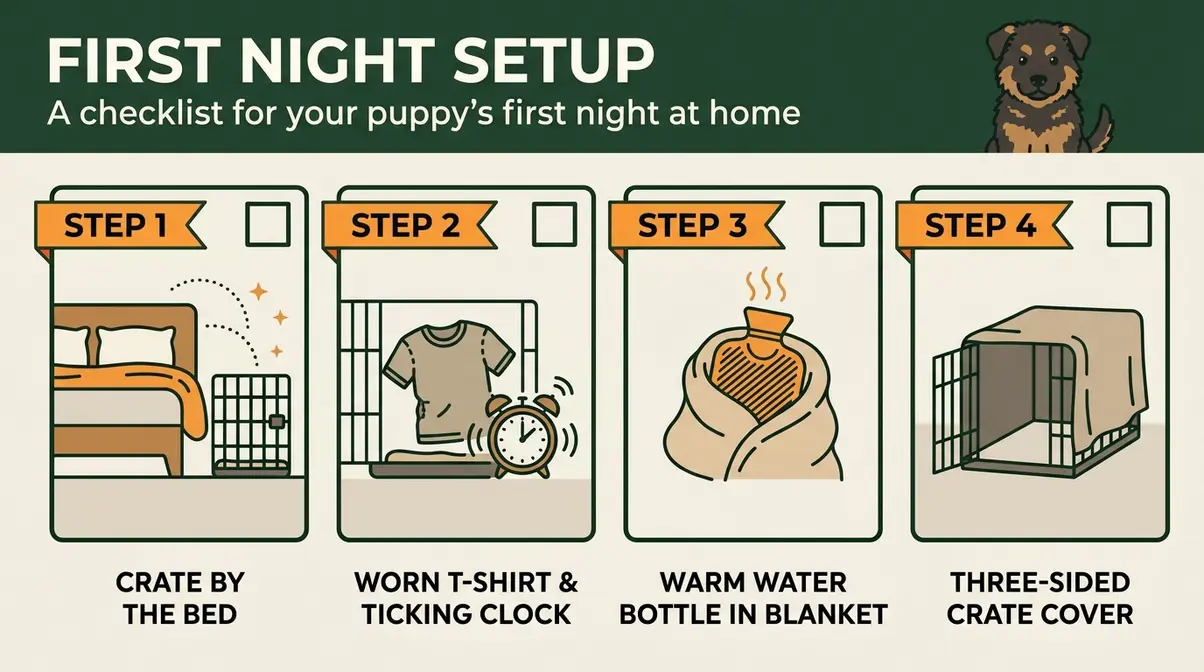
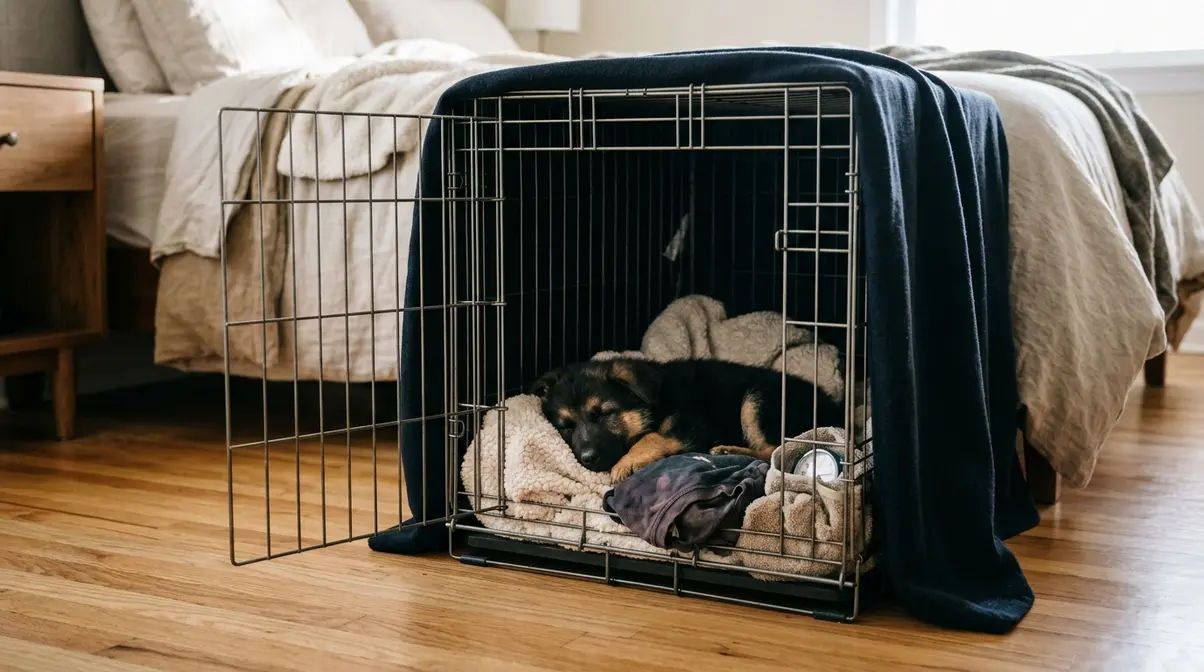
- Place the crate next to your bed, not in another room. Your puppy needs to hear and smell you. Isolation in a separate room increases crying and stress on the first night.
- Add comfort items. A worn T-shirt carries your scent and is one of the most effective calming tools available. Add a ticking clock wrapped in a towel, the rhythm mimics the mother’s heartbeat. A warm (not hot) water bottle under a blanket adds physical warmth without overheating.
- Check for genuine needs before responding to crying. Hunger, a full bladder and pain are the three real reasons a puppy cries at night. If all needs are met, a calm verbal reassurance is acceptable. Avoid picking her up immediately every time, this can reinforce demand crying over time.
- Expect one or two wake-ups. Most 6-week-old GSD puppies wake once or twice overnight. By 8 to 10 weeks, many sleep through a 6-hour stretch.
If your puppy cries persistently and won’t settle after needs are met, consult your vet, some puppies experience significant stress from early separation that may benefit from professional support.
Now that you’ve got the first night covered, let’s look at what your puppy looks like at this age, and what’s normal.
What Does a 6-Week-Old German Shepherd Look Like?
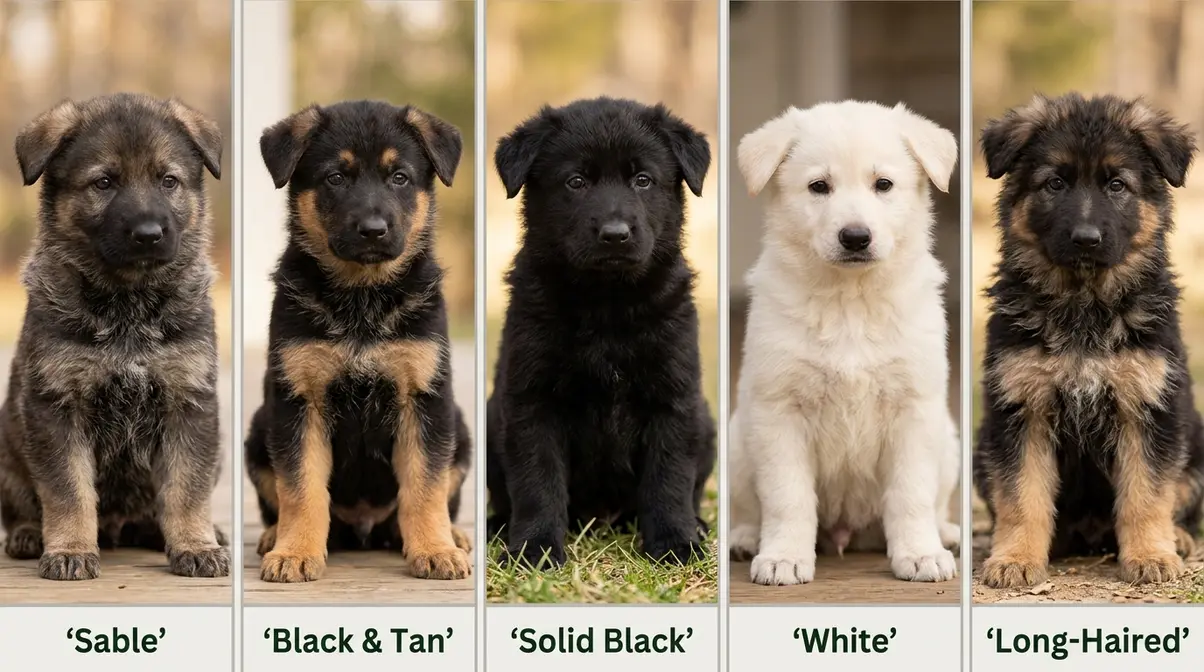
At 6 weeks, a GSD puppy is roughly the size of a large guinea pig, compact, round-bellied, with ears that may still be floppy or just beginning to stand at the base. Coat color is often darker than it will be at adulthood, and the full adult coat has not yet developed. What you see at 6 weeks is a puppy coat: softer, fluffier and frequently misleading about the adult color.
The five main coat variants look noticeably different from one another even at this age. Sable is the most common and often appears dark brown or black at 6 weeks, owners are frequently surprised when their “black” sable puppy lightens dramatically over the next few months. Black and tan puppies show their saddle pattern early, with tan points visible on the legs, face and chest. Solid black puppies are uniformly dark from birth. White GSD puppies are clearly pale at 6 weeks, though the white coat deepens in texture as they mature. Long-haired puppies are distinguishable by the feathering already visible around the ears and paws, the longer coat is apparent even at this early stage.
Between 6 weeks and 6 months, a GSD puppy changes dramatically. Ears rise and firm up, the puppy coat gives way to the adult double coat, and sable puppies in particular can look like an entirely different dog by 6 months. For how sable GSD coats change over time, that guide covers the full progression in detail.
For a full photo gallery of 6-week-old German Shepherd coat types and colors, see what 6-week-old German Shepherd puppies look like.
Appearance is one benchmark. Weight is another, and it’s the one most new owners worry about most.
How Much Does a 6-Week-Old German Shepherd Weigh?
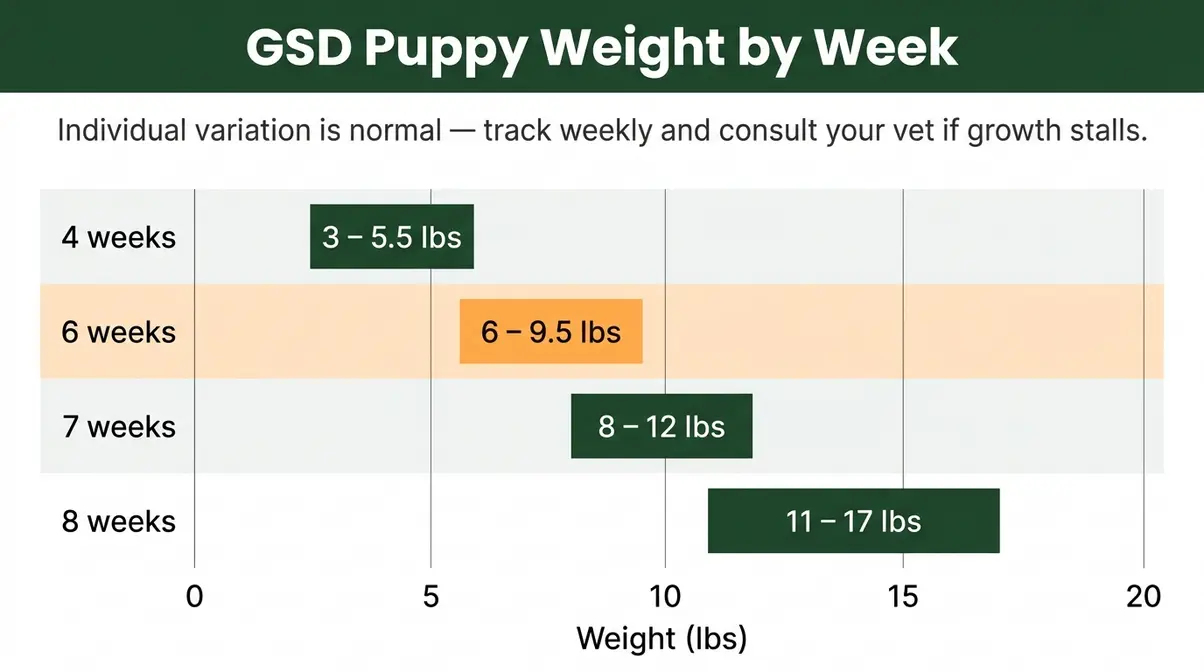
A 6-week-old German Shepherd puppy typically weighs around 8 pounds, but treat this as a typical range, not a fixed target. Individual puppies vary based on sex, genetics and how well they’ve been fed during the weaning process. The Pawlicy German Shepherd growth chart compiles typical weight ranges by age, with its own disclaimer that figures are typical averages rather than official breed standards.
Males tend to be slightly heavier than females even at 6 weeks, a difference that becomes more pronounced as they approach adulthood. One owner on germanshepherds.com reported a healthy puppy at 6.5 pounds at 6 weeks, useful as voice-of-customer context, but not a health benchmark. Some healthy puppies fall below 8 pounds; others exceed it. What matters more than any single number is consistent weekly weight gain.
Call your vet if your puppy seems unusually small for her age, is not gaining weight between weekly checks, appears lethargic or refuses to eat. These are the signals that warrant professional assessment, not a slight variance from an average figure.
For a week-by-week size reference for German Shepherd puppies from 4 to 8 weeks and beyond, that chart covers the full early growth period.
For a full week-by-week weight and size chart from 4 to 8 weeks, see German Shepherd puppy weight by week.
Weight depends heavily on how well your puppy is eating. Here’s what to feed a 6-week-old German Shepherd, and how often.
What Should You Feed a 6-Week-Old German Shepherd Puppy?
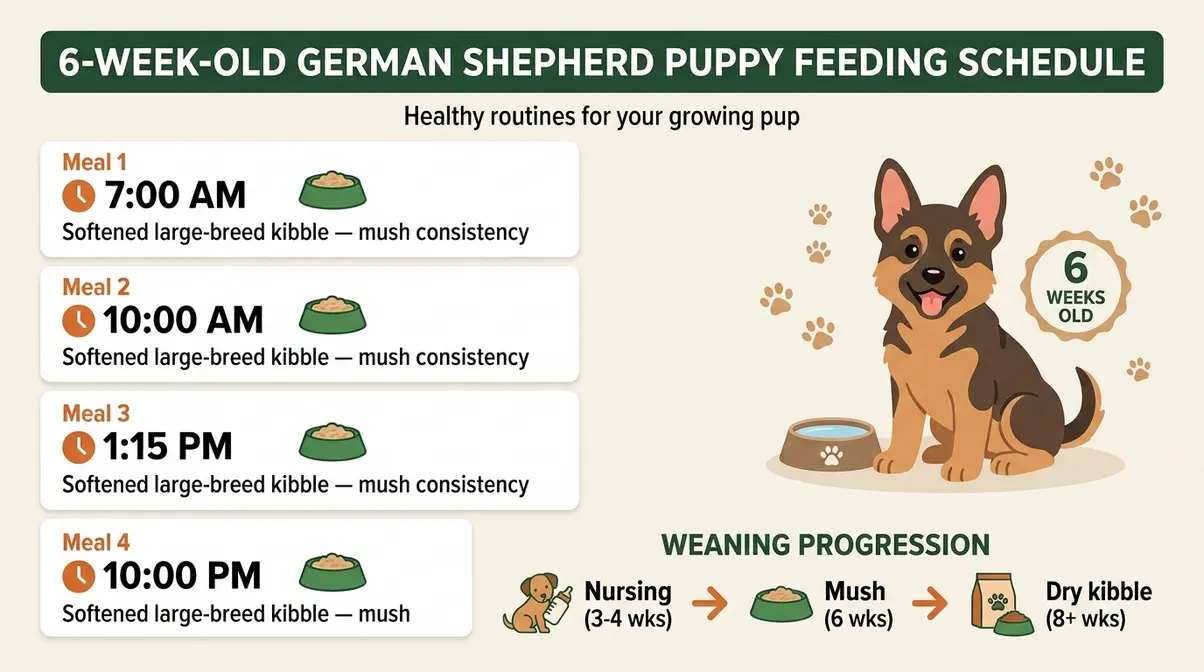
At 6 weeks, feed large-breed puppy kibble softened with warm water into a mush, 4 times per day. No cow’s milk, it causes digestive upset in puppies. No adult food, it lacks the protein and calcium ratios that growing puppies need. The Mittelwest German Shepherd feeding chart, an animal nutritionist-referenced guide used by one of the most reputable GSD breeding programs, confirms that weaning typically begins around 3 to 4 weeks and is largely complete by 7 to 8 weeks.
To soften kibble: add warm (not boiling) water, wait 10 to 15 minutes, then mash with a fork until it reaches a porridge consistency. For portion size, follow the kibble manufacturer’s puppy guidelines for your puppy’s current weight and adjust based on body condition, ribs should be easily felt but not visibly prominent. Start with the lower end of the recommended range and increase if the puppy seems consistently hungry after meals.
For puppy feeding stages in the GSD diet guide, that article covers food transitions from puppyhood through adulthood.
For a full feeding schedule, weaning timeline and food recommendations, see what to feed a 6-week-old German Shepherd puppy.
Do Puppies Still Nurse at 6 Weeks?
At 6 weeks, German Shepherd puppies are typically in the process of weaning, not fully weaned, but no longer dependent on mother’s milk as their primary nutrition. If your puppy is still with her mother, the mother may allow some nursing while also beginning to discourage it more frequently. This push-pull is a natural part of the weaning process and not a sign that anything is wrong.
If your puppy has already been separated, puppy milk replacer can supplement softened kibble during the transition, but it’s not a long-term substitute for solid food. Think of 6 weeks as the transition week: your puppy is moving from milk to mush, not from milk to nothing. The Mittelwest feeding chart notes that weaning typically begins around 3 to 4 weeks and is largely complete by 7 to 8 weeks, making 6 weeks a critical midpoint in the process.
The nursing question is straightforward. The overnight feeding question is harder, and more urgent for new owners.
Can a 6-Week-Old Puppy Go All Night Without Eating?
No verified overnight fasting limit exists in current veterinary guidance for 6-week-old puppies, and it’s worth being honest about that gap rather than inventing an answer. What is known: puppies this age eat 4 small meals per day, and their digestive systems are still developing. Very young puppies can experience hypoglycemia (low blood sugar) if they go too many hours without food, which is why overnight feeding matters.
The most practical approach most owners use: feed the last meal as late as practically possible, around 10 to 11 pm, and the first morning meal around 6 to 7 am. If your puppy wakes crying at 3 am and it’s been more than 5 to 6 hours since the last meal, a small feeding is reasonable. Ask your vet how to handle night feeding for your specific puppy, individual guidance here is more reliable than any general rule.
Now that feeding is clear, here’s how to build all of it, feeding, play, sleep and potty, into a single repeatable daily routine.
Your 6-Week-Old German Shepherd’s 24-Hour Daily Schedule
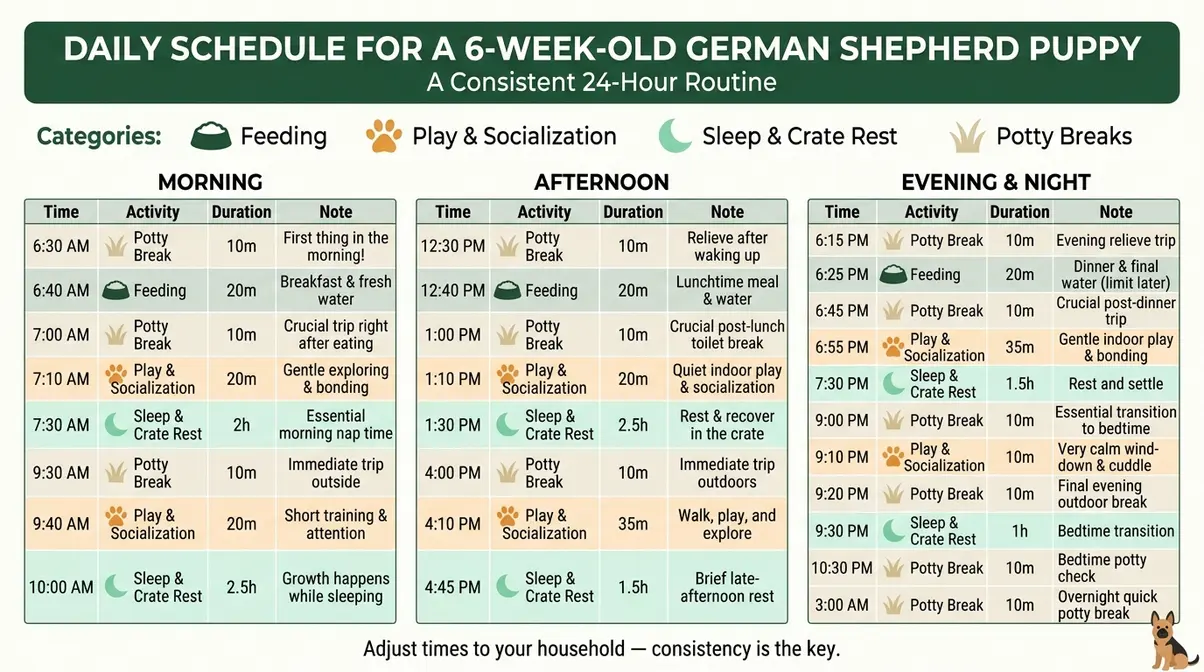
This is The 6-Week Playbook in practice, a repeatable 24-hour routine built from veterinary feeding guidance and developmental research. Predictability reduces anxiety in young puppies, especially those separated from their litter early. Use this as a starting point and adjust to your household; your vet can help you fine-tune it.
A 6-week-old German Shepherd puppy needs 4 small meals of softened large-breed kibble per day, a potty break every 1 to 2 hours when awake, and approximately 16 to 18 hours of sleep in a 24-hour period.
| Time | Activity | Duration | Notes |
|---|---|---|---|
| 6:30 am | Wake + potty | 5-10 min | Carry outside immediately; praise every success |
| 7:00 am | Meal 1 | 10-15 min | Softened kibble mush; remove bowl after 15 min |
| 7:15 am | Play + socialization | 15-20 min | Gentle handling; introduce one new stimulus |
| 7:45 am | Nap in crate | 60-90 min | Puppies this age sleep approximately 16-18 hrs/day |
| 9:30 am | Potty | 5 min | Every 1-2 hrs when awake |
| 10:00 am | Meal 2 | 10-15 min | Same as Meal 1 |
| 10:15 am | Play + bite inhibition | 15-20 min | Yelp and disengage if bitten too hard |
| 11:00 am | Nap | 60-90 min | Crate rest; not punishment |
| 1:00 pm | Potty | 5 min | |
| 1:15 pm | Meal 3 | 10-15 min | |
| 1:30 pm | Play + socialization | 15-20 min | One new stimulus per session |
| 2:00 pm | Nap | 60-90 min | |
| 4:00 pm | Potty | 5 min | |
| 4:30 pm | Play | 15-20 min | Keep sessions under 20 min |
| 5:00 pm | Nap | 60-90 min | |
| 7:00 pm | Potty | 5 min | |
| 7:30 pm | Gentle play + handling | 15 min | Calm evening energy only |
| 8:00 pm | Nap | 60-90 min | |
| 10:00 pm | Meal 4 (late) | 10-15 min | Last meal as late as possible |
| 10:20 pm | Potty | 5 min | Final potty before crate |
| 10:30 pm | Crate for night | , | Warm crate, worn T-shirt, ticking clock |
| 3:00 am | Overnight potty check | 5 min | If puppy cries, check needs first |
Adjust times to your household schedule. The key is consistency, same times every day.
Morning and Daytime Routine
The first 15 minutes after your puppy wakes up are the most important for potty training. Carry her outside before she has a chance to squat inside, this single habit, repeated every morning, builds the association between waking and going outdoors faster than any other technique. Praise every successful outdoor potty with a calm, warm “good girl” and a small treat.
Play sessions in the morning should stay under 20 minutes. Puppies this age tire quickly, and overstimulation leads directly to biting and crying, not misbehavior, just a puppy who has hit her limit. When she starts to get mouthy or frantic, that’s the signal to move to nap time. Nap time in the crate is not punishment; frame it as rest time from the start, and make the crate a place she associates with calm and comfort.
Bite inhibition during play deserves its own technique. When she bites your hand, say “ouch” in a high-pitched voice, stand up and turn away for 30 seconds. Then offer a chew toy. Repeat every time, consistently. Never use your hands as toys, this is the single most common mistake that makes biting worse. A training 6-week-old German Shepherd session doesn’t need to be formal; the bite-inhibition practice built into every play session is already training.
The daytime routine is manageable once you get the rhythm. The evening and night routine is where most new owners struggle.
Evening and Night Routine
After 7 pm, reduce stimulation deliberately. No rough play, no excited visitors, no loud games. Calm handling and gentle petting only, this signals to your six-week-old German Shepherd puppy that nighttime is different from daytime. Puppies learn this distinction faster than most owners expect, but only if the signal is consistent.
Meal 4 is the most strategically important meal of the day. Feed it as late as practically possible, 10 to 11 pm works well for most households, to extend the overnight gap and reduce the chance your puppy wakes from hunger at 3 am. This is the most practical lever you have for improving overnight sleep in the first weeks.
Crate setup matters more than most new owners realize. A warm (not hot) water bottle under a blanket adds physical warmth. Your worn T-shirt provides your scent. A ticking clock wrapped in a towel mimics the rhythm of the mother’s heartbeat. Cover three sides of the crate with a blanket to create a den feeling, dark, enclosed spaces are naturally calming for dogs. Place the crate next to your bed so she can hear and smell you throughout the night.
When she cries overnight, check for genuine needs first: hunger, a full bladder, or pain. A calm verbal reassurance, a quiet “it’s okay” without picking her up, is acceptable. Most 6-week-old GSD puppies wake once or twice overnight. By 8 to 10 weeks, many sleep through a 6-hour stretch without waking.
If your puppy cries persistently for more than 20 to 30 minutes despite all needs being met, consult your vet, some puppies experience significant separation distress that may benefit from professional support.
The schedule gives you the structure. The next step is knowing when and how to start training, because 6 weeks is not too early.
How to Start Training a 6-Week-Old German Shepherd Puppy
Starting 6-week-old German Shepherd puppy training is not too early, it’s the right time, as long as sessions are short (3 to 5 minutes), positive and reward-based. GSD puppies are highly motivated by food rewards at this age, which makes training surprisingly effective even at this young stage. The step-by-step guide to starting basic obedience early covers the foundational commands in detail.
The three most important things to teach first, in order:
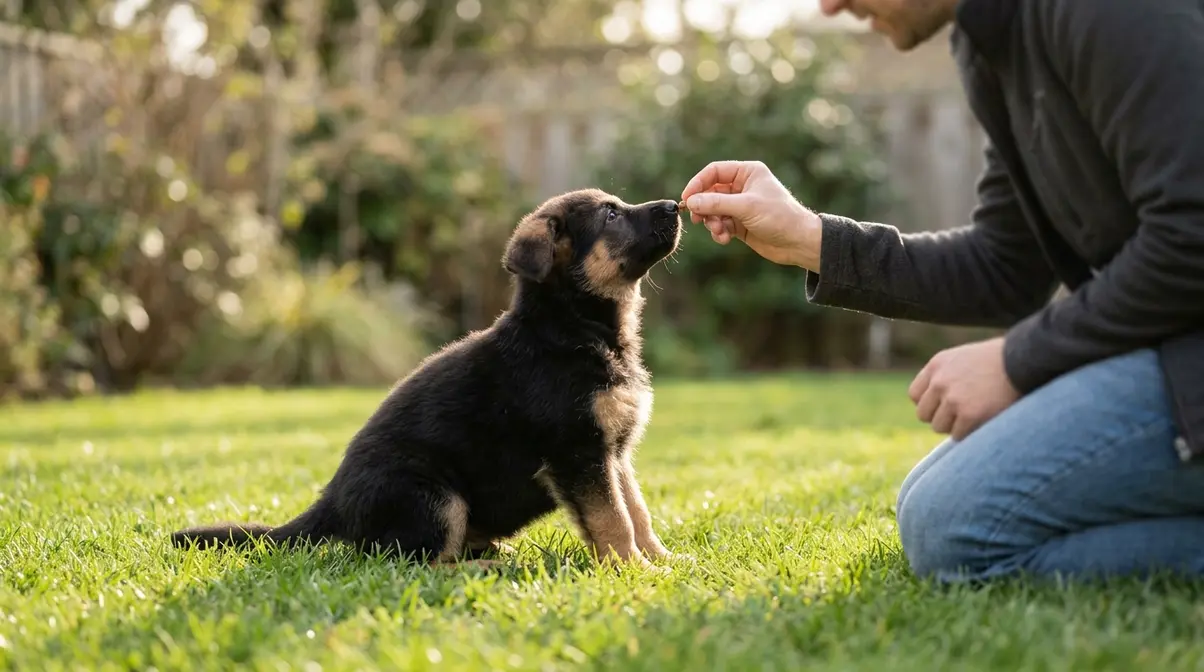
- Name recognition. Say your puppy’s name in a warm, clear voice. The moment she looks at you, reward with a small treat and calm praise. Repeat 5 to 10 times per session. This is the foundation for every command that follows.
- Sit. Hold a treat just above her nose and move it slowly back over her head. As her nose follows the treat upward, her hindquarters will naturally lower. The moment she sits, say “sit” and reward immediately. Keep sessions to 3 to 4 repetitions, she’ll lose focus quickly.
- Crate comfort. Feed all meals in the crate with the door open. Drop treats inside throughout the day. Never use the crate as punishment. Building a positive crate association now prevents weeks of overnight crying later.
Run 3 to 4 short training sessions per day, built into the daily schedule, after meals and before naps are natural insertion points. Sessions longer than 5 minutes produce diminishing returns at this age; end each one while she’s still engaged, not after she’s already lost interest.
For a full step-by-step guide to training a 6-week-old German Shepherd puppy, including crate training and basic commands, see how to train a 6-week-old German Shepherd puppy.
Training is the proactive side of puppy ownership. The reactive side, knowing which weeks are hardest and why, is just as important.
What Are the Hardest Puppy Weeks for German Shepherd Owners?
For most new GSD owners, the first two weeks at home are the hardest. Sleep disruption, constant potty trips and relentless biting are all normal, but exhausting. Your puppy is adjusting to a new environment without her littermates, which amplifies crying and anxiety. Knowing this doesn’t make the sleep deprivation easier, but it does make it less alarming.
The second hardest period comes much later. Around 8 months, adolescence hits: selective hearing, boundary-testing and a sudden surge in energy that can feel like starting over. For what GSD temperament is really like, that guide covers the full behavioral arc from puppyhood through maturity.
Three things make the first two weeks more manageable:
- The schedule from the previous section, predictability is the single most effective anxiety reducer for a newly separated puppy.
- The bite-inhibition technique, yelp, disengage, redirect. Consistency here shortens the biting phase significantly.
- The first-night plan, warm crate, worn T-shirt, ticking clock, crate next to your bed. Most owners who struggle the first night improve dramatically by night three once the routine is consistent.
It does get easier. GSD puppies are among the most trainable breeds in the world, and the effort you invest in weeks 6 to 10 pays off in ways that are genuinely visible by the time adolescence arrives.
For a full guide to GSD puppy behavior stages, temperament and the hardest ages, see the hardest puppy weeks and what to expect.
The hard weeks pass faster when you know what’s coming. So does the puppy, here’s how fast a 6-week-old GSD grows.
How German Shepherd Puppies Grow: From 2 Weeks to 6 Months
German Shepherd puppies develop quickly, and the changes between 2 weeks and 6 months are dramatic. Here are the key milestones:
- 2 weeks old: Eyes open, beginning to crawl; ears still sealed; fully dependent on mother. A 2-week-old German Shepherd puppy is essentially immobile, small, eyes newly open, just beginning to find its legs.
- 4 weeks old: Walking and beginning to play; first teeth emerging; starting to lap water. A 4-week-old German Shepherd puppy’s development accelerates rapidly from this point, with social play and early vocalizations becoming more frequent each day.
- 6 weeks old: Baby teeth fully in; weaning underway; socialization window fully open; coordination improving fast.
- 8-week-old German Shepherd puppy: The ideal rehoming age, socialization window still open, first vaccination typically due, emotionally ready for a new home. According to Cornell University’s Riney Canine Health Center, an 8-week-old German Shepherd has had two additional weeks of littermate lessons and is emotionally ready for a new home, making this the minimum recommended age for rehoming.
By 6 months, a GSD puppy looks dramatically different from the compact, round-bellied creature you brought home. Ears are fully erect. The adult double coat is coming in, replacing the soft puppy coat. Weight typically reaches somewhere in the range of 35 to 50 pounds, though this varies by sex and genetics. Adolescent energy is in full effect, your puppy is fast, curious, and increasingly confident.
The 6-to-8-week window remains the most important transition in early development. Those two weeks of littermate lessons, mother’s presence and continued socialization are why ethical breeders hold their puppies until 8 weeks minimum.
For a full week-by-week growth timeline from 2 weeks to 6 months, see what changes from 6 to 8 weeks and beyond.
Common Risks and Mistakes When Caring for a 6-Week-Old GSD
Common Mistakes New GSD Owners Make at 6 Weeks
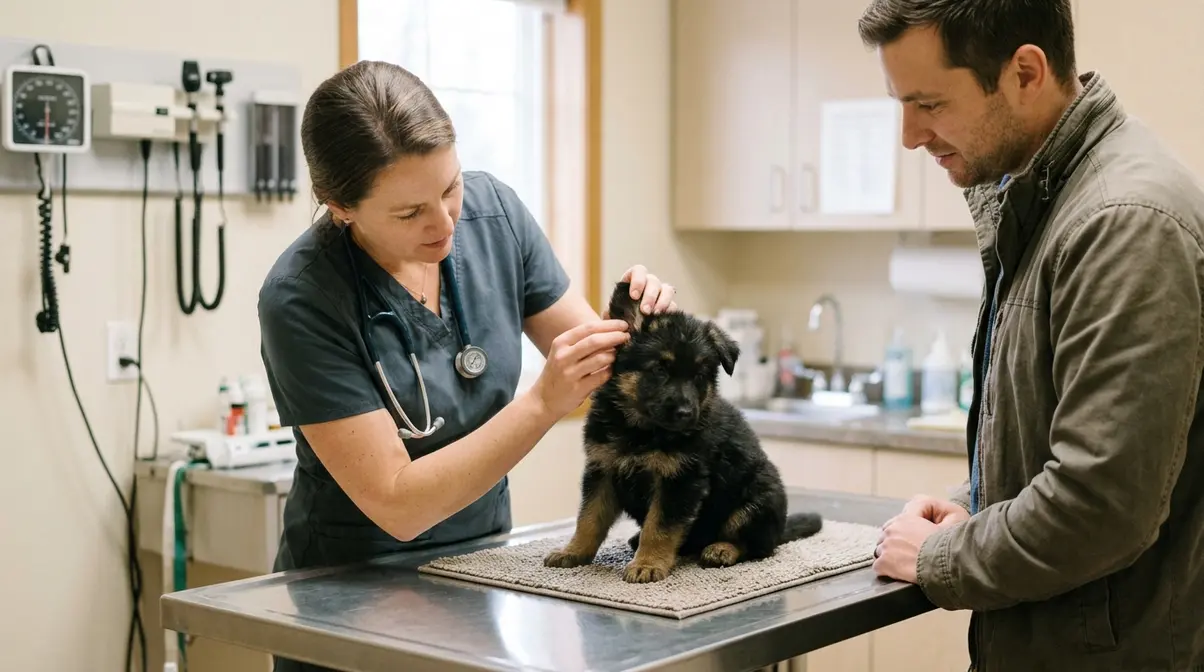
Most mistakes at this stage are easy to avoid once you know about them. The biggest issues are under-socialization and skipping the vet visit, both of which are more consequential than overfeeding, though all three matter.
Pitfall 1, Skipping the vet visit. The scenario: the owner assumes the breeder handled everything. What goes wrong: the deworming schedule lapses, parvo risk goes unassessed, and the vaccination timeline gets delayed. How to avoid it: book within the first 48 hours of bringing the puppy home, regardless of what the breeder tells you they already did.
Pitfall 2, Overfeeding or underfeeding. The scenario: the owner free-feeds or follows adult dog portions. What goes wrong: digestive upset, hypoglycemia risk from underfeeding, or obesity risk from overfeeding. How to avoid it: follow the kibble manufacturer’s puppy weight guidelines, 4 measured meals per day, remove the bowl after 15 minutes.
Pitfall 3, Too much stimulation on day one. The scenario: the owner invites everyone to meet the new puppy the day she arrives. What goes wrong: the puppy becomes overwhelmed, bites more, sleeps poorly and takes longer to settle. How to avoid it: one new stimulus per day, quiet first week, no visitors until she’s had 3 to 4 days to adjust.
Pitfall 4, Using punishment. The scenario: the owner scolds or taps the puppy for biting or accidents. What goes wrong: increases fear and anxiety, particularly severe in early-separated puppies who are already stressed. How to avoid it: redirection and reward only at this age. No punishment, ever.
Pitfall 5, Letting the puppy meet unvaccinated dogs. The scenario: the owner takes the puppy to a dog park or pet store to socialize her. What goes wrong: parvo exposure before vaccination is complete is a genuine and severe risk. How to avoid it: no public dog areas until your vet clears it, typically around 16 weeks.
Most of these mistakes are easy to avoid once you know about them. But some situations require a vet call, not a Google search.
When to Call Your Vet Immediately
The UC Davis Veterinary Genetics Laboratory GSD health panel covers GSD-specific health conditions and genetic screening relevant to long-term planning, but for acute symptoms right now, these four red flags require a vet call, not a wait-and-see approach:
- Lethargy, a puppy that won’t wake up, won’t eat and won’t respond to stimulation. This is a medical emergency at any age; don’t wait.
- Vomiting or diarrhea lasting more than 24 hours, dehydration risk is severe in puppies this young, and deterioration can be rapid.
- Bloody stool, a potential sign of parvovirus. Do not wait even 24 hours; call your vet immediately.
- Refusal to eat for more than 12 hours, hypoglycemia risk is real in very young puppies, and a puppy that won’t eat needs professional assessment.
If you’re unsure whether a symptom is serious, call your vet. At 6 weeks, err on the side of caution every time.
⚠️ Veterinary Disclaimer: This article is for informational purposes only and does not replace professional veterinary advice. If you have concerns about your puppy’s health, contact your vet immediately.
Now let’s answer the questions that come up most often, the ones new GSD owners search for at midnight.
Frequently Asked Questions
What should a 6 week old puppy be doing?
A 6-week-old German Shepherd puppy should be active, playful and curious, exploring her environment and play-fighting with littermates. Her baby teeth have come in, and she’s transitioning from mother’s milk to softened solid food in 4 small meals per day. This is the heart of the critical socialization window, so gentle handling of paws, ears and mouth, plus safe human contact, is appropriate right now. Avoid public areas until your vet clears it. Individual puppies vary in energy and developmental pace.
Is 6 weeks too early to take a German Shepherd puppy home?
Yes, 6 weeks is generally considered early for a German Shepherd puppy to leave her mother and littermates. The ideal window is 8 to 12 weeks, because that period teaches bite inhibition, dog-to-dog communication and emotional stability, skills that are difficult to replicate later. Early separation raises the risk of anxiety and fearfulness in adult dogs. If you’ve already brought a 6-week-old GSD home, structured socialization and a consistent daily routine can help significantly. Ask your vet for individualized guidance.
Do puppies still nurse at 6 weeks?
At 6 weeks, German Shepherd puppies are typically in the process of weaning, not fully weaned, but no longer dependent on mother’s milk as their primary nutrition. If still with their mother, she may allow some nursing while beginning to discourage it more frequently. Breeders typically feed a mush of large-breed puppy kibble softened with warm water, about 4 times per day. Puppy milk replacer can supplement if the puppy is separated early. Full weaning is typically complete by 7 to 8 weeks.
Can 6 week old puppies go all night without eating?
No verified overnight limit exists in current veterinary guidance for 6-week-old puppies. Puppies this age eat 4 small meals per day, and their digestive systems are still developing. A late evening meal around 10 to 11 pm followed by an early morning meal around 6 to 7 am is the practical approach most owners use. If your puppy wakes crying at night, check for hunger first before deciding how to respond. Ask your vet for guidance specific to your puppy’s individual needs.
How much does a 6 week old German Shepherd weigh?
A 6-week-old German Shepherd puppy typically weighs around 8 pounds, though individual puppies vary based on sex, genetics and feeding history. Males tend to be slightly heavier than females even at this age. Treat any weight figure as a typical range, not a fixed target, some healthy puppies weigh as little as 6.5 pounds at 6 weeks. Track growth weekly and consult your vet if your puppy seems unusually small, is not gaining weight between checks, or appears lethargic.
What is the hardest week of a puppy?
For most new owners, the first two weeks at home are the hardest, sleep disruption, constant potty trips and relentless biting are all normal but exhausting. The puppy is adjusting to a new environment without her littermates, which amplifies crying and anxiety significantly. A consistent daily schedule, a warm crate near your bed and short positive training sessions make the biggest difference in getting through this period. The second hardest stretch typically comes around 8 months, during adolescence. It does get easier, consistently.
What age is the hardest puppy stage?
The first two weeks at home (typically 6 to 10 weeks) and the adolescent period around 8 months are the two hardest stages for German Shepherd owners. Early weeks bring sleep deprivation and biting; adolescence brings selective hearing and boundary-testing. Both are temporary and manageable with consistency. German Shepherds are highly trainable, which means the effort you put in during weeks 6 to 10 pays off visibly by the time adolescence arrives, and makes that second hard stage significantly shorter.
Are girl or boy puppies easier?
Female German Shepherd puppies are often described as slightly easier to manage in the early weeks, they tend to mature a little faster and may be less boisterous than males. Male GSD puppies are typically larger and may be more exuberant, which some owners find harder to manage at 6 weeks. That said, individual temperament varies far more than sex does. The puppy’s socialization history, your training consistency and the daily routine you build together matter more than whether she’s a girl or a boy.
What age are puppies most cuddly?
German Shepherd puppies are typically most cuddly between 8 and 12 weeks, old enough to feel secure with their new owner, but young enough to still seek constant physical contact. At 6 weeks, puppies are more interested in play and exploration than cuddling. As they enter adolescence around 6 to 9 months, many GSDs become more independent. Most adult German Shepherds remain affectionate with their family, though they express it through proximity and loyalty rather than the lap-dog cuddling of puppyhood.
What to Do in Your First Week With a 6-Week-Old German Shepherd
For new GSD owners, a 6-week-old German Shepherd puppy needs four things above all else: a vet visit this week, 4 small meals of softened large-breed kibble per day, a warm crate near your bed for the first nights, and a consistent daily routine. Research indicates that the socialization window from 3 to 12 weeks is the most important period in a dog’s behavioral development, every positive experience you create right now has an outsized impact on who your GSD becomes as an adult.
The 6-Week Playbook isn’t about perfection. It’s about replacing the guesswork and forum debates with a repeatable routine you can trust. The 24-hour schedule in this guide is a starting point, your vet and your puppy will help you refine it as the weeks go on and you both find your rhythm.
Start with the schedule today. Book your vet appointment this week. And when you’re ready to go deeper, our guides cover feeding, weight tracking, training, appearance and the full growth timeline in detail, so you have a trusted resource at every stage of your GSD’s first year.
 German Shepherd Diet: Complete Feeding Guide for Every Life Stage