
Named after Keratitis Ueberreiter (a man who defined the disease), Dog Keratitis or Pannus happens to be a disease affecting the eyes of the animal. The dog suffers from chronic inflammation of the surface of the cornea. Even the conjunctiva is affected. In short, it is a painless, immune-mediated disease in which both the cornea and conjunctiva take the brunt. Cornell describes it as “an immune-related eye disease in which lesions develop on the cornea” and notes it “occurs most often in the German Shepherd Dog” (Cornell, retrieved 2026-08-12). Treatment is topical corticosteroids or other immune-modulating drugs such as cyclosporine (VCA Animal Hospitals, retrieved 2026-08-12).
This eye disease is also dubbed German Shepherd Dog Keratitis because it is predominantly found in German Shepherd species. Poodles, Siberian Huskies, Belgian Tervuerens, Border Collies, Greyhounds, and Dachshunds are rarely affected by the same.
What it looks like, and why it matters
Pannus starts quietly. It usually appears at the outer edge of the cornea, often in both eyes, as a pinkish or greyish film creeping inward.
VCA describes the course: “As pannus progresses, the lesion will flatten and spread out, will become pigmented or dark in color, and scarring will spread over the cornea” (retrieved 2026-08-12).
That pigment is the problem. It is not a stain on the surface, it is opaque tissue growing across the window your dog sees through. And here is the sentence that should decide how seriously you take an eye check:
“If the condition is not treated, the pet will become blind.” That is VCA, not us (retrieved 2026-08-12).
Notably, pannus is not painful in the way an ulcer or an injury is, so a dog will not tell you. It has to be looked for.
How a vet confirms it
Diagnosis is usually a straightforward in-clinic job. VCA lists the tests as “corneal staining with fluorescein dye, intraocular pressure (IOP) testing, and corneal or conjunctival scrapings” (retrieved 2026-08-12).
Each answers a different question. The fluorescein stain checks for an ulcer, which matters enormously because steroid drops make an undetected ulcer worse. The pressure test rules out glaucoma. The scraping looks at the cells to confirm the immune picture.
This is exactly why “my friend has leftover eye drops” is a bad idea. The drops that treat pannus are the drops that damage an ulcerated eye.
Why German Shepherds, specifically
If you own this breed, pannus is one of the few conditions genuinely worth knowing by name before you ever see it.
VCA states that pannus “occurs primarily in middle-aged German shepherd dogs or German shepherd mixes, and Belgian Tervurens, but other breeds may also be affected” (VCA Animal Hospitals, retrieved 2026-08-12). Cornell agrees, recording that the disease “affects many dog breeds but occurs most often in the German Shepherd Dog” (Cornell University College of Veterinary Medicine, retrieved 2026-08-12).
Two things drive it. It is thought to be hereditary, and it is immune-mediated, meaning the dog’s own immune system is attacking the surface of its cornea. On top of that, VCA notes predisposing factors: “increased exposure to ultraviolet light or living at high altitudes may contribute to the development of pannus” (retrieved 2026-08-12).
So the genetics load the gun and sunlight pulls the trigger. That is why a dog in Colorado or Arizona may show it earlier and harder than the same dog at sea level under grey skies.
What Happens in Pannus?
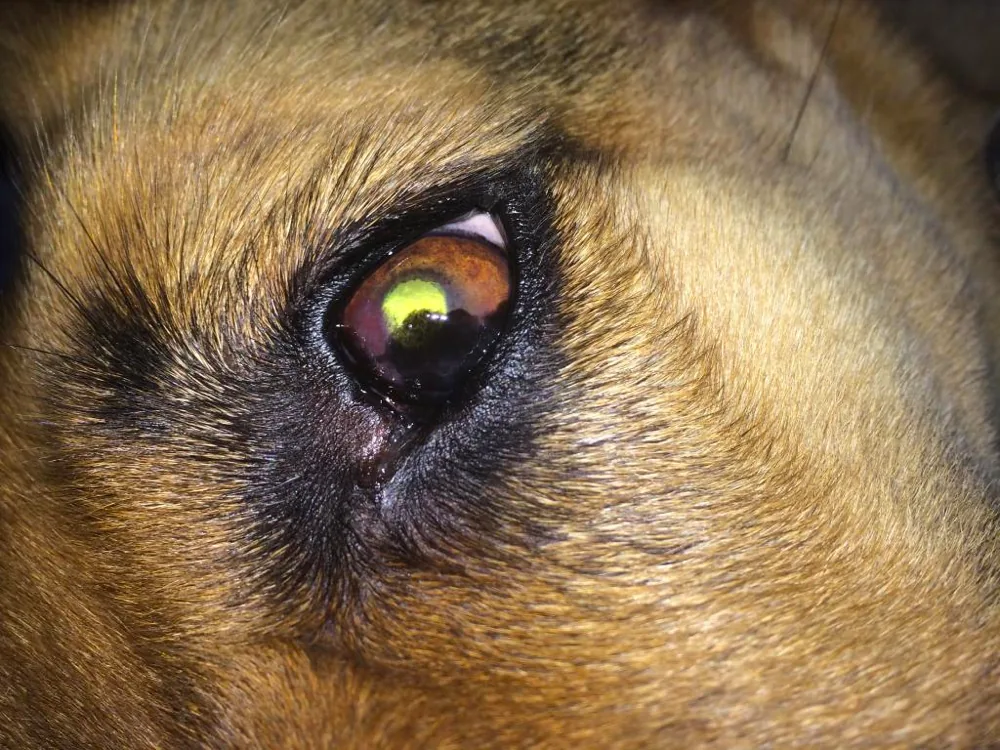
The first appearance of Pannus happens in the outer regions of the cornea in both eyes (in major cases). The disease leads to the establishment of vascular granules and connective tissue in between the sclera and cornea , the growth takes place on the topmost layers of the cornea. This in turn results in the development of a cherry-colored spot that is opaque in nature and whose uneven surface is encircled by a fatty grayish-white band. With the progression of the disease, the cells responsible for pigment formation migrate from the outer layers toward the center of the cornea , the color of the spot ranges from grayish-pink to black and brown appearance. The inflammation comes along with the reddening of the conjunctiva. Actually, the dog suffers from a malfunctioning immune response to its own cornea, which gets manifested as pigmentation and scars.
What Causes Pannus?
Earlier it was thought that some infectious agents were in play. In recent days, Pannus is generally accepted to be the impairment of the immune system. At the onset of the disease, both endogenic and exogenic factors are responsible for causing the disease. Endogenic means something that is naturally produced by the body and in the case of this disease the endogenic factor is pinned to the inherent predisposition of the disease , but the hereditary factor is not yet fathomed properly by vet science. The external or exogenic factor that matters is the UV (Ultraviolet) rays of the sun. These harmful rays catalyze the onset of disease and it is a proven fact that Dog Keratitis or Pannus happens to affect dogs more in the summer months.
What’s the Treatment for Pannus?
If left untreated the inflammation will gradually spread to cover the entire surface of the cornea and the possible outcome might be complete blindness in the terminal stages. The pigment deposition is responsible for blurring the transparency of the cornea. Since Pannus affects both eyes, lack of veterinary care is sure to result in complete loss of eyesight.
The vet ensures to treat the active phases of the Pannus as fast as possible to prevent a severe outbreak and ultimate vision loss. They prescribe cortisone to suppress any kind of flare-up. If the disease is in its acute stage cortisone is administered via injections. But before the shot, the eye is anesthetized locally to avoid the feeling of pain.
Once you are back from the vet’s chamber you should continue cortisone therapy, combined with ointment application, on your pet. Topical corticosteroid drops are typically used up to four times a day, at whatever frequency and duration your vet prescribes. Never increase the frequency on your own. Steroid eye drops can make an undetected corneal ulcer considerably worse. Cornell notes that pannus management requires lifelong treatment with topical corticosteroids to prevent vision impairment or blindness (Cornell University College of Veterinary Medicine, retrieved 2026-08-12), so this is a condition you manage rather than cure. There’s another medical treatment at your disposal. It is the topical application of an ointment called cyclosporin , this is effective for the long-term management of the disease. It depends on the vet to choose between corticosteroid and cyclosporine eye drops.
In extremely adverse cases, surgical removal of the top layer of the corneal surface is the best way out. But it should be kept at bay, unless a dire necessity. Last but not the least, a regular visit to the doctor is important to check factors that might trigger the onset of Pannus.
Avoid UV Rays
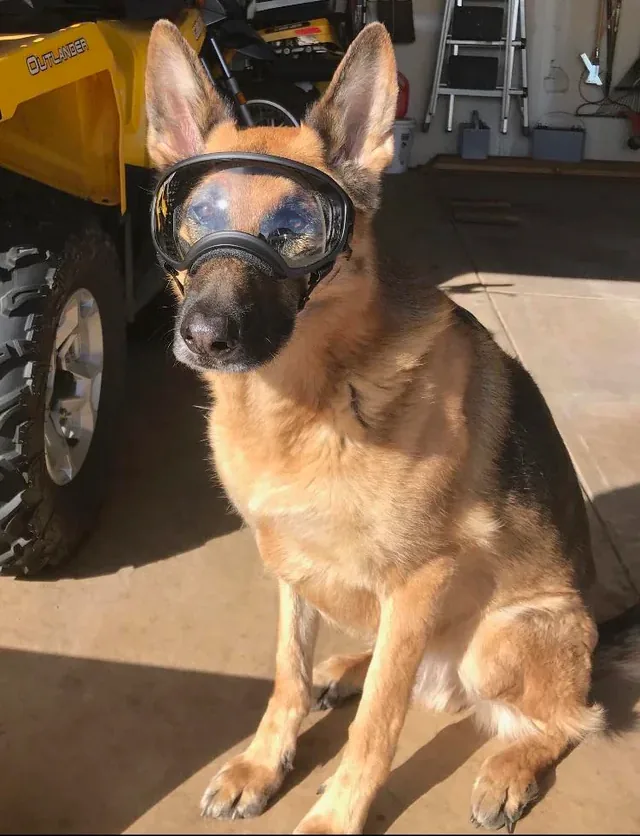
Ultraviolet rays are harmful and they trigger Pannus in German shepherds. So, if your pet is affected ensure that there is no such exposure. Avoid taking dogs out in the strong sun or snow glare. If the dog needs exercise it needs to be taken out on a stroll in the early hours of the morning. If you cannot avoid taking the animal out, you should protect the dog’s eyes with specially fitted sunglasses. Another way out is to administer a UV-blocking agent in the eyes. This needs to be reapplied at hourly intervals.
This is management for life, not a course of treatment
Set the expectation correctly now and the next ten years are much easier.
VCA is explicit: “Treatment will not cure the condition but will halt the progression and may reverse some of the changes. The treatment of pannus is for life” (VCA, retrieved 2026-08-12). Cornell puts it the same way, that management “requires lifelong treatment with topical corticosteroids to prevent vision impairment or blindness” (retrieved 2026-08-12).
The encouraging half is that it works. VCA notes “most cases respond well to topical medications” (retrieved 2026-08-12).
So the failure mode is not the drug. It is stopping the drug. A dog whose eyes look clear after six months looks clear because of the drops, and the pigment comes back when they stop.
Practical UV protection
Since ultraviolet exposure is a predisposing factor, reducing it is one of the few things you control directly.
- Shift the walks. Early morning and evening instead of the middle of the day.
- Think about altitude and reflection. High ground, snow, sand and open water all raise exposure.
- Ask about protective eyewear. VCA notes a vet may suggest dog sunglasses such as Doggles (retrieved 2026-08-12). Introduce them gradually rather than strapping them on before a hike.
- Shade in the yard. A dog that sunbathes for hours is getting a daily dose.
- Keep the recheck appointments. The dose gets tapered to the lowest that holds the disease, and that only works if someone is looking.
None of this replaces the medication. It reduces the load the medication has to carry.
Other eye and health conditions in the breed
Cloudiness in an older German Shepherd is not always pannus. Our article on nuclear sclerosis covers the harmless age-related change that gets mistaken for a cataract, and it affects a different part of the eye entirely. For the broader health picture see our German Shepherd care guide, and for two other inherited conditions worth knowing by name, degenerative myelopathy and hemophilia A.
Catching it early: what to check at home
Pannus is painless and starts at the edge of the cornea, which is precisely where an owner is least likely to look. A one-minute habit changes the odds.
- Look in daylight, not lamplight. Take the dog to a window or outside in shade. Early changes are subtle and warm indoor light hides them.
- Compare the two eyes. Pannus is usually bilateral, but rarely perfectly symmetrical. A difference between the eyes is easier to spot than a change in one.
- Check the outer corner specifically. That is where the pinkish or greyish film typically creeps in from.
- Watch for a third eyelid that looks thickened or depigmented. A related form affects the third eyelid rather than the cornea.
- Photograph it. A phone photo each month, same light, same angle, beats memory. Take them to the recheck.
None of this is a diagnosis. It is early detection, which for a condition whose untreated endpoint is blindness is worth five minutes a month.
Questions worth asking your vet
- Was a fluorescein stain done before we started steroid drops? This is the safety check. Steroids worsen an undetected corneal ulcer.
- Corticosteroid, cyclosporine, or both? VCA lists topical corticosteroids and cyclosporine as the treatment options (retrieved 2026-08-12). Ask which and why for this dog.
- What is the taper plan? The aim is usually the lowest frequency that holds the disease, not a fixed dose forever.
- How often do we recheck? Put the dates in the calendar at the appointment.
- What should make me call sooner? Redness, squinting, rubbing or any sign of pain is a different problem and needs seeing.
- Does my dog’s environment need changing? Worth asking directly if you live at altitude or somewhere with strong year-round sun.
The short version
Pannus is an immune-mediated disease of the cornea that turns up most often in middle-aged German Shepherds. Ultraviolet light and altitude make it worse. It is painless, which is exactly why it gets caught late.
Treatment does not cure it. VCA is clear that treatment “will halt the progression and may reverse some of the changes” and that it “is for life” (VCA Animal Hospitals, retrieved 2026-08-12). Most cases respond well.
So the practical takeaway is small and specific. Look at your dog’s eyes in daylight once a month, and if you are already treating, do not stop because they look clear. They look clear because you did not stop.

 Degenerative Myelopathy in German Shepherds: Symptoms, Causes and Treatment