
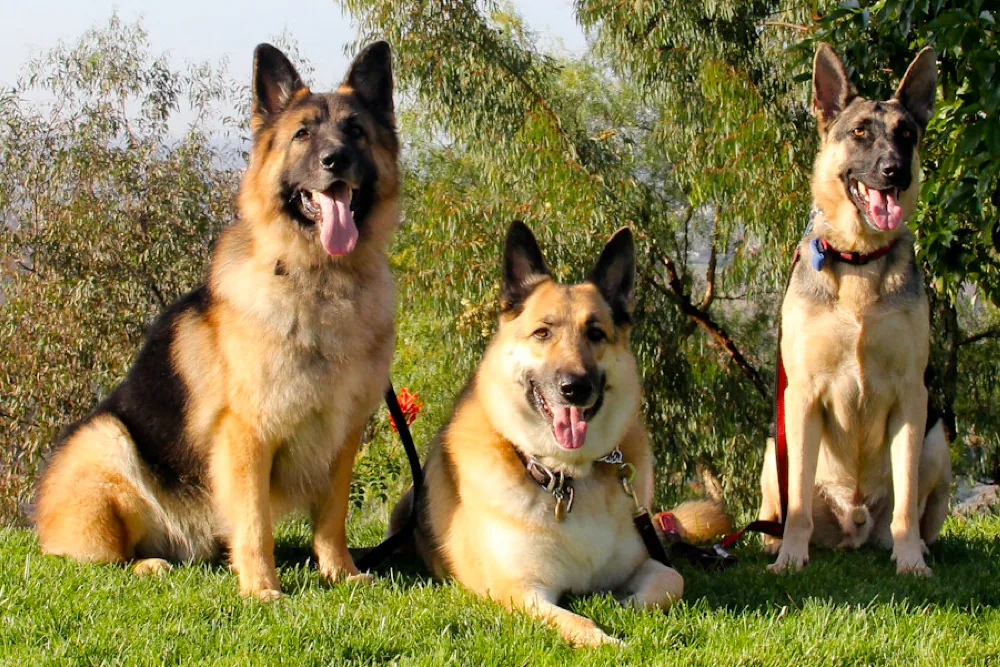
Quick question: can you feel your German Shepherd’s ribs without pressing, but not see them standing out? If yes, you’ve already got the single most useful care check in this whole article, and you can do it in ten seconds without a scale.
German Shepherd care comes down to five things done consistently. One to two hours of daily exercise. A complete-and-balanced diet fed to body condition rather than to the label’s cup measure. Regular brushing of a heavy double coat. Routine ear, nail and dental care. And a vet who knows the breed’s specific risks. None of it is complicated, and most of it is just relentless.
Below you’ll find each of those in turn, with the numbers sourced rather than repeated. We’ll also clear up one protein figure that circulates constantly online and is quietly wrong for most adult dogs.
| Daily exercise | 1 to 2 hours, physical plus mental (PetMD) |
|---|---|
| Protein, adult maintenance | Minimum 18% of dry matter (AAFCO, via Merck) |
| Protein, puppies and pregnancy | Minimum 22.5% of dry matter (AAFCO, via Merck) |
| Coat | Double coat of medium length (AKC standard) |
| Bathing | A few times a year, not monthly (PetMD) |
| Average lifespan | Median 10.3 years, IQR 8.0 to 12.1 (VetCompass, 12,146 dogs) |
| Hip dysplasia rate | 18.0% of screened dogs 2010 to 2016, down from 46.2% in 1995 to 1999 (Swiss registry) |
What Does German Shepherd Care Actually Involve?
German Shepherd care is the routine of meeting a large, athletic working breed’s daily needs: exercise, feeding, coat care, routine hygiene and preventive veterinary care. What makes this breed different from a smaller companion dog isn’t the list, it’s the volume. Everything on it is bigger, and the consequences of skipping it are bigger too.
Two things drive most of the difficulty. The first is energy: a German Shepherd who doesn’t get a physical and mental outlet will invent one, and you won’t like it. The second is size, because joint problems and bloat are far more serious in a 75-pound dog than in a 15-pound one.
The good news is that the work is front-loaded. Establish the routines in the first year or two and most of this becomes automatic. Skip them, and you spend years managing problems that were preventable.
How Much Exercise Does a German Shepherd Need?
Plan on one to two hours of exercise every day. That’s PetMD’s figure for the breed, and it describes an “active and athletic breed” needing that much “for their physical and mental health.” Note the second half of that sentence. Mental work is not a bonus you add once the walking is done, it’s half the requirement.
A tired body with a bored brain still produces a destructive dog. Scent games, training sessions, puzzle feeders and anything requiring your dog to solve rather than sprint all count toward the total. Fifteen minutes of hard thinking often settles a German Shepherd better than another mile of walking.
Working lines typically need more than the top of that range and show lines sometimes less, which is worth knowing before you commit. Either way, the intelligence behind the requirement is real, and how that intelligence actually measures up explains why mental work carries so much weight here.
Why a puppy gets less, not more
This is the exercise mistake that costs the most later. German Shepherds grow fast, and until the growth plates close, repetitive high-impact work can do damage that shows up as joint disease in adulthood. A young dog under roughly 12 to 18 months should not be doing prolonged trotting, long runs alongside a bike, or repeated jumping.
What a puppy should get is free play on soft ground, at their own pace, with the option to stop. Off-leash running in a safe space, chasing a rolled ball, and short training sessions are ideal. Ask your vet where your individual dog is in that timeline, since the growth chart varies by line and by dog.
Adjusting for an overweight or older dog
An overweight German Shepherd cannot be exercised straight into shape, and trying will hurt their joints. Build up gradually from easy leash walking, and ask your vet about swimming or hydrotherapy, which loads the muscles without loading the joints. The same applies in reverse to seniors, whose stamina drops before their enthusiasm does.
What Should You Feed a German Shepherd?
Feed a complete-and-balanced commercial diet appropriate to your dog’s life stage, and check the label for an AAFCO nutritional adequacy statement. That statement is the part that matters, and it’s usually in small print on the back or side of the bag. It tells you the food was formulated for a defined life stage rather than assembled on vibes.
Here’s where a widely repeated number goes wrong. You’ll see advice saying a German Shepherd needs “at least 22% protein.” That figure is close to the AAFCO minimum for growth and reproduction, which is 22.5% of dry matter. For adult maintenance, the AAFCO minimum is 18% of dry matter. Applying the puppy number to an adult dog isn’t dangerous, but it is the wrong benchmark, and it gets quoted as though it were the adult one.
What actually matters more than chasing a protein percentage is feeding to your dog’s body condition and adjusting as it changes. The number on the bag is a starting point, not a prescription.
Portion control beats diet philosophy
How much you feed matters more than which premium brand you picked. Measure meals rather than eyeballing them, count treats as part of the daily total, and reweigh the portion whenever your dog’s condition or activity changes. Free-feeding a breed prone to joint problems is a slow-motion mistake.
Feeding two smaller meals rather than one large one is also worth discussing with your vet, given this breed’s bloat risk. Any question about a therapeutic or weight-loss diet belongs with your vet rather than a forum, because those diets are formulated to do a specific job.
Is Your German Shepherd at a Healthy Weight?
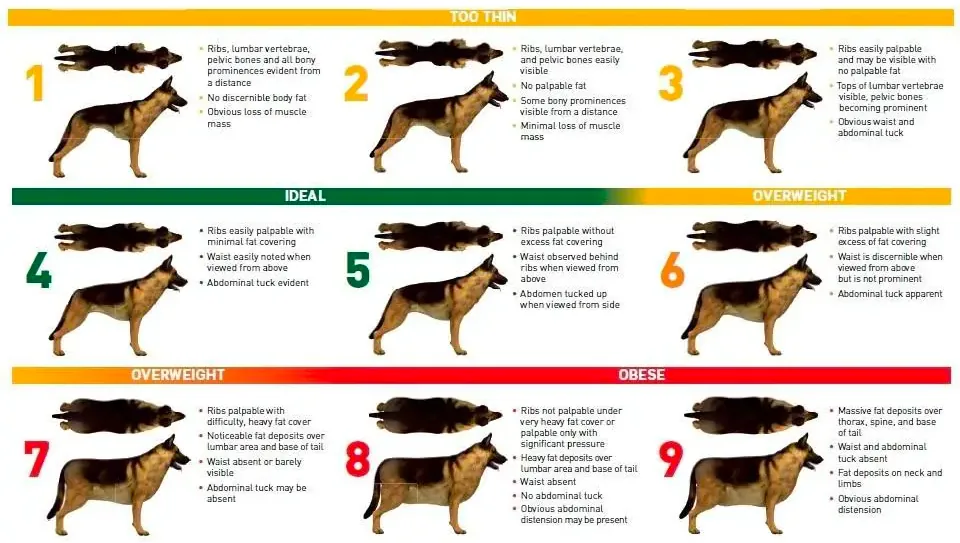
Use your hands, not the scale. A German Shepherd at a healthy body condition has ribs you can feel easily under a thin layer of covering but cannot see standing out. Viewed from above there’s a visible waist behind the ribs, and from the side the belly tucks up rather than running level.
If the ribs and the spine are prominently visible, your dog is likely too thin, and that deserves a vet visit rather than just more food. Underweight in a well-fed dog points to something else: parasites, dental pain, a digestive problem, or a condition affecting how food is absorbed. Quantity and quality of food are both worth reviewing, but not before ruling out a medical cause.
If you can’t find a waist from above and the belly looks rounded, your dog is carrying too much. Excess weight in this breed compounds every joint risk it already has.
Where to go deeper on weight
Weight is the one part of care where a small drift becomes a real health problem quietly, so it earns its own article. We cover the full obesity picture there: how to score body condition properly, the specific health risks that follow, and how to take weight off safely under veterinary supervision.
Weight also interacts with lifespan more than most owners realize. If you want the wider view, what actually shapes a German Shepherd’s lifespan puts body condition alongside the other factors you can influence.
How Do You Groom a German Shepherd’s Double Coat?
Brush often, and bathe rarely. The AKC’s official breed standard describes the coat this way: “The ideal dog has a double coat of medium length. The outer coat should be as dense as possible, hair straight, harsh and lying close to the body.” That dense undercoat is what sheds, and brushing is how you manage it.
Sources disagree on frequency, and it’s worth knowing that rather than being handed one number. PetMD recommends brushing “every day with a pin brush,” while much of the general breed advice online lands on two or three times weekly. Daily is the safer target during shedding season; two or three times a week is realistic the rest of the year.
On bathing, PetMD is blunt: German Shepherds “only need a bath a few times a year.” Frequent bathing strips the oils that keep a double coat working. If your dog smells, brush first and look for a skin or ear problem before reaching for shampoo.
Shedding season and what not to do
Twice a year this breed drops undercoat in quantities that seem medically improbable. That’s normal. Brush more, use an undercoat rake, and accept the situation. What you should not do is shave a double coat to reduce shedding, because the coat insulates against heat as well as cold and does not always grow back correctly.
Coat type does vary within the breed, and so does the shedding load. Coat colors and patterns covers the variation, and how often to bathe goes into the practical routine in more detail.
What Routine Care Gets Forgotten?
Ears, nails and teeth, almost always in that order. These are the three jobs with no obvious daily reminder, which is exactly why they get skipped until something hurts.
Ears need checking regularly, and this breed’s erect ears are better ventilated than a drop-eared dog’s but still collect debris. Look for redness, odor, dark discharge or head-shaking, and stop cleaning and call your vet if you find any of those. Nails want trimming or grinding roughly monthly if they aren’t wearing down naturally, since overgrown nails change how a dog stands and loads their joints.
Teeth are the most neglected of the three and the most expensive to ignore. Daily brushing with a dog-specific toothpaste is the standard, and never use human toothpaste. If you can only manage a few times a week, that still beats nothing.
How to clean ears without causing damage
Use a veterinary ear cleaner, never a cotton swab pushed into the canal, and never water. If your dog resists strongly, that’s often pain rather than stubbornness, which is a reason to see a vet rather than to persist. Cleaning their ears safely walks through the technique step by step, and if it isn’t working for you, a groomer or vet tech can do it.
Veterinary Care and What to Watch For
Preventive veterinary care matters more in this breed than in most, because German Shepherds carry a few specific risks worth catching early. Hip dysplasia is the one most people have heard of, and the best figures for it come from screening registries. A Swiss study followed 5,326 German Shepherds. It found that “while 46.2% of them were dysplastic between 1995 and 1999, the number dropped to 18.0% in the period 2010 to 2016” (Ohlerth et al., Frontiers in Veterinary Science, 2019, retrieved 2026-08-14).
Two things are worth taking from that. The rate is falling, which is the argument for buying from a breeder who screens, in one statistic.
The second is a caution the authors give themselves. Only 30.9% of the eligible population was ever officially scored, and they state plainly that “the true CHD-prevalence can therefore not be determined by scoring potential breeding stock only” (retrieved 2026-08-14). Dogs with obvious problems are less likely to be submitted. Treat any single prevalence figure as a floor rather than a measurement.
Hip dysplasia is a joint malformation causing pain and reduced mobility. Elbow dysplasia is also common and produces lifelong front-limb pain.
The one you need to recognize instantly is bloat. PetMD describes gastric dilatation-volvulus as “a sudden life-threatening condition when the stomach enlarges with gas (bloat) and then twists upon itself (GDV).” A dog with a distended abdomen, retching without producing vomit, drooling and obvious distress needs emergency care immediately, not an appointment tomorrow.
Keep vaccinations, parasite prevention and dental checks on schedule, and take behavior change seriously as a symptom. A dog who suddenly becomes irritable or withdrawn is often a dog in pain.
The one emergency worth memorising
Merck names German Shepherd Dogs explicitly among the breeds at risk of gastric dilation and volvulus (Merck Veterinary Manual, retrieved 2026-08-14). The rest of that list is Great Danes, Irish Setters, Gordon Setters, Weimaraners, Saint Bernards, Standard Poodles and Bassett Hounds.
Merck calls it “an acute, life-threatening condition” needing “immediate medical and surgical intervention”.
You do not need to understand the mechanism to act on it. You need to recognise it, so learn these:
- Nonproductive retching the dog tries repeatedly to be sick and nothing comes up. This is the single most recognisable sign.
- Hypersalivation and restlessness drooling, pacing, unable to settle.
- Acute or progressive abdominal distention a belly that looks tight or swollen.
Any of those means the vet now, at night, on a Sunday, whatever it is. Not in the morning.
The causes, the risk factors and what a preventive gastropexy does and does not achieve are covered in full in our article on bloat in German Shepherds. This page carries only the part you need at speed.
Care Through the Life Stages
What good care looks like changes substantially with age, and treating a nine-month-old like an adult is a common error. A puppy needs frequent small meals, restricted high-impact exercise, and heavy investment in socialization. An adolescent needs all of that plus patience, because trainability genuinely dips around eight months.
Adults are the easy stretch: settled routine, consistent exercise, annual vet visits. Seniors need the routine loosened again, with shorter and more frequent walks, joint monitoring, and vet visits twice a year rather than once. Weight control matters most at both ends of life.
Two stage-specific milestones catch owners out. The teething timeline explains the chewing phase that feels endless, and the one-year mark covers what changes when your dog stops being a puppy on paper but not in behavior.
Care around heat cycles and neutering
An unspayed female German Shepherd has care needs that shift temporarily around each heat cycle, covering hygiene, exercise and how closely the dog is supervised. Heat cycles in German Shepherds covers the timing and the practical management. Timing of spay or neuter in a large breed is genuinely debated among vets, so make that decision with yours rather than from a general rule.
Seasonal Care: Heat, Cold and Shedding
That double coat insulates in both directions, which means a German Shepherd tolerates cold well and heat much less well than owners assume. In summer, exercise early or late, and check pavement temperature with your hand before walking. Watch for heavy panting, bright red gums or a dog who lies down and won’t continue. Heatstroke is an emergency.
Winter is easier but not unlimited. A healthy adult with a full coat handles cold weather comfortably, while puppies, seniors and thin-coated dogs have far less margin. Wind, wet and time outdoors matter more than the temperature reading alone.
If you’re trying to judge where the line sits for your own dog, how much cold is too much gets specific about the signs to watch for.
Which Of These Routines Actually Matters Most?
Everything above is worth doing, but a checklist gives no sense of proportion. It is more useful to know which routines map onto what German Shepherds are actually treated for.
A VetCompass study followed 12,146 German Shepherds under UK primary veterinary care. The most frequently recorded disorders were “otitis externa (7.89%), osteoarthritis (5.54%), diarrhoea (5.24%), overweight/obesity (5.18%) and aggression (4.76%)” (O’Neill et al., Canine Genetics and Epidemiology, 2017, retrieved 2026-08-13).
| Routine on this page | What it maps onto | Priority |
|---|---|---|
| Ear checks and cleaning | Otitis externa, 7.89% the single most commonly recorded disorder in the breed | Highest |
| Weight control and portioning | Overweight/obesity, 5.18% and it worsens the arthritis above it | Highest, and the one you fully control |
| Exercise built gradually, non-slip flooring | Osteoarthritis, 5.54% | High |
| Consistent diet, noting stool changes | Diarrhoea, 5.24% | Medium |
| Coat brushing | Comfort and shedding; no entry in the top five | Lower than it feels |
The causes of death in the same study point the same way: “musculoskeletal disorder (16.3%), inability to stand (14.9%), neoplasia (14.5%) and spinal cord disorder (13.6%)”. Add the first, second and fourth and roughly 45% of deaths relate to the dog losing the use of its back end. Anything that preserves mobility into old age is therefore the highest-value habit on this page.
One place the advice genuinely pulls in two directions
Keeping a Shepherd lean is the best thing you can do for its joints. But Merck lists lean body condition among the risk factors for gastric dilation and volvulus, alongside once-daily feeding, feeding only dry kibble, rapid eating and advancing age (retrieved 2026-08-14).
Both things are true, and it is more honest to say so than to pretend the advice points one way. In practice it does not change the target weight; it changes how the food is delivered. Split the daily ration across two or more meals rather than one, slow a fast eater down, and know the emergency signs above. That is the whole of the reconciliation.
For what else is common in the breed, see our overview of German Shepherd health issues, and for how long they actually live, German Shepherd lifespan.
Final Thoughts
German Shepherd care rewards consistency far more than it rewards spending. Picture two dogs. One gets a daily outlet for body and brain, measured meals, a brush most days, and a vet who sees them before anything is wrong. The other gets the premium food bag and no routine. The first dog does better, every time.
If you take one habit from this article, make it the ten-second body-condition check. Hands on the ribs, look from above for a waist, look from the side for a tuck. It catches the slow drift that a scale and a busy week will both miss.
And when something seems off, believe your dog rather than the internet. For the personality side of living with this breed, the German Shepherd temperament covers what to expect and why. Our full training guide handles the behavior half, our health section collects the conditions worth knowing about, and our full German Shepherd hub covers everything else.
Disclaimer: PetVR publishes general information sourced from veterinary and kennel-club references, cited inline. It is not veterinary advice. Always consult a licensed veterinarian about your dog’s health, diet, or behavior. Read our full disclaimer.
 Top 10 Best German Shepherd Breeders in Alabama (AL)