
Before we directly drop down to Mitochondrial Myopathy in German Shepherd Dog, let us talk a bit about what is “Mitochondria” and what is “Myopathy” separably.
Mitochondria are the cellular structures in an organism in which energy is produced from the oxidation of fuels such as glucose and fat in the form of heat and mechanism i.e. working ability. Researchers have discovered some biochemical defects in the mitochondria. Some of the known mitochondrial diseases in dogs and other organisms occur due to abnormalities in the mitochondrial DNA.
Myopathy is a neuromuscular disorder that makes the muscle fibers dysfunctional due to one or more reasons. This consequently results in the weakening of muscles, leading to cramping and stiffness of muscles, and muscular spasms. Myopathy can be of different types like mitochondrial myopathies, congenital myopathies, muscular dystrophies, etc.
Inherited disorders of carnitine metabolism in dogs are among the most important causes of mitochondrial myopathy in German Shepherd Dogs and other dog breeds. The mitochondrial disorders in German Shepherds occur due to gene mutations – either nuclear genomes or mutations in mitochondrial DNA. The mutations in mitochondrial DNA in German Shepherd Dogs and any other canine breeds get transmitted by maternal inheritance. Putting this in simple, Mitochondrial myopathies in the GSD breed and in any other canine breeds are caused by genetic mutations, which directly affect the functioning of the electron transport chain (ETC).
Although not in very large numbers, a few cases of Mitochondrial Myopathy have been found in German Shepherd Dogs. The histochemical and ultrastructural findings in the case of mitochondrial myopathy in the German Shepherd Dog breed have been reported quite infrequently by vets.
Why this needs a muscle biopsy, not a blood test
This is the practical thing to understand before asking your vet about it.
In the case report, the diagnosis came from muscle biopsy with special stains, not from blood. Histochemistry showed subsarcolemmal oxidative activity, reduced NADH and succinate dehydrogenase, and an absence of cytochrome oxidase activity. Classic ragged red fibres were demonstrated with Gomori trichrome stain, and electron microscopy confirmed “subsarcolemmal accumulations of mitochondria and morphologically atypical mitochondria” (Paciello et al., Vet Pathol 2003, retrieved 2026-08-12).
Translated: a pathologist looked at muscle tissue, stained it in several different ways to see which energy-producing enzymes were working, and then looked at the mitochondria themselves under an electron microscope.
That is a referral-level investigation. It is not something a general practice runs on a Tuesday, and it is not something to request casually. It is the right step when common causes have been excluded and a young dog has unexplained, progressive exercise intolerance with muscle wasting.
What actually goes wrong
Mitochondria are the parts of a cell that turn fuel into usable energy. Muscle is one of the hungriest tissues in the body, so when mitochondria underperform, muscle is where you notice it first.
That is why the signature is not pain or lameness but running out of energy. A dog that starts a walk normally and fades. A dog that cannot sustain what it could manage last month.
What the documented case looked like
Because this rests on case-level evidence, the most honest thing to give you is the actual case rather than a generalised description.
The dog was a 9-month-old male German Shepherd, referred for progressive exercise intolerance. On examination he had “a stiff, stilted gait and marked atrophy and hypotonia of skeletal muscle”, meaning wasted, floppy muscle rather than tense or painful muscle (Paciello et al., Vet Pathol 2003, retrieved 2026-08-12).
Bloodwork showed raised muscle enzymes: creatine kinase at 181 U/L, lactate dehydrogenase at 510 U/L and aspartate aminotransferase at 123.6 U/L, which the authors described as “suggesting a muscle disease” (retrieved 2026-08-12).
Note the word suggesting. Raised muscle enzymes say the problem is in muscle. They do not say which muscle disease, and that distinction is the whole reason the next step exists.
How rare is this, honestly?
Before anything else, some perspective, because the internet is very good at making rare things feel likely.
Mitochondrial myopathy in German Shepherds is documented at the level of individual case reports, not as a common breed disease. The paper this article is named after, Paciello and colleagues in Veterinary Pathology in 2003, is filed by PubMed under publication type “Case Reports” and describes one dog (Paciello O, Maiolino P, Fatone G, Papparella S. Mitochondrial myopathy in a German Shepherd dog. Vet Pathol. 2003 Sep;40(5):507, retrieved 2026-08-12).
So if you are here because your German Shepherd is weak or tires quickly, the overwhelming likelihood is that the cause is one of the common conditions, not this one. Those are listed near the end of this article, and that section is probably the most useful part of the page for you.
This article exists because the condition is real, it is documented in this breed, and the picture is distinctive enough to be worth recognising. It does not exist to suggest your dog has it.
Mitochondrial Myopathy in a German Shepherd Dog
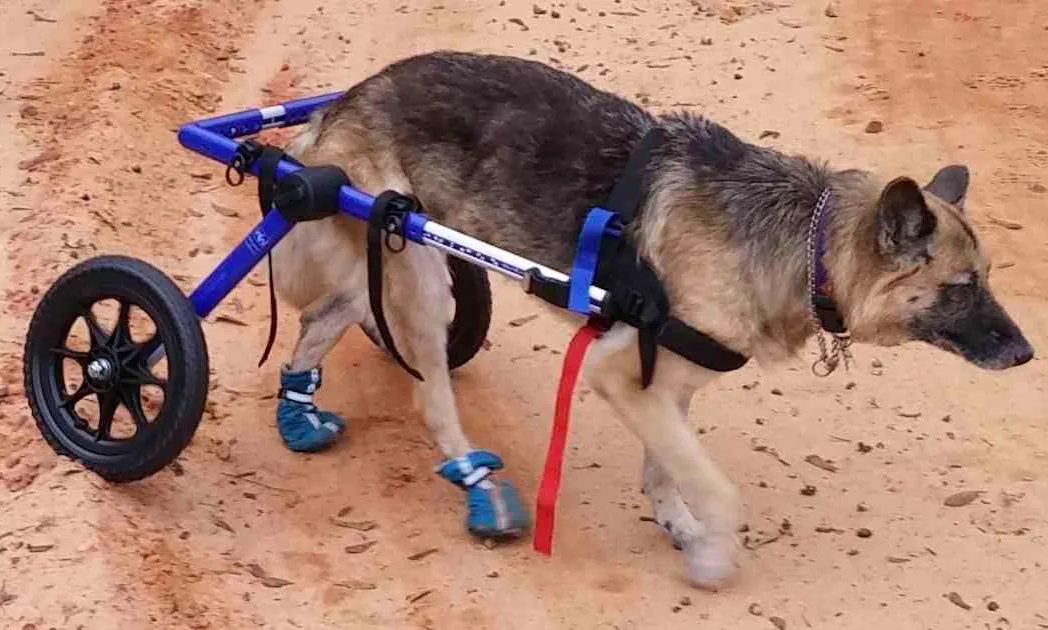
A male German Shepherd Dog of around 36 weeks old had been referred to the Department of Veterinary Clinical Science, Surgery Section, University of Naples. The dog had a history of intolerance to exercise, reluctance to move, and spontaneous pain. The symptoms had started showing just a month before the dog was referred to the Department of Veterinary Clinical Science, Surgery Section, University of Naples. The condition had been progressively increasing, showing signs of systemic muscle atrophy, mainly in limb and truncal muscles, accompanied by muscular pain, stiffness in gait, and thoracolumbar kyphosis (spinal deformity). The German Shepherd with such a clinical symptom was exhibiting bunny hopping in hind legs while trying to move fast.
Since the orthopedic and neurologic examinations of the German Shepherd Dog turned out to be unremarkable, his blood samples had been collected for hematologic and serologic examination. The report of hematologic examination did not show any abnormalities, while on the other hand, the biochemistry revealed an increase in the level of creatine kinase at 37 C (181 U/liter), lactate dehydrogenase (510 U/liter), and aspartate aminotransferase (123.6 U/liter). Moreover, radiographs of the stifle region and coxofemoral had been taken. However, no abnormalities could be found in the radiograph report. Muscle biopsies were also taken from the femoral biceps muscle for histopathologic examination.
Organs affected in case of Mitochondrial Myopathy
In mitochondrial disorders in dogs, the worst affected organs are the ones that mainly depend on oxidative metabolism (chemical reactions involving oxygen). However, these organs include the brain, skeleton, heart muscles, sensory organs, and kidney. The existence of the mildest degree of mitochondrial myopathy in GSD, like any other canine breed, will cause mild weakness of muscles, which would be most noticed in the arms. There will also be exercise intolerance.
Signs of Mitochondrial Myopathy
German Shepherd Dog – like any other dogs affected with mitochondrial myopathies has severe exercise intolerance that can be consistently demonstrated with even mild exercise. They have stiff, stilted gait, bunny-hopping in the pelvic limbs, reluctance to move, and spontaneous pain. Laboratory tests reveal exercise-induced metabolic acidosis.
Diagnosis of Mitochondrial Myopathy
Diagnosis of mitochondrial myopathies in German Shepherd dogs often involves multifaceted approaches. It requires a demonstration of post-exercise plasma lactate and pyruvate concentrations. Light and electron microscopic evaluation of the mitochondria of the dog within muscle biopsy sections are also used to diagnose mitochondrial myopathies in canine breeds. Precise characterization is dependent on specialized biochemical tests and molecular studies.
Mitochondrial Myopathy Treatments
Treatments of Mitochondrial Myopathy in GSD or other canine breeds range from treating the symptoms to very specific cause-targeting treatments. The common treatments include the administration of antioxidants – especially vitamin E, alternative energy sources – creatine monohydrate, lactate reduction – dichloroacetate and no to be forgettable exercise training. Exposing the patients to the correct type and degree of exercise is a particularly very important modality in treating Mitochondrial Myopathy in German Shepherd Dogs and other dog breeds.
Far more likely explanations for a weak or tiring German Shepherd
If you take one section away from this page, make it this one.
| What you see | Consider first |
|---|---|
| Hind legs weak and wobbly, no pain, knuckling, older dog, slowly worsening | Degenerative myelopathy |
| Difficulty rising, bunny-hopping, stiffness after rest | Hip dysplasia |
| Sore lower back, tail weakness, hind-limb lameness, aged 3 to 7 | Degenerative lumbosacral stenosis, covered in our spinal disc article. Merck names this breed specifically for it |
| Sudden lameness that moves between legs, aged 6 to 18 months | Panosteitis |
| Tires quickly, breathing faster at rest, cough, middle-aged or older | Dilated cardiomyopathy |
| Hungry, eating well, still losing weight, pale voluminous stools | Exocrine pancreatic insufficiency |
| Vague illness that comes and goes and is worse around stress | Addison’s disease |
Every one of those is more common than mitochondrial myopathy, and several have specific tests and effective treatments.
What to do if your dog is tiring easily
- Write down what you actually see. How far into a walk, how it recovers, whether it is worse in heat, whether it is getting worse week on week.
- Film it. A phone video of the gait is worth more than any description. Take it at the point where the tiredness shows, not at home on the carpet.
- Note whether there is pain. Pain points at joints and spine. Painless weakness points at nerve and muscle.
- Ask for a general work-up first. Muscle enzymes, a general panel, and an orthopaedic and neurological examination will redirect most cases.
- Ask about referral only if the common causes come back clear and the dog is genuinely deteriorating. That is the point at which a muscle biopsy becomes a reasonable conversation.
Our German Shepherd care guide covers routine health monitoring, and this guide to the breed energy curve is worth reading if you are unsure whether your dog is unwell or simply growing up.
Exercise intolerance is not the same as being unfit
Owners often struggle to describe this to a vet, and the description is what gets the right tests ordered. It is worth separating three things that all look like “my dog gets tired”.
Being unfit. The dog manages less than it used to because it has been doing less. It improves with gradual conditioning, it is worse after a lay-off, and it does not get worse week on week while activity stays the same.
Not wanting to. A dog in pain slows down to avoid the pain. Look for reluctance at specific moments: getting up, jumping, stairs, the first few minutes of a walk. That pattern points at joints and spine rather than muscle.
Genuine exercise intolerance. The dog starts willingly and then runs out. The mind is keen and the body stops. It is the same distance every time, it does not improve with conditioning, and it may be worse in heat.
That third pattern is what “exercise intolerance” means clinically, and it is the phrase used in the case report that names this condition (Paciello et al., Vet Pathol 2003, retrieved 2026-08-12). If it fits your dog, say those exact words to your vet, and say whether it is getting worse.
Is there any treatment?
Be realistic here, and be wary of what gets sold on the back of this diagnosis.
There is no established cure for mitochondrial myopathy in dogs. Care is supportive: managing activity so the dog works within what it can sustain, maintaining muscle without exhausting it, and keeping weight down so that less energy is needed for the same work.
You will find supplements marketed for mitochondrial support, often built on human products. We are not going to tell you they work, because for this condition in dogs there is no evidence base that would justify saying so. If you want to try something, do it through your vet, one change at a time, with a clear idea of what improvement would look like and a date to reassess.
The genuinely useful interventions are unglamorous: shorter and more frequent exercise instead of long outings, avoiding heat, and stopping before the dog hits the wall rather than after.
The honest summary
Mitochondrial myopathy is a real but rare muscle disorder, documented in this breed at case-report level. The picture is a young dog with progressive exercise intolerance, wasted and floppy muscle, a stiff stilted gait, and raised muscle enzymes. Confirming it needs a muscle biopsy with special stains and electron microscopy, which is referral territory.
If your German Shepherd is weak or tiring easily, start with the common causes in the table above. They are far more likely, and several of them have specific tests and treatments that change the outcome.
And if the common causes come back clear while your dog keeps deteriorating, that is the moment to ask about referral rather than to keep repeating the same tests.

 Nuclear Sclerosis in German Shepherds: Symptoms, Causes, and Treatments