Published: 2026-08-10. Last updated: 2026-08-10. Author: Rachel Baxley. Reviewed by the PetVR editorial team (see About Us).
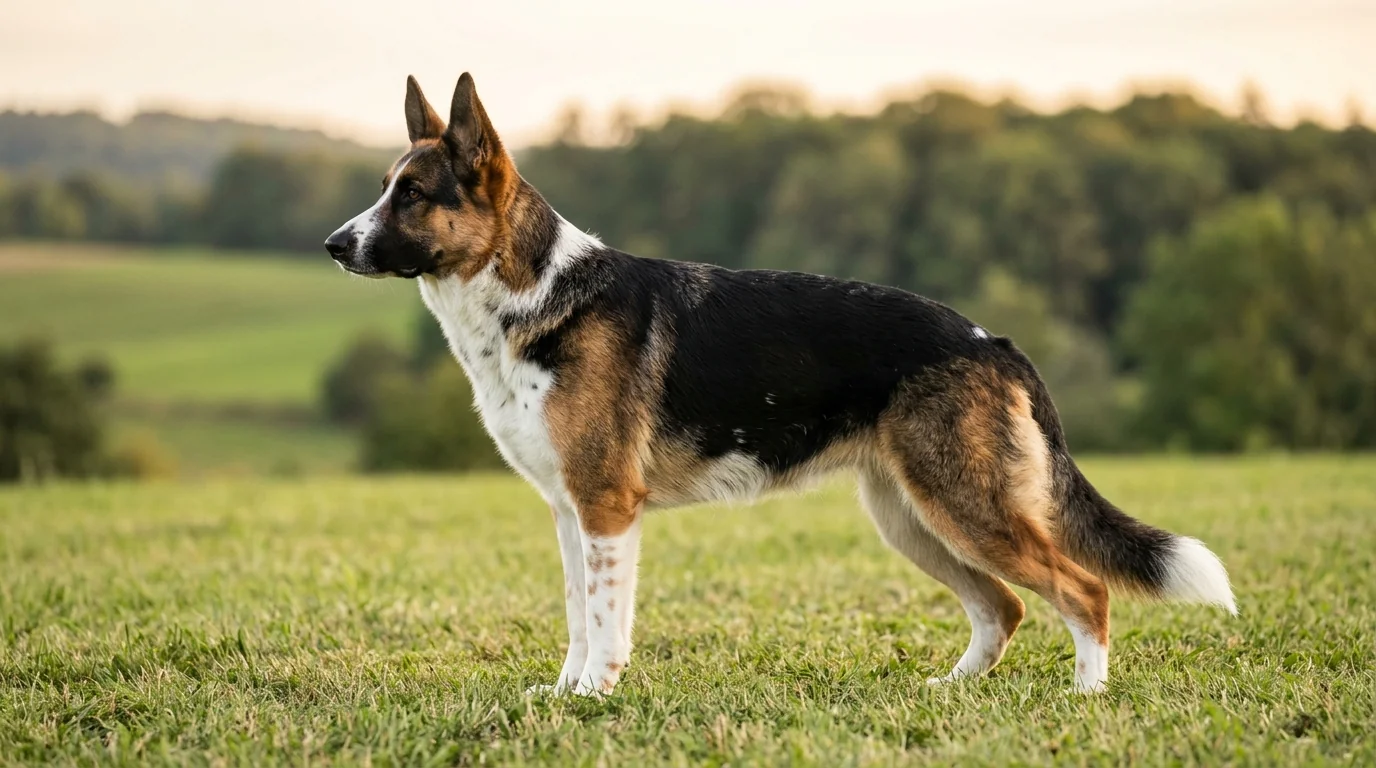
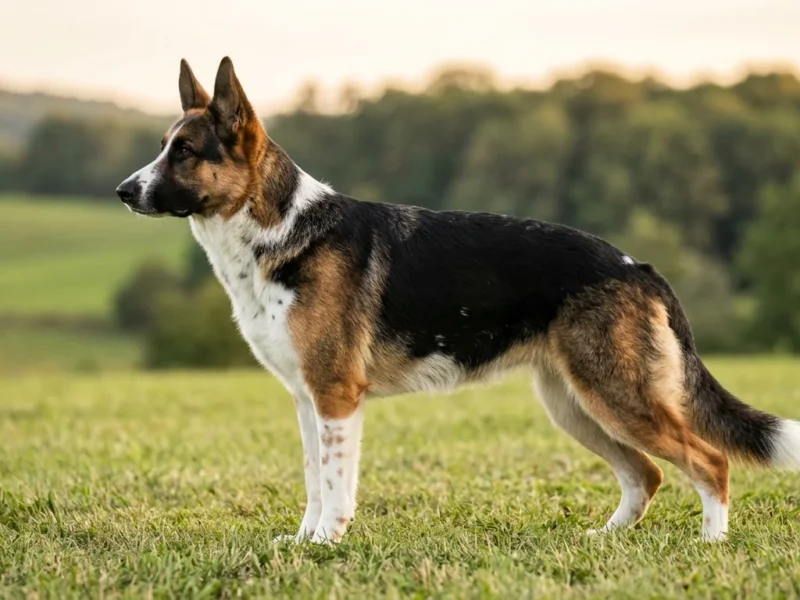
A Panda German Shepherd is a purebred German Shepherd whose black-and-tan or sable coat is broken up by large white patches on the chest, muzzle, legs, and belly. The look is striking. The price tag can be too. Panda buyers tend to ask the same three questions on repeat. Is this dog real? What should it cost? And where do I find one without getting scammed? Before you fall in love with a photo or wire a deposit, it’s worth knowing exactly what makes a panda a panda. It’s also worth knowing what a fair breeder does differently from one that’s just riding a colour trend.
Curious how this compares to the other rare coats in the breed? Our guide to the full German Shepherd colour spectrum covers all seven recognised patterns side by side.
What is a Panda German Shepherd?
A Panda German Shepherd is a standard German Shepherd Dog carrying a single dominant mutation in the KIT gene. The KIT gene is one of the pigment-cell control genes shared by most mammals, and its job is telling colour-producing cells where to grow during a puppy’s development. That one mutation produces a white-spotted, panda-bear pattern on top of the dog’s normal base colour. It isn’t a mix, a designer breed, or a new breed. The genes for body type, size, ears, tail, temperament, and drive are the same GSD genes as any other dog in the breed. This is a purebred with unusual paint, not a new breed with unknown behaviour.
The typical panda has roughly 30 to 40 percent white on the coat. The white typically shows up as a blaze on the face, a white chest and belly, four white socks, and a white tail tip. The rest of the coat holds the base colour the dog would have had anyway, which is usually black-and-tan or sable.
The founding dog: one puppy in one litter, in 2000
Every panda German Shepherd alive today traces back to one female puppy. Her name was Franka von Phenom, and her Wikipedia entry still records the details. She was born October 4, 2000, to two ordinary black-and-tan working-line parents at Phenom Shepherds in the United States. Both parents were fully DNA-verified purebred German Shepherds with no white-coated ancestors, so the mutation was a genuine new event.
The breeder ran DNA tests on both parents and the puppy to rule out mismating with another breed. The results came back clean. Franka was purebred, and the white pattern was a spontaneous change in her own DNA. Because the mutation is dominant, she passed the panda look to roughly half of every litter she produced. That’s how one puppy started an entire coat line.
Franka’s descendants are still the source of nearly every panda German Shepherd in the world. Therefore, if a breeder claims a panda puppy that can’t be traced back to the Phenom line, that’s a red flag worth walking away from. In other words: no Phenom pedigree, no real panda.
Is a panda German Shepherd purebred?
Yes. A properly bred panda German Shepherd is a fully purebred GSD carrying one variant of a normal breed gene. It is not a mix, and there is no White Shepherd, Border Collie, Boxer, or Australian Shepherd in the ancestry line.
The confusion is understandable. A large white patch on a traditionally solid-coloured breed looks like the result of an outcross. For example, social media routinely mislabels pandas as “GSD × Border Collie” or “piebald mix.” However, DNA testing has settled the question. As a result, the American Kennel Club will register a panda whose parentage checks out, the same as any other coloured GSD.
How does the panda coat pattern work genetically?
The KIT gene is one of the pigment-cell control genes shared by most mammals. It tells melanoblast cells (the future pigment producers) where to travel during a puppy’s early development in the womb. The panda mutation partially disables that guidance in a specific pattern. Cells fail to reach some parts of the coat, and those areas grow in white.
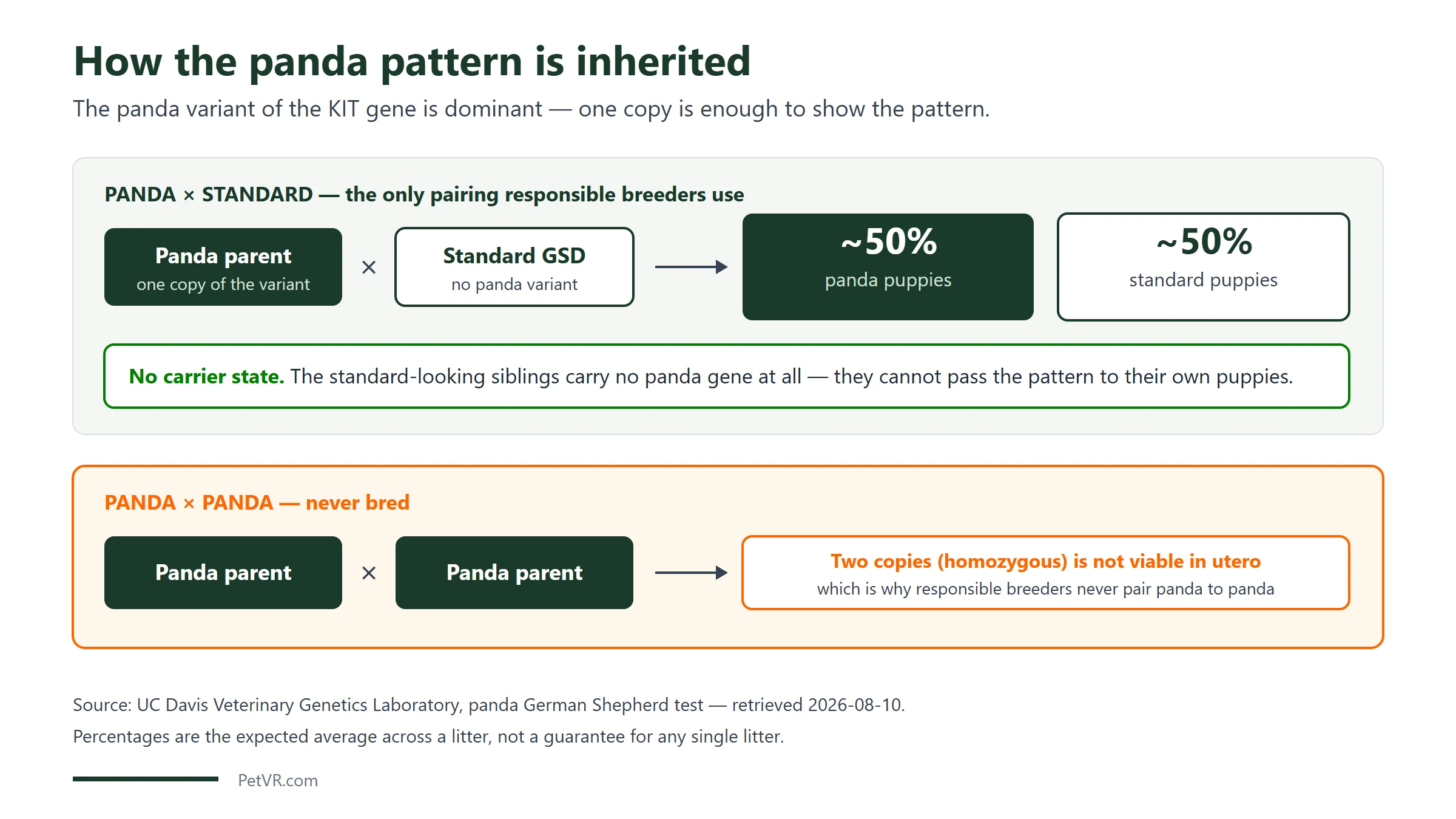
Because the mutation is dominant, a puppy needs only one copy from one parent to look like a panda. For example, breed one panda to a standard-coated GSD and roughly half the litter will be pandas. On the other hand, the other half will look completely normal, and they carry no panda gene at all. Those normal-looking siblings can’t pass the pattern to their own puppies later.
Two panda genes in the same dog (called homozygous, meaning both copies of the gene carry the mutation) is a different story. As a result, responsible breeders never pair panda to panda. See the health section for what happens.
Panda and piebald are not the same thing
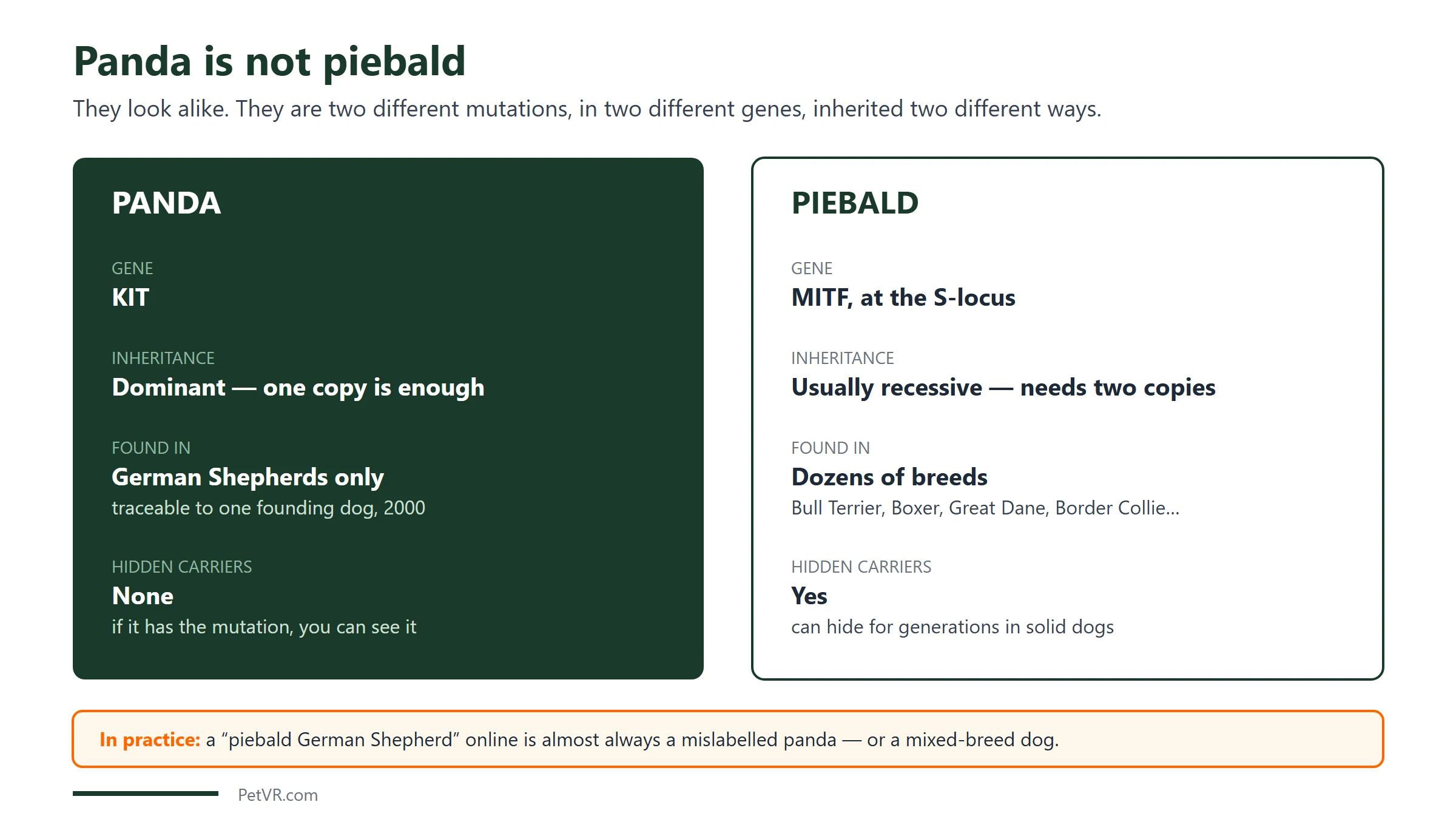
No, they aren’t the same. Panda and piebald look similar to the eye and are often confused online. However, they’re two different mutations in two different genes, and they produce two different inheritance patterns.
Piebald is caused by a variant of the MITF gene at what geneticists call the S-locus. In fact, it shows up in dozens of breeds: Bull Terriers, Boxers, English Setters, Great Danes, Border Collies, and many others. Piebald is usually recessive, so a puppy needs two copies of the variant to look spotted. On the other hand, panda is dominant and needs only one. In addition, piebald can hide for generations in solid-coloured dogs before surfacing in a litter.
Panda is a single dominant mutation in the KIT gene, present in exactly one breed (the German Shepherd) and traceable to exactly one founding dog. There’s no hidden carrier state. If a GSD looks like a panda, it has the mutation. If it doesn’t have the mutation, it doesn’t look like a panda. The two patterns aren’t interchangeable, and a “piebald German Shepherd” in a Facebook post is almost always a mislabelled panda or a mixed-breed dog.
Are panda German Shepherds recognized by the AKC?
Yes and no, and the difference matters. A panda German Shepherd can be registered with the American Kennel Club as long as its parentage is verified. That’s because AKC registration turns on pedigree, not on coat colour. As a result, a panda can hold official AKC papers, compete in agility, obedience, tracking, dock diving, and any other AKC performance sport. In addition, it can be bred and pedigreed like any other GSD.
What a panda can’t do is compete in AKC conformation shows. The breed standard treats white markings as a disqualifying fault in the show ring, so a panda won’t be judged against other GSDs for structure and type. This is the same nuance we cover in our guides to the solid-white German Shepherd, the blue German Shepherd, and the isabella German Shepherd. Registration eligibility and conformation eligibility are two separate questions.
How much does a panda German Shepherd cost?
A panda German Shepherd puppy from a reputable, health-testing breeder typically costs $2,500 to $5,000 in the United States, with rare exceptions above and below that range. That is roughly two to three times what a standard-coloured, pet-quality GSD sells for. In addition, the premium reflects scarcity of the founding line and the extra genetic testing responsible breeders run.
The reason the range is so wide is that “panda” by itself isn’t a quality signal. For example, two puppies priced $2,500 apart can look identical and be genetically identical. However, the difference sits in what the breeder did before the litter was born. In particular, fair-value pricing usually reflects:
- Both parents OFA-cleared for hips and elbows
- Both parents DNA-tested for the panda mutation to confirm one panda parent and one standard parent
- A DNA-verified pedigree traceable to the Phenom Shepherds line
- Age-appropriate vaccinations, deworming, and a written health guarantee
- A breeder willing to answer twenty questions and place the puppy on a spay/neuter contract if it is being sold as a pet
Prices above about $5,000 are usually a scarcity markup rather than a quality markup. On the other hand, prices below about $1,500 almost always mean at least one of the items above is missing. In particular, a very low price is never a bargain on a dog you’ll live with for a decade.
What health issues affect panda German Shepherds?
A panda German Shepherd has the same lifetime risk profile as any other purebred GSD, plus one condition specific to the mutation itself. Homozygous is the term for a dog that inherited the same gene variant from both parents. Paired panda genes aren’t viable in utero. Every other health concern is the standard GSD list.
The homozygous problem matters at the breeding stage, not the pet stage. However, the math is easy to see. If a breeder pairs two panda dogs, each parent carries one copy of the mutation. As a result, the expected litter breaks down predictably. One-quarter are homozygous, carrying two panda copies. One-half are heterozygous, carrying one panda copy and showing the panda look. The remaining quarter carry no copy at all. Meanwhile, the homozygous puppies don’t survive to term. Consequently, panda-to-panda pairings produce smaller-than-expected litters and effectively waste a mother’s heat cycle. Therefore, the responsible pairing is always panda × standard.
For the dog you take home, the everyday health picture is the German Shepherd health picture:
- Hip and elbow dysplasia: the breed’s best-known orthopaedic risk. Ask to see OFA or PennHIP certificates on both parents (see the Orthopedic Foundation for Animals hip grading scheme for what those grades mean). Our German Shepherd hip dysplasia guide walks through the symptoms and the vet workup.
- Degenerative myelopathy (DM): a progressive spinal-cord disease linked to the SOD1 gene, treated as inherited rather than autoimmune. Ask whether the parents have been Embark-tested or PennGen-tested for the SOD1 mutation (Embark Veterinary publishes a plain-English breakdown of the test and what results mean for a breeding decision).
- Bloat (gastric dilatation and volvulus, or GDV): an emergency that any large deep-chested breed can hit. Learn the signs and know your nearest 24-hour vet clinic.
- Exocrine pancreatic insufficiency (EPI): a heritable GSD-specific digestive condition that shows up as chronic loose stool and weight loss even with a good appetite.
- Skin allergies and hot spots: common enough that any GSD household should have a plan.
There’s a stubborn myth online that panda German Shepherds are inherently less healthy than standard GSDs because of their coat. Set aside the lethal-homozygous issue (which is a breeding-pair problem, not an individual-dog problem). However, there’s no peer-reviewed evidence that a heterozygous panda carries elevated disease risk from the mutation itself. In particular, the KIT gene affects pigment-cell migration. In contrast, it doesn’t touch the immune system, hearing, or vision.
Finding a responsible panda German Shepherd breeder
Because pandas descend from a small founding population, the pool of reputable breeders is short. The breeders who work with the pattern are concentrated among kennels that can document a link back to the founding line, and their litters are infrequent. As a result, that scarcity drives both the honest price premium and the scams that follow any scarce, expensive dog.
Use this checklist before you send a dime:
- Ask for a UC Davis panda-mutation test on both parents. The UC Davis Veterinary Genetics Laboratory runs a specific panda test for $58 per dog. A real breeder will already have the certificates in hand for the panda parent. Anyone who’s never heard of the test, or refuses to run it, isn’t the breeder you want.
- Ask for OFA hip and elbow certificates on both parents. Bare minimum. If they can’t produce them, walk.
- Ask for a DNA-verified pedigree back to Phenom Shepherds. Every legitimate panda line traces to Franka von Phenom. A reputable breeder can show you the paperwork.
- Visit in person, or ask for a live video walkthrough of the whelping area. Photos are cheap. A live view isn’t. A breeder unwilling to do either is hiding something.
- Read the contract before you send a deposit. A reputable contract includes a health guarantee, a return-to-breeder clause, and (for pet-quality puppies) a spay or neuter agreement.
- Beware panda-to-panda breedings. If a breeder proudly advertises two panda parents, that’s a sign they’re prioritising litter appearance over dog welfare. Their litters will be smaller than they should be because of the non-viable homozygous puppies.
Not sure whether a breeder is the right fit? Our German Shepherd breeders directory lists verified US kennels by state and is a reasonable place to start comparison-shopping.
What is the temperament of a panda German Shepherd?
Exactly what you’d expect from a German Shepherd. Coat colour and pigment-cell genes aren’t linked to the genes that control temperament, drive, trainability, or sociability. A panda GSD grows into the same intelligent, loyal, high-energy working dog as any standard-coloured littermate.
You’re signing up for a dog that needs one to two hours of hard exercise a day. In addition, it needs structured training that starts the week you bring the puppy home, and enough mental work to keep its brain busy. Bored German Shepherds redecorate. In contrast, well-exercised, well-trained ones are among the most rewarding companion dogs in the world.
If you’re new to the breed, browse our guide to the different lines of German Shepherds before you commit. In fact, a working-line puppy and a show-line puppy grow into different dogs. In comparison, the coat colour is the least of the differences that matter to a first-time owner.
Final Thoughts
In fact, a Panda German Shepherd is a real dog, from a real breed. Notably, the mutation showed up once, in one puppy, in the year 2000, and has been carefully carried forward since. It isn’t a mix. It isn’t a scam by definition. It isn’t a health problem in itself. In other words, what it is is a dog that costs more than the average GSD. In addition, that price premium only pays off if the breeder actually did the extra work behind it.
So buy from someone who tests both parents. Specifically, buy from someone who can trace the pedigree back to Franka von Phenom, and who breeds panda to standard (never panda to panda). In addition, skip the Facebook ad with a wire-transfer-only deposit. Then enjoy a decade with one of the more visually unusual purebred dogs on the planet.
This article was written by Rachel Baxley and reviewed by the PetVR editorial team. For our sourcing policy and how to reach us, see About PetVR or Contact.