
If you’ve ever wondered how strong a German Shepherd is, the answer starts with a surprising contrast: a GSD bites at roughly 240 PSI according to Curtis Legal Group (2026), which sounds enormous until you learn a Rottweiler hits ~328 PSI. That contrast alone tells you something important: the GSD isn’t the strongest dog on every measure, but it’s freakishly strong across all of them at once.
The confusion is real. Published bite-force figures for the same breed range from 238 to 305 PSI depending on the source, Curtis Legal Group cites 240 PSI as a standard estimate, while working-line references push higher, and “strong” means something different when you’re measuring bite pressure versus pulling force versus sustained speed. In this guide, you’ll learn exactly how strong a German Shepherd is across five measurable dimensions, with every figure traced to a named source.
This article covers bite force, speed, pulling power, breed comparisons, and a full FAQ answering the questions readers search most.
How We Reviewed These Figures
We reviewed bite-force, weight, and speed figures from legal and injury references (Curtis Legal Group, Rice Kendig), veterinary sources (PetMD), and owner community threads (r/germanshepherds). All figures are treated as estimates; no single number is presented as exact. Where sources disagree, we name each source and explain why the figures differ.
A German Shepherd’s bite force is estimated at ~240 PSI by Curtis Legal Group (2026), with working-line sources citing ranges up to 305 PSI, powerful, but below a Rottweiler’s ~328 PSI (Curtis Legal Group, 2026).
- Bite force: Curtis Legal Group estimates ~240 PSI; working-line and Schutzhund sources cite up to 305 PSI; grip and control matter as much as raw crushing power.
- Top speed: A healthy GSD reaches 30-35 mph in short bursts; sustained pace is roughly 15-20 mph over distance.
- Pulling power: Owner reports from r/germanshepherds describe GSDs pulling up to three times their bodyweight, treat this as anecdotal, not measured.
- Size: Adult males weigh 65-90 lbs; females 50-70 lbs, per PetMD.
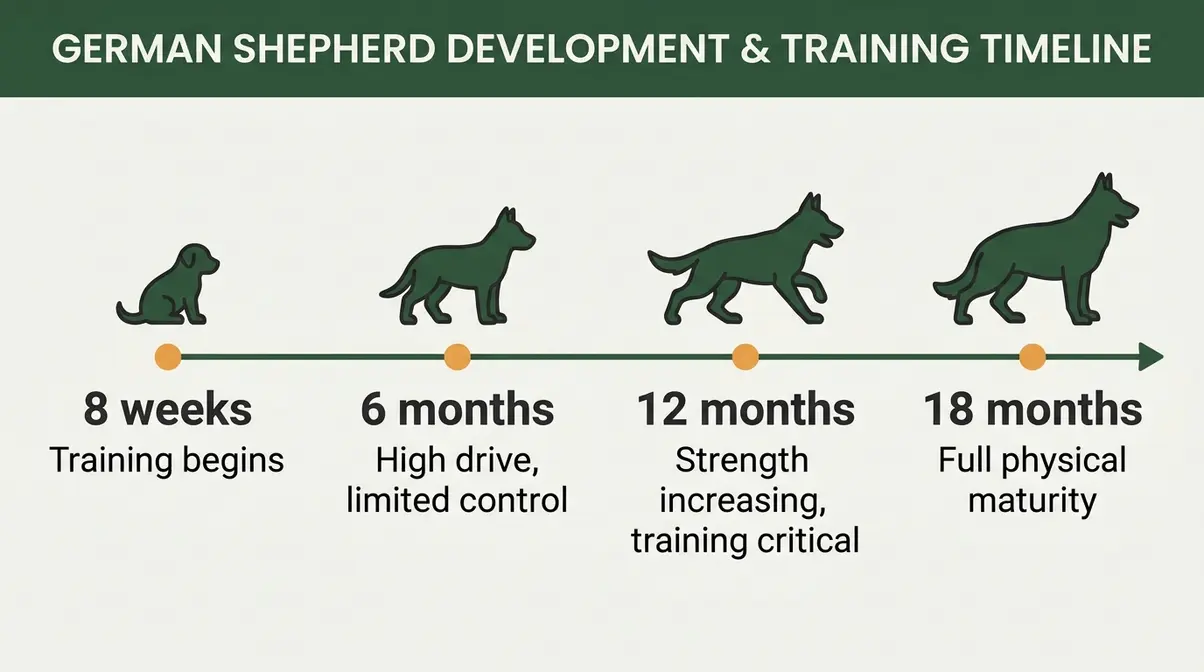
- Maturity: Full physical strength arrives around 18 months, young dogs can feel “freakishly strong” before their training catches up.
How Strong Is a German Shepherd?
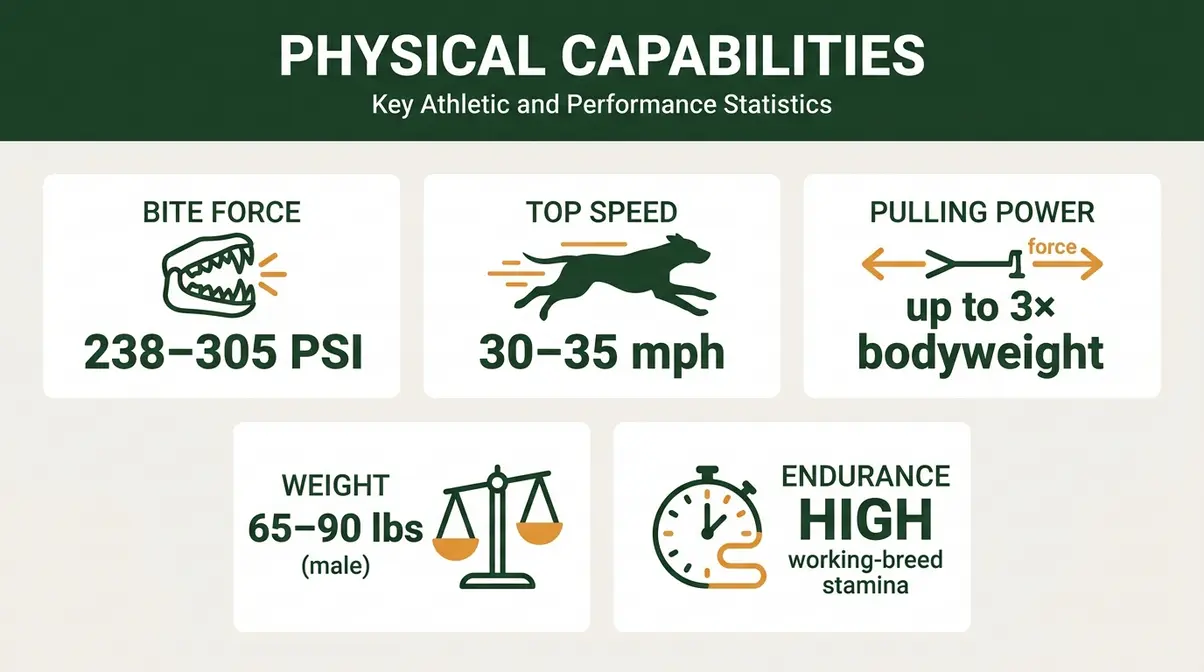
A German Shepherd is strong across five measurable dimensions: bite force (~240 PSI per Curtis Legal Group, with working-line estimates up to 305 PSI), top speed (30-35 mph), pulling power (anecdotally up to 3× bodyweight), adult weight (65-90 lbs for males), and endurance that outlasts most breeds. “Strong” means something different depending on which dimension you measure. What makes the GSD feel disproportionately powerful for its size is the combination of explosive athleticism and high drive.
A German Shepherd’s bite force is estimated at ~240 PSI by Curtis Legal Group, more than twice a human’s roughly 120 PSI (Curtis Legal Group, 2026). Working-line and Schutzhund-trained dogs may test higher, with some sources citing up to 305 PSI. But bite force is just one piece. To understand how strong a German Shepherd really is, you need all five dimensions working together, what this article calls the five-dimension strength framework: bite, speed, pull, size, and endurance.
Weight, Size, and Physical Build
PetMD lists adult male GSDs at 65-90 lbs and females at 50-70 lbs, with height ranging from 22-26 inches at the shoulder. Those numbers matter because a 90-lb dog leaning into a leash exerts force well beyond what most adults expect, not just from weight, but from the angle and drive behind the push. If you’ve ever been pulled off balance by a large dog, you already know that weight alone doesn’t tell the full story.
The GSD’s muscular hindquarters and deep chest are the anatomical reasons it can do both. The deep chest provides lung and heart capacity for sustained effort; the hindquarters generate explosive acceleration from a standing start. Together, they explain why the breed excels at everything from sprint work to long-distance tracking.
Full physical maturity arrives around 18 months. Before that, young dogs can feel freakishly strong because their drive and energy outpace their training. This is the moment owners describe on Reddit, a six-month-old GSD that already weighs 55 lbs and has zero leash manners is a genuinely difficult animal to manage, not because it’s aggressive, but because it’s powerful and unstructured. If you’re in this phase with your dog, consistent training from puppyhood is the only reliable answer.
Worth noting: a GSD mix can vary significantly from the purebred range. A GSD crossed with a Malinois may be lighter and faster; a GSD crossed with a Rottweiler may carry more weight and bite force. If you’re evaluating a GSD mix, assess each strength dimension individually rather than assuming it matches the purebred profile.
Size and build set the stage, but the dimension that surprises most people is how fast a GSD can actually move.
Speed and Endurance
Speed is one reason a German Shepherd feels so strong. PetMD cites a top speed of roughly 30-35 mph in short bursts, with a sustained pace of approximately 15-20 mph over distance. Treat 30 mph as a top-end figure, it’s what a fit, motivated GSD hits in a sprint, not what it maintains on a long run. If you’ve ever watched a GSD sprint across a field, you already know this feels faster than the numbers suggest.
The anatomical enablers are the same ones behind its pulling power: muscular hindquarters, a deep chest for cardiovascular capacity, and strong shoulders that drive forward momentum. A dog that can close 30 feet in under a second feels more powerful than its weight alone suggests.
Endurance is the dimension competitors rarely mention. A GSD doesn’t just sprint, it works. Police and military dogs are selected in part because they can maintain high output over hours, not just seconds. That combination of speed and stamina is a core part of what makes the breed “Built Different” compared with same-weight dogs that tire faster.
For a full breakdown of GSD speed, including how it compares with Greyhounds, Malinois, and other fast breeds, see how fast German Shepherds can run and how their top speed compares with other breeds.
Speed is impressive, but GSD owners will tell you the most surprising strength dimension is what happens when the dog decides to pull.
Pulling Power and Leash Strength
No peer-reviewed pulling-force measurement for GSDs exists in the available research. What the data does show: adult males weigh 65-90 lbs, and a high-drive dog leaning into a leash can knock an adult off balance. That’s worth stating plainly, the data gap is real, and the anecdotal evidence is compelling enough to take seriously.
Here’s what one owner reported in the r/germanshepherds thread (2024):
“They can carry 1/3 their bodyweight, but they can pull 3X their bodyweight. My GSD is 110 pounds. Incredibly powerful dogs.”
, Owner report, r/germanshepherds (2024; anecdotal, not measured data)
(Note: 110 lbs exceeds the typical breed standard range of 65-90 lbs for adult males per PetMD, this may reflect a large individual, a GSD mix, or an owner estimate.)
The behavioral explanation matters here. A GSD’s high drive means it wants to pull, and that motivation amplifies the perceived force beyond what raw weight predicts. This is the “Strength with intensity” dimension: the dog’s mental engagement multiplies its physical output in a way that a calmer, same-weight breed simply doesn’t replicate.
Tug of war is where this becomes obvious to most owners. A GSD that has been trained to grip and hold will sustain pressure far longer than a same-weight breed with lower drive. What owners sometimes call a “Powerful Ground Slam”, that sudden full-body lunge into a tug, isn’t just muscle. It’s drive, timing, and commitment to the task. That behavioral dimension is absent from most breed-strength comparisons, which focus on weight and PSI alone.
That pulling force raises a question most prospective owners quietly wonder about: could a person actually hold one back?
Can a Human Overpower a German Shepherd?
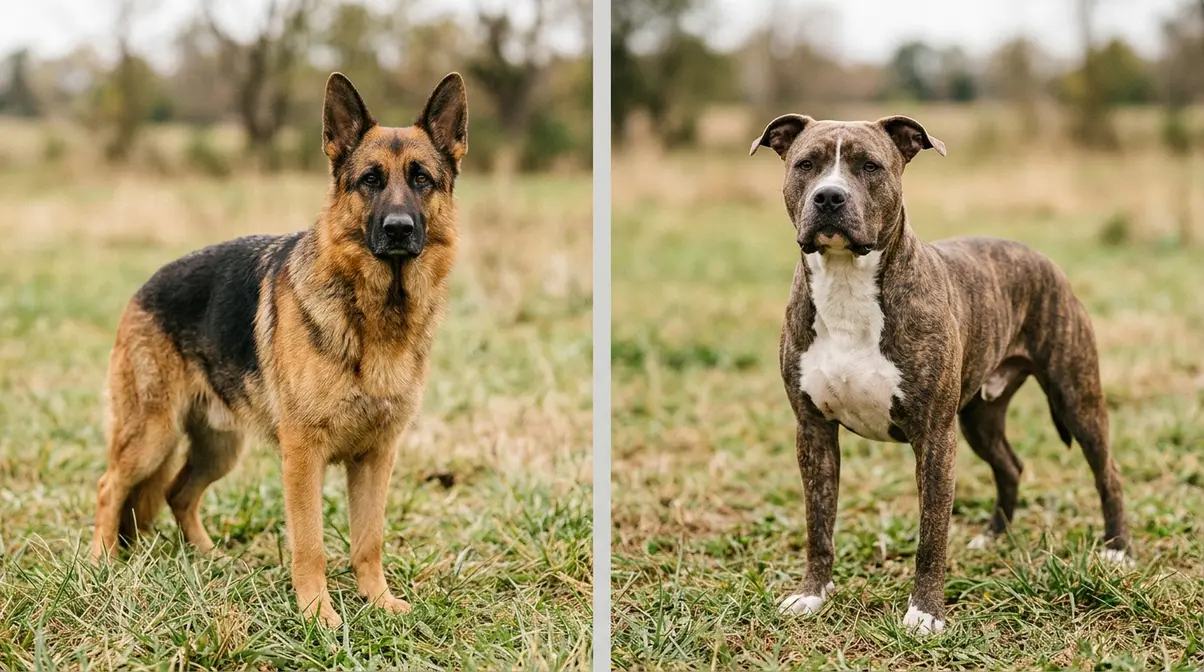
No direct contest study exists in the available research, and that’s worth saying upfront. But the data we do have points in a clear direction. Adult male GSDs weigh 65-90 lbs per PetMD, and their bite force (~240 PSI per Curtis Legal Group) is more than twice a human’s roughly 120 PSI, according to Rice Kendig (2025). A high-drive GSD leaning into a leash can knock most adults off balance, not because of weight alone, but because of the angle, speed, and commitment behind the movement.
Owner consensus in the r/germanshepherds thread (2024) is consistent: young, untrained GSDs are described as difficult to physically restrain. That’s an anecdote, not measured data, but when dozens of experienced owners describe the same thing, it’s worth treating as signal.
The practical answer is that training and equipment, not raw strength, are the real control mechanisms. Police and military handlers use harnesses, long lines, and bite sleeves rather than trying to physically overpower a working GSD. A trained dog responds to commands; an untrained 80-lb GSD with high drive is a different situation entirely. One reason a German Shepherd is so strong in practice is that its drive means it commits fully, there’s no half-measure in how it pulls, grips, or pushes. If you’re managing an untrained GSD, equipment and consistent commands are your most effective tools.
Physical strength is one thing, but the dimension that generates the most online debate is bite force, where the published numbers tell a more complicated story.
When GSD Strength Becomes a Handling Challenge
GSD strength creates specific handling challenges in three scenarios worth knowing before you commit to the breed:
- Adolescent dogs (6-18 months): High drive plus a growing body before training is established. This is the freakishly strong phase owners describe, the dog is powerful enough to cause problems but hasn’t yet learned why it shouldn’t.
- Leash reactivity: A reactive 80-lb GSD can pull a smaller adult off their feet in a single lunge. This isn’t aggression, it’s redirected drive with no outlet.
- Tug and play: A GSD that has learned to grip will sustain pressure most owners underestimate. The dog isn’t trying to hurt anyone; it’s doing what it was bred to do.
The good news: strength is manageable with consistent training from puppyhood and appropriate equipment (front-clip harness, long line). CDC guidance on dog bite prevention offers a general framework for responsible ownership, not GSD-specific, but the principles apply. Frame this as informed ownership, not a warning label. If you’re preparing for a GSD, start training at 8 weeks and don’t wait for problems to appear.
Understanding the full picture of GSD strength starts with bite force, the most-cited, most-misunderstood number in the breed’s profile.
How Strong Is a German Shepherd’s Bite?
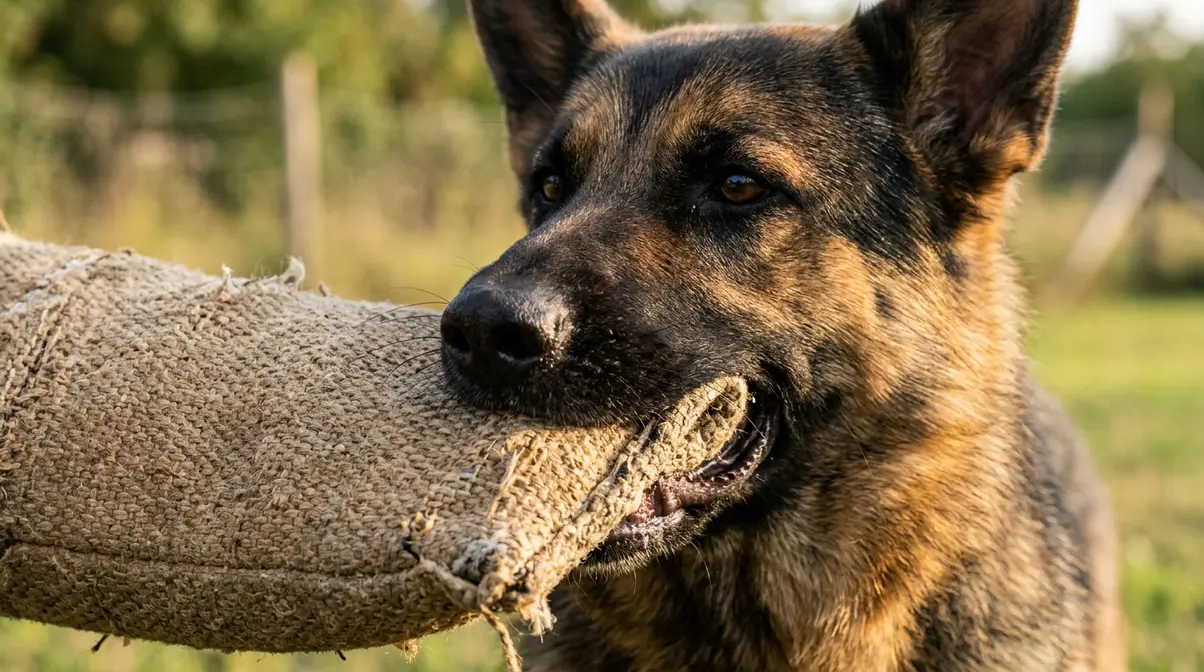
A German Shepherd’s bite force is estimated at ~240 PSI (pounds per square inch, a measure of the pressure a bite exerts on a surface) by Curtis Legal Group (2026), with working-line and Schutzhund sources citing ranges up to 305 PSI. For comparison, a human bite averages roughly 120 PSI, while a Rottweiler reaches ~328 PSI. The variation exists because most published figures come from legal and injury references, not controlled biomechanics studies, and working-line dogs may test higher than pet-line dogs.
Bite force is the most-discussed of the five GSD strength dimensions, but it’s also the most misunderstood, largely because the numbers don’t agree, and nobody explains why.
What the PSI Numbers Actually Mean
PSI stands for pounds per square inch. Understanding how strong a German Shepherd’s bite force really is requires knowing why the figures vary. A GSD at 240 PSI means every square inch of the bite surface receives 240 lbs of force, roughly the pressure of a 240-lb weight balanced on a one-inch square. That’s a useful mental image for understanding why bite force matters in protection and working contexts.
Most published GSD bite-force numbers come from legal and injury blogs, not peer-reviewed biomechanics studies. Working-line and Schutzhund-trained dogs may test higher than pet-line dogs because their bite training develops grip strength and commitment alongside raw jaw power. Curtis Legal Group (modified 2 March 2026) cites 240 PSI as a standard estimate for the breed. Rice Kendig (2025) and Wüstenbergerland (February 2025) cite ranges up to 305 PSI for working lines. Both are credible references for their respective estimates; the disagreement is a feature of the data, not an error. Treat any single number as an estimate, not a precise measurement.
For a deeper look at the breed’s bite force figures and what they mean in practice, PetVR’s German Shepherd facts page covers the full picture.
With that context, the breed comparison tells a clearer story.
German Shepherd Bite Force vs. Other Breeds
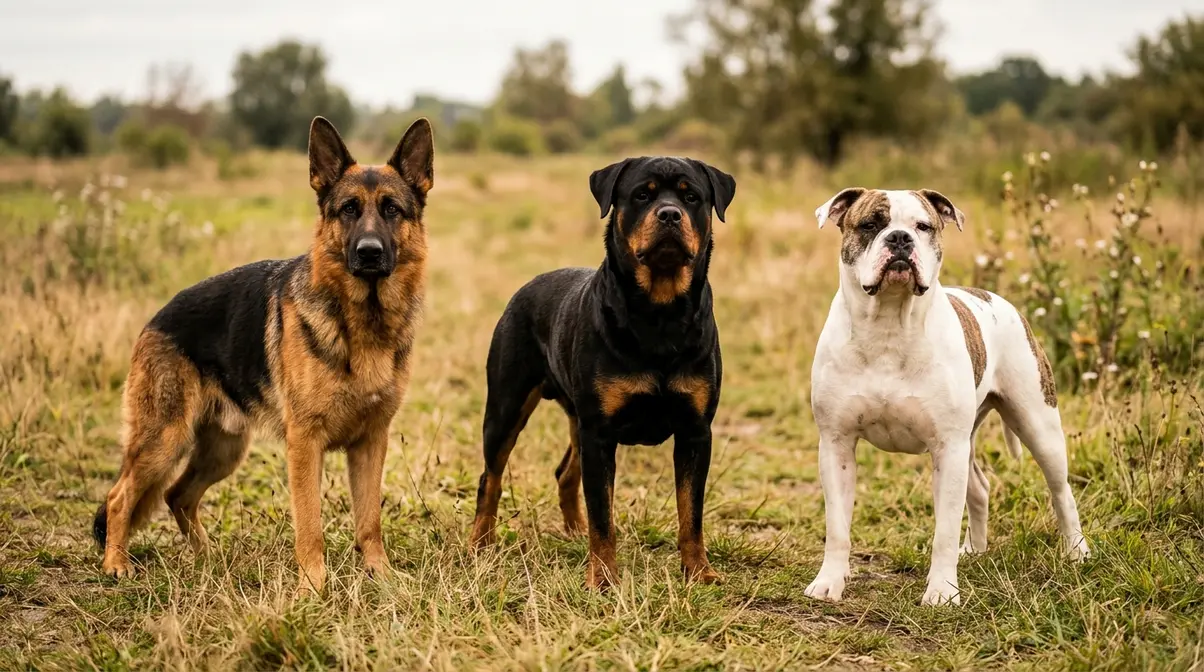
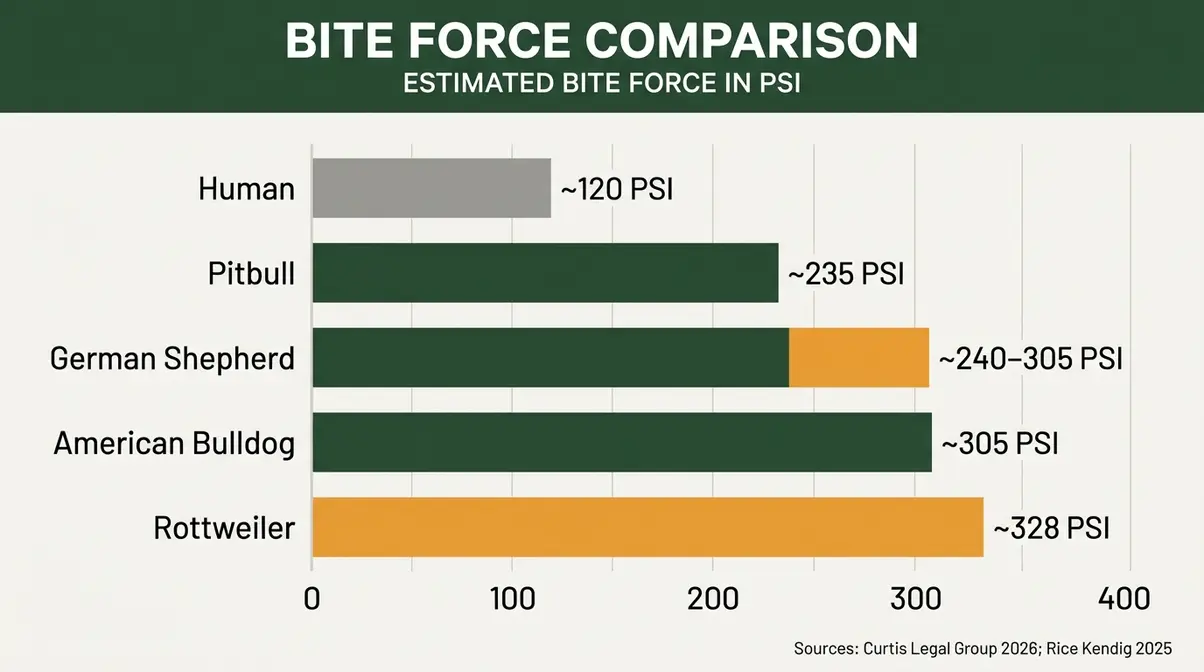
A Rottweiler’s bite force (~328 PSI) exceeds a German Shepherd’s (~240 PSI per Curtis Legal Group; up to 305 PSI for working lines) by roughly 10-37%, depending on which GSD estimate you use, making the GSD powerful but not the strongest-biting working breed (Curtis Legal Group, 2026; Rice Kendig, 2025).
| Breed | Bite Force (PSI) | Source | Notes |
|---|---|---|---|
| Human | ~120 PSI | Rice Kendig, 2025 | Average adult |
| Pitbull | ~235 PSI | Curtis Legal Group, 2026 | Estimate; varies by source |
| German Shepherd | ~240 PSI (standard); up to 305 PSI (working lines) | Curtis Legal Group, 2026; Wüstenbergerland, Feb 2025 | Working lines may test higher |
| American Bulldog | ~305 PSI | Curtis Legal Group, 2026 | Estimate |
| Rottweiler | ~328 PSI | Rice Kendig, 2025; Curtis Legal Group, 2026 | Estimate |
The table makes one point clearly: how strong a German Shepherd’s bite is depends on what you’re comparing it to. Against a human (120 PSI), the GSD is more than twice as powerful. Against a Rottweiler, it falls short on raw crushing force. The American Bulldog (~305 PSI) matches the GSD’s upper working-line estimate. Only the Rottweiler is unambiguously higher across all cited sources.
The GSD’s strength advantage isn’t bite force alone, it’s the combination of adequate bite force and speed and endurance that no single competitor breed matches across all three dimensions.
A counterintuitive finding worth flagging: Pitbull bite force (~235 PSI) is slightly below the GSD’s standard estimate (~240 PSI). Many readers assume Pitbulls bite harder, the data, at least from these sources, doesn’t support that.
Raw PSI, though, only tells part of the story, what a GSD does with that bite matters as much as the number.
Why Grip and Control Matter More Than Raw PSI
A GSD’s effectiveness in protection work comes from a firm, sustained grip, high pain tolerance, and training, not raw crushing power alone. A Rottweiler may bite harder, but a trained GSD holds longer and releases on command. That distinction matters enormously in working contexts.
Police and military forces use GSDs not because they have the highest PSI, but because they combine adequate bite force with speed, trainability, and endurance. This is the “Built Different” quality owners describe, it’s a package of traits, not a single metric. A Schutzhund-trained GSD will sustain a bite sleeve grip for 30+ seconds on command, a behavioral feat that raw PSI doesn’t capture and that most higher-PSI breeds can’t replicate with the same reliability.
Working-dog selection research consistently shows that behavioral traits, drive, grip commitment, handler focus, are prioritized alongside physical ones, a principle documented by Cornell veterinary canine health research. This is the consensus across working-dog communities and professional K9 programs: a 240-PSI dog ends up doing police work while higher-PSI breeds don’t, because the behavioral package matters as much as the jaw strength. That’s why you’ll find GSDs in law enforcement worldwide, not Rottweilers or American Bulldogs.
The breed comparison that generates the most reader curiosity, though, isn’t GSD vs. Rottweiler, it’s GSD vs. Pitbull.
German Shepherd vs. Pitbull: Who’s Stronger?
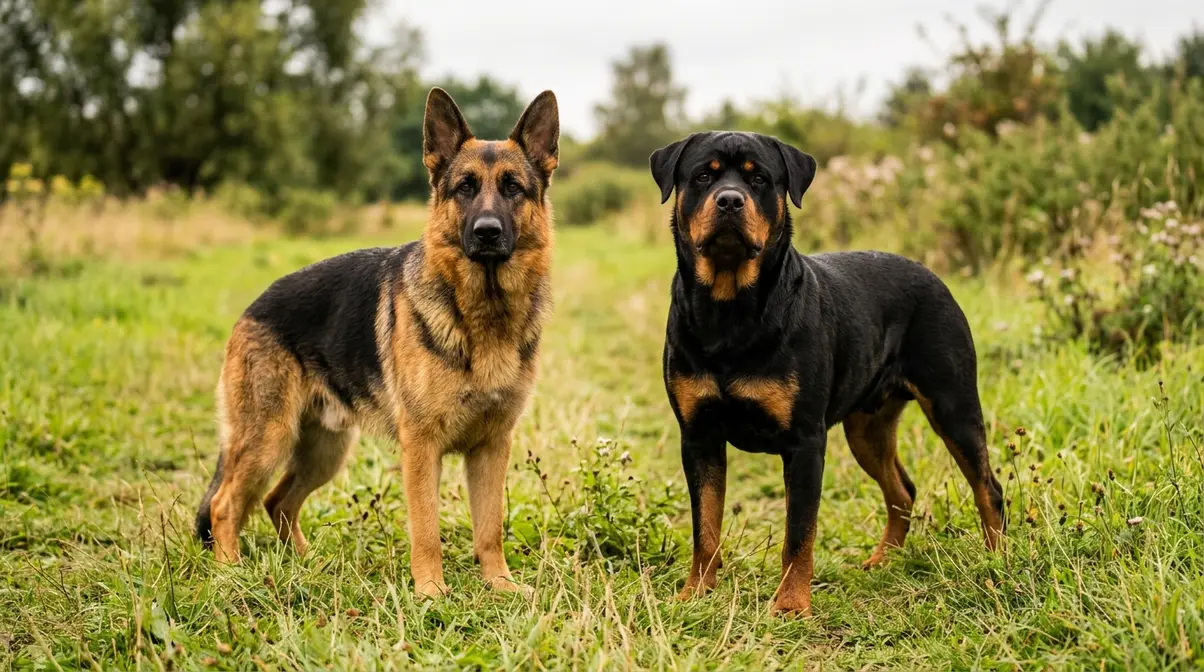
Neither breed is universally “stronger”, the answer depends on what you measure. On bite force, the GSD edges ahead (~240 PSI vs. roughly 235 PSI for Pitbulls, per Curtis Legal Group, 2026). On build and low-center-of-gravity pulling resistance, the Pitbull’s stockier frame gives it an advantage. The GSD leads on speed and endurance. The answer depends on which of the five strength dimensions you’re measuring.
Questions like “can a German Shepherd beat a Pitbull in a fight” or “how fast can a German Shepherd overpower a Pitbull” aren’t really strength questions, they’re curiosity questions. The useful reframe is: stronger at what?
| Dimension | German Shepherd | Pitbull | Source |
|---|---|---|---|
| Bite Force | ~240 PSI (standard); up to 305 PSI (working lines) | ~235 PSI | Curtis Legal Group, 2026 |
| Male Weight | 65-90 lbs | 35-60 lbs | PetMD; general breed standard |
| Top Speed | ~30-35 mph | ~25-30 mph | PetMD; general breed standard |
| Build | Athletic, lean | Stocky, muscular | General breed standard |
| Endurance | High (working breed) | Moderate | General breed standard |
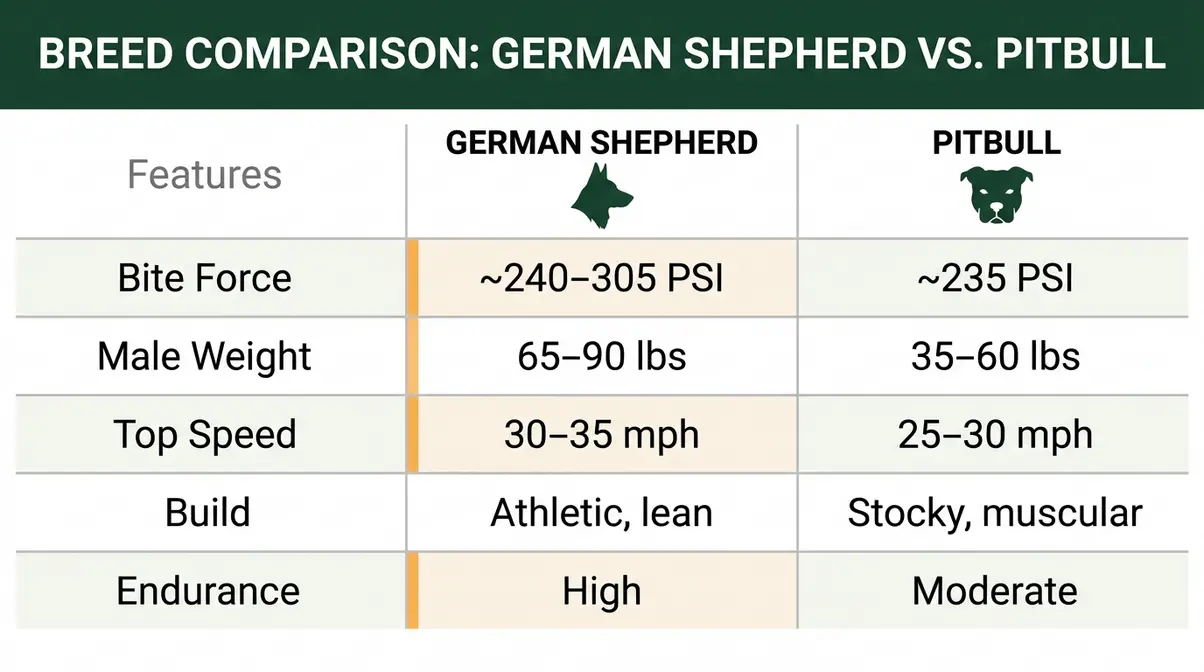
A German Shepherd’s bite force (~240 PSI per Curtis Legal Group) slightly exceeds a Pitbull’s (~235 PSI), but a Pitbull’s stockier build gives it a lower center of gravity and more pound-for-pound pulling resistance (Curtis Legal Group, 2026).
What the table shows overall: the GSD is heavier, faster, and matches or slightly exceeds the Pitbull on bite force. The Pitbull’s stockier, lower-slung build may give it more resistance in a straight pulling contest, lower center of gravity is a genuine mechanical advantage. On speed and endurance, the GSD leads clearly.
The responsible framing here matters. Both breeds are powerful, and both require experienced handling and consistent training. Speculating about fight outcomes isn’t useful, and it misses the actual point, which is that strength in either breed is a management question, not a threat assessment. If you’re choosing between these two breeds, your lifestyle and training commitment matter far more than any PSI figure.
Beyond the Pitbull comparison, a broader question emerges: where does the GSD actually rank among the world’s strongest dogs?
Which Dogs Are Stronger Than a German Shepherd?
On bite force, the Rottweiler (~328 PSI) clearly outranks the German Shepherd. The American Bulldog (~305 PSI) matches the GSD’s upper working-line estimate. Only the Rottweiler is unambiguously higher across all cited sources, per Curtis Legal Group (2026). But “strongest” depends on the dimension, no single breed leads on bite force, speed, pulling power, and endurance simultaneously. The GSD’s advantage is its balance across all five strength dimensions, which is why it remains one of the most widely used working dogs despite not topping any single metric.
On bite force alone, Rottweilers (~328 PSI) and American Bulldogs (~305 PSI) outrank the German Shepherd (~240 PSI standard estimate), but no single breed leads across all five strength dimensions (Curtis Legal Group, 2026; Rice Kendig, 2025).
| Breed | Bite Force (PSI) | Notes | Source |
|---|---|---|---|
| Rottweiler | ~328 PSI | Highest in common references | Curtis Legal Group, 2026; Rice Kendig, 2025 |
| American Bulldog | ~305 PSI | Matches GSD upper working-line estimate | Curtis Legal Group, 2026 |
| German Shepherd | ~240 PSI (standard); up to 305 PSI (working lines) | Range reflects bloodline variation | Curtis Legal Group, 2026 |
| Pitbull | ~235 PSI | Estimate | Curtis Legal Group, 2026 |
| Human | ~120 PSI | Average adult | Rice Kendig, 2025 |
The “no. 1 strongest dog” question has no clean answer because different sources use different metrics. For bite force, the Rottweiler leads in the most commonly cited references. For pulling power relative to body weight, breeds like the Alaskan Malamute are often mentioned, though direct, sourced comparisons are hard to find. For overall athletic balance across the five dimensions, the GSD holds its own against any breed on the list.
Breeds described as “more powerful than a German Shepherd” on bite force alone include the Rottweiler. The American Bulldog ties the GSD’s upper working-line bound but doesn’t surpass the standard estimate. On raw size, breeds like the Kangal (a Turkish livestock guardian) are sometimes cited in bite-force discussions, though sourced figures for the Kangal vary widely and are harder to verify than the breeds in the table above.
A GSD mix complicates the picture further. A GSD × Rottweiler cross may carry higher bite force and more body weight; a GSD × Malinois may be faster and more driven with a slightly lighter frame. There’s no single “GSD mix” strength profile, the specific cross determines the result. Assess each dimension individually if you’re evaluating a mixed-breed dog.
With the breed comparisons in place, let’s answer the questions that bring most readers to this page.
Frequently Asked Questions

Who’s Stronger, a Pitbull or a German Shepherd?
The answer depends on what you measure, neither breed is universally stronger. On bite force, the German Shepherd edges ahead slightly (~240 PSI per Curtis Legal Group vs. roughly 235 PSI for Pitbulls). On build and low-center-of-gravity resistance, the Pitbull’s stockier frame gives it an advantage in straight pulling contests. The GSD leads on speed and endurance. “Stronger” is a five-part question, not a one-word answer, and the dimension you pick changes the result. If you’re choosing a working dog, the GSD’s speed and endurance advantage is hard to match.
Can a Human Overpower a German Shepherd?
No definitive study exists on this, but the available data makes the answer clear. Adult male GSDs weigh 65-90 lbs, and their bite force (~240 PSI per Curtis Legal Group) is more than twice a human’s roughly 120 PSI. A high-drive GSD leaning into a leash can knock most adults off balance. Owners consistently describe young, untrained GSDs as difficult to physically restrain, not because of weight alone, but because of drive and unpredictability. Training and equipment, not raw strength, are the real control mechanisms. If you’re managing a young GSD, start with a front-clip harness.
Can a German Shepherd Run 30 mph?
Yes, a healthy German Shepherd can reach top speeds of roughly 30-35 mph in short bursts. They can also sustain approximately 15-20 mph over longer distances. Muscular hindquarters, a deep chest for cardiovascular capacity, and strong shoulders all contribute to this speed. Reaching top speed takes roughly 7-8 strides from a standing start. Treat 30 mph as a top-end figure, not an everyday pace, it’s what a fit, motivated GSD hits at full sprint.
What Is the No. 1 Strongest Dog?
There’s no single “strongest” dog, it depends on the dimension you measure. For bite force, Rottweilers (~328 PSI) and American Bulldogs (~305 PSI) rank above the German Shepherd (~240 PSI standard estimate). For pulling power relative to body weight, breeds like the Alaskan Malamute are often cited, though direct comparisons are hard to source. The German Shepherd ranks among the most balanced working dogs across bite force, speed, and endurance combined. Using the five-dimension framework, “strongest” is always a five-part question.
How Strong Is a German Shepherd’s Bite?
A German Shepherd’s bite force is estimated at ~240 PSI by Curtis Legal Group (2026), with working-line and Schutzhund sources citing ranges up to 305 PSI depending on bloodline. For context, a human bite averages roughly 120 PSI, while Rottweilers reach ~328 PSI. Working-line and Schutzhund-trained dogs may test at the higher end of the range. Most published figures come from legal and injury references, not controlled biomechanics studies, so treat any single number as an estimate. Grip, sustained pressure, and training matter as much as raw PSI in real working contexts.
Can a German Shepherd Kill a Tiger or Leopard?
In a direct encounter, no, the size and strength difference is too large. A male Bengal tiger weighs 400-570 lbs, far beyond a GSD’s 65-90 lb frame, and has predatory adaptations built for killing large prey. A leopard weighs 66-200 lbs with comparable hunting capabilities. A German Shepherd’s ~240-305 PSI bite force and domestic-dog build are no match for either big cat. This is a curiosity question, not a realistic scenario. The GSD’s strength is exceptional for a domestic dog, not in comparison with apex predators.
What Is the #1 Most Aggressive Dog?
No single breed is definitively the “most aggressive”, aggression is shaped more by training and socialization than by breed. Some legal and injury references list breeds like the Pitbull and Rottweiler among those involved in the most bite incidents. German Shepherds appear on some lists due to their use in police and protection work, not because aggression is a defining trait. A 2022 study of 18,385 dogs found that breed is a poor predictor of individual aggression. For a grounded look at what breed really says about German Shepherd aggression and temperament, the evidence is more nuanced than any ranking suggests.
What Is the Most Loyal Dog Breed?
“Most loyal” isn’t a measurable metric, but German Shepherds consistently rank among the top breeds for loyalty in owner surveys and breed assessments. Their loyalty stems from a strong bonding instinct, GSDs typically attach deeply to one primary handler. This same trait can make them aloof with strangers, which is sometimes misread as aggression. Breeds like the Labrador Retriever and Golden Retriever are often cited alongside the GSD for loyalty. Like strength, loyalty depends on what you measure and how you define it. If deep handler bonding is what you’re after, the GSD delivers it consistently.
What to Do With a Dog This Strong
For anyone wondering how strong a German Shepherd is, the answer spans five dimensions. Bite force is estimated at ~240 PSI by Curtis Legal Group (Curtis Legal Group, 2026), powerful, but below a Rottweiler’s ~328 PSI. Top speed reaches 30-35 mph in bursts. Pulling power, while anecdotal, impresses even experienced owners. The breed’s real strength is its balance: not dominance in any single dimension, but all five working together in a package no single competitor breed currently matches.
That balance is the core insight of the five-dimension framework. “Strong” is a five-part question, bite, speed, pull, size, endurance, and the GSD’s competitive advantage is that it answers all five at once. The Rottweiler bites harder. The Greyhound runs faster. But no common working breed combines adequate figures across every dimension the way the GSD does. That’s what the counterintuitive Rottweiler comparison at the top of this article was pointing toward.
If you own or are considering a GSD, channel that strength through consistent training from 8 weeks onward, the breed’s drive is an asset with structure and a genuine challenge without it. PetVR’s guides on GSD speed and temperament give you the full picture of what you’re working with, and what you’re working toward.

 German Shepherd vs Belgian Malinois: Key Differences