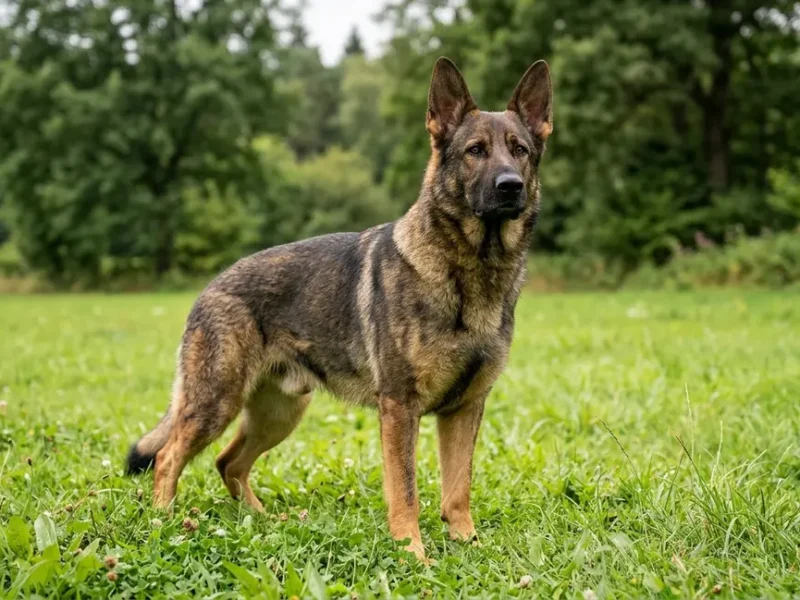
Your German Shepherd puppy greets every stranger with a wagging tail and zero suspicion. That’s not a flaw, it’s exactly where good german shepherd guard training starts. The real risk isn’t a friendly puppy; it’s skipping the foundational steps and ending up with a dog that’s reactive, unpredictable, or a legal liability.
In this guide, you’ll get a phase-by-phase german shepherd guard training plan, from basic obedience at month three to professional-only protection work at year one, so you build a reliable, controllable dog, not a dangerous one. We’ll cover what your dog needs to know first, the four training phases, alert barking, and when to hand off to a certified professional.
German shepherd guard training works in four age-based phases, and skipping any one of them creates an unpredictable or legally liable dog.
- Start with obedience, not guarding: Sit, down, stay, come, and heel must be reliable before any guard work begins (months 3-6).
- Socialize early: The critical window closes around 16 weeks, exposure to people, sounds, and environments during this period shapes whether your dog reacts from confidence or fear.
- Teach the off-switch first: A dog that can’t settle on cue isn’t ready for territorial work.
- Bite work is professional-only: DIY attack training creates liability and safety risks, full stop.
- Instincts emerge, but they need shaping: Most German Shepherds show protective behavior between 1-2 years old; training channels it safely through The Four-Phase Guard Readiness Path.
Will a German Shepherd Protect You Without Training?
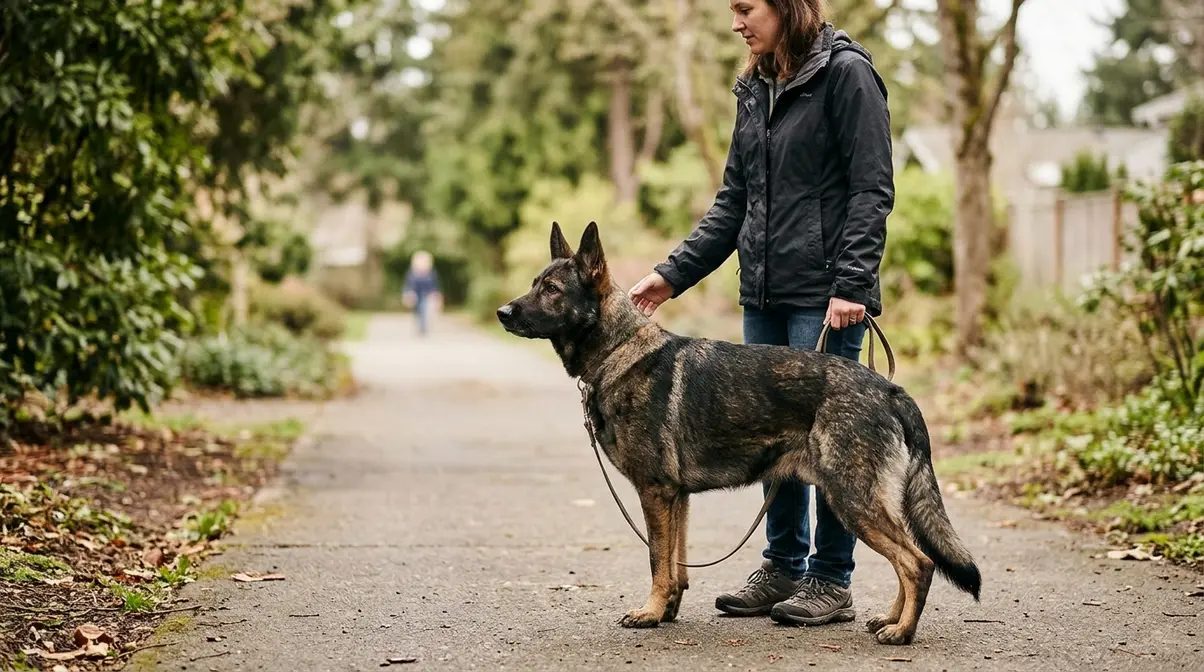
German Shepherds are naturally inclined to protect, but instinct alone isn’t reliable, and that’s exactly why german shepherd guard training starts with obedience, not territorial behavior. Protection instincts typically emerge between 1 and 2 years old (r/germanshepherds community consensus, 2024), and without proper socialization, that instinct becomes fear-based reactivity rather than genuine discernment. A dog that growls at every stranger isn’t assessing threats; it’s anxious.
The distinction matters more than most owners realize. A dog reacting from anxiety barks at the mail carrier, the neighbor’s kid, and the delivery driver with equal intensity. It’s not making a threat assessment, it’s overwhelmed. Real guarding is calm, controlled, and purposeful. The dog notices something unusual, alerts you, and then looks to you for direction.
“Most commenters agree that protection instincts come naturally to German Shepherds, often emerging between 1-2 years old, with socialization and structured training determining whether those instincts become an asset or a problem.”
, GSD owner community (r/germanshepherds, 2024)
This community consensus tracks with German Shepherd temperament and confidence, the AKC describes a confident, direct, and approachable dog, not an indiscriminately suspicious one. Breed genetics predict only part of individual behavior; early experience fills in the rest.
One more thing worth knowing: adolescent GSDs (roughly 6-24 months) often go through fear periods where previously neutral stimuli suddenly seem threatening. A dog in a fear period may appear reactive but isn’t ready for guard work. Pushing ahead during this stage reinforces anxiety, not protection instincts.
This is why The Four-Phase Guard Readiness Path maps each training milestone to a readiness test, so you only advance when your dog is genuinely ready. Before any territorial work begins, your dog has to pass a foundation test, and that starts with the basics.
What Your Dog Must Know Before Guard Training Begins
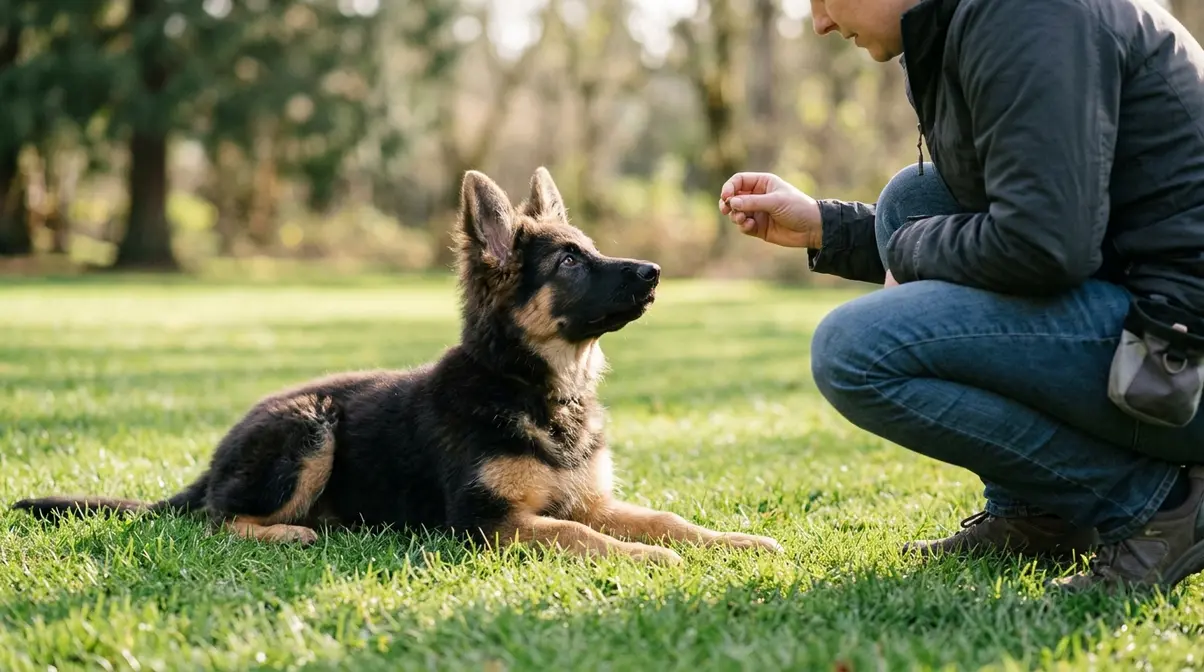
Foundation obedience is the non-negotiable entry point for all GSD protection training. A dog that can’t sit, stay, or come reliably under mild distraction isn’t ready for territorial training, and pushing ahead creates dangerous gaps that are much harder to close later.
As a general principle in professional dog training: “A German Shepherd that can’t hold a 30-second down-stay with a stranger present isn’t ready for guard training, impulse control comes before territorial work.” These commands are the entry ticket to Phase 1 of the Four-Phase Guard Readiness Path.
The Commands Your Dog Must Master First
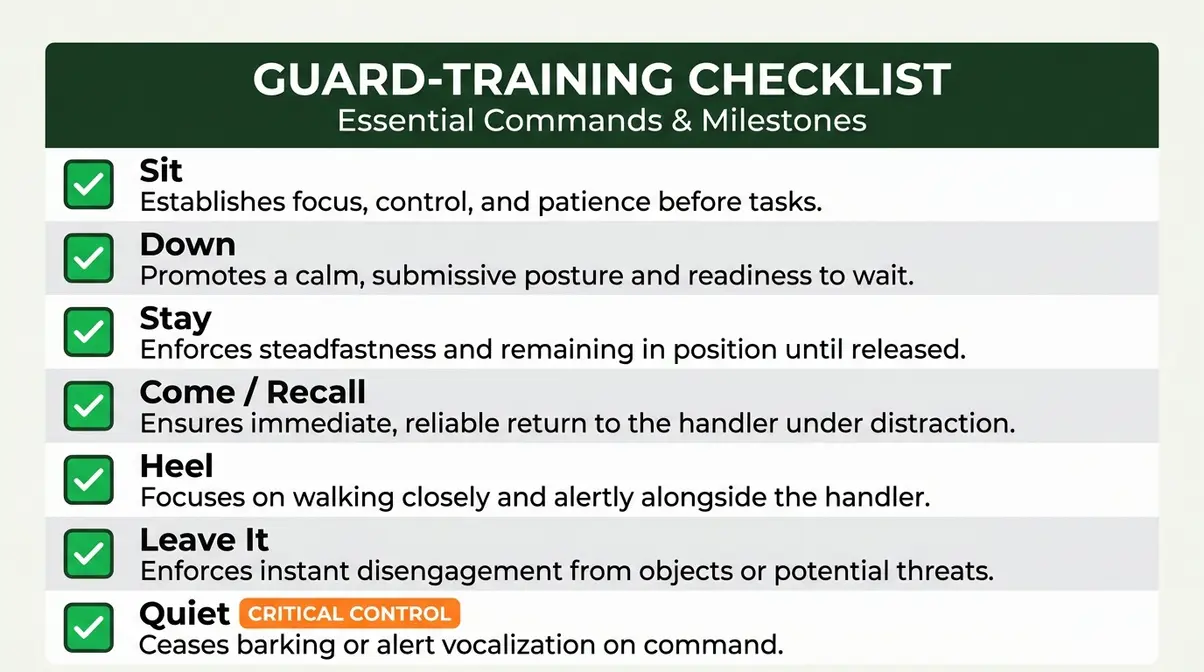
For german shepherd training for beginners, the six-command checklist below is the safest starting point before any guard-related work is introduced. German Shepherd puppy training typically begins at 8-10 weeks, but the prerequisite command set for guard work should be solid by month 6. A consistent german shepherd training schedule, two to three short sessions daily, is more effective than occasional long sessions for building reliable command responses. Here are the six commands your dog needs, and why each one matters specifically for guard scenarios:
- Sit: Creates an immediate pause behavior. A dog that sits on cue can be stopped mid-arousal before a situation escalates.
- Down: Lower arousal position. Useful for settling a dog that’s alert but not facing a genuine threat.
- Stay: Teaches the dog to hold position while you assess a situation. Critical for controlled boundary work.
- Come (recall): The foundation of “come away from the threat.” If your dog won’t recall under distraction, you have no off-switch in a real scenario.
- Heel: Keeps your dog controlled at your side when you approach a perceived threat, not lunging ahead or pulling back.
- Leave it: Core impulse control. A dog that can disengage from food, toys, or stimuli on cue has the self-regulation guard work requires.
For puppy training basics for sit, down and come, a 10-week-old puppy can start with sit and come right away; by month 6, all six commands should be solid. Best Mate Dog Training recommends 5-10 minute sessions, two to three times daily for puppies. Intermediate dogs can handle 15-minute sessions. Keep sessions short, positive, and end on a success.
The readiness test for this phase: Your dog performs sit, down, 30-second stay, come, and heel reliably with a stranger present at 10 feet, with no lunging or excessive barking. If your dog fails this test after 8 weeks of consistent work, return to a lower-distraction environment before adding any guard-related exercises.
One important note: adolescent dogs (6-24 months) may temporarily regress on commands during fear periods. Don’t interpret that regression as a sign to push harder, go back to basics in a calm environment until reliability returns.
Working Line vs. Show Line, Does It Matter for Guard Training?
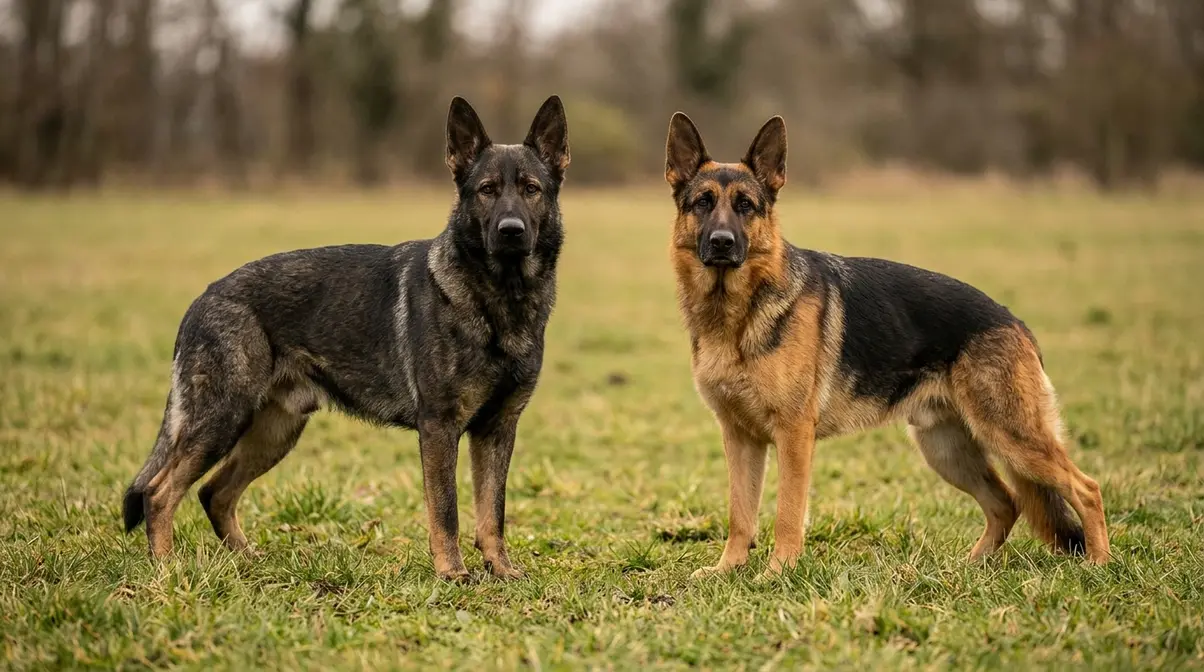
Yes, but not in the way most owners expect. The line your dog comes from affects the training timeline, not the training structure. Both lines follow the same four-phase plan; the pace just differs.
Working-line GSDs (Czech, DDR, West German working line) typically have higher defense drive and prey drive. They may show territorial behavior earlier, sometimes as young as 6 months, and respond faster to protection-sport training. Defense drive in working-line German Shepherds is worth understanding before you start, because a high-drive dog needs more structured outlets and more impulse control work early in the process. A Czech working-line dog that barks at the fence at 6 months isn’t showing guard potential, it needs impulse control work, not encouragement.
Show-line GSDs (West German show line, American show line) tend to be calmer and more family-oriented. They may seem completely indifferent to strangers until 18 months or later. That’s not a flaw, it’s a temperament difference. Show-line vs. working-line energy and drive makes clear that a show-line puppy happily greeting strangers at 6 months is exactly on track.
Neither line is a better guard dog. Both need the same four phases. The practical difference: working-line owners should prioritize impulse control from day one, while show-line owners shouldn’t interpret a friendly, confident puppy as a training failure.
Whichever line you have, the four-phase training plan is the same, the timeline just varies. Here’s how it works.
The Four-Phase German Shepherd Guard Training Plan
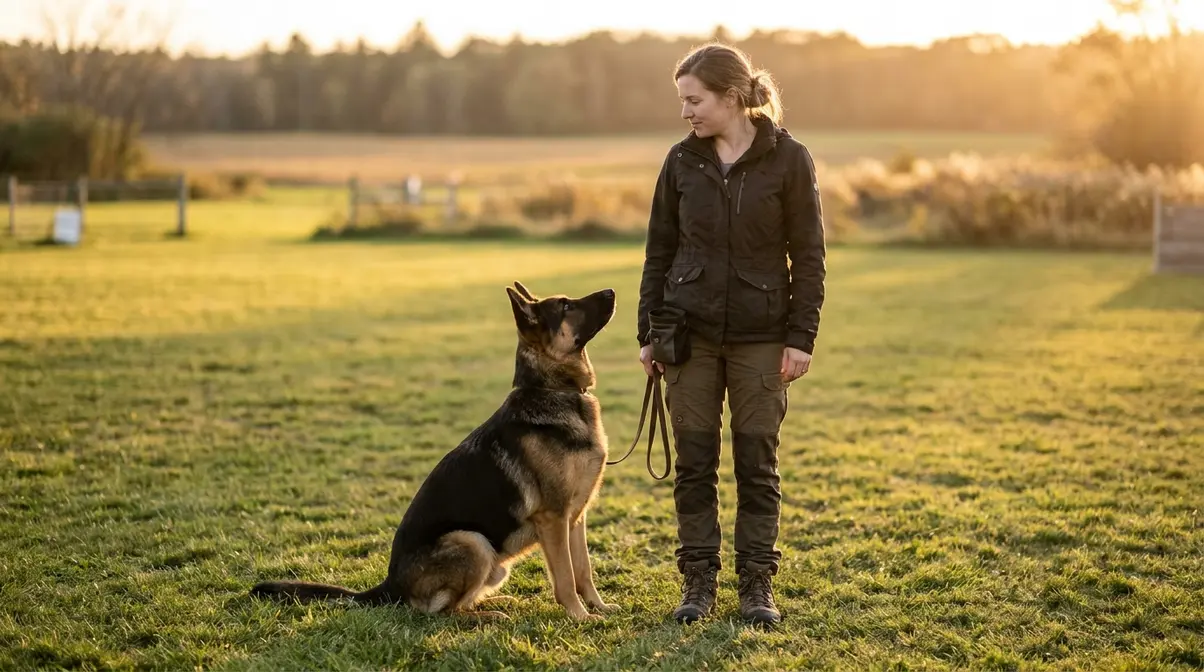
The Four-Phase Guard Readiness Path structures german shepherd guard training into four age-anchored stages. Whether you call it gsd protection training or guard readiness work, the four-phase structure is the same. Each phase has a clear goal, specific exercises, and a readiness test, your dog doesn’t advance until it passes. Rushing any phase doesn’t speed up the process; it creates the reactive, uncontrollable dog you were trying to avoid.
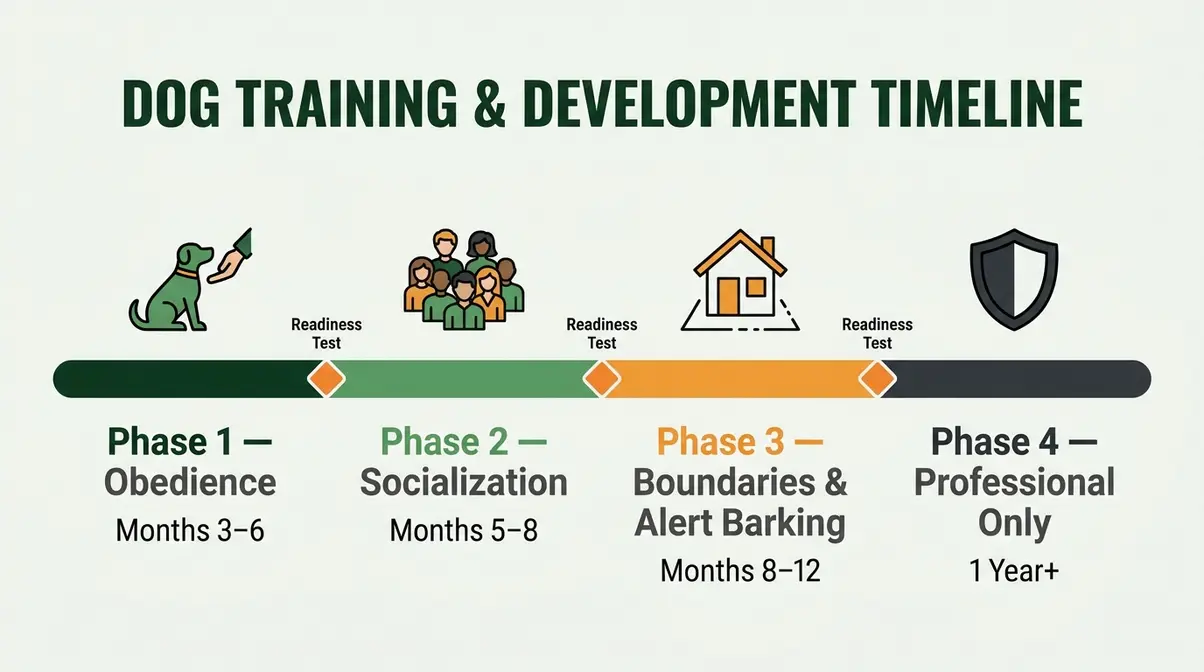
Phase 1, Foundation Obedience (Months 3-6)
Goal: Reliable response to all six prerequisite commands under mild distraction.
This is the phase most owners want to skip, and the one that determines whether everything else works. GSD protection training built on shaky obedience produces a dog that knows when to bite but not when to stop. That’s the exact outcome you’re trying to avoid.
Exercises:
- Sit/down/stay with duration, build from 10 seconds to 60 seconds with a stranger walking past at 10 feet. Reward the calm holding of position, not just the position itself. The dog should stay relaxed, not frozen with tension.
- Recall under distraction, call your dog away from a toy, food, or a mild environmental stimulus. This is the foundation of “come away from the threat” in real guard scenarios. Practice this daily.
- Loose-leash heel, your dog walks calmly at your side past strangers without pulling, lunging, or barking. This matters because a dog that drags you toward every stimulus has no controlled guarding behavior, just unmanaged arousal.
Session length: 5-10 minutes, two to three times daily. Puppies under 4 months have short attention spans, keep it under 5 minutes and use high-value treats like chicken or cheese rather than kibble. End every session on a success, even if that means reducing difficulty. Best Mate Dog Training recommends this short, positive-session structure specifically for German Shepherd foundation work.
Readiness test: Your dog performs sit, down, 30-second stay, come, and heel reliably with a stranger present at 10 feet, no lunging, no excessive barking.
Troubleshooting: If your dog fails the readiness test after 8 weeks, don’t add guard-related exercises. Go back to a lower-distraction environment and rebuild. Adding territorial pressure on an unstable foundation creates anxiety, not confidence.
Once your dog passes the Phase 1 readiness test, socialization becomes the priority, and the clock is ticking.
Phase 2, Socialization and Environmental Stability (Months 5-8)
Goal: A calm, confident dog that can tell normal from genuinely threatening, and that reacts from discernment, not fear.
Most owners rush to Phase 3 (territorial boundaries) without completing this one. A dog that hasn’t been properly socialized interprets every stranger as a threat. That’s not guarding, it’s generalized anxiety with teeth.
The AVSAB position statement on puppy socialization is clear: “The socialization window for puppies closes around 16 weeks, exposure to people, sounds, and environments during this period is the single most important factor in whether a German Shepherd guards from confidence or fear” (AVSAB, 2014). If your dog is already past this window, socialization is still possible, it just takes more time and patience.
Exercises:
- Controlled stranger introductions, invite people of different ages, appearances, and clothing (uniforms, hats, high-visibility vests) to approach calmly. Reward your dog for calm observation. Not barking. Not cowering. Just noticing and relaxing.
- Environmental exposure, parks, parking lots, hardware stores (where allowed), busy sidewalks. The goal isn’t to overwhelm the dog, it’s to build a dog that notices new things without reacting. Let your dog set the pace; dragging a frightened dog past scary things is flooding, not socialization.
- Sound desensitization, doorbells, car horns, crowd noise, construction sounds. Start at low volume and increase gradually. A dog that panics at a doorbell isn’t ready for territorial training.
Adolescent fear periods: Between 6 and 24 months, many GSDs go through phases where previously neutral stimuli suddenly seem threatening. Don’t push guard work during these periods. Go back to confidence-building: known environments, familiar people, predictable routines. The AVSAB guidance on preventive behavioral care recommends regular contact with friendly people and dogs throughout the first year of life to build lasting behavioral stability.
Session length: Daily exposure, 15-30 minutes. Life is the classroom during this phase, formal session structure matters less than consistent, positive new experiences.
Readiness test: Your dog approaches a stranger calmly on leash, holds a sit while the stranger pets it, and recovers from a sudden loud sound (a clap or car horn) within 10 seconds.
Troubleshooting: A dog that cowers, freezes, or shows fear-based reactivity needs more socialization time, and possibly a consultation with a certified behaviorist, before any territorial work begins. Pushing ahead makes the problem significantly worse.
A well-socialized dog that passes the Phase 2 test is ready to learn where its territory ends and a stranger’s space begins.
Phase 3, Territorial Boundaries and Alert Barking (Months 8-12)
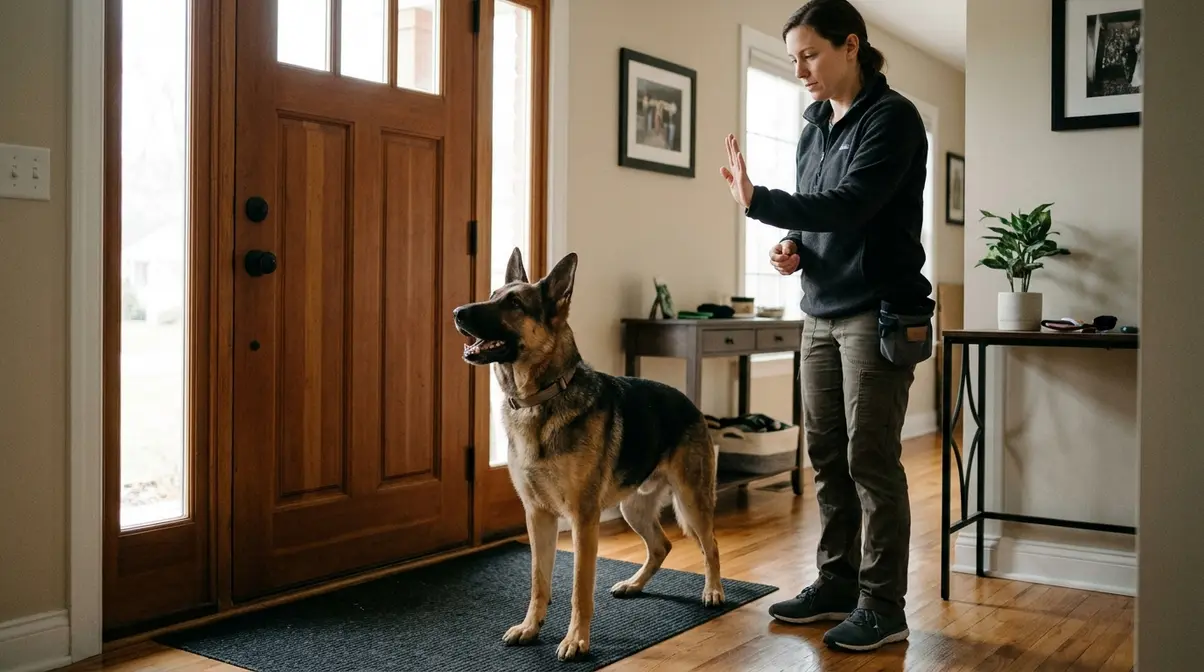
Goal: Your dog alerts (barks) when someone approaches the property boundary, stops on the “quiet” command, and does not lunge, fence-fight, or escalate.
This is where the off-switch becomes essential. A dog that alerts but won’t stop is a liability, not a guard dog. The quiet command and place/settle training are the two tools that make Phase 3 manageable. If they aren’t solid before you start this phase, go back.
Exercises:
- Staged boundary approach, have a helper approach the fence or door while you watch. When your dog barks, say “good alert” or use a marker word, then immediately give the “quiet” command. Reward silence, not barking. The goal is a dog that alerts you and then looks to you for direction.
- Delivery driver drill, practice with real low-stakes arrivals: mail, packages, food delivery. Your dog alerts once or twice, you acknowledge it (“good dog, quiet”), and the dog settles. Reward the settle. Never reward continuous barking.
- Place/settle as the off-switch, after any alert, send your dog to its place (a mat or bed) and reward calm staying. This is the behavioral off-switch that makes a guard dog manageable in everyday life.
Alert vs. aggression, know the difference:
| Behavior | Alert (Goal) | Aggression (Problem) |
|---|---|---|
| Trigger | Genuine boundary approach | Any movement, sound, or stranger |
| Bark pattern | 2-4 barks, then looks to owner | Continuous, escalating |
| Body language | Upright, ears forward, tail up | Hackles raised, lunging, snapping |
| Response to “quiet” | Stops within 3 seconds | Ignores command |
| Recovery | Settles on place cue | Remains aroused, paces |
Session length: 10-15 minutes for staged drills; real-world practice is ongoing.
Readiness test: Your dog alerts to a stranger at the boundary, stops barking within 3 seconds of the “quiet” command, and goes to place on cue.
Troubleshooting: If your dog won’t stop barking, the quiet command isn’t trained well enough. Return to the speak/quiet drill sequence in an earlier section before continuing territorial work. Don’t allow lunging or fence-fighting at any point, these behaviors reinforce reactivity, not controlled guarding.
Phase 3 is the limit of what most owners should do on their own. What comes next requires a certified professional.
Phase 4, Professional-Only Protection Work (1 Year+)
Goal: Understand what formal protection training involves, why it requires a certified professional, and what the regulated sport pathway looks like, not how to do it yourself.
IGP/Schutzhund (Internationaler Gebrauchshund Prüfungsordnung, formerly Schutzhund) is a three-phase protection sport: tracking, obedience, and protection. The protection phase uses a decoy, a trained helper in a bite suit, and is conducted under strict FCI/USCA rules. This is not a backyard exercise. It requires a trained club, a certified decoy, and a dog that has passed the entry-level BH (Begleithund) temperament test, which assesses whether a dog is stable enough to begin bite work at all. A dog that fails the BH test isn’t ready.
Decoy work is performed by trained helpers who know how to read a dog’s drive signals and stress responses in real time. An untrained person acting as a decoy, even wearing a sleeve, is a serious safety risk for everyone involved.
There’s also the personal protection dog (PPD) route, for owners who want a dog trained for real-world protection rather than sport competition. PPD training requires even more rigorous professional oversight than IGP and is not appropriate for most pet owners.
Professional training bodies widely advise that teaching a dog to bite to protect territory creates unnecessary legal liability, consult a certified trainer before pursuing any bite-work program. For a grounded overview of what professional protection training actually requires, and why DIY bite work is dangerous, German Shepherd protection training outlines the key distinctions clearly.
If Phase 4 is where you want to go, the next section tells you how to find the right professional, and what to watch out for.
How to Teach Alert Barking and the Quiet Command
Alert barking is a trainable, controllable behavior, not a natural on/off switch you either have or don’t. The quiet command and place/settle training are the two tools that give you real control over when and how long your dog alerts. As a general principle in professional dog training, a dog that barks with purpose and silences on cue is a reliable guard dog; one that barks continuously and ignores commands is a liability.
The quiet command is also the Phase 3 readiness test. If your dog can’t pass it, don’t advance.
Teaching “Speak” and “Quiet” on Cue
Most owners try to teach “quiet” by yelling at a barking dog, which the dog interprets as the owner joining in. The quiet command must be trained proactively, not reactively. That means teaching “speak” first.
The staged door-knock drill:
- Have a helper knock on the door or ring the doorbell.
- When your dog barks, say “speak” (or “alert”) and mark the behavior with a verbal “yes” or a clicker.
- After 2-3 barks, say “quiet” firmly.
- Wait for even 1 second of silence, then mark and reward immediately.
- Repeat 5-10 times per session.
Why “speak” comes first: You can’t teach “quiet” until the dog is barking on purpose. Capturing the bark on cue gives you control over when it starts, which makes stopping it much easier. You’re not suppressing a behavior; you’re putting it under stimulus control.
Common mistake: Rewarding the dog while it’s still barking. The reward must come after silence, not during barking. If you’re clicking or treating while the dog is mid-bark, you’re reinforcing the bark, not the quiet.
After 2-3 weeks of daily 10-minute sessions, most dogs will alert on the “speak” cue and stop within 2-3 seconds of “quiet.” For a visual demonstration of this sequence, the (https://www.youtube.com/watch?v=d2a3GcVFam0&t=28) shows the technique applied to a German Shepherd, treat it as experiential context and pair it with the professional guidance in this article.
Never allow lunging at the door, fence-fighting with passersby, or continuous barking at delivery drivers. These behaviors reinforce reactivity, not controlled guarding.
The quiet command stops the bark, but the off-switch keeps the dog calm after the threat has passed.
The Off-Switch, Place and Settle Training
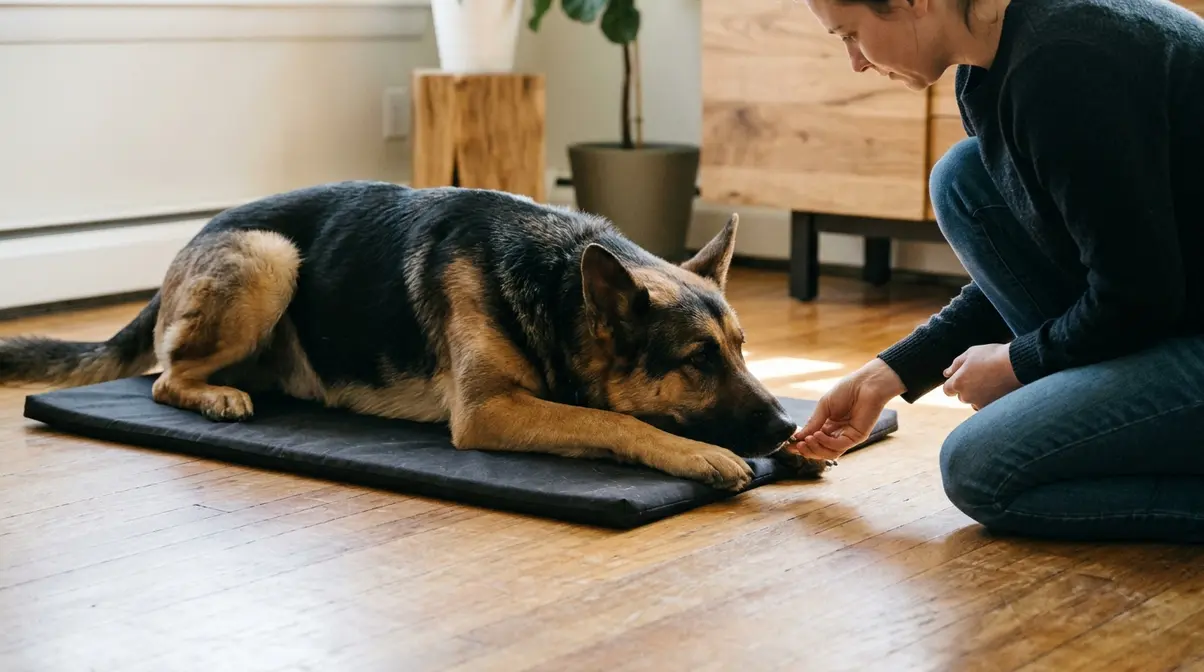
Place means your dog goes to a specific mat or bed and stays there calmly until released. After an alert, you send the dog to place, and it settles. That’s the off-switch. Without it, a dog that alerts well but can’t settle afterward is exhausting to live with and difficult to trust. For more on teaching a German Shepherd to settle on cue, the process is simpler than most owners expect.
How to build the place command:
- Start with your dog on the mat for 30 seconds, rewarding calm behavior.
- Gradually extend duration, 1 minute, then 2, then 5.
- Once your dog can hold place for 2 minutes with no distractions, add a doorbell or knock.
- Reward the dog for staying on place through the distraction, then release.
The mental work angle: A dog with a reliable place command has better impulse control overall. Mental work, training sessions, puzzle feeders, scent games, reduces over-arousal and builds the calm that guard work requires. For high-drive dogs especially, a 15-minute training session does more to reduce reactivity than a 30-minute run. Physical exercise burns energy; mental work teaches the dog to regulate itself.
After a delivery driver leaves, say “place” and reward your dog for going to its mat and staying there for 60 seconds. This replaces lingering arousal with a calm, rewarded behavior, and that’s exactly what a reliable guard dog does between alerts.
Alert barking and the quiet command are the ceiling of what most owners should train on their own. Here’s how to know when you’ve reached that ceiling, and what to do next.
When to Hand Off to a Professional (and What It Costs)
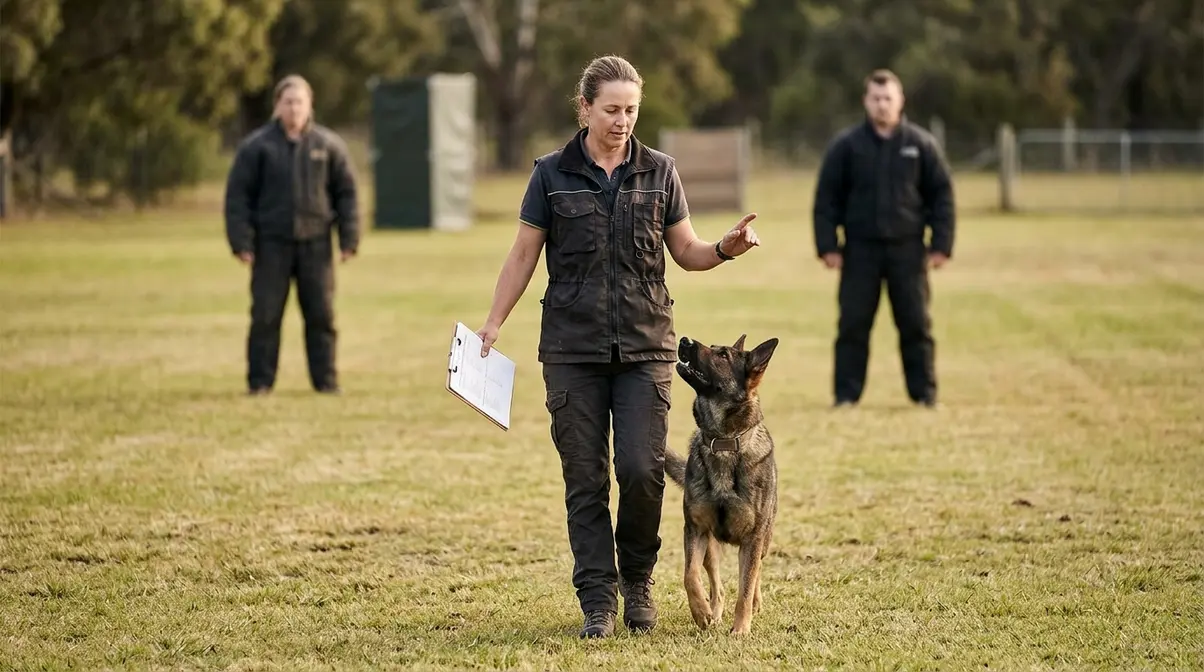
Formal protection work, bite work, sleeve work, decoy work, belongs with a certified professional. This isn’t a matter of skill level; it’s a matter of safety and legal liability. Phase 4 of the Four-Phase Guard Readiness Path begins the moment you contact a certified professional.
What Professional Protection Training Actually Involves
The IGP/Schutzhund club route is the safest, most structured path to formal protection work. Your dog competes in a regulated sport with a trained decoy under FCI/USCA rules. The BH temperament test is the entry point, without passing it, the dog doesn’t begin bite work. The BH evaluates whether a dog is stable enough to handle the pressure of protection training without tipping into generalized anxiety or aggression.
The personal protection dog (PPD) route is for owners who want a dog trained for real-world scenarios rather than sport. It requires even more rigorous professional oversight and is not appropriate for most pet owners. If you’re considering this route, expect a longer program, a more intensive evaluation process, and a higher cost.
⚠️ Safety and Liability Notice: Bite work, sleeve work, and attack-style training must only be conducted by a certified professional trainer or within a regulated IGP/Schutzhund club. Attempting these techniques at home, including encouraging your dog to bite sleeves, snap at hands, or play aggressive tug-of-war, can create generalized aggression, fear-based reactivity, and serious legal liability. Local dog-bite laws vary; consult a legal professional if you’re unsure of your liability as a protection-dog owner.
Professional training bodies widely advise that teaching a dog to bite to protect territory creates unnecessary legal liability, consult a certified trainer before pursuing any bite-work program. For a detailed overview of what professional training requires, German Shepherd protection training covers the key distinctions between sport IGP, PPD work, and the risks of DIY bite training.
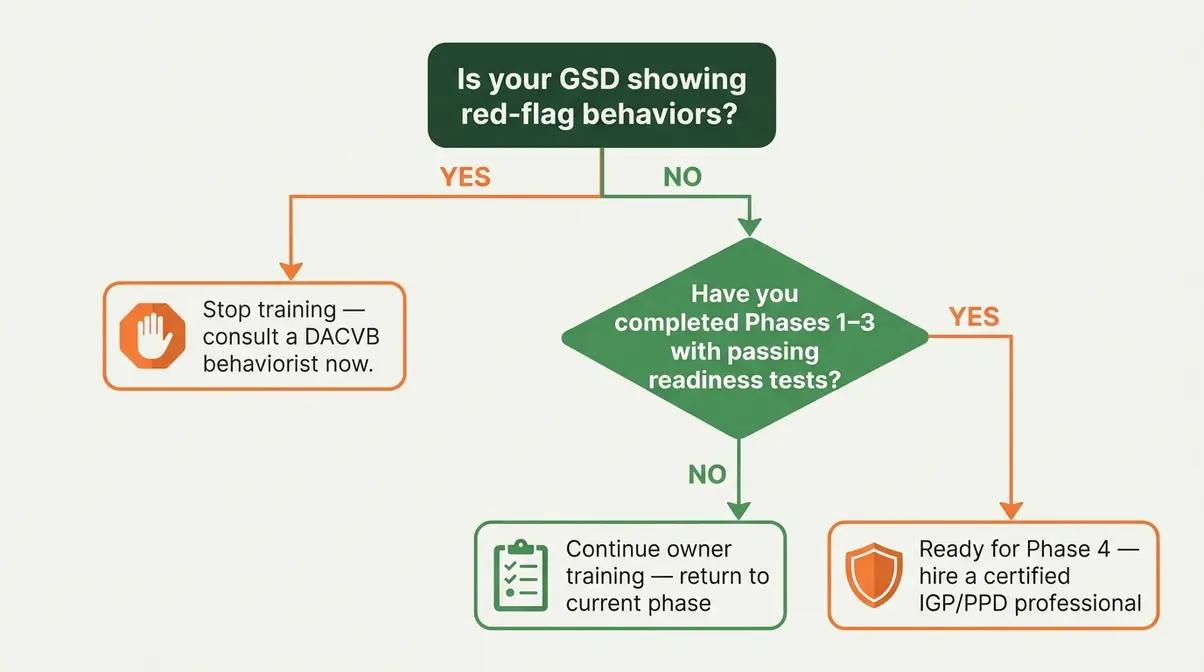
Once you’ve decided to work with a professional, here’s how to find the right one, and what to watch out for.
How to Vet a Trainer and What to Expect to Pay
“Certified” in dog training has no legal definition, anyone can call themselves a trainer. The certification bodies that matter are:
- CCPDT (Certification Council for Professional Dog Trainers), requires demonstrated knowledge and adherence to humane training standards
- IAABC (International Association of Animal Behavior Consultants), focuses on behavior modification and ethical practice
- AVSAB member trainers, aligned with the American Veterinary Society of Animal Behavior’s position on humane methods
Use the CCPDT trainer directory to find a certified professional near you. When searching for german shepherd guard dog training near me, prioritize certification and methodology over proximity, a reputable IGP club 45 minutes away is a better choice than an uncertified trainer down the street. The related search for best german shepherd training near me often surfaces service pages; always verify credentials before committing.
Questions to ask before hiring:
- What certifications do you hold, and from which body?
- Can I observe a training session with another dog before committing?
- What methods do you use, and do you use punishment or aversives on dogs showing fear?
- Do you have experience with IGP/Schutzhund or personal protection training specifically?
- Can you provide references from clients with German Shepherds?
Red flags: No certification; refusal to let you observe a session; use of shock collars or harsh corrections on young or fearful dogs; promises of a “fully trained guard dog” in a matter of weeks.
German shepherd protection training cost varies widely by region, trainer experience, and program type. Board-and-train programs, group classes, and private sessions carry very different price points, ask for a detailed breakdown before committing to any program. Do not choose based on price alone; methodology and certification matter far more.
Even with a great trainer, there are situations where you should stop all guard training immediately and seek professional help.
Safety, Liability, and Red Flags to Watch For
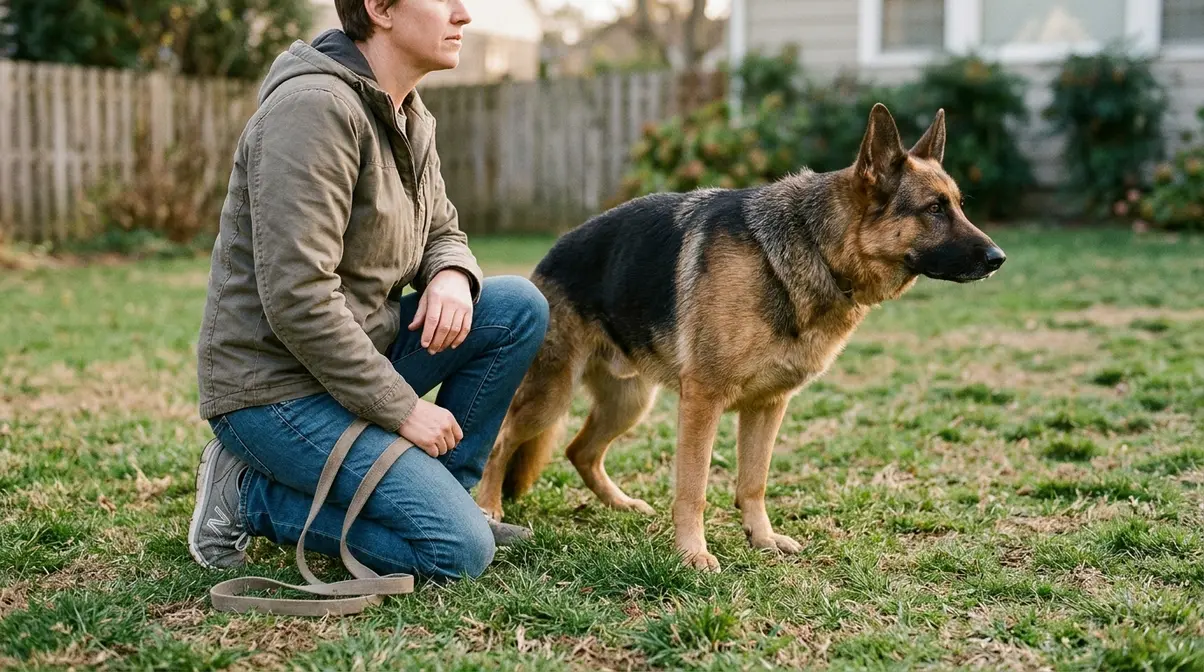
German shepherd training protection carries real legal weight. Owning a dog trained for protection isn’t the same as owning a pet dog under the law, and the distinction matters before you begin Phase 3 or Phase 4.
Legal Liability and Local Dog-Bite Laws
In most jurisdictions, owning a dog trained for protection increases the owner’s legal liability if the dog bites, even in a scenario where the bite was arguably protective. Local ordinances vary significantly: some areas restrict certain breeds, require special permits for trained protection dogs, or hold owners to a higher standard of care once a dog has completed protection training.
This is not legal advice. Before beginning formal protection training, check your local animal control rules and consult a local attorney about your specific liability exposure. What applies in one county may not apply in the next.
Beyond the legal side, there are behavioral red flags that mean you should stop training immediately.
Red Flags That Mean Stop and Seek Help
These behaviors indicate a dog that needs professional behavioral intervention, not more guard training. Pushing through them makes the underlying problem worse.
- Unprovoked growling or snapping at family members or known visitors
- Inability to recover from a fear stimulus within 30 seconds (prolonged freeze, trembling, or panic)
- Resource guarding that escalates to biting
- Aggression toward other dogs that the owner can’t interrupt with a verbal cue
- Any bite that breaks skin, stop all guard training and consult a veterinary behaviorist (DACVB) immediately
The AVSAB guidance on behavioral care recommends professional intervention for dogs showing fear-based or aggressive behaviors that don’t resolve with standard training. If you encounter any of these red flags, look for a diplomate of the American College of Veterinary Behaviorists (DACVB) or use the IAABC directory to find a qualified behavior consultant.
Here are the questions owners ask most often about german shepherd guard training.
Frequently Asked Questions
At what age should I start guard training my German Shepherd?
Start with basic obedience, not guard work. Sit, down, stay, come, and heel are typically taught from months 3-6, with socialization running through months 5-8 and territorial boundary work beginning around months 8-12. The socialization window closes around 16 weeks, so early exposure to people and environments is critical. Advanced protection work starts at 1 year or later, with a certified professional only.
Can I teach my German Shepherd to guard without making it aggressive?
Yes, guard training relies on obedience, clear boundaries, and structured socialization, not on teaching aggression. Early exposure to different people, sounds, and environments helps your dog tell normal situations from genuine threats. A dog that pulls, jumps on strangers, or ignores recall isn’t ready for protective duties. Control and impulse management come before any territorial work, and a reliable “quiet” command is non-negotiable.
How do I teach my German Shepherd to bark on alert and stop on command?
Pair a command word, “speak” or “alert”, with a staged trigger like a knock at the door, and reward the dog when it barks. Immediately follow with a firm “quiet” command, and reward the first moment of silence. Repeat in 10-minute sessions until the dog stops within 3 seconds of the cue. Never allow lunging or fence-fighting, alert barking should be purposeful and brief.
Should I try bite work or attack training myself?
No, DIY bite work is dangerous and potentially illegal. Encouraging a young dog to bite sleeves, snap at hands, or play aggressive tug-of-war can create fear-based reactivity, generalized aggression, and serious legal liability. Professional training bodies widely advise that teaching a dog to bite to protect territory creates unnecessary legal liability. For formal protection work such as Schutzhund/IGP, work only with a certified, reputable professional trainer.
Will a German Shepherd protect me without training?
German Shepherds are naturally inclined to protect, and protection instincts typically emerge between 1 and 2 years old. But instinct alone isn’t reliable guarding. Without socialization, a dog may react from fear or generalized suspicion rather than real discernment, barking at everyone rather than assessing actual threats. Obedience, socialization, and impulse control are needed to make protective behavior safe, controlled, and genuinely useful.
Key Golden Rules for German Shepherd Guard Training
For German Shepherd owners, guard training works best as a four-phase process, obedience first, socialization second, territorial boundaries third, and professional-only protection work last. The socialization window closes around 16 weeks (AVSAB, 2014), making early exposure the single most important factor in whether your dog guards from confidence or fear. Every phase has a readiness test, and your dog doesn’t advance until it passes.
The Four-Phase Guard Readiness Path exists because skipping phases doesn’t speed up the process, it creates the reactive, uncontrollable dog you were trying to avoid. If your puppy greets strangers happily at 6 months, that’s not a problem to fix; it’s the foundation you’re building on. Control before drive, always.
Here are the eight golden rules that keep german shepherd guard training safe, structured, and effective:
- Start obedience at month 3, not guarding. Sit, down, stay, come, and heel come first, every time.
- Socialize before the 16-week window closes. Exposure during this period determines whether your dog guards from confidence or fear.
- Master all six commands before territorial work. If the foundation isn’t solid, don’t advance.
- Teach “quiet” before you teach “speak.” You need the off-switch before you open the tap.
- Use place/settle as the behavioral off-switch. A dog that can’t settle after an alert is a liability, not an asset.
- Never push guard work during a fear period. Adolescent GSDs (6-24 months) need confidence-building, not territorial pressure.
- Stop immediately if any red-flag behavior appears. Unprovoked aggression, resource guarding that escalates, or any bite that breaks skin means stop and consult a DACVB.
- Never attempt DIY bite work, certified professionals only. This is the line between a reliable guard dog and a legal liability.
Start with Phase 1 this week: pick one command, run three 5-minute sessions, and check whether your dog passes the readiness test before moving on. Our guides on working-line German Shepherds and show-line dogs can help you set realistic expectations for your specific dog’s timeline.
 German Shepherd History: Origin, Evolution & Legacy