Ask five German Shepherd owners how many coat types their breed has and you’ll get three different answers. Kennel clubs say two. Breeders say two or three. Owner forums say anywhere from two to five, depending on whether you’re counting colors as coat types, which, it turns out, most people are.
If you’ve searched “german shepherd coat types” and come away more confused than when you started, that’s not your fault. The top results mix coat length, coat color and coat pattern into one jumbled list, and none of them explain why the sources disagree. You’ve probably seen terms like “stock coat,” “plush,” “long coat” and “fluffy” used interchangeably, and you still can’t tell which one your dog has.
By the end of this guide, you’ll know exactly which coat your German Shepherd has, why sources disagree on the number of types, and how coat type differs from coat color. We’ll cover the official kennel club definitions, the plush coat debate, how to tell the three types apart at a glance, and how to spot a mislabeled dog when you’re buying.
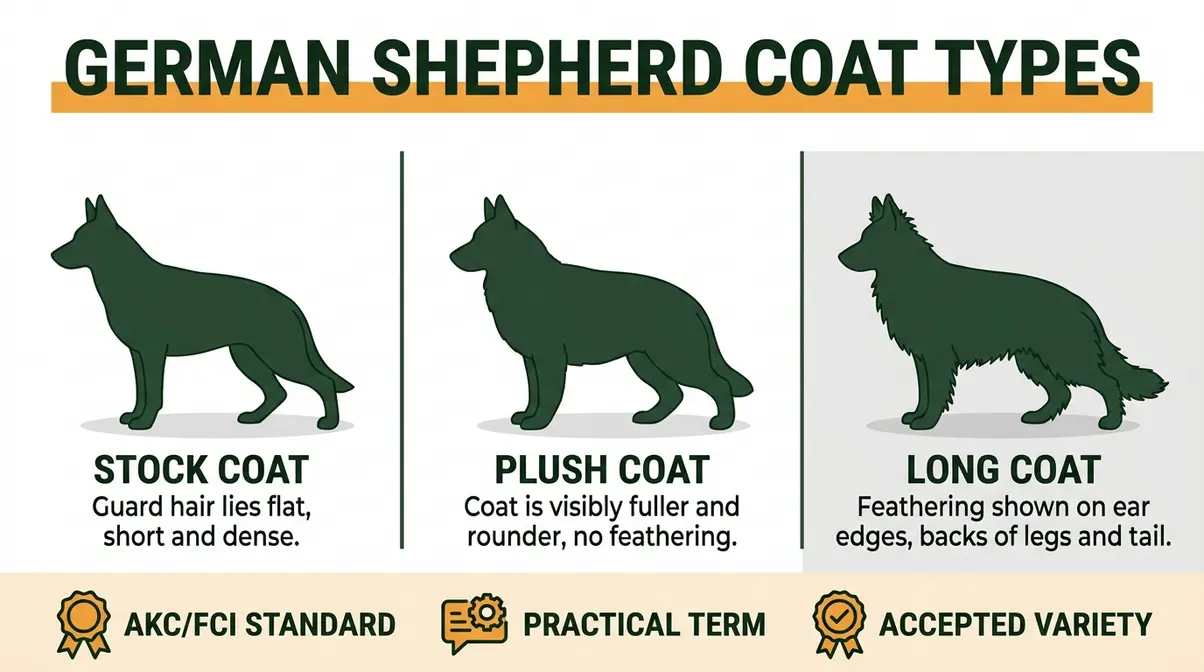
German Shepherd coat types come down to two officially recognized categories, stock (short, dense) and long, though many breeders and owners also recognize a plush coat as a practical middle ground.
- Stock coat: dense, medium-length guard hair that lies flat against the body; the breed standard for working and police lines
- Long coat: longer, softer hair with feathering on the ears, legs and tail; produced by a recessive gene widely reported in GSD breeding communities
- Plush coat: fuller and denser than a stock coat but without the feathering of a long coat; not an AKC or FCI-recognized separate type
- Key distinction: coat type (length and texture) is entirely separate from coat color (black and tan, sable) and coat pattern (saddle, bi-color), mixing these three things up is the most common source of confusion
What Are the German Shepherd Coat Types?
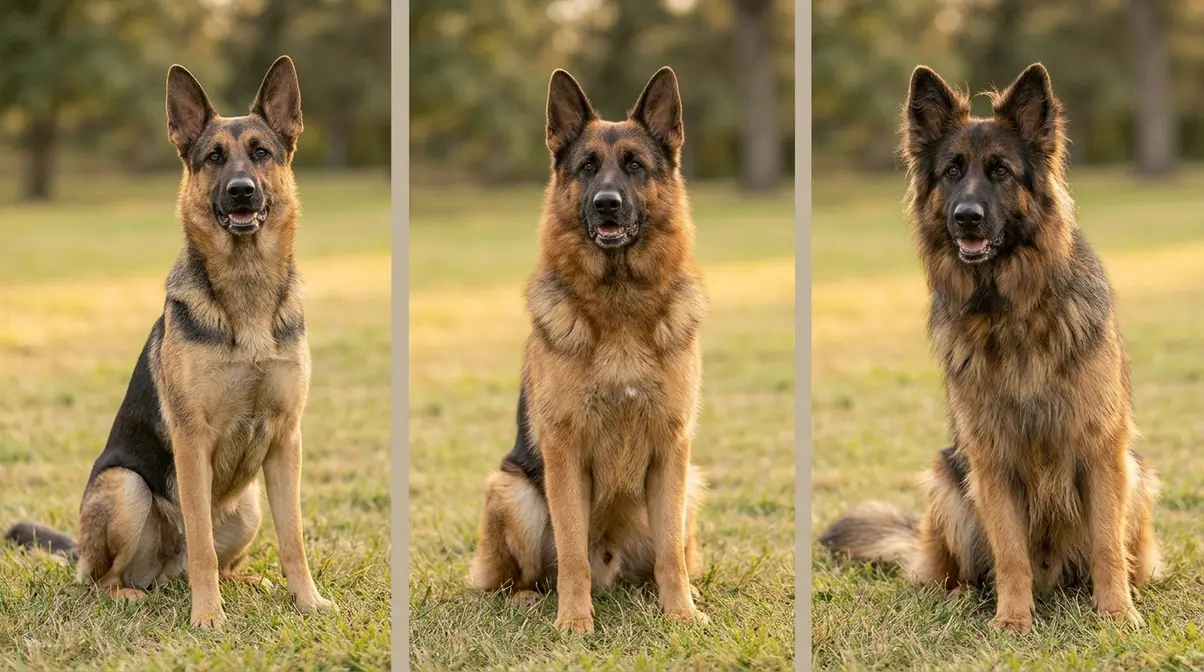
German Shepherds have two coat types recognized by major kennel clubs: the stock coat (short, dense, lying flat against the body) and the long coat (longer, softer, with feathering on the ears, legs and tail). Many breeders and owners also recognize a plush coat as a middle ground, fuller and denser than a stock coat but without the flowing feathering of a long coat. The plush isn’t classified as a separate type by the AKC or FCI, but you’ll encounter the term constantly in GSD communities. Coat type refers to length and texture only, not color or pattern.
For a breed-wide overview of German Shepherd coat lengths and colors, the PetVR breed facts page covers the full picture.
What Does “Coat Type” Actually Mean?
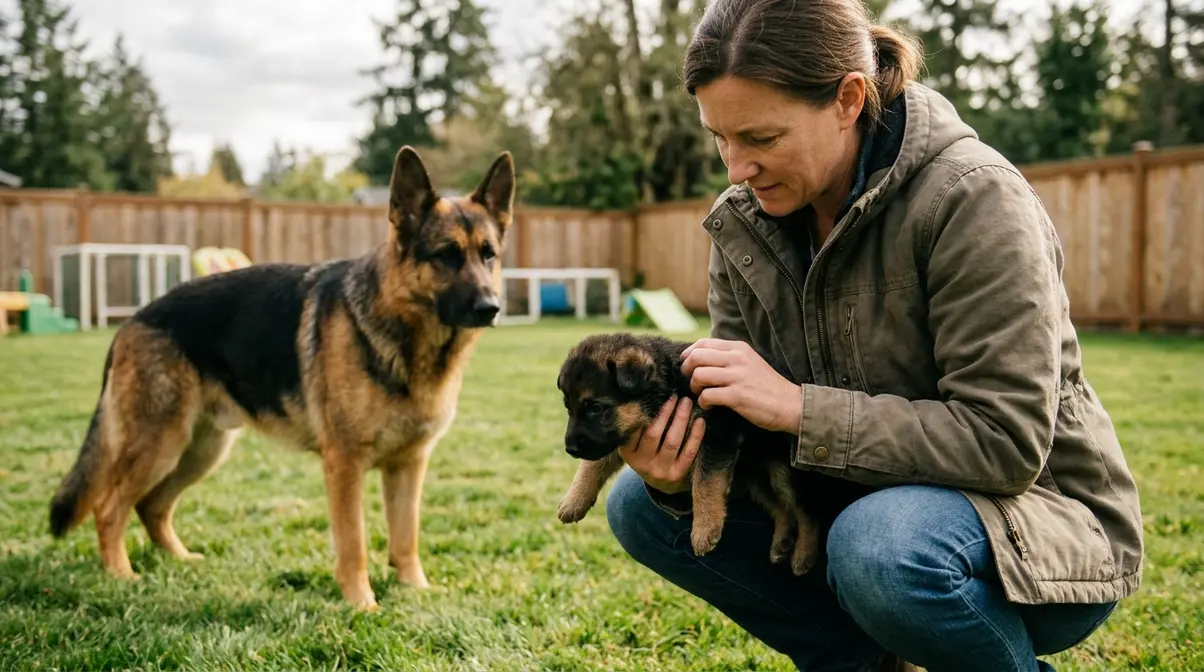
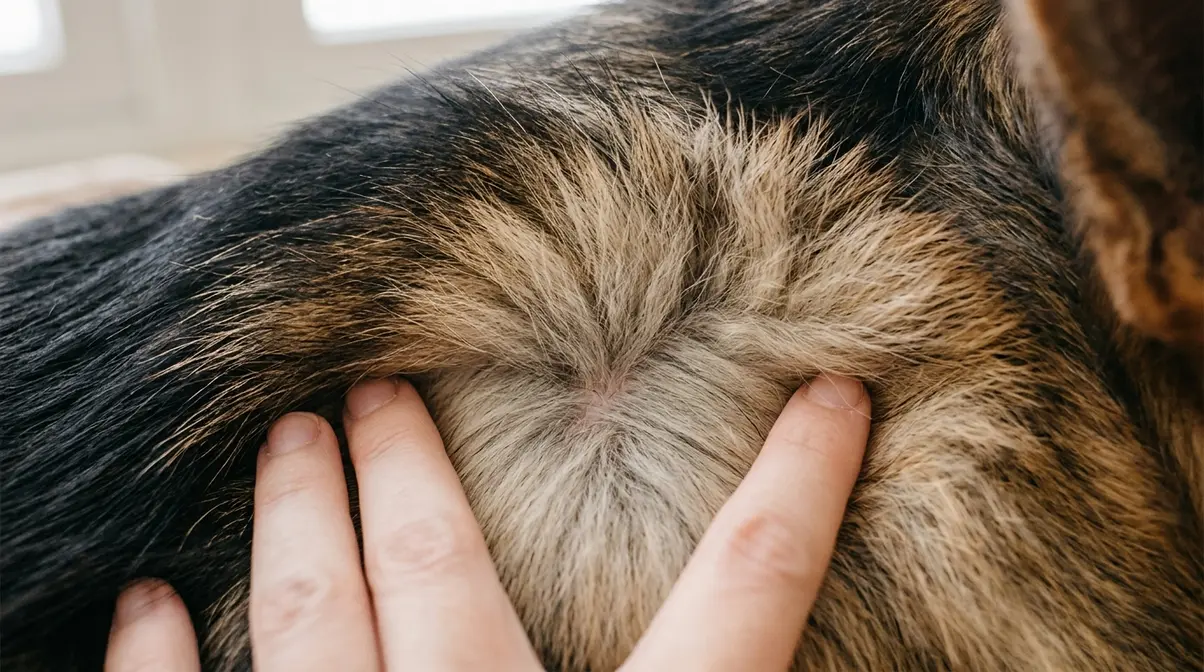
Every German Shepherd, regardless of coat type, has a double coat: an outer layer of guard hair and a dense, insulating undercoat beneath it. The guard hair handles weather, it sheds water, resists debris and protects the dog from cold and heat. The undercoat traps warm air close to the skin and sheds heavily twice a year.
Coat type describes the length and texture of that outer guard hair only. It has nothing to do with color or pattern, those are separate traits entirely. A stock coat GSD and a long coat GSD can be identical in color; only the guard hair length differs.
One more term you’ll need: feathering. Feathering is the longer, softer hair that grows on the ears, backs of legs, tail and belly of long-coat GSDs. It’s the single most visible difference between a long coat and a stock coat, and its absence is what separates a plush coat from a long coat.
The AKC breed standard defines the ideal GSD outer coat as dense, straight, harsh and lying close to the body, soft, silky, too long, woolly, curly and open coats are listed as faults.
This distinction matters from the moment you look at a litter. One owner described it exactly:
“Wondering what coat type this would be. Its not fluffy like his brothers, it lays flat.”
That “lays flat” observation is the most reliable cue for a stock coat. The guard hair lies close to the body with no lift or fluff. If a puppy’s coat stands away from the body or looks fuller than its littermates, you’re likely looking at a plush or long coat, and feathering on the ears will tell you which.
Some dogs sold as German Shepherds have only a single coat layer, no undercoat at all. This is a breed-purity red flag and worth keeping in mind as you read through the identification section below.
With the double-coat structure clear, you can now see why the length and texture of that outer guard hair is what separates one coat type from another.
The Two Official Coat Types (What Kennel Clubs Say)
The FCI breed standard recognizes exactly two German Shepherd coat varieties: the double coat (stock) and the long double coat, both requiring an undercoat (FCI Standard N°166). The UKC breed standard describes the same two types, the double coat and the long and harsh outer coat. The AKC’s position has been a source of some confusion; the current AKC breed standard describes the stock coat as the ideal and historically listed the long coat as a fault, though the AKC breed profile page acknowledges both coat lengths exist in the breed.
The table below shows how the three major kennel clubs treat GSD coat types:
| Kennel Club | Coat Types Recognized | Standard Coat Description | Long Coat Description | Long Coat Status |
|---|---|---|---|---|
| AKC | Two (stock and long) | Dense, straight, harsh guard hair lying close to body; thick undercoat | Longer, softer guard hair; feathering on ears, legs, tail | Historically a fault; verify current AKC page for updated position |
| FCI | Two (double coat and long double coat) | Outer coat dense, straight, harsh, lying flat; undercoat required | Longer outer coat, soft, with feathering; undercoat required | Accepted variety (FCI Standard N°166) |
| UKC | Two (double coat and long harsh outer coat) | Outer coat lies close, dense, straight; short, dense undercoat | Long, harsh outer coat; short, dense, fine-textured undercoat | Accepted variety |
The stock coat (also called the standard coat or short coat GSD) is the most common coat type in working and police lines. The guard hair is medium-length, dense and straight, lying close to the body over a thick, weather-resistant undercoat. A working-line GSD in a police K9 unit almost always has a stock coat, the dense, flat guard hair sheds water and resists debris better than a long coat.
The long coat has longer, softer guard hair, often slightly wavy, with visible feathering on the ears, legs, tail and belly. The long-coat trait is widely reported in GSD breeding communities to come from a recessive gene, meaning both parents must carry the gene for a long-coat puppy to appear, though this claim should be verified against current AKC, FCI or UKC documentation before treating it as settled fact.
So kennel clubs agree on two types. But spend any time in GSD owner communities and you’ll hear a third term: the plush coat.
Where Does the Plush Coat Fit?
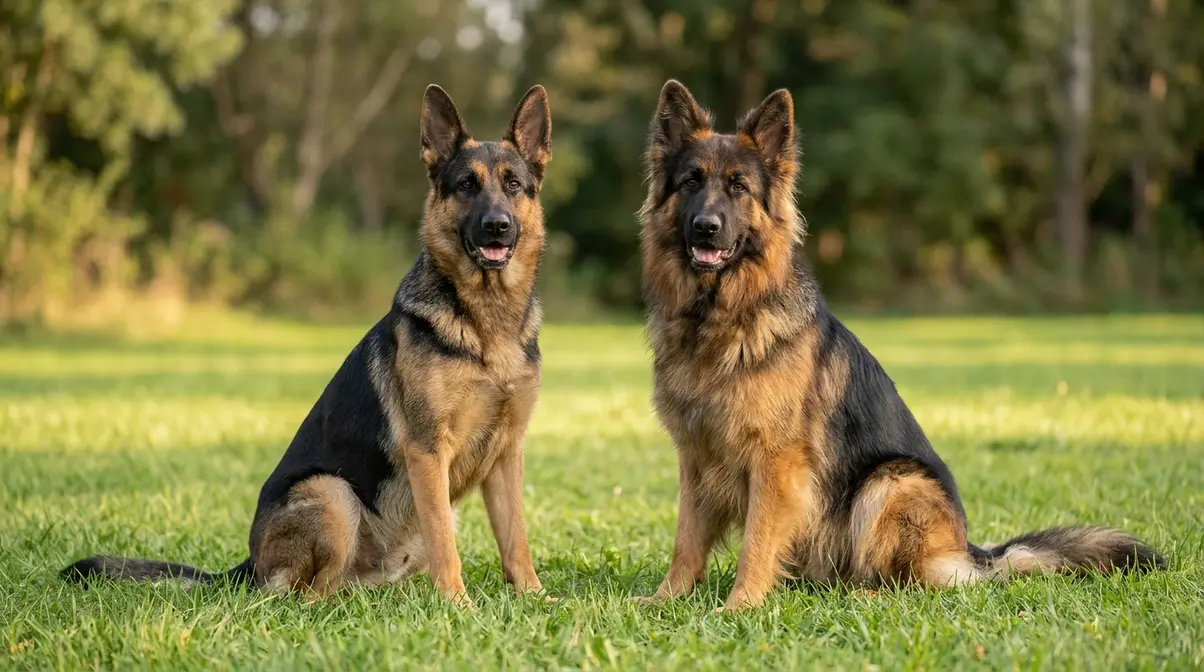
The plush coat sits between stock and long in terms of guard hair length. The coat looks fuller and denser than a typical stock coat, which is why owners describe it as “fluffy”, but it doesn’t have the flowing feathering on the ears and legs that defines a long coat. In formal breed standards, the plush coat falls within the stock coat category. The AKC and FCI don’t classify it as a separate type. In practice, though, many breeders and owners use the term to describe dogs that look noticeably fuller than a working-line stock coat without crossing into long-coat territory.
Neither position is wrong. They’re simply using different classification systems, one formal, one practical.
Three visible cues for identifying a plush coat:
- Guard hair length: noticeably longer and fuller than a stock coat, but no flowing feathering on the ears or backs of the legs
- Texture: softer than a stock coat to the touch; the coat stands slightly away from the body rather than lying flat
- Tail: often bushier than a stock coat’s tail, but the ear edges remain smooth (unlike a long coat’s fringed ears)
If your GSD’s coat looks fuller than a police dog’s but doesn’t have the flowing feathering of a show dog, you’re probably looking at a plush coat. Many show-line GSDs from American and Canadian lines have this fuller appearance, breeders sometimes call it a “medium coat german shepherd.”
Now that you know the three terms you’ll encounter, stock, plush and long, the next section shows exactly how to tell them apart by sight.
Coat Type vs Coat Color: Why the Confusion?
Here’s the clearest way to hold the distinction in your head. Coat type describes the length and texture of the guard hair: stock, plush or long. Coat color describes the pigmentation: black and tan, sable, solid black, solid white. Coat pattern describes how that color is distributed across the body: saddle, bi-color, blanket. These are three separate things, and mixing them up is the most common source of confusion when reading about german shepherd coat types and colors.
A sable GSD can have a stock coat or a long coat. A black-and-tan German Shepherd with a stock coat and a black-and-tan German Shepherd with a long coat are the same color, but very different coat types. The color doesn’t change; only the guard hair length does.
The confusion is understandable. Most breed pages mix coat type and color in the same section, and search results for “german shepherd coat types” frequently return color guides. This article separates them deliberately: type in H2-1 and H2-2, color and pattern in H2-3.
For now, focus on length and texture. Coat colors and patterns are covered in their own section below.
With that distinction clear, let’s look at how to tell a stock coat from a plush or long coat in practice.
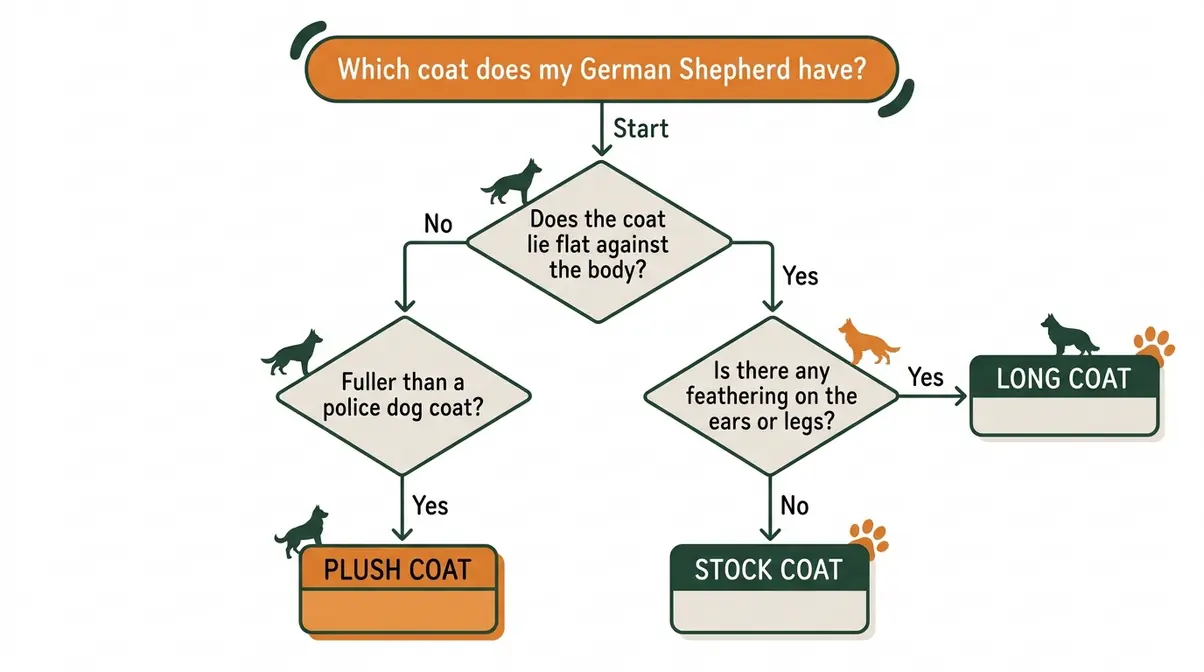
Stock, Plush and Long Coat: What’s the Difference?
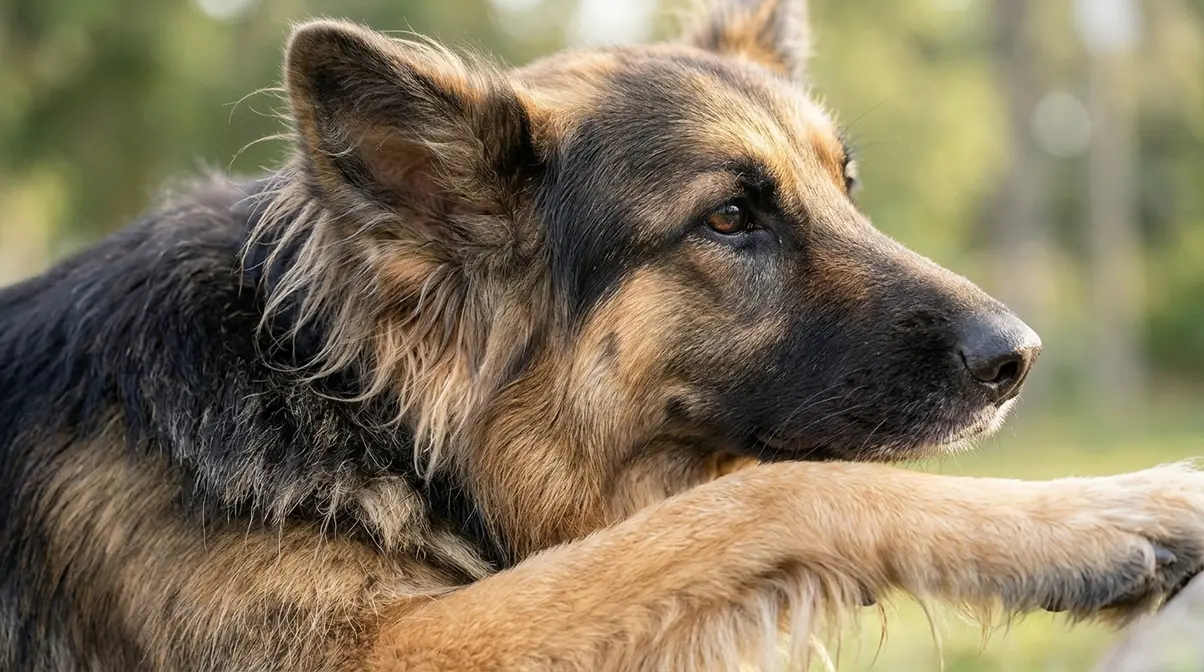
A stock coat has dense, medium-length, straight guard hair that lies close to the body over a thick undercoat, it’s the most common coat in working and police lines. A long coat has longer, softer hair with feathering on the ears, legs, tail and belly, and the long-coat trait is widely reported to come from a recessive gene. The plush coat sits between the two: fuller and denser than a stock coat, but without the feathering that marks a long coat. All three types have a double coat with an undercoat.
| Coat Type | Guard Hair Length | Texture | Feathering | Undercoat | Breed Standard Status |
|---|---|---|---|---|---|
| Stock (Standard) | Medium | Dense, straight, harsh, lies flat | None or minimal | Thick, dense | AKC/FCI/UKC standard |
| Plush | Medium-long | Fuller, denser than stock; stands slightly off body | None or minimal | Thick | Not a separate AKC/FCI type |
| Long | Long | Softer, slightly wavy | Visible on ears, legs, tail, belly | Present (thinner than stock) | Accepted by FCI and UKC; verify current AKC status |
The AKC breed standard describes the ideal German Shepherd outer coat as dense, straight, harsh and lying close to the body, soft, silky, too long, woolly, curly and open coats are all listed as faults.
This section is purely about type, length and texture. Color and pattern are separate, as the “Type vs Color vs Pattern” framework makes clear. A sable GSD and a black-and-tan GSD can have identical coat types; only the pigmentation differs.
For more on long-haired German Shepherd puppies and how they are bred, PetVR’s dedicated page covers the genetics and breeding considerations in detail.
Stock Coat: What to Look For
The stock coat GSD is what most people picture when they think of a German Shepherd, the working dog, the police K9, the Schutzhund competitor. It’s the most common coat type in the breed and the one described as standard in all three major kennel club standards.
Three visual cues for identifying a stock coat:
- Guard hair lies flat: Run your hand against the grain, it feels dense and slightly coarse, not soft or silky. The hair returns immediately to lying flat against the body.
- No feathering: The ears, backs of the legs, tail and belly all have the same short, flat coat as the body. There’s no flowing or fringing hair anywhere.
- Clean body silhouette: The dog’s outline looks athletic and defined, not rounded or fluffy. There’s no visual “puffiness” around the neck or hindquarters.
A short coat german shepherd dog from Czech or DDR working lines almost always has this coat, dense, flat and weather-resistant. This is exactly the coat the owner in our opening quote was describing: “it lays flat.” That simple observation is the most reliable stock coat cue you’ll find.
The stock coat is also the most forgiving in terms of grooming. The flat guard hair sheds debris more readily than a long coat and doesn’t tangle. Shedding is still substantial, twice-yearly blowouts are part of GSD ownership regardless of coat type, but daily brushing isn’t usually necessary.
If your dog’s coat looks fuller than that, not quite flat, but not flowing either, you may be looking at a plush coat.
Plush Coat: The Middle Ground
The plush coat german shepherd is the most misidentified of the three types, partly because it doesn’t fit neatly into either kennel club category and partly because “fluffy” is a relative term. Compared to a working-line stock coat, a plush coat looks noticeably fuller. Compared to a long coat, it looks neat and close, no feathering, no fringing.
Three visual cues for identifying a plush coat:
- Fuller guard hair: The coat is longer and denser than a stock coat, giving the dog a slightly rounded, “fluffy” appearance, especially around the neck and shoulders.
- Texture softer than stock: To the touch, the guard hair feels less coarse than a stock coat but not as silky or wavy as a long coat. The coat stands slightly away from the body rather than lying flat.
- No feathering on ears or legs: This is the key difference from the long coat. The ear edges are smooth, not fringed. The backs of the legs don’t have flowing hair. The tail may be bushier than a stock coat’s, but the ears and legs remain clean.
Many show-line GSDs from American and Canadian bloodlines have this fuller coat. Breeders sometimes call this a “medium coat german shepherd”, it’s not a separate AKC or FCI category, but it’s a useful practical descriptor. The plush coat falls within the stock coat range in formal standards; the “plush” term simply acknowledges that some stock coats are noticeably fuller than others.
The long coat is the easiest to spot, once you know what feathering looks like.
Long Coat: Feathering and the Recessive Gene
The long coat is the most visually distinctive of the types of GSD coats, once you know the feathering cue, you won’t mistake it for anything else.
Three visual cues for identifying a long coat:
- Feathering: Longer hair grows on the ears (giving a “mane” or fringed effect), backs of the legs, tail and belly. The ear edges look soft and fringed rather than smooth. This is the single definitive marker.
- Softer, slightly wavy guard hair: The outer coat is noticeably softer than a stock coat’s and may part slightly along the back. The texture is closer to silky than coarse.
- Rarity in working lines: Long coats are less common than stock coats, particularly in working and police lines. The long-coat trait is widely reported in GSD breeding communities to result from a recessive gene, meaning both parents must carry it for a long-coat puppy to appear, though breeders should verify this against current AKC, FCI or UKC documentation before citing it as settled fact.
In a litter of eight puppies, you might see one or two long-coat pups. The owner in our opening quote noticed exactly this pattern: one puppy’s coat “lays flat” while his brothers were “fluffy.” The flat-coated puppy was showing the stock coat cue; the fluffier siblings were likely showing early signs of plush or long coat, and the presence or absence of ear feathering would tell you which.
Now that you can tell the coat types apart, the next question is often: what color is my German Shepherd? That’s a separate question, and the answer is more varied than most people expect.
German Shepherd Coat Colors and Patterns
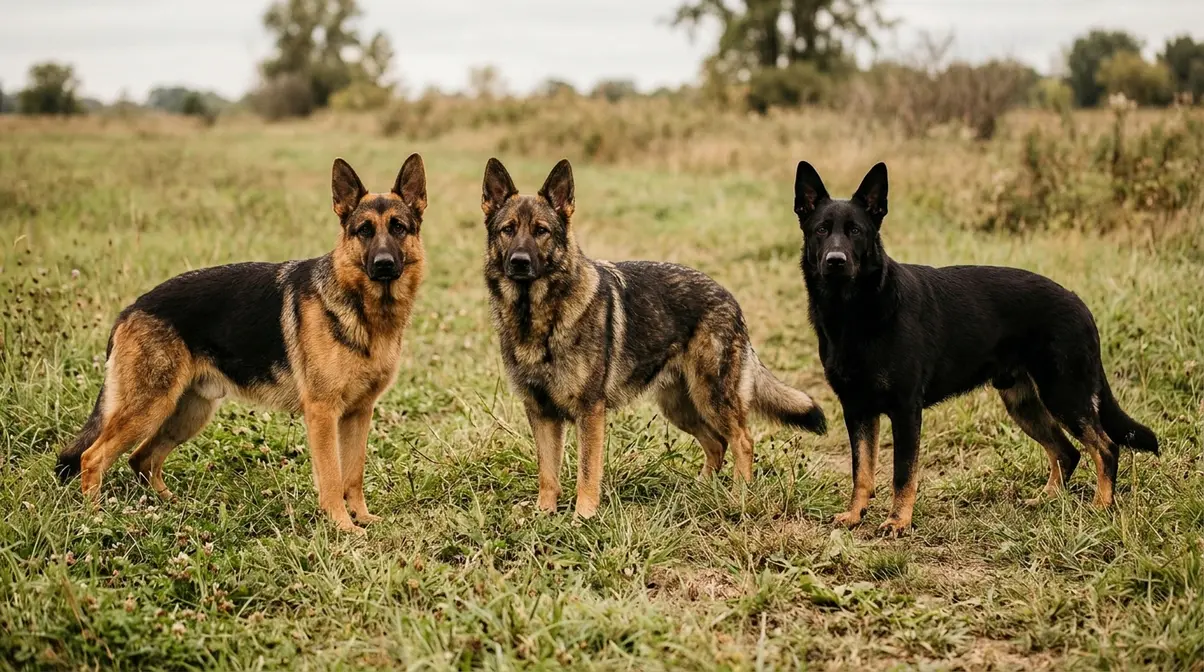
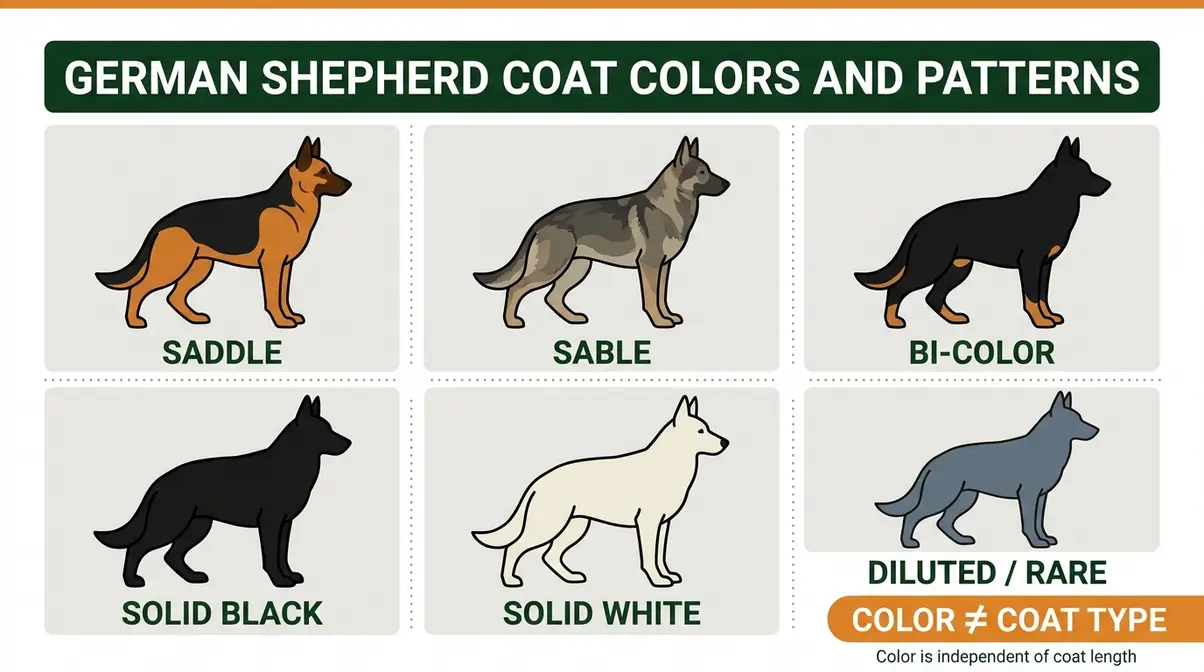
German Shepherd coat colors and patterns are entirely separate from coat type. A sable GSD can have a stock coat or a long coat, the color doesn’t change the coat type. The main patterns are saddle, sable and bi-color, and all three can appear in any coat type. Rarer colors include solid black, solid white and diluted shades such as blue, liver and isabella. Understanding german shepherd coat types and colors as distinct layers, the “Type vs Color vs Pattern” framework, prevents the most common identification errors.
This section covers the color and pattern layer. The different types of german shepherd colors are wider than most owners expect, and some of the rarest ones carry breed-standard consequences worth knowing about.
The Main Coat Patterns: Saddle, Sable and Bi-Color
The three most common GSD coat patterns each have a distinct visual signature. Learn one identifying cue per pattern and you’ll be able to name any standard GSD’s pattern at a glance.
Saddle pattern (also called “saddle back”) is the classic black-and-tan look. A dark saddle of black or dark brown covers the back and sides, with tan or red on the legs, chest and face. This is the most recognizable GSD pattern, the baseline for what most people picture when they think “German Shepherd.” If your dog looks like a classic police dog with a dark back and tan legs, that’s the saddle pattern.
Sable pattern works differently. Each individual hair is banded with multiple colors, typically black tips on a tan, gold or gray base. Because the color is distributed across individual hairs rather than in distinct zones, a sable GSD has no clear saddle marking. The whole body appears to blend from darker to lighter, and the shade can range from gold-sable to dark sable depending on how heavily the black banding covers the base color. Sable is historically significant: the breed’s founder, Max von Stephanitz, favored sable dogs, and it’s considered the original GSD coat pattern. For more on how sable, silver and blue coats differ, PetVR’s gray German Shepherd page goes into the genetics in detail.
Bi-color pattern is mostly black with tan restricted to the paws, lower legs and sometimes a small amount on the face. It’s often confused with solid black. The key cue: look at the feet. If there’s tan on the paws and lower legs but nowhere else, that’s bi-color. A fully solid-black dog has no tan anywhere.
If your GSD looks like a classic police dog, dark back, tan legs, that’s the saddle pattern. If the color seems to blend across the whole body with no distinct saddle, that’s sable.
Beyond these three main patterns, a handful of rarer colors appear in GSD litters, and some of them are disqualified by kennel clubs.
Rare Colors and What the Breed Standards Say
The different types of german shepherd colors extend well beyond the saddle and sable patterns most people know. Several rare colors appear in GSD litters, and their breed-standard status varies significantly.
No single color is universally named the rarest. Solid black is uncommon; solid white comes from a recessive gene and is disqualified in many kennel club shows; diluted colors (blue, liver, isabella) are breed faults; and the panda pattern is the rarest of all, traced to a single founding dog.
Here’s how the four main rare color types break down:
- Solid black: A recognized AKC color, but uncommon. The dog is entirely black with no tan markings, verify current AKC recognition status before citing this as settled fact, since breed standard language can be updated. Often confused with bi-color; the key check is whether there’s any tan on the paws.
- Solid white: Comes from a recessive gene and is disqualified in AKC and FCI conformation shows, not a health fault, but a showing disqualification. The White Shepherd is a separate breed in some registries.
- Diluted colors (blue, liver/chocolate, isabella/lilac): Listed as faults in most breed standards. These result from dilution genes that produce a washed-out version of the standard colors. According to the AKC breed standard, faulted colors are clearly defined, verify the specific color language against the current standard before publishing.
- Panda pattern: Caused by a KIT-gene mutation that produces white spotting. Extremely rare, traced to a single founding dog. For more on the rare panda coat and how its genetics work, PetVR’s panda GSD page covers the mutation and its implications. For more on the rare isabella coat and why it is uncommon, the isabella page explains the dilution genetics in plain language.
One important editorial note: a rare color is not the same as a rare coat type. A solid black GSD can have a stock coat, a plush coat or a long coat. The rarity is in the pigmentation, not the guard hair length. A breeder selling a “rare blue German Shepherd” at a premium is selling a color fault at an inflated price, the coat type is irrelevant to that transaction.
Color is fixed from birth. Coat type, however, isn’t always obvious in a puppy, and many owners are surprised by how much a GSD’s coat can change in the first year.
How Does a German Shepherd Puppy’s Coat Develop?
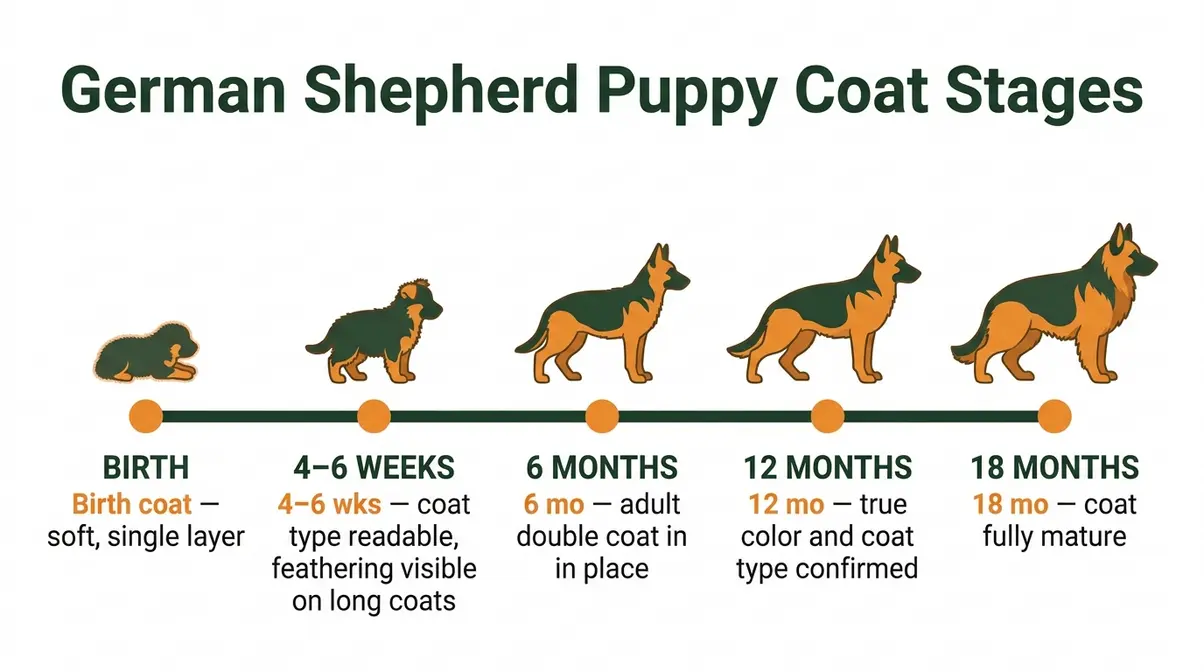
German Shepherd puppies in the same litter can look surprisingly different. One puppy’s coat lies flat; another’s is noticeably fluffier. This isn’t random, it’s an early sign of which coat type each puppy will have as an adult. German Shepherd puppy coat stages follow a predictable pattern, and you can often read the signs by six weeks of age. Knowing what to look for saves a lot of confusion, especially for owners who pick a puppy at four weeks and wonder why it looks different at six months.
For more detail on what a six-week-old puppy’s coat usually looks like, PetVR’s dedicated page covers the developmental milestones in full.
What a Newborn GSD Coat Looks Like
German Shepherd puppy coat stages begin with a birth coat that doesn’t look much like the adult double coat at all. Newborn GSD puppies have a soft, single-layer birth coat, fluffy and fine, designed to keep the puppy warm in its first weeks of life. This is not the adult double coat. There’s no guard hair layer yet and no real undercoat.
The birth coat doesn’t reliably predict adult coat type. All newborn GSD puppies look similarly soft and fluffy regardless of whether they’ll be stock, plush or long coat as adults. Trying to identify coat type in a newborn is like trying to predict a sable puppy’s adult color at birth, you’ll likely be wrong.
Sable puppies offer the clearest example of this: they’re often much darker at birth than they’ll be as adults. What looks almost black at birth can be a warm gold-and-black sable by 12 months. The adult coat reveals both the true color and the true coat type.
If you’re looking at a litter of newborn GSD puppies and trying to predict their adult coat type, wait until at least four to six weeks, the birth coat doesn’t tell you much.
By four to six weeks, the differences between puppies in a litter start to become visible.
When Does the Adult Coat Come In?
The transition from birth coat to adult double coat is gradual, and it follows a fairly consistent timeline across german shepherd puppy coat types:
- 4-6 weeks: The adult coat begins to replace the birth coat. This is the first point where coat type becomes readable. Long-coat puppies may show early feathering around the ears and between the toes at this stage, a reliable early sign. Stock-coat puppies will start to look sleeker and flatter than their fluffier littermates.
- 6 months: Most GSDs have their adult double coat in place by around six months of age, guard hair and undercoat both present. The coat may still look uneven or slightly patchy as the transition completes, particularly around the neck and hindquarters.
- 12-18 months: The coat continues to develop and fill out. A plush coat may look similar to a stock coat at six months and only show its fuller, denser character as the dog approaches maturity. Long-coat feathering becomes more pronounced over the first year.
A sable puppy that looked almost black at birth may be a warm gold-and-black sable by 12 months, the adult coat reveals the true color and pattern simultaneously.
One practical note: the adolescent period (roughly 6-18 months) is also when shedding increases significantly as the adult coat establishes itself. This is normal regardless of coat type, though long-coat and plush-coat dogs tend to tangle more during this transition than stock-coat dogs.
If you want to predict coat type before the adult coat is fully in, there are a few early signs to look for.
Early Signs of Coat Type in a Puppy
By four to six weeks, coat type is often readable if you know the three cues:
- Long coat early sign: Feathering around the ears and between the toes at 4-6 weeks. The ear edges look “fringed” or soft rather than smooth. This is the most reliable early cue, if you see fringed ears on a four-week-old puppy, you’re almost certainly looking at a long coat.
- Stock coat early sign: The coat lies flat against the body by 4-6 weeks; the puppy looks sleek rather than fluffy. This is the “lays flat” cue from the owner quote. The puppy’s outline looks clean and defined, not rounded.
- Plush coat early sign: The coat looks fuller and denser than a stock coat puppy’s, but there’s no feathering on the ears. The puppy looks “fluffy” but not fringed. This is the trickiest to read early, some plush-coat puppies don’t fully show their character until six months or later.
The owner in our opening quote had it right: “it lays flat” is the stock coat cue. “Fluffy like his brothers” points to plush or long, and the presence or absence of ear feathering tells you which. These are early signs, not guarantees, the adult coat at 12-18 months gives you the definitive answer.
Knowing what coat type to expect is especially useful if you’re choosing a puppy. Here’s how to find the coat you want, and how to make sure you’re getting a genuine GSD.
Choosing a Coat Type and Checking Breed Purity
If you want a specific coat type, a short coat German Shepherd puppy for working use, or a long coat for show, the coat type is set by genetics, not training. You need to find a breeder who breeds for that coat type and can show you the parents’ coats. Here’s how to find the right puppy and make sure you’re getting a genuine GSD.
How to Find a Puppy With Your Preferred Coat
Short coat (stock coat) GSD puppies are the most common and easiest to find. Most reputable GSD breeders, particularly those working with Czech, DDR or West German working lines, produce stock-coat litters as the norm. Ask the breeder to show you both parents’ coats. If both parents have flat, dense stock coats, the puppies will almost certainly follow. A short coat german shepherd breeder focused on working lines will typically have dogs with the flattest, densest guard hair.
Long coat GSD puppies are less common, particularly in working lines. Both parents must carry the recessive long-coat gene (widely reported in breeding communities, though breeders should verify this against current kennel club documentation) for long-coat puppies to appear in a litter. Look for breeders who specifically breed long-coat lines and can show you pedigree records demonstrating long-coat ancestry. Don’t accept a breeder’s verbal assurance, ask to see the documentation.
Plush coat puppies aren’t a separate breeding category. They appear in standard GSD litters when the parents carry slightly fuller coat genetics. Ask the breeder about the parents’ coat fullness and look at previous litters if photos are available.
Three practical steps for finding the right coat:
- Ask to see both parents in person or in clear photos, not just the puppies
- Ask for AKC or UKC registration papers for both parents
- Ask whether the breeder has produced the coat type you want in previous litters, and ask to see evidence
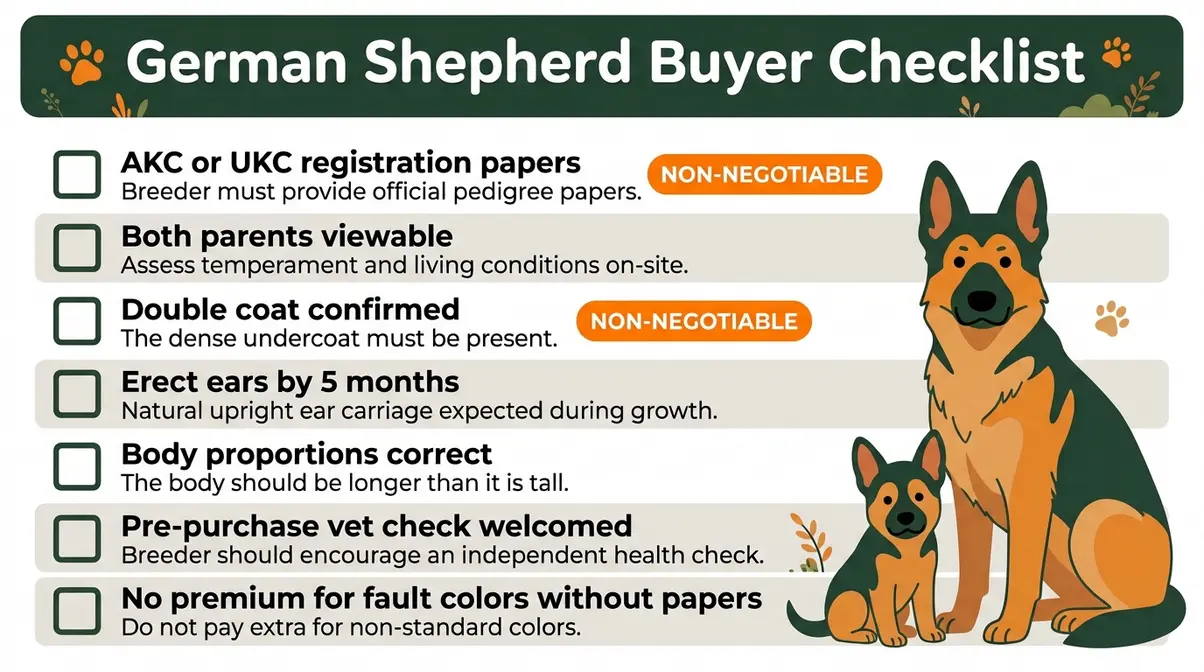
A reputable short coat german shepherd breeder will show you both parents, provide AKC or UKC registration papers, and be able to explain the coat genetics of their line. The AKC German Shepherd breed profile covers AKC registration and breed standard information that any reputable breeder should be working from. If a breeder can’t show you the parents, walk away.
Finding the right breeder is step one. Step two is making sure the dog you’re buying is actually a purebred German Shepherd.
How to Identify a Pure German Shepherd
The most reliable method for identifying a purebred German Shepherd is registered pedigree papers from the AKC, UKC or an equivalent kennel club, physical appearance alone can’t confirm purebred status. Many mixed breeds look convincingly like GSDs, particularly German Shepherd crosses with Malinois, Husky or Labrador. Papers don’t guarantee health or temperament, but they do confirm the dog’s registered lineage.
Physical cues that support, but don’t confirm, purebred status:
- Double coat: All purebred GSDs have a double coat. A single-layer coat with no undercoat is a red flag regardless of how the dog looks otherwise.
- Erect ears by 4-5 months: GSD ears should stand fully erect by around four to five months. Floppy ears in an adult GSD suggest a mixed breed.
- Body proportions: A GSD is longer than it is tall, with a strong, well-muscled hindquarters and a characteristic sloping topline. A dog that looks square or has a flat back is worth questioning.
- Characteristic gait: The GSD’s ground-covering trot is distinctive, long, effortless strides with a low-slung, fluid movement. A choppy or stilted gait is atypical.
DNA testing (Embark, Wisdom Panel) is a reliable secondary check if papers aren’t available. These tests confirm breed composition, not registration status, they’re useful for identifying mixed breeds but won’t substitute for a registered pedigree. The UKC breed standard defines GSD physical standards including coat type, which makes it a useful reference for purity verification.
The most reliable way to verify a German Shepherd’s breed purity is a registered pedigree from the AKC, UKC or an equivalent kennel club, physical appearance alone can’t confirm purebred status.
A single-coat dog sold as a GSD is a red flag, all purebred GSDs have a double coat. If the dog has a single, silky coat with no undercoat, ask for papers.
Knowing what a genuine GSD looks like helps you spot the red flags when something doesn’t add up.
Red Flags for Fake or Mislabeled Dogs
A “fake” GSD is usually a mixed-breed dog sold as a purebred. The most reliable red flags are no registration papers, no pedigree, a single-layer coat and a breeder who can’t show you both parents. A breeder selling a “rare” color at a premium with no papers is another significant warning sign, ask for documentation before handing over any money.
Here’s a practical checklist of red flags to run through before buying any dog sold as a German Shepherd:
- No AKC or UKC registration papers, a reputable breeder of purebred GSDs will have these
- Breeder can’t show both parents, if you can’t see at least one parent in person or verified photos, that’s a problem
- Single-layer coat with no undercoat, all purebred GSDs have a double coat; run your fingers through the coat and feel for the dense undercoat beneath the guard hair
- Ears still floppy after six months, GSD ears should be fully erect by five months at most; persistent floppy ears in an adult suggest a mixed breed
- Price significantly below market rate with no explanation, unusually cheap puppies often signal a backyard breeder or a mixed-breed dog being passed off as purebred
- Breeder discourages a vet check before purchase, any reputable breeder will welcome a pre-purchase vet examination
- Dog sold as “rare” color at a premium with no papers, blue, liver and isabella are breed faults in most standards, not premium features; a breeder charging extra for a fault color and refusing to provide papers is a significant red flag
The types of german shepherds coats listed as breed faults, blue, liver, isabella, and the diluted shades, are sometimes marketed as “rare” to justify inflated prices. A blue German Shepherd at three times the market price with no papers is not a rare find; it’s a breed fault being sold as a feature.
A note on “rare” colors with papers: a solid black or sable GSD from a registered litter is not a red flag. Rare colors from documented, registered bloodlines are legitimate, the concern is when “rare” is combined with no documentation and a premium price.
With the coat types, colors and buying checklist covered, here are the questions GSD owners ask most often.
Frequently Asked Questions
What Are the Different Types of German Shepherd Breeds?
German Shepherds are usually described by coat type, coat color and bloodline. Coat types include the stock coat (short, dense, lies flat), the plush coat (fuller middle ground, not an AKC/FCI-recognized separate type) and the long coat (feathering on ears, legs and tail). Beyond coats, enthusiasts also distinguish working lines from show lines. Coat type refers to length and texture; color describes patterns such as saddle or sable, they’re entirely separate traits, and mixing them up is the most common source of confusion.
What Is the Rarest German Shepherd Coat?
No single color is universally named the rarest. Solid black is uncommon; solid white comes from a recessive gene and is disqualified in many kennel club shows. Diluted colors, blue, liver and isabella, are listed as breed faults in most standards. The panda pattern, caused by a KIT-gene mutation, is the rarest of all and has been traced to a single founding dog. These are color rarities, not coat-type rarities, a rare-colored GSD can have any coat type.
What Is the Difference Between a Long Coat and a Stock Coat German Shepherd?
A stock coat has dense, medium-length, straight guard hair that lies close to the body over a thick undercoat, it’s the most common coat in working and police lines. A long coat has longer, softer hair with feathering on the ears, legs, tail and belly, and it tends to tangle more easily. The long-coat trait is widely reported to come from a recessive gene, meaning both parents must carry it. Both types have a double coat with an undercoat.
How Do You Identify a Pure German Shepherd?
The most reliable method is registered pedigree papers from the AKC, UKC or an equivalent kennel club, physical appearance alone can’t confirm purebred status. Physical cues that support but don’t confirm purebred status include a double coat, erect ears by four to five months, and the characteristic GSD body proportions. A single-layer coat with no undercoat is a red flag worth investigating. DNA testing is a useful secondary check if papers aren’t available, though it confirms breed composition rather than registration status.
How Do You Spot a Fake German Shepherd?
A “fake” GSD is usually a mixed-breed dog sold as a purebred. Key red flags: no AKC or UKC registration papers, the breeder can’t show you both parents, the dog has a single-layer coat with no undercoat, or the price is far below market rate. A breeder selling a “rare” color at a premium with no papers is another warning sign. Ask for papers and a pre-purchase vet check before committing to any purchase.
Is It Better to Have a Girl or Boy German Shepherd?
It depends on your situation and experience level. Female GSDs generally mature sooner and are often easier to train, which can make them a good fit for first-time owners. Male GSDs are typically larger and may have a longer, more demanding adolescence. Both sexes make loyal, capable companions, and the coat type you want is available in both sexes, since coat type and sex are entirely independent traits. For a deeper look at how male and female German Shepherds differ in training and maturity, PetVR’s comparison page covers the differences in detail.
What Should You Not Do to a German Shepherd?
Avoid harsh corrections and inconsistent rules, German Shepherds respond best to consistent, positive reinforcement training. Don’t leave them alone for long periods; they’re working dogs that need both mental and physical stimulation daily. Skipping socialization in the first 16 weeks is a common mistake with long-term consequences for confidence and reactivity. Don’t neglect coat care either, especially for long-coat and plush-coat dogs that tangle more easily than stock-coat dogs.
What Is the Hardest Age With a German Shepherd?
Most GSD owners find adolescence, roughly 6 to 18 months, the most challenging period. The dog is physically strong but still testing boundaries, and the adult coat is also coming in during this window, which typically means heavier shedding. Males often experience a longer and more demanding adolescence than females. Consistent training and daily exercise during this period make a measurable difference in the dog’s long-term behavior and responsiveness.
For GSD Owners: Three Things That Settle the Coat Question
For GSD owners, the coat question comes down to three things: type, color and pattern. Kennel clubs recognize two coat types, stock and long, while many breeders and owners also use the term plush for a fuller middle ground. Coat type (length and texture) is separate from coat color (saddle, sable, bi-color) and coat pattern. Knowing the difference helps you identify your dog’s coat, choose the right puppy and spot a mislabeled one.
The disagreement between “two coat types” and “three or more” isn’t a mistake, it reflects the gap between formal breed standards and practical owner experience. Both are useful. The kennel club definition tells you what’s standard; the owner community’s “Type vs Color vs Pattern” framework tells you what you’ll actually see and need to describe when talking to a breeder or vet.
If you’re still unsure which coat your dog has, use the identification flowchart above, it takes you through the three key cues (feathering, texture and length) in under a minute. And if you’re buying a puppy, take the buyer checklist with you: registration papers and a visible double coat are the two things no reputable breeder will hesitate to show you.
 German Shepherd Skin Problems: Causes and Treatment