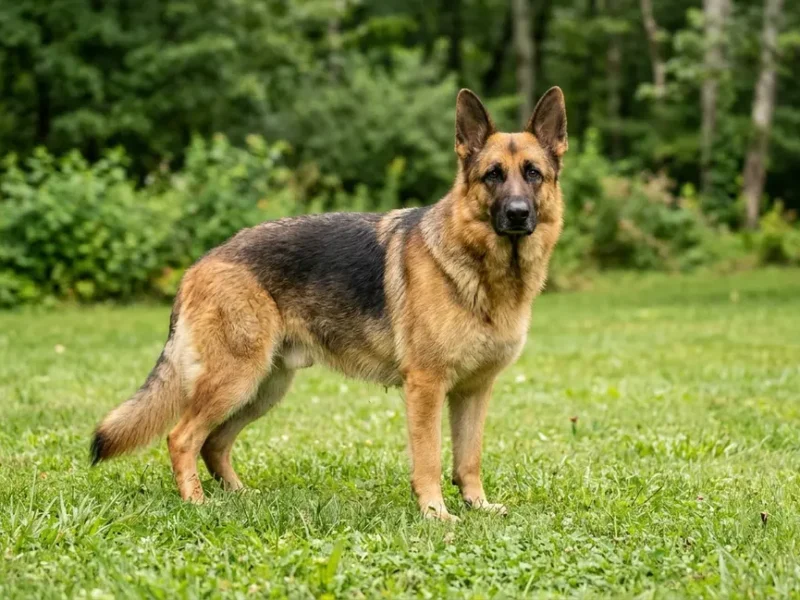
Your GSD smells yeasty. There’s a hot spot on her lower back, again. You’ve tried the grain-free food, the medicated baths, the Apoquel, even a homemade diet. Nothing sticks. The problem clears up for a few weeks, then comes right back, sometimes worse than before.
“My GSD has such bad skin issues. I’ve tried EVERYTHING. Apoquel, special diet/grain free, making her food, medicated baths, etc. She smells yeasty and…”
That frustration is real, and it’s more common than you’d think. But here’s the thing: the problem usually isn’t that you haven’t tried hard enough. The reason most German Shepherd skin treatments fail is that pyoderma, yeast overgrowth, and atopic dermatitis look nearly identical but need opposite remedies. Steroids worsen infections. Antifungals don’t touch allergies. Treating the wrong condition, even with the right product, guarantees the cycle continues.
This guide walks you through the most common GSD skin conditions, what each one actually looks like, and exactly when to call your vet for a confirmed diagnosis.
German Shepherd skin problems are among the most common reasons GSDs visit the vet, driven by the breed’s genetic predisposition to immune-mediated and allergic conditions (vetified.co, 2026).
- Diagnosis before treatment: Pyoderma, yeast overgrowth, and atopic dermatitis look nearly identical but need opposite treatments, steroids worsen infections, antifungals don’t touch allergies.
- The Diagnosis-First Framework: Get cytology or skin scrapings before applying anything; guessing costs time, money, and your dog’s comfort.
- Most common conditions: Hot spots, pyoderma, atopic dermatitis, flea allergy dermatitis, yeast overgrowth, and mange, each has a distinct pattern and a specific diagnostic test.
- When to act fast: Pus, rapid spread, strong odor, draining lesions, or a new lump all need a vet within 24-48 hours, not a home remedy.
- Diet matters, but only with a trial: An 8-12 week elimination diet with a novel protein is the only reliable way to confirm food allergy.
German Shepherd skin problems include hot spots, bacterial pyoderma, atopic dermatitis, flea allergy dermatitis, yeast overgrowth, mange, and immune-mediated conditions such as perianal fistulas. The breed’s double coat, genetic predisposition to immune dysregulation, and high allergen sensitivity make it one of the most skin-prone breeds in veterinary practice. If your GSD keeps cycling through the same symptoms despite treatment, the missing step is almost always a confirmed diagnosis of the underlying trigger.
What Are the Most Common German Shepherd Skin Problems?
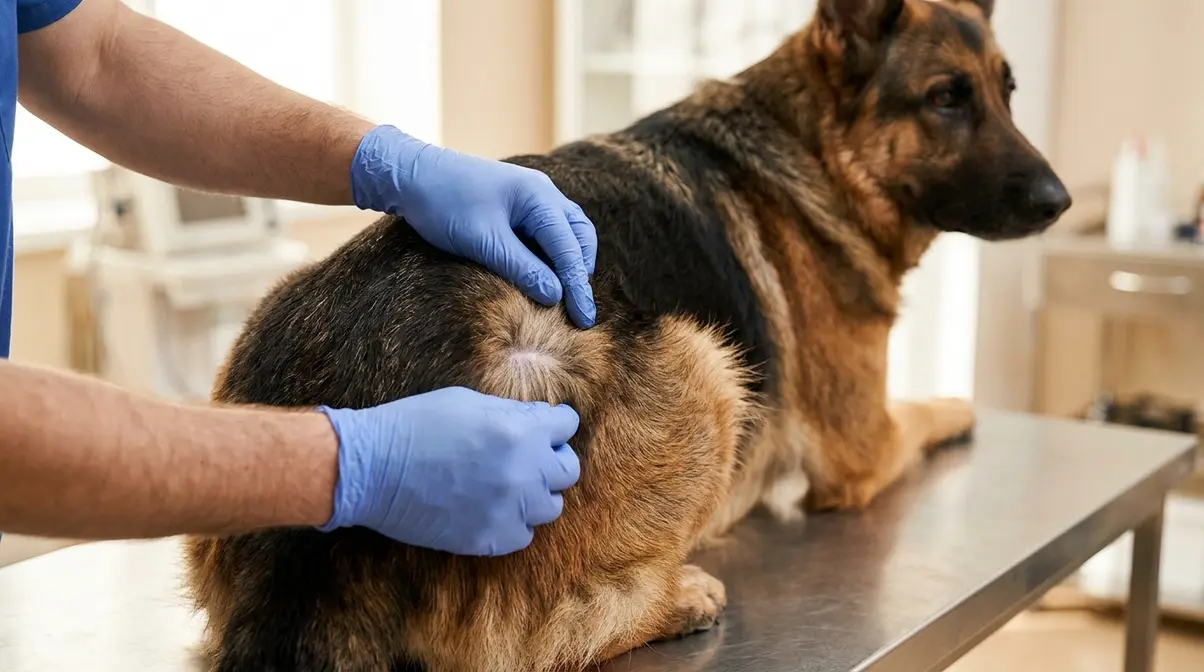
German Shepherd skin problems include hot spots, bacterial pyoderma, atopic dermatitis, flea allergy dermatitis, yeast overgrowth, mange, and immune-mediated conditions such as perianal fistulas. The breed’s double coat, genetic predisposition to immune dysregulation, and high allergen sensitivity make it one of the most skin-prone breeds a vet sees.
German Shepherds are among the breeds most frequently diagnosed with chronic skin conditions, including deep pyoderma and allergic dermatitis, giving them one of the highest rates of skin disease in veterinary practice (vetified.co, 2026). The breed’s double coat creates a warm, damp microenvironment close to the skin where bacteria and yeast thrive. What makes this especially challenging is that the same dog can have two or three overlapping conditions at once, which is exactly why the Diagnosis-First Framework matters here: every GSD skin problem requires a confirmed diagnosis before treatment, because conditions that look identical need opposite remedies.
German Shepherds are among the dog breeds most frequently diagnosed with atopic dermatitis, pyoderma, and immune-mediated skin disease, conditions that often overlap and require separate diagnostic confirmation before treatment (pro.dermavet.com; pacificvethospital.com).
Why German Shepherds Are So Prone to Skin Issues
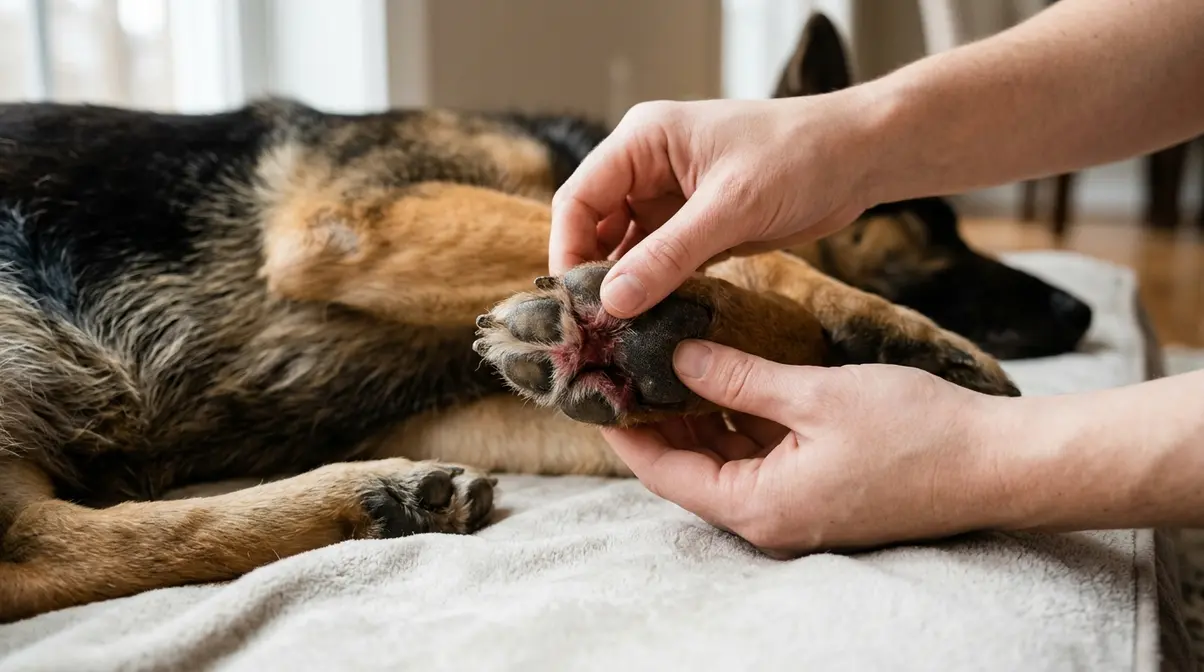
The double coat is the first piece of the puzzle. GSDs have two distinct layers: a dense, soft undercoat that sits close to the skin, and longer guard hairs on top. Think of it like wearing a wool sweater in summer, the skin underneath stays warm and damp. That warm, moist environment is exactly what bacteria and yeast need to multiply. When moisture gets trapped after a swim, a bath, or even a humid afternoon, the conditions for a hot spot or yeast flare are already in place.
The second factor is genetic. Peer-reviewed veterinary dermatology research consistently identifies GSDs as overrepresented in veterinary dermatology caseloads for atopic dermatitis and immune-mediated conditions. White and black coat variants carry the same underlying genetic risk profile as standard-colored GSDs, so if you’re searching for white German Shepherd skin problems or black GSD skin issues, the cause and the treatment path are identical.
Age matters too. German Shepherd puppy skin problems often look different from adult presentations: demodectic mange is more common in puppies because their immune systems are still maturing. Atopic dermatitis typically appears between ages one and three. Perianal fistulas, painful, ulcerated tracts around the anus, tend to peak in middle-aged to older dogs. Knowing the age pattern helps you and your vet narrow down the most likely cause quickly.
One more point competitors often miss: secondary infections layer on top of primary allergic or immune conditions. A GSD with recurring hot spots on the lower back is often showing the first visible sign of an underlying flea allergy or atopic dermatitis. The hot spot is a symptom, not the disease, and treating it without finding the trigger is what keeps the cycle going.
Understanding why GSDs are vulnerable is step one, but knowing what each condition actually looks like is what lets you describe it accurately to your vet.
The 7 Most Common Conditions: A Comparison Table
These seven conditions account for the majority of German Shepherd skin visits. They can look nearly identical, which is exactly why diagnosis comes before treatment.
| Condition | Typical Appearance | Common Location | Odor | Itch Level | Usual Vet Test |
|---|---|---|---|---|---|
| Hot spot (acute moist dermatitis) | Red, weeping, matted fur; erythema (redness) and erosion (shallow skin break) | Lower back, neck, hip | Mild to moderate | Intense | Clinical exam |
| Bacterial pyoderma | Pustules, crusts, epidermal collarettes (circular scales where a pustule healed), alopecia (hair loss) | Trunk, groin, face folds | Moderate to strong | Moderate to intense | Cytology, culture and sensitivity |
| Atopic dermatitis | Chronic erythema, lichenification (skin thickening from repeated scratching) | Paws, belly, ears, face | None to mild (unless secondary infection) | Intense, chronic | Intradermal test, elimination trial |
| Flea allergy dermatitis | Scabs, alopecia at tail base | Tail base, lower back, inner thighs | None | Intense | Flea comb, clinical exam |
| Yeast overgrowth (Malassezia) | Dark, greasy, lichenified skin; hyperpigmentation | Ears, paws, skin folds | Strong, musty/yeasty | Moderate to intense | Cytology |
| Demodectic/sarcoptic mange | Patchy alopecia, scaly, crusty skin | Face, legs; generalized (sarcoptic) | None to mild (demodex); variable (sarcoptic) | Variable to intense | Skin scraping |
| Perianal fistulas | Draining, ulcerated tracts | Around anus | Strong | Painful | Clinical exam, biopsy |
Sources: DermaVet, PetMD, vetified.co, synthesized for comparison; verify individual entries against current veterinary guidelines.
Notice that hot spots, pyoderma, and yeast all involve redness and odor, but they need opposite treatments. Steroids that calm an allergic reaction can make a bacterial infection dramatically worse. This is the core of the Diagnosis-First Framework: the right remedy depends entirely on what the cells under the microscope actually show.
A GSD with a “hot spot” on the lower back that keeps coming back despite chlorhexidine washes is likely showing flea allergy dermatitis. The hot spot is a symptom; flea control is the treatment.
This table is a recognition guide, not a diagnosis. Many conditions require cytology, skin scrapings, or cultures to confirm, your vet will choose the right test.
Now that you know the conditions by name, the next step is learning to recognize them by sight, which is where a visual guide becomes essential.
What About Tumors and Lumps?
The veterinary literature does not offer a single definitive frequency ranking of GSD-specific tumors, but neoplasia accounts for 14.5% of recorded deaths in a UK German Shepherd population study (pmc.ncbi.nlm.nih.gov/articles/PMC5532765/). Hemangiosarcoma, a high-risk tumor in German Shepherds, is one of the most commonly cited tumor types in the breed, with the skin among its known sites.
The practical message is simple: any new lump, growth, or lesion that appears suddenly, grows, bleeds, or changes shape needs a veterinary examination, not a wait-and-see approach and not a home remedy. A soft, moveable lump under the skin (a lipoma) can look very different from a firm, fixed, rapidly growing mass, but only a fine-needle aspirate or biopsy can confirm which it is. Images and checklists cannot replace that step.
For a full picture of common health issues in German Shepherds, including neoplasia risk, the linked resource covers the full scope of what the breed faces across its lifespan.
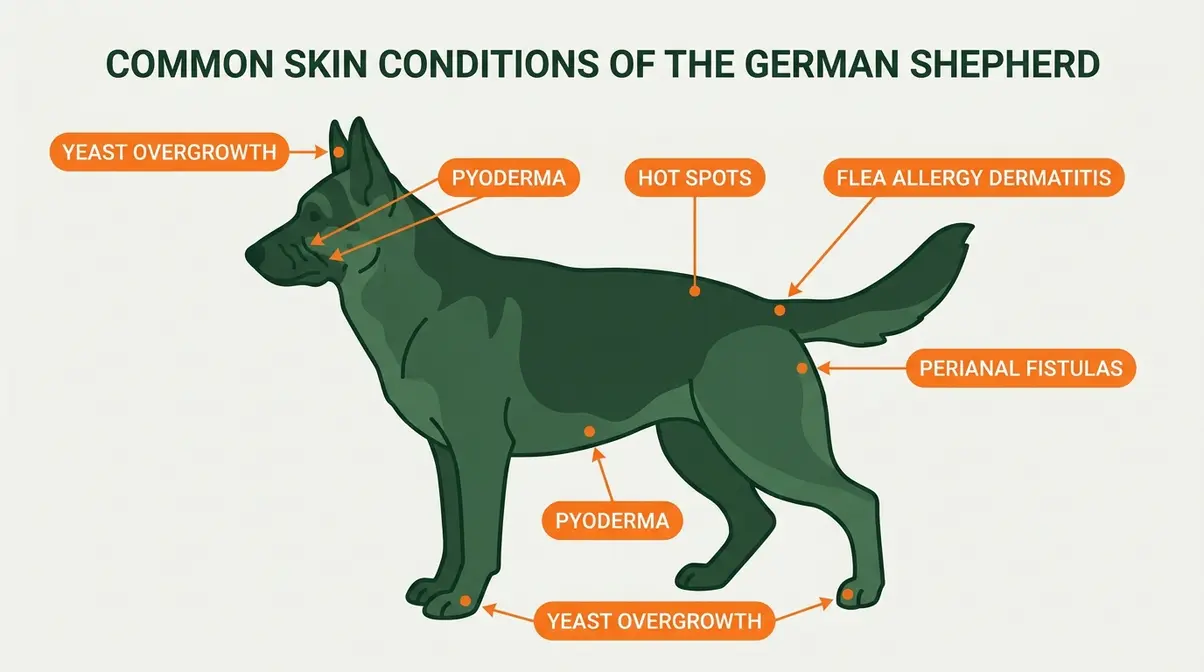
Knowing the conditions is one thing, but owners often come to the vet saying “I don’t know how to describe it.” The next section gives you the visual vocabulary to do exactly that.
How to Identify German Shepherd Skin Problems by Appearance
German Shepherd skin problems look different depending on the cause. Hot spots appear as red, weeping, matted patches; pyoderma shows circular crusts or pustules; atopic dermatitis causes chronic redness on the belly, paws, and ears; flea allergy dermatitis concentrates scabs at the tail base. A vet must confirm the cause before treatment.
Picture this: you spot a red patch on your GSD’s belly and reach for the hydrocortisone cream. The lesion worsens over the next 48 hours, spreading and developing a foul odor. What happened? The patch was a pyoderma pustule, a bacterial infection, and the steroid suppressed the immune response just enough for the bacteria to multiply. The Diagnosis-First Framework applied to visual identification means that even a clear, well-lit photo is a starting point, not a conclusion. Cytology or a skin scraping is the only reliable confirmation.
What a Hot Spot, Scab or Rash Actually Looks Like
German Shepherd skin scabs and lesions fall into recognizable patterns once you know what to look for. Cornell University College of Veterinary Medicine emphasizes that visual identification of skin lesions must be confirmed by cytology or skin scrapings before treatment, images alone are insufficient for a diagnosis.
Hot spot (acute moist dermatitis): Red, weeping, matted fur. Owners often find it by smell before sight. Typically 2-10 cm; appears suddenly within hours. The key lesion vocabulary: erythema (redness), erosion (a shallow skin break), and exudate (fluid discharge). The fur around it often looks wet and matted.
Pyoderma scabs: Circular crusts, epidermal collarettes (ring-shaped scales that mark where a pustule has healed), and patchy alopecia. Often on the belly, groin, or face folds. Smell ranges from moderate to strong. Dermatitis German Shepherd skin problems pictures often show these collarette patterns as the most recognizable visual marker.
Yeast darkening: Skin becomes hyperpigmented (darker than normal), thickened, and greasy. The musty or corn-chip smell concentrates in skin folds, ears, and between the toes.
Before your vet visit, photograph the following, this checklist is one of the most practical things you can bring:
- Full-body photo showing your dog’s posture and coat
- Close-up of the lesion with a coin or ruler for scale
- Photo of the lesion’s location on the body (belly, tail base, ear, paw)
- Note the smell (yeasty, sour, none) and itch level (constant, intermittent, only at night)
- Note when it started and whether it’s spreading
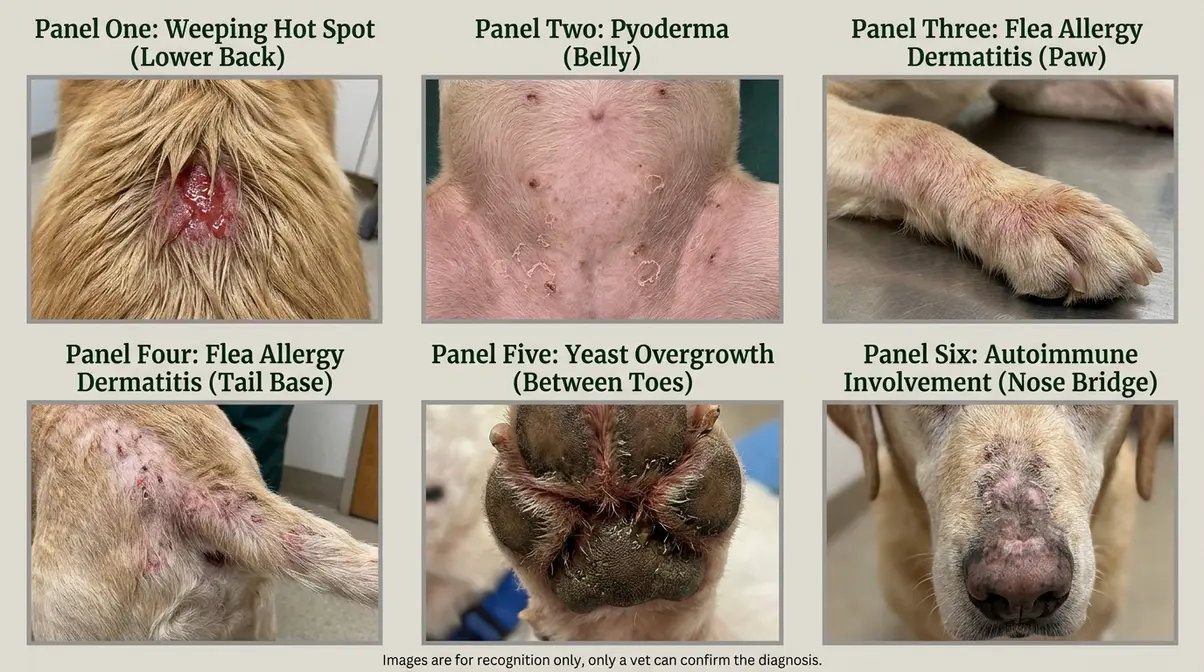
Pollen allergy rashes and autoimmune lesions are two of the most-searched visual questions, and the two most likely to be misidentified at home.
Pollen Allergy Rash vs. Autoimmune Lesions: Key Differences
Pollen allergy (atopic dermatitis) rash: This skin allergy German Shepherd presentation concentrates on the face, ears, paws, belly, and armpits. What it looks like: chronic erythema, lichenification (skin thickened from repeated scratching), and alopecia from rubbing. The pattern is often seasonal, worse in spring and fall, but year-round when dust mites or mold are the trigger. No distinctive odor unless a secondary infection develops on top of the inflamed skin.
Autoimmune-type lesions: Perianal fistulas are the most GSD-specific autoimmune presentation, draining, ulcerated tracts around the anus; painful; strong odor; not itchy in the typical sense. Nose-bridge depigmentation and crusting can suggest discoid lupus erythematosus, though this requires a biopsy to confirm. These look nothing like a typical allergy rash, which is part of what makes them easy to misidentify.
The honest answer to “What do autoimmune rashes look like?” is that they vary widely and often look like severe infections or allergies. A GSD with draining tracts around the anus that don’t respond to antibiotics is showing a classic perianal fistula pattern, an immune-mediated condition that needs immunosuppressive therapy, not more antibiotics.
The photos in this article are for recognition only, a veterinarian using cytology, skin scrapings, or biopsy is the only reliable way to confirm the cause.
Once you can describe what you’re seeing, the next question is whether it’s a surface problem or something deeper, like a bacterial or fungal infection that needs targeted treatment.
Skin Infections in German Shepherds: Pyoderma, Yeast, Mange and Ringworm
German Shepherd skin infections fall into four categories: bacterial pyoderma (the most common), yeast overgrowth (Malassezia), mange (demodectic or sarcoptic), and ringworm (a fungal infection). Each needs a different treatment, antibiotics, antifungals, antiparasitic medication, or antifungal shampoos, and cytology or skin scrapings are the only reliable way to tell them apart.
Antibiotics treat bacteria. Antifungals treat yeast. Giving the wrong one doesn’t just fail, it can actively make the other condition worse. This is the clinical reality behind the Diagnosis-First Framework, and it’s the reason that German Shepherd skin infection treatment must begin with a confirmed diagnosis, not a best guess. For owners who have tried medicated baths without lasting relief, this is usually the missing step: the bath treats the surface, but the underlying trigger keeps the infection coming back.
Recurring pyoderma in German Shepherds is almost always a secondary infection, the underlying trigger (allergy, immune suppression) must be identified and treated to prevent recurrence (pro.dermavet.com).
Bacterial Pyoderma: The Smelly, Recurring Infection
If your GSD smells yeasty rather than sour or musty, the cause may be yeast rather than bacteria, but only cytology tells you which. Pyoderma is a bacterial skin infection, most commonly caused by Staphylococcus pseudintermedius in dogs. It presents as pustules, epidermal collarettes (circular scales), crusts, and patchy alopecia. Smell ranges from moderate to strong. It can be superficial or deep, deep pyoderma in GSDs is a serious condition that can cause draining tracts and requires a longer, more targeted treatment course.
Why does it keep coming back? Pyoderma is almost always secondary to an underlying trigger, atopic dermatitis, food allergy, flea allergy, or immune suppression. Treating the infection without finding the trigger guarantees recurrence. This is the clinical fact that explains “I’ve tried antibiotics three times and it keeps coming back.” The antibiotic cleared the bacteria, but the allergy that opened the door is still there.
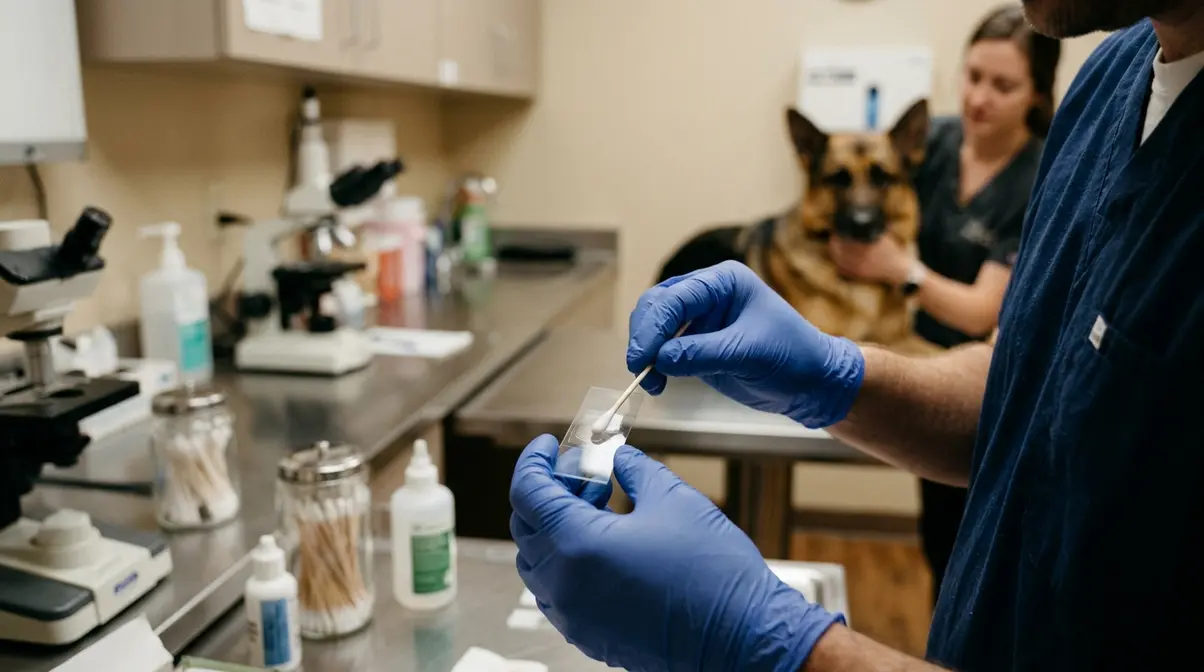
Diagnosis starts with cytology, examining cells under a microscope to confirm bacteria versus yeast. Culture and sensitivity testing then identifies which antibiotic will actually work against that specific bacterial strain. Without these tests, antibiotic choice is a guess. A GSD treated with a two-week antibiotic course that clears up and then relapses within four to six weeks almost certainly has an underlying allergy driving the infection. The next step is an allergy workup, not another antibiotic course.
Antibiotic selection for pyoderma should always be guided by culture and sensitivity results, ask your vet about testing before starting a course. This article does not provide antibiotic dosing.
For more on when a recurring skin odor needs a vet, PetVR’s bathing guide covers the key warning signs in detail.
Yeast overgrowth, mange, and ringworm each have their own distinct pattern, and one of them can spread to the people in your household.
Yeast Overgrowth, Mange and Ringworm
Yeast overgrowth (Malassezia pachydermatis) is the classic “smells yeasty” complaint. The skin becomes dark, greasy, and lichenified, concentrated in the ears, paws, and skin folds. Diagnosed by cytology. Treated with antifungal shampoos or oral antifungals, not antibiotics. Like pyoderma, it’s often secondary to allergies.
Mange comes in two very different forms:
- Demodectic mange (Demodex mites): NOT contagious. Caused by immune suppression, common in puppies whose immune systems are still developing, and in immunocompromised adults. Patchy alopecia, scaly skin. Diagnosed by skin scraping.
- Sarcoptic mange (Sarcoptes scabiei): HIGHLY contagious to other dogs and can cause a temporary skin reaction in humans. Intense itch. Diagnosed by skin scraping, though mites are often hard to find, a negative scraping doesn’t rule it out.
Ringworm (Microsporum canis) is not a worm, it’s a fungal infection. It causes circular patches of alopecia with a scaly border. Ringworm is zoonotic, meaning it spreads between pets and people. According to CDC guidance on fungal skin infection spread from pets, all affected individuals, pets and people, need treatment simultaneously (CDC, current). Diagnosed by fungal culture or Wood’s lamp. Treated with antifungal medication.
A household where multiple pets and a child develop circular, scaly patches at the same time is showing a classic ringworm transmission pattern. If you suspect sarcoptic mange or ringworm, isolate the affected dog from other pets and family members until a vet confirms the diagnosis and starts treatment.
Infections are often the visible result of an underlying allergy, which brings us to the most common root cause of recurring GSD skin problems.
Allergies and Itch Relief: What You Can and Can’t Give Your GSD
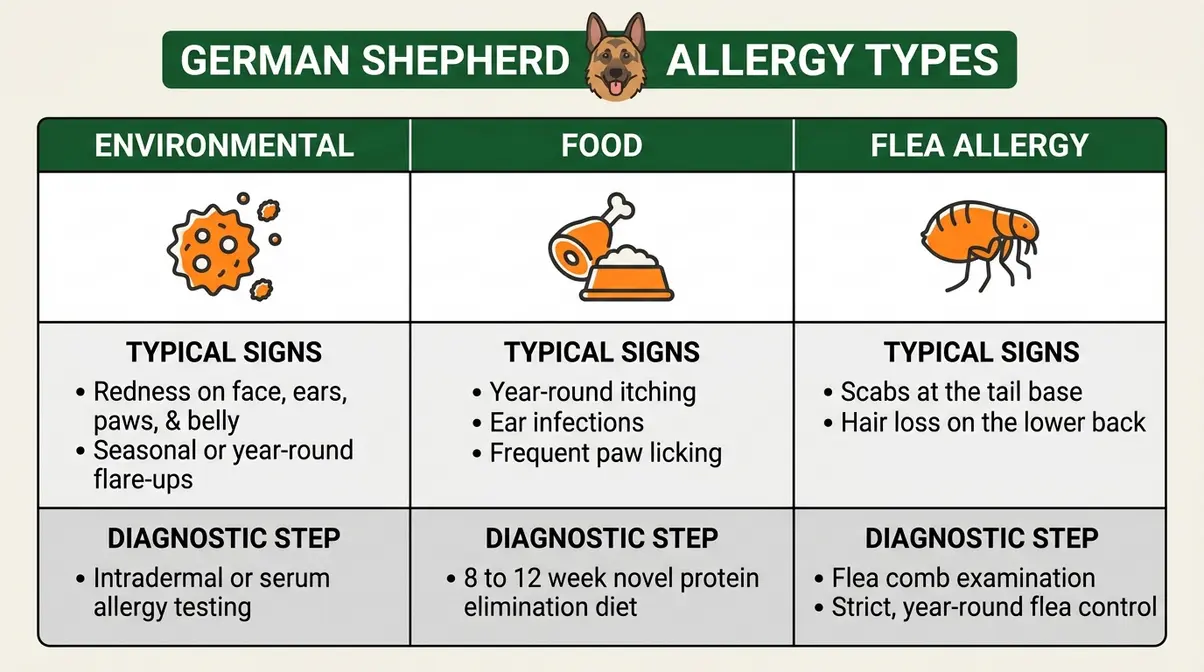
German Shepherd allergies fall into three types: environmental (atopic dermatitis), food, and flea allergy dermatitis. Each needs a different treatment path. Prescription options like Apoquel and Cytopoint manage itch effectively, but they don’t eliminate the trigger. Ask your vet before giving any human medication, Benadryl and hydrocortisone require veterinary guidance for safe use in dogs.
If your GSD is still itching despite medicated baths, a grain-free diet, and a course of Apoquel, the trigger probably hasn’t been identified yet. The three allergy types look similar on the surface but have completely different causes, and the Diagnosis-First Framework applies here just as much as it does to infections. Apoquel and Cytopoint manage the immune response; they don’t eliminate the allergen. Without identifying whether the trigger is food, environment, or fleas, itch relief is a band-aid.
Environmental, Food and Flea Allergies, and How to Tell Them Apart
Environmental allergy (atopic dermatitis) is triggered by pollen, dust mites, and mold. It can be seasonal or year-round. It concentrates on the face, ears, paws, belly, and armpits. Diagnosis involves intradermal allergy testing or serum allergy testing, though false positives are common with serum tests. Management includes allergen avoidance where possible, immunotherapy (allergy shots or sublingual drops), and prescription anti-itch therapy.
Food allergy is triggered by a protein source, commonly chicken, beef, dairy, or wheat. It’s not the same as food intolerance. Symptoms include chronic itch, ear infections, and paw licking that’s year-round, not seasonal. The only reliable diagnostic tool is an 8-12 week elimination diet with a novel protein such as venison, duck, or kangaroo. Blood and saliva tests for food allergy have poor sensitivity and specificity and are not considered reliable diagnostic tools by veterinary dermatology consensus.
Grain-free diets are not the same as an elimination diet, grain-free foods often contain the same protein sources that trigger food allergies. An elimination trial requires a novel or hydrolyzed protein source your dog has never eaten before.
Flea allergy dermatitis (FAD) is triggered by a single flea bite in sensitized dogs and concentrates at the tail base, lower back, and inner thighs. Diagnosed by finding fleas or flea dirt, or by response to strict flea control. Year-round flea prevention is the treatment. A GSD with chronic ear infections, paw licking, and belly rash that doesn’t improve seasonally is showing a classic food allergy pattern, the next step is an 8-12 week elimination trial, not another antibiotic course.
The FDA guidance on veterinary drug approval confirms the regulatory status of Apoquel (oclacitinib) and Cytopoint (lokivetmab) as FDA-approved options for canine allergic itch (FDA, current).
Once the allergy type is identified, the question becomes: what can you safely give your dog for relief while you work through the diagnosis?
Apoquel, Cytopoint and Over-the-Counter Options, What Your Vet May Recommend
Apoquel (oclacitinib) is a JAK inhibitor, FDA-approved for canine pruritus. It works within four hours and controls itch without the side effects associated with long-term steroid use. It requires a prescription and ongoing vet monitoring. Apoquel manages the immune response while the underlying trigger is identified, it’s not a cure. The reason Apoquel can seem to “stop working” for some dogs isn’t drug resistance; it’s that the underlying trigger (often food allergy or flea allergy) was never addressed.
Apoquel (oclacitinib) and Cytopoint (lokivetmab) are FDA-approved for canine allergic itch, but neither eliminates the allergen trigger, so identifying whether the cause is food, environment, or fleas remains essential (FDA, current).
Cytopoint (lokivetmab) is an injectable anti-IL-31 antibody, FDA-approved for canine atopic dermatitis. Given as a monthly injection, it targets the itch signal directly. Also requires a vet prescription.
Benadryl (diphenhydramine) and hydrocortisone are the two most-searched over-the-counter options. MedlinePlus publishes diphenhydramine information for human patients only and does not address canine dosing or safety, a veterinarian is the appropriate source for guidance on giving this drug to dogs (NLM, current). Hydrocortisone cream (human formulation) is sometimes applied short-term to localized areas, but applying it to an infected lesion can worsen the infection by suppressing the local immune response. An owner who gives Benadryl for a rash that turns out to be pyoderma may see temporary sedation but no improvement in the infection, and may delay the antibiotic treatment the dog actually needs.
The three most-searched OTC questions, Will Benadryl make a rash go away? Which is better, hydrocortisone or Benadryl? What should you never mix Benadryl with?, are all questions for your vet, not a product label.
This article does not provide dosing for Benadryl, hydrocortisone, Apoquel, Cytopoint, or any other medication. Always consult a licensed veterinarian before giving your dog any human or prescription medication.
Knowing what’s available is useful, but the real question most owners have is: what can I actually do right now, at home, while I wait for the vet appointment?
How to Treat German Shepherd Skin Problems at Home and with Your Vet
Start with a professional diagnosis, many skin conditions look alike but need opposite treatments. For a hot spot, trim the hair around it, clean gently with a chlorhexidine wash, and use a cone to stop licking. Then follow your vet’s prescription, which may include medicated shampoos, anti-itch therapy, or antibiotics.
The most common reason German Shepherd skin treatments fail is that they address the symptom, the rash, the itch, the scab, without confirming the cause. The Diagnosis-First Framework is the organizing principle for this entire section: every step starts with diagnosis, because the right treatment depends entirely on the confirmed cause. What follows covers safe home care, when to see the vet, and what home remedies can and can’t do.
Safe Home Care for Hot Spots, Dry Skin and Medicated Baths
Hot spot care, numbered steps:
- Trim the hair around the lesion to 1-2 cm beyond the edge (use blunt-tipped scissors or clippers, ask your vet to show you the first time)
- Clean gently with a chlorhexidine solution (0.05% concentration for skin, your vet can recommend a specific product)
- Apply a cone (Elizabethan collar) immediately, licking is the number one cause of hot spot worsening
- Do NOT apply human hydrocortisone cream, Neosporin, or any ointment without vet guidance, these can worsen infection or cause toxicity if licked
- Call your vet, most hot spots need a prescription antimicrobial or anti-itch treatment to resolve fully
According to PetMD hot spot care guidance, the clip-clean-cone sequence is the foundation of home care, and most hot spots require prescription treatment to resolve fully (PetMD, 2024). Hot spot care without treating the underlying trigger, flea allergy, atopic dermatitis, or food allergy, results in recurrence in the majority of cases.
If the hot spot is larger than a palm, has pus, smells strongly, or is spreading rapidly, skip home care and call your vet today.
How to treat German Shepherd dry skin: Brush the double coat two to three times per week to distribute natural oils and remove dead undercoat. Avoid over-bathing, which strips the natural oils that protect the skin barrier. Some veterinary literature supports omega-3 fatty acid supplementation for skin barrier function in atopic dogs, discuss whether this is appropriate for your dog with your vet before adding any supplement.
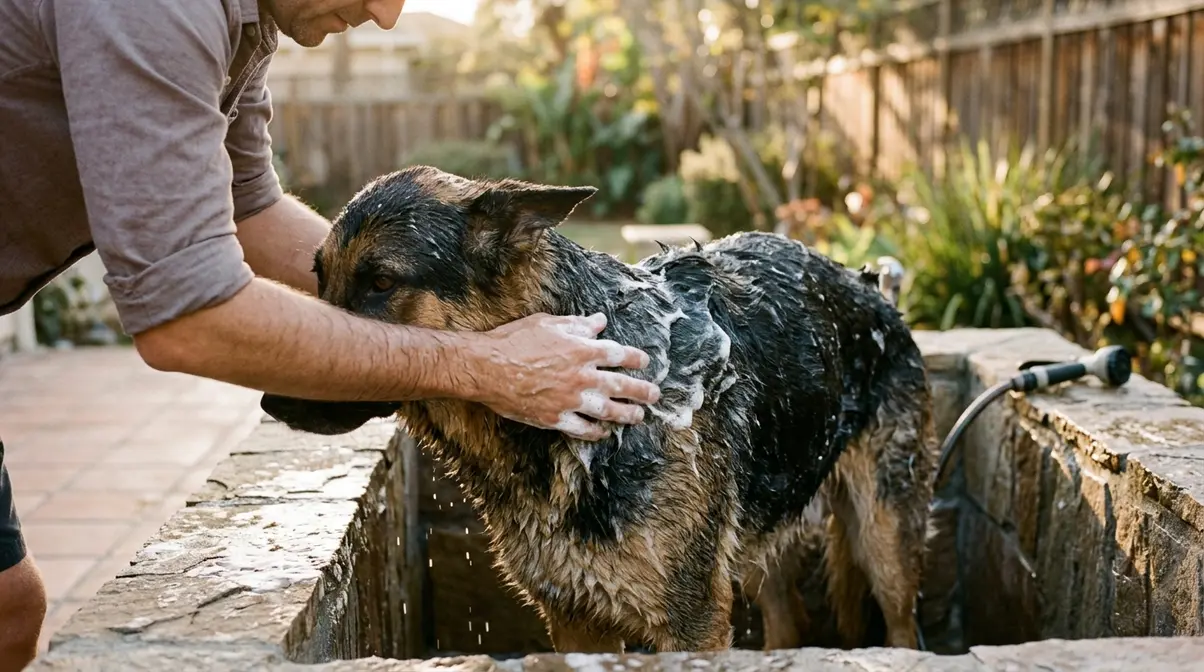
Medicated bath routine: During an active infection, twice-weekly medicated baths are a common starting frequency; maintenance typically drops to weekly. Leave the shampoo on for the contact time specified on the label, typically five to ten minutes. Rinsing immediately defeats the antimicrobial purpose. Use a veterinary-grade chlorhexidine or ketoconazole shampoo, not a human dandruff shampoo. A GSD with recurring hot spots on the lower back who relapses within two weeks of a medicated bath almost certainly has an underlying flea allergy, the bath treats the surface, but the flea trigger needs year-round prevention.
Knowing when to stop home care and call the vet is as important as knowing what to do at home, and the triage flowchart below makes that decision clear.
When to See the Vet and What to Expect
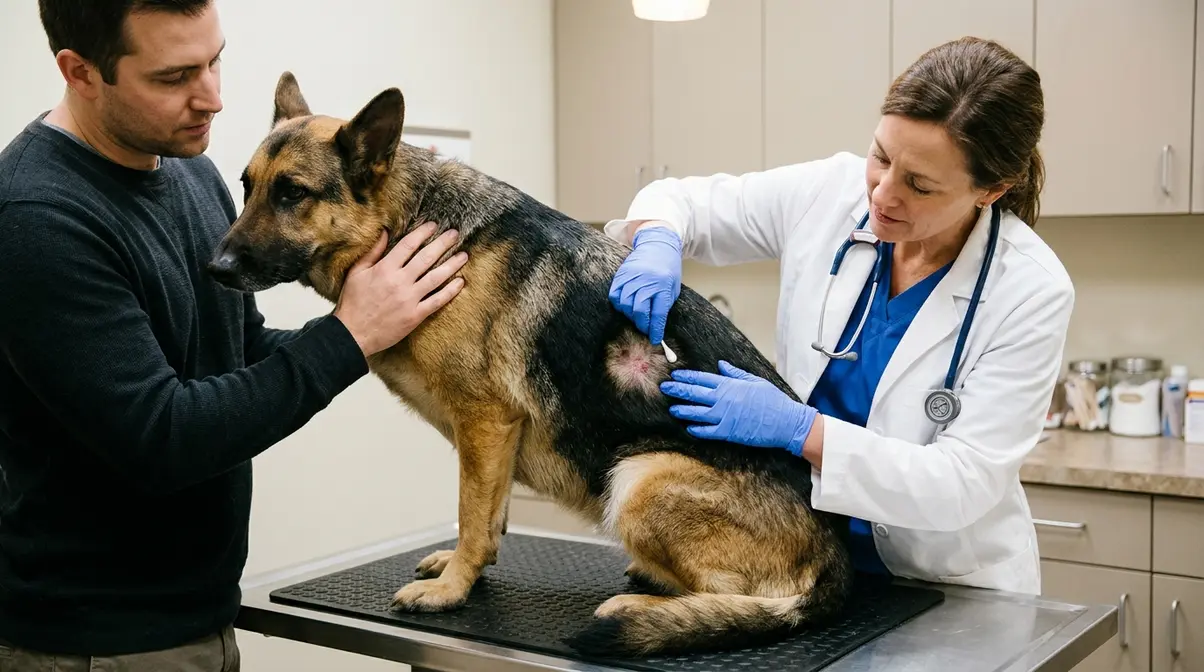
Triage tiers, how to treat German Shepherd skin problems based on urgency:
- See a vet today (emergency):
- Pus or draining lesions anywhere on the body
- Rapid spread, lesion doubling in size within 24 hours
- Strong, foul odor that doesn’t improve with washing
- Signs of pain: crying, guarding the area, refusing to walk
- A new lump or growth, especially firm, fixed, or growing
- Suspected sarcoptic mange or ringworm (contagious to household members)
- Perianal fistula signs: draining tracts around the anus, pain when sitting
- See a vet within 48 hours:
- Hot spot larger than a palm
- Lesion not improving after 24 hours of home care
- Recurring infection (third episode in 12 months)
- Suspected ringworm (zoonotic risk)
- Monitor at home and book a routine appointment:
- Small, localized hot spot caught early
- Mild dry skin
- Known allergy flare with a management plan already in place
Vet-visit checklist, German Shepherd skin problems treatment starts with preparation:
- Bring the “what to photograph” photos from the identification section above
- Note when the problem started and whether it’s seasonal or year-round
- List every product used, shampoos, supplements, medications, diet changes, and the result
- Note the smell (yeasty, sour, none) and the itch pattern (constant, worse at night, only after walks)
- Bring a list of all current medications and supplements
What diagnosis looks like: Cytology (cells examined under a microscope, confirms bacteria versus yeast, typically 10-15 minutes in-clinic); skin scraping (rules out mange, 10-15 minutes); culture and sensitivity testing (identifies the specific bacteria and the antibiotic that kills it, takes three to five days). As of October 2026, typical cost ranges are approximately $50-150 for cytology, $100-250 for culture and sensitivity, and $200-500 for allergy testing, verify current costs with your vet or local veterinary school, as these vary by region and practice.
An owner who brings photos, a symptom timeline, and a product list gives the vet the context to move directly to the right diagnostic test, skipping the repeat questioning that eats up appointment time.
Home remedies are the most-searched topic in this space, and the most misunderstood. Here’s what the evidence actually supports.
Home Remedies: What the Evidence Supports (and What It Doesn’t)
What has some evidence (with caveats):
- Colloidal oatmeal baths: Some veterinary evidence supports oatmeal as a soothing agent for mild skin irritation. Use as a complement to vet treatment, not a replacement.
- Omega-3 fatty acid supplementation: Some veterinary literature supports omega-3s for skin barrier function in atopic dogs. Discuss the specific product and form with your vet before adding.
- Chlorhexidine washes: Veterinary-grade, evidence-based for surface bacterial reduction. This is the one home-care tool with consistent support in veterinary practice.
What lacks evidence and may cause harm:
- Apple cider vinegar: No peer-reviewed evidence for canine skin conditions. Acidic, can irritate and worsen broken or inflamed skin.
- Coconut oil: No peer-reviewed evidence for treating GSD skin conditions. High fat content may worsen yeast overgrowth.
- Quercetin: No peer-reviewed evidence supports its use for canine skin conditions. It is an oral supplement, not a topical agent, do not give it to your dog without veterinary guidance.
Why treatments fail, the troubleshooting list:
- Treating the symptom, not the cause (hot spot without flea control)
- Wrong product for the condition (antifungal shampoo for a bacterial infection)
- Insufficient contact time for medicated shampoos (rinsing too quickly)
- Not preventing licking (no cone)
- Stopping treatment too early (antibiotics need a full course to work)
A GSD whose hot spots “always come back” despite oatmeal baths and coconut oil is showing the classic pattern of an unaddressed underlying trigger. The home remedies soothe the surface; they don’t address the allergy or infection driving the problem.
If you’ve tried a home remedy for more than three to five days without improvement, or if the lesion is worsening, stop and call your vet. Home care is appropriate only for mild, localized, early-stage problems.
Diet is one of the most common things owners change first, and one of the most misunderstood. Here’s what actually works for food-related skin problems.
Best Food for German Shepherds with Skin Allergies
The best food for a German Shepherd with skin problems depends on the confirmed allergy trigger. For food allergy, an 8-12 week elimination diet with a novel protein (venison, duck, kangaroo) or a hydrolyzed protein diet is the diagnostic gold standard. Grain-free diets are not the same as an elimination trial and rarely resolve food allergies on their own.
Many GSD owners switch to grain-free as the first step, and see no improvement. That’s because food allergies in dogs are almost always triggered by a protein source, not a grain. Switching foods without changing the protein is like changing the packaging on the same meal. The best food for a German Shepherd with skin problems isn’t a specific brand, it’s the right diagnostic approach. And the Diagnosis-First Framework applies here too: switching to grain-free without a vet-guided elimination trial is not a food allergy diagnosis. It’s a guess.
Elimination Diets and Novel Proteins: The Diagnostic Gold Standard

An 8-12 week elimination diet with a novel protein is the only reliable diagnostic tool for food allergy in dogs, blood and saliva tests for food allergy have poor sensitivity and specificity, according to veterinary dermatology guidelines, ask your vet for the current evidence base.
The trial works like this: your dog eats a single novel protein (venison, duck, kangaroo, rabbit, a protein it has genuinely never eaten before) and a single carbohydrate source, with nothing else. No treats, no flavored supplements, no table scraps. If symptoms improve significantly over the trial period, food allergy is confirmed. If not, food allergy is effectively ruled out.
Hydrolyzed protein diets offer an alternative for dogs that have eaten many protein sources over their lives. The protein is broken into fragments too small to trigger an immune response. These diets require a prescription from a vet and are not available over the counter.
What to expect: improvement typically begins at four to six weeks, with full resolution at eight to twelve weeks. Partial improvement suggests food allergy is one of multiple triggers, often food allergy combined with environmental allergy. A GSD whose itching improves by 70% on an elimination trial but doesn’t fully resolve likely needs both triggers addressed.
Do not attempt an elimination trial without vet guidance, the diet must be nutritionally complete, and your vet needs to monitor for improvement and rule out other causes simultaneously.
For more on novel protein diets for dogs with food allergies, PetVR’s diet guide covers the full range of options and how to structure a trial correctly.
Grain-free diets are the most popular first step, but the evidence behind them for skin allergies is more complicated than the marketing suggests.
Grain-Free Diets: What the Evidence Actually Says
Grain-free does not equal elimination diet. Grain-free foods frequently contain the same protein sources, chicken, beef, salmon, that trigger food allergies in dogs. Switching from a chicken-based grain-inclusive food to a chicken-based grain-free food changes the grain but not the allergen. The itch continues.
Beyond the protein question, the FDA has investigated a potential link between grain-free diets and dilated cardiomyopathy (DCM) in dogs. The FDA Center for Veterinary Medicine has examined this potential connection, discuss any grain-free diet choice with your vet before switching (FDA, current).
The practical recommendation: if you want to try a dietary change for skin problems, work with your vet to design a proper elimination trial. The trial identifies the specific trigger; a grain-free switch is a guess. An owner who switches from chicken-based kibble to a grain-free chicken-based formula and sees no improvement has changed the grain, not the allergen, the next step is a novel protein trial, not another grain-free brand.
If your GSD has been on a grain-free diet for more than 12 months, mention it to your vet at the next appointment, they may recommend a cardiac screening.
Diet, infections, and allergies are all manageable with the right diagnosis, but some signs mean you need to act today, not next week.
When Should You Be Worried? Red Flags That Need a Vet Today
See a vet today if your GSD has pus, draining lesions, a strong foul odor, rapid spread, signs of pain, a new lump, or suspected mange or ringworm. These signs go beyond home care and need a confirmed diagnosis and prescription treatment. The American Veterinary Medical Association advises seeking immediate care for any rapidly spreading, painful, or draining skin lesion (AVMA, current).
Signs That Need Immediate Vet Attention
- Pus or draining lesions anywhere on the body
- Rapid spread, lesion doubling in size within 24 hours
- Strong, foul odor that doesn’t improve with washing
- Signs of pain: crying, guarding the area, refusing to walk
- A new lump, growth, or swelling, especially firm, fixed, or growing
- Suspected sarcoptic mange or ringworm (contagious to household members)
- Perianal fistula signs: draining tracts around the anus, pain when sitting
This list is not exhaustive. If you’re unsure whether a symptom is serious, call your vet, a phone triage call is always appropriate.
Even when the signs aren’t emergencies, there are situations where home care simply isn’t enough, and continuing to try remedies delays the treatment your dog actually needs.
When Home Care Isn’t Enough
- No improvement after three to five days of home care
- Third or more episode of the same problem in 12 months (recurring infections need a trigger workup, not another course of the same treatment)
- Lesion spreading beyond the original area despite treatment
- Suspected food allergy, this requires a vet-guided elimination trial, not a DIY diet switch
- Any skin problem in a puppy under six months (the immune system is still developing and is more vulnerable to complications)
The Diagnosis-First Framework applies here too, recurring problems need a diagnosis, not a longer list of home remedies.
Before we wrap up, here are the answers to the questions German Shepherd owners ask most often about skin problems.
Frequently Asked Questions About German Shepherd Skin Problems
How can I treat a skin rash?
Start by getting a professional diagnosis, many skin conditions look alike but need opposite treatments. For a localized hot spot, carefully trim the hair around it, clean gently with a veterinary antimicrobial wash such as chlorhexidine, and use a cone to stop licking. Most rashes need a vet-prescribed treatment, medicated shampoos, anti-itch therapy, or antibiotics, to resolve fully. Applying a human cream before diagnosis can worsen an underlying infection rather than clearing it up.
What are the most common tumors in German Shepherds?
Hemangiosarcoma is one of the highest-risk tumors in German Shepherds, with the skin among its common sites. The breed is overrepresented in veterinary oncology caseloads for several tumor types, though no single definitive frequency ranking exists in the published literature. Neoplasia accounts for a meaningful share of recorded deaths in GSD population studies. Any new lump, growth, or lesion needs a veterinary examination, not a wait-and-see approach.
What are some good ointments for treating skin rashes?
The right ointment depends entirely on the confirmed diagnosis, steroids, antifungals, and antibiotics are not interchangeable. Many skin conditions look identical but need opposite treatments; applying a steroid cream to a bacterial infection can worsen it significantly. Ask your vet before applying anything, they may prescribe a medicated shampoo, a targeted anti-itch therapy, or an antibiotic after cytology or skin scrapings confirm the cause. No over-the-counter ointment reliably treats the underlying condition.
Can you show me pictures of a pollen allergy skin rash?
Pollen allergy (atopic dermatitis) in German Shepherds causes chronic redness, thickened skin, and hair loss, concentrated on the face, ears, paws, and belly. It’s often seasonal (worse in spring and fall) but can be year-round when triggered by dust mites or mold. The labeled photo gallery in this article shows what these lesions look like in context. Images are for recognition only, cytology or skin scrapings are the only reliable diagnostic confirmation.
What do autoimmune rashes look like?
Autoimmune skin conditions in German Shepherds vary widely in appearance, the most GSD-specific is perianal fistulas, which cause painful, draining, ulcerated tracts around the anus. Nose-bridge depigmentation and crusting can suggest discoid lupus erythematosus, though biopsy is required to confirm. Many autoimmune lesions look like severe infections or allergies, making visual identification unreliable at home. Only a veterinarian using cytology, skin scrapings, or biopsy can confirm an autoimmune cause.
Will Benadryl make an allergy rash go away?
Benadryl (diphenhydramine) is a human antihistamine, canine dosing, safety, and effectiveness for skin rashes require veterinary guidance, not a label check. Allergies are usually the root cause of recurring hot spots and pyoderma, and treatment depends on the type: environmental, food, or flea. Prescription options like Apoquel or Cytopoint are more reliably effective for canine allergic itch than antihistamines. Ask your vet before giving any human medication to your dog.
Which is better for itchy skin, hydrocortisone or Benadryl?
Neither hydrocortisone nor Benadryl can be recommended without a confirmed diagnosis, they suit different conditions and carry different risks in dogs. Itchy skin needs a diagnosis first, because steroids, antifungals, and antibiotics are appropriate for different underlying causes. Long-term management of canine allergic itch typically includes Apoquel, Cytopoint, medicated shampoos, and year-round parasite prevention. Ask your veterinarian which option, if any, is appropriate for your dog’s specific situation.
What should you never mix Benadryl with?
Drug interactions with Benadryl in dogs are a medical question, no safe or unsafe combinations can be listed here without veterinary guidance. Interactions depend on your dog’s current medications, health conditions, and the specific formulation of diphenhydramine being considered. Tell your veterinarian about every medication, shampoo, and supplement your dog receives before adding anything new. Never combine products on your own, especially while a prescription treatment is already underway.
What to Do Next: Your GSD’s Path to Clearer Skin
German shepherd skin problems, from hot spots and pyoderma to atopic dermatitis and perianal fistulas, are among the most common reasons GSDs visit the vet, driven by the breed’s genetic predisposition to immune-mediated and allergic conditions (vetified.co, 2026). Our review of the veterinary literature on these conditions consistently points to the same conclusion: the Diagnosis-First Framework is the organizing principle, get cytology or skin scrapings before applying any treatment, because the right remedy depends entirely on the confirmed cause. Conditions that look identical need opposite treatments, and guessing costs time, money, and your dog’s comfort.
If you’ve tried Apoquel, grain-free diets, medicated baths, and multiple vet visits without lasting relief, the missing step is almost always a confirmed diagnosis of the underlying trigger, not a new product. The framework in this guide gives you the language and the checklist to make that conversation with your vet count. Describe what you see, note what you’ve tried, and ask specifically about cytology and culture and sensitivity testing.
Start with the “what to photograph” checklist and the vet-visit preparation list from this guide. Book an appointment and bring your photos, your symptom timeline, and your product list. Ask your vet about cytology and culture and sensitivity testing, and whether an 8-12 week elimination trial is the right next step for your dog’s specific situation.
 When to Spay a German Shepherd: Timing Guide