Wobbler Syndrome in GSD and other breeds are narrowing or deformed spinal cervical (neck) vertebrae, generating pressure on the spinal cord by the lower cervical (neck) vertebrae thereby severely affecting the gait of the dog.
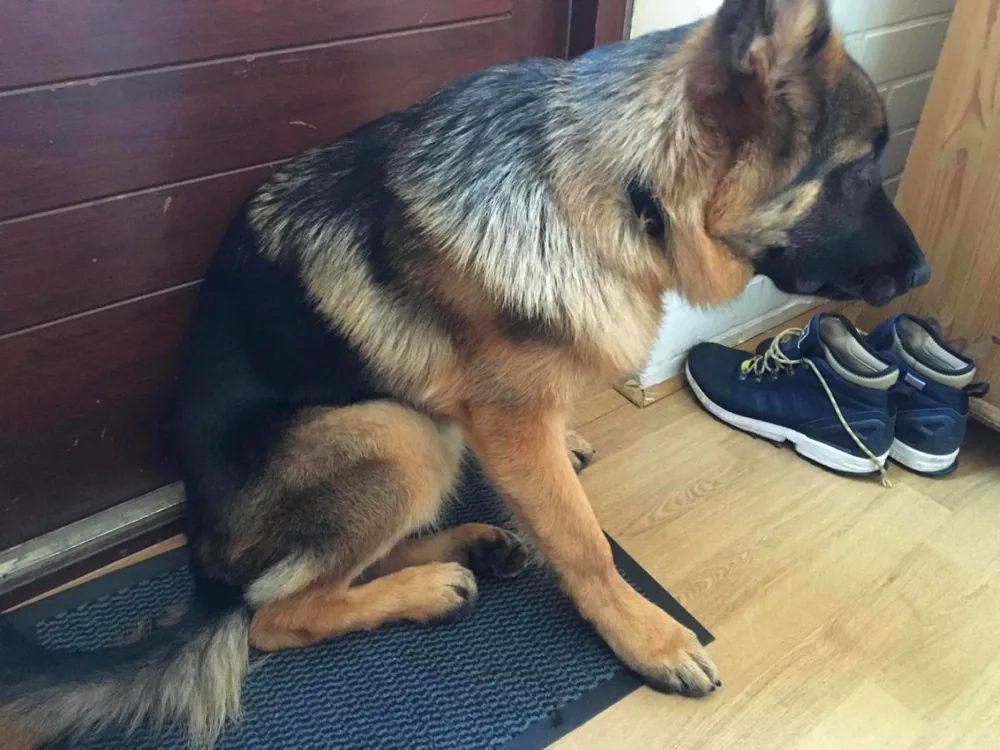
Does your dog feel weak and have an unsteady or wobbly gait? Your pet might be the victim of Wobbler Syndrome which affects its cervical vertebrae (bones in the neck that enclose the spinal cord). Here the problem starts with the narrowing down (or stenosis) of the vertebral canal which leads to spinal cord compression or the rupture of the disc. The resultant effect is cervical instability and it has been noticed that dogs affected have a bulging disc or herniation of the contents of the disc, especially in large breed dogs who are middle or old-aged.
The affected breeds are Dobermans, Great Danes, German Shepherds, Boxers, Basset Hounds, St. Bernards, and Weimaraners. Both puppies and adult dogs are affected. Some other names of Wobbler Syndrome are Cervical Spondylomyelopathy (CSM), Cervical Vertebral Malformation (CVM), and Cervical Vertebral Instability (CVI). The exact reasons for the abnormalities in the vertebral column are still not known correctly. Scientists assume that there may be a probability a genetic factor that plays its role. Although this condition is mostly found in certain families of great Danes, the German Shepherd Dog breed is no exception.
The gait that names this condition
If you learn one thing from this page, learn this description, because it is unusually specific and it is what separates wobbler from everything else.
Merck describes “subtle ataxia of all limbs, often evident as a long, protracted stride in the pelvic limbs, with short-strided gait in the thoracic limbs” (Merck Veterinary Manual, retrieved 2026-08-12).
In plain terms: long and floaty behind, short and choppy in front. The back end swings out too far and lands imprecisely, while the front legs take small, careful steps. It is where the name comes from, and it is why owners describe a dog that looks slightly drunk.
All four limbs is the other half of the clue. A condition affecting only the hind legs is not this one, because the compression sits above the nerves supplying the front legs too.
Film it. A ten-second video of your dog walking away from you and towards you tells a vet more than any description you can write, and gait is exactly the kind of thing that improves the moment you enter a consulting room.
Straight answer on breed first
You are probably here because your German Shepherd is unsteady on its feet. So before the detail, the useful truth.
Wobbler syndrome is not a German Shepherd condition. Merck describes two forms and names different breeds for each. The disc-associated form “affects middle-aged large-breed dogs, especially Doberman Pinschers”, and the bone-associated form “affects young giant-breed dogs, including Great Danes, Mastiffs, and Rottweilers” (Merck Veterinary Manual, retrieved 2026-08-12). The German Shepherd is not named for either.
Can it happen in this breed? Any large dog can develop cervical spinal cord compression. But if your German Shepherd is wobbly, there are three conditions that are considerably more likely, and they are listed near the end of this page. That section is probably the most useful part of it for you.
We are telling you this rather than implying otherwise, because a wrong assumption here costs you weeks chasing the wrong diagnosis.
What wobbler syndrome actually is
The proper name is cervical spondylomyelopathy. Merck defines it as “compression of the spinal cord caused by abnormal development of the cervical vertebrae” (retrieved 2026-08-12).
The problem is in the neck, and that is the key to the whole picture. Nerve signals to all four legs pass through the neck, so a compression high up affects the whole dog, not just the back end.
Two versions, two age groups:
| Form | What compresses the cord | Who gets it | Typical age |
|---|---|---|---|
| Disc-associated | A bulging disc in the lower neck | Middle-aged large breeds, especially Dobermans | Around 7 years |
| Bone-associated | Malformed vertebrae narrowing the canal | Young giant breeds: Great Danes, Mastiffs, Rottweilers | Several months to 4 years |
What Happens in Wobbler Syndrome?
The space between two vertebrae is cushioned by fluid-filled discs. But in a Wobbler patient, in due course of time, the disc degenerates and ruptures. This exerts additional pressure on the spinal cord. Even skeletal changes can be seen. The vertebral ligaments become loose and overstretched in nature. The cause of the disease is not yet known and there is a possible genetic connection to the disease.
Wobbler Syndrome Signs
The main problem with Wobbler Syndrome is a crouching stance since the dog fails to coordinate its limbs and the torso. In some cases, the dog drags the toes of its rear leg. Gradually dragging starts in the front legs too. Apart from neck pain, the pet shows signs of general weakness. The head shows stiffness and is carried on a bent-down posture. The walk of the dog becomes so very clumsy that it becomes difficult for it to maintain body balance – the reason why it falls in an attempt to turn quickly. The gait is that of a drunken person – mild incoordination in movement (ataxia), which can eventually get escalated to the involvement of the front legs. It might also lead to paralysis of the hind and front legs. In many cases, Wobbler Syndrome shows signs that match the clinical symptoms of other bone disorders and diseases like arthritis, hip dysplasia, and infection of the inner ear. The signs are progressive , which means that in adult dogs the symptoms become more prominent. In German Shepherd Dog, Wobbler syndrome is usually noticed at the age of approximately 4 or 5 years, although a subject can also be diagnosed with this condition at the age of 10 to 12 months. The major signs include:
- Shows a change in the shape of the body of the vertebra
- Shows apparent loss of cranioventral corner of the Vertebrae
- Shows the unusual width and shape of the disc space cranial to the affected region of the vertebra.
- Shows calcification of the affected disc
- Shows osteophyte formation or reactive bone and end-plate sclerosis
- Shows deformity in the articular processes
How to Diagnose Wobbler Syndrome?
An X-ray investigation shows that the Wobbler Syndrome-affected dog has malaligned vertebrae and disk spaces that are narrowed. MRI or CT scans can point to the exact place of compression in the spinal cord.
Prevention and Treatment
Since genetics is believed to have been playing its role here, selective breeding is the only best way to avoid producing wobbler offspring. Avoid feeding a very high quality (high protein diet) to your puppies right after the weaning. The overdosage of calcium and protein in puppy foods may expose them to the risk of this condition. Administering multiple vitamins in the right dose is suggested to avoid this condition.
The treatment depends largely on a series of distinctive factors such as the severity of the condition, age of the subject, prospects of the long-term treatment process, and so on… The administration of corticosteroids plays an effective role in controlling the symptoms. The steroid medication works to reduce the swelling in the compressed area. Surgery can also be considered to rectify spinal cord compression. Here the ruptured disc material is removed to stabilize the affected vertebrae. One more treatment option at my disposal is electroacupuncture. A neck brace proves to be of great support for the spine; it also reduces inflammation. One important point to note is Wobbler Syndrome cannot be cured but definitely treatments are available to alleviate the pain and discomfort.
Suggestions
The food and water bowl have to be elevated to further decrease the pressure in the neck region. Certain activities/games where the dog has to dip down his head should be avoided, for instance, playing fetching balls, etc.
Food plays a pivotal role in keeping Wobbler Syndrome at bay. Do not feed your pet a high protein diet which can easily catalyze the development of Wobbler disease. In many cases, there are no preventive measures for the disease because of its genetic connection. According to many reputable breeders, there has been a noticeable downfall in the number of incidences of Wobblers Syndrome and certain other growth-related diseases in German Shepherds and other canine breeds when the body weight is kept under control growth rate is nutritionally slowed down. However, nutritionally controlling the growth rate has to be scientific. Your puppy should not be exposed to diseases caused by malnutrition. Experts’ guidance in this regard is however essentially necessary.
How it is confirmed
Not on a plain X-ray. Merck is direct: “definitive diagnosis requires myelography, CT, or MRI” (retrieved 2026-08-12).
Ordinary radiographs may show changes in the vertebrae, but they cannot show the spinal cord itself or how much it is being squeezed. Since the treatment decision hinges on where the compression is and how severe, advanced imaging is what that decision has to rest on.
Practically, that usually means a referral. If you are being asked to travel for an MRI, this is why.
Treatment: the two routes and their numbers
Merck gives figures for both, and they are worth knowing before the conversation rather than during it.
Medical management is “exercise restriction, prednisone, and, if necessary, weight loss”, with improvement in roughly 50% of cases (Merck Veterinary Manual, retrieved 2026-08-12).
Surgery: “overall, ~80% of dogs do well with surgery” (retrieved 2026-08-12).
Those numbers frame the decision honestly. Medical management helps half of dogs and avoids spinal surgery. Surgery helps most dogs but carries the risks and cost of a major procedure on the neck. Neither is the obviously correct answer, which is why this is a conversation and not an instruction.
One practical note that applies whichever route you take: use a harness rather than a collar. A dog with a compressed cervical spinal cord should not have pressure applied to its neck by a lead.
What a wobbly German Shepherd usually has instead
This is the section to act on.
| What you see | Consider first |
|---|---|
| Hind legs only, weak and wobbly, no pain, knuckling over, older dog, slowly worsening | Degenerative myelopathy |
| Sore lower back, tail weakness, hind-limb lameness, aged 3 to 7 | Degenerative lumbosacral stenosis. Merck names this breed specifically for it. Covered in our spinal disc article |
| Difficulty rising, bunny-hopping, stiffness after rest, pain | Hip dysplasia |
| Neck pain, reluctance to lower the head, all four limbs affected | Cervical disc disease or wobbler |
Two questions sort most of this out faster than anything else. Is your dog in pain? Degenerative myelopathy is painless; disc and lumbosacral problems hurt. Are the front legs involved? Front-leg involvement points at the neck; hind-legs-only points lower down.
Take the answers, and a video, to your vet. Our care guide covers mobility monitoring as dogs age.
What to write down before the appointment
Neurological problems are diagnosed largely on pattern, and the pattern lives in your observations rather than in the consulting room. Ten minutes of notes genuinely changes the quality of the appointment.
- Which legs. Hind only, or all four? This single answer splits the list in half.
- Pain or no pain. Does your dog object to being touched anywhere along the spine or neck? Does it yelp on rising?
- How the paws land. Look at whether the toes drag or the paw turns under, and whether the nails on one side are worn flat.
- Speed of change. Weeks, months or years. Sudden onset and slow decline point in different directions.
- Better or worse with exercise. Some problems ease as the dog warms up; others worsen the longer it goes.
- Continence. Any change in bladder or bowel control is significant and is often not volunteered because owners find it embarrassing.
- Video. Walking away, walking towards, and turning a tight circle. Turning often exposes hind-limb weakness that straight-line walking hides.
Take the notes and the video with you. A vet watching your dog move on film at the point where it was actually struggling is working with far better information than one watching an adrenalised dog on a clinic floor.
A note on prevention, and on what cannot be prevented
Wobbler syndrome arises from how the vertebrae developed, so there is no exercise plan or supplement that prevents it. Anyone selling you one is selling you something else.
What is worth doing for any large dog, and helps whichever of these conditions you are dealing with, is unglamorous: keep the dog lean for its whole life, use a harness rather than a collar for a dog with any neck or spinal issue, give it traction indoors, and keep muscle on with steady moderate exercise rather than bursts of high impact.
None of that is a cure. All of it reduces the load on a spine that is already working harder than it should.
 Digestive Tract Disorder in German Shepherds