OCD or Osteochondritis is a disease when there’s some development defect in cartilage bone tissue. Any joint (shoulder, elbow, stifle, hock) in the body of the dog can get affected by OCD because here cartilage has a great role to play in the smooth gliding of one bone over the other. In this regard cartilage is a flexible tissue that lines or connects the surfaces of two bones. But when the cartilage gets lifted or separated from its place the dog feels pinching pain because the hard surfaces of the bones come in close contact and friction.
Usually, large breed dogs are affected by OCD, especially when they are within the tender age of 4-8 months. But OCD can even happen even in the later stages of a dog’s life. Some of the common dog breeds affected by this disease are German Shepherds, Labrador Retrievers, Great Danes, and likewise. The shoulder is by far the most commonly affected joint, followed by the elbow, the stifle (knee) and the hock (ankle) (VCA Animal Hospitals, retrieved 2026-08-12). Merck lists the same four joints (Merck Veterinary Manual, retrieved 2026-08-12). Male dogs have a high incidence of OCD compared to female dogs.
The part you can actually control: how you feed a big puppy
Most of the causes are outside your hands. Genetics, hormones, blood supply, plain bad luck. One is not.
VCA is direct about it: “this disease is more common in dogs receiving too much energy, protein and calcium in the diet. Other factors may also include genetics, rapid growth, trauma, lack of blood flow, and hormonal factors” (retrieved 2026-08-12).
Read that first sentence again, because it runs against instinct. Owners of large-breed puppies often try to help by feeding richer food, adding calcium, or topping up with supplements to “support the joints”. Over-supplementing calcium in a growing large-breed puppy is not neutral. It is a risk factor.
What this means practically:
- Use a large-breed puppy formulation and follow the feeding guide rather than free-feeding. These diets are formulated to slow growth to a healthier rate, not to maximise it.
- Do not add calcium to a complete commercial diet unless your vet has specifically told you to.
- Keep the puppy lean. A fast-growing heavy puppy is loading immature joints.
- Be sceptical of joint supplements marketed for growing puppies. Ask your vet before adding anything.
- Go easy on high-impact exercise while the growth plates are open. Repeated jumping and hard turns on a young joint are trauma, which is on the same list of contributing factors.
Bigger and faster is not better in a breed like this. Steady is better.
The age window: 6 to 9 months
If there is one thing to take from this page, it is when to be watching.
VCA states that OCD “occurs in rapidly growing large breed dogs between 6 and 9 months of age and tends to occur more often in male dogs” (VCA Animal Hospitals, retrieved 2026-08-12).
That is a narrow, predictable window, and it lands right in the middle of a German Shepherd puppy’s fastest growth. It is also the age when owners are most likely to explain away a limp as “he tweaked it playing” and wait to see if it settles.
A limp in a large-breed puppy between six and nine months is worth an X-ray rather than a wait-and-see.
The Cause Behind OCD
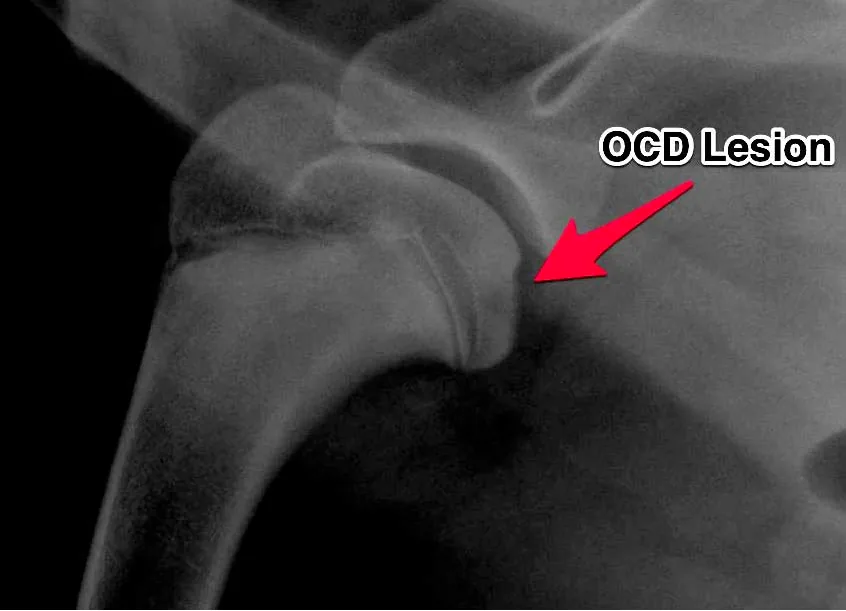
Osteochondritis is a developmental disease of growing bone tissue caused by improper growth of cartilage with respect to neighboring cartilage. Development failure results in the thickening of cartilage and hence it becomes vulnerable to injury. The thickened cartilage is fragile and any kind of external force like a sudden jump or leap of the dog might lead to a crack, wherein the cartilage lifts itself away from the bones. Sometimes the cartilage flap gets fully or partially detached. This causes difficulty in the gliding action of the bones since there’s an abrasive rub between the two bones.
What Signals OCD?
The first signal of OCD is a limp in either one or both hind limbs of the dog, no matter where’s the existence of OCD. The shoulder, elbow, stifle and hock are the joints to watch. OCD is a cartilage-and-bone lesion inside a joint, so the lumbosacral spine is not a typical site. Persistent hind-end weakness or wobbliness in a German Shepherd points instead to hip dysplasia, degenerative myelopathy or lumbosacral disease, and each of those needs a different work-up. The dog faces great difficulty in rising up and shows stiffness while walking. A slinky or lazy gait is a characteristic of the disease because of joint inflammation. The dog tends to avoid stairs and jumping off a deck. The pet loses interest in normal walking and running activities. There’s a lack of enthusiasm for chasing a ball, which supposedly happens to be a favorite activity of the pet.
OCD Diagnosis
Accurate diagnosis is possible through X-rays and CT (Computed Tomography) scans. Diagnosis time is very crucial because if OCD is detected late (past one year), there is a slim chance for the dog to recover.
What’s the Treatment for OCD?
The most effective treatment lies in surgery. But before the development of defective cartilage flaps or lesions preventive action can be taken by the administration of pain-relieving medications like NSAIDs. There are other conservative management measures for OCD like exercise restriction, weight control, nutritional factors, and nutraceuticals like glucosamine. All these are targeted toward normal cartilage development. But when the case has worsened and an abnormal cartilage flap has developed the only way out is surgical healing. Surgery is made through medical processes called arthroscopy (camera and instruments are passed through tiny incisions) or arthrotomy (open-joint surgery techniques).
Genetic management is also important to keep OCD at bay. An OCD dog should ideally be neutered in order to check the inheritance of genetic traits in future generations. Pet owners can take another proactive measure by feeding their pets a low-calorie diet. Calcium supplements are also advised by veterinary experts. The idea behind this is to control the abysmal rate of growth in the cartilage lining the bones.
Prognosis depends on which joint
This is the detail most articles leave out, and it changes how worried you should be.
VCA states: “If the shoulder joint is affected, the prognosis is good; if the elbow joint is affected, the prognosis is guarded” (VCA, retrieved 2026-08-12).
Since the shoulder is the most commonly affected joint, the most likely version of this diagnosis is also the most treatable one. That is genuinely good news to have on the drive home from the clinic.
The elbow is a harder joint to get a clean result from, which is why an elbow lesion carries a more cautious outlook. Either way, osteoarthritis in the affected joint later in life is a real possibility, so long-term weight control and sensible exercise stay part of the plan well after the acute problem is dealt with.
What treatment actually involves
There are two routes, and which one applies depends on how loose the cartilage is.
Conservative management. VCA describes this as “strict rest and activity restrictions for several weeks” (retrieved 2026-08-12). Strict is the operative word. That means lead walks only and no stairs, sofas or garden zoomies, for a young dog that wants none of those restrictions. Most owners underestimate how hard this is, and half-doing it is how conservative management fails.
Surgery. Where a flap has separated, “surgery will be required to remove the defective flap or the floating piece” (retrieved 2026-08-12). The loose fragment is what keeps irritating the joint, so removing it is what allows the surface to heal over.
Diagnosis comes first either way. VCA notes radiographs are usually performed, with ultrasound or an arthroscopic examination required in some cases (retrieved 2026-08-12). Merck lists the same four joints, the shoulder, elbow, stifle and hock, as the sites where the abnormal ossification happens (Merck Veterinary Manual, retrieved 2026-08-12).
Related joint and mobility conditions
A limping or wobbly German Shepherd is not always OCD, and the alternatives are treated very differently. See hip dysplasia and elbow dysplasia for the two developmental conditions most often confused with it, panosteitis for the shifting-leg lameness that turns up at a similar age, and degenerative myelopathy for painless hind-end weakness in an older dog. Our care guide covers growth and exercise for puppies.
What OCD actually is, in plain terms
The name is intimidating and the mechanism is not.
A growing puppy builds bone by laying down cartilage first and then converting it to bone underneath. In OCD that conversion goes wrong in one patch. The cartilage there keeps thickening instead of turning to bone, and because cartilage has no blood supply of its own, the thickened patch starves. VCA describes the result as “an inflammatory condition that occurs when the diseased cartilage separates from the underlying bone” (VCA Animal Hospitals, retrieved 2026-08-12).
Picture a loose tile on a floor. While it stays put, the surface is still walkable. Once an edge lifts, every step catches it, and the movement is what keeps the joint inflamed. If it detaches completely it becomes a free fragment inside the joint, sometimes called a joint mouse.
That is why treatment splits the way it does. A patch that is still attached may settle with rest. A lifted flap generally has to come out, because nothing heals underneath a piece that keeps moving.
What you will actually notice at home
OCD is a lameness problem, and the lameness is not always dramatic.
VCA describes affected dogs as typically limping or lame in the affected leg or legs, with the joint sometimes “swollen and warm to the touch.” It also notes the variation: “the lameness may be mild and intermittent, while in other cases, the dog may be in constant pain” (retrieved 2026-08-12).
Things owners of a six to nine month old puppy should treat as worth a call:
- A limp that comes and goes rather than one that steadily improves. Intermittent does not mean minor here.
- Stiffness after rest, particularly first thing in the morning or after a nap following a big day.
- A shortened stride or a nodding head when trotting, which is how front-leg lameness usually shows.
- Heat or swelling around a joint, especially the shoulder or elbow.
- Reluctance to take stairs, jump into the car, or play as long as usual.
- Flinching when a specific joint is handled. Do not go digging around a painful joint yourself; just note which one and tell the vet.
Because it often affects both sides, a dog with bilateral shoulder OCD may not show an obvious limp at all. It just moves oddly, or gets tired quickly, or seems reluctant. That version is very easy to write off as a lazy puppy.
Questions worth asking your vet
- Which joint, and is it one side or both? This drives the prognosis, and OCD is frequently bilateral.
- Is the fragment still attached, or has it lifted? That is the difference between rest and surgery.
- If we try rest first, how strict, and for how long, and what do we do if it does not work?
- Should the other joints be X-rayed while we are here? Worth asking, given how often both sides are involved.
- Is my puppy’s diet right for a large breed? Bring the food bag label and every supplement.
- What does the exercise plan look like for the next six months?
- What can we do now to slow arthritis later? Weight control is usually the answer, and it starts immediately.
 Subaortic Stenosis – SAS in German Shepherds: Symptoms and Treatment