
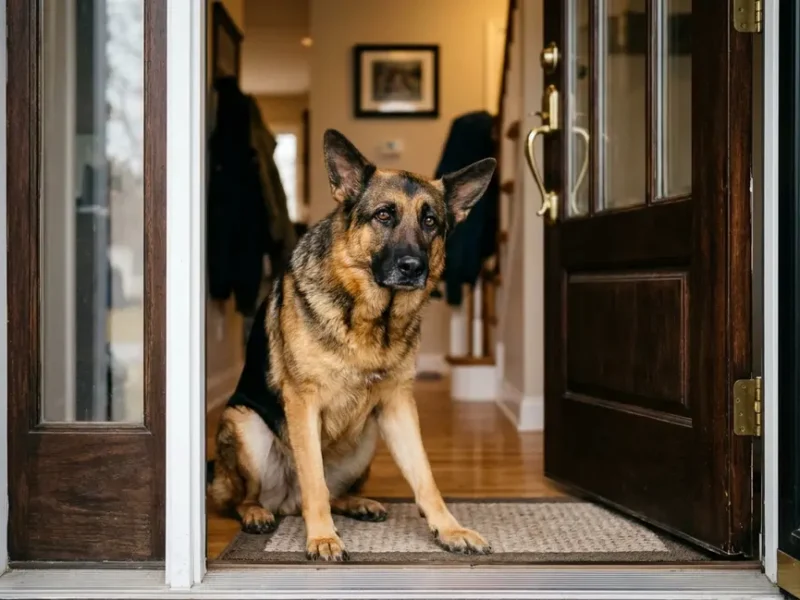
You came home to shredded door frames, a soiled floor, and a dog that looks both guilty and desperate. If that sounds familiar, you’re not imagining the problem, and you’re not alone.
“We just got a 1-year-old female German Shepherd about 2 weeks ago. She has severe separation anxiety, keeps having accidents in the house often …”
, GSD owner, r/germanshepherds
The instinct is to scold, to say a long goodbye, or to hope she “grows out of it.” Each of those responses makes things worse. German Shepherd separation anxiety is a genuine panic response, not stubbornness, not spite, and it needs a structured plan, not a correction.
By the end of this guide, you’ll know exactly what’s driving your German Shepherd’s panic, how to build your dog’s confidence step by step, and when to bring in professional help. This guide covers the signs, the root causes, a five-step training plan with specific timing examples, and a clear path to a vet or behaviorist when you need one.
German shepherd separation anxiety is a genuine panic response, not bad behavior, that affects many GSDs because of their intense pack-bonding instincts.
- Recognize the signs: Vocalization, destructive chewing, house soiling, and pacing that start within 20-45 minutes of your departure are the clearest indicators.
- Don’t punish: Scolding an anxious dog increases fear and makes the problem worse.
- Train gradually: Desensitize departure cues, then build alone time from seconds to minutes, advancing only when your dog is fully calm.
- Use comfort aids: Exercise first, then try calming tools (an item of your clothing, white noise, Adaptil diffusers) as supplements, not fixes.
- Know when to escalate: Severe or self-injuring cases need a vet or certified applied animal behaviorist, not more training alone.
- In This Guide:
- Do German Shepherds Get Separation Anxiety?
- What Does German Shepherd Separation Anxiety Look Like?
- Are Puppies and Rescue Dogs More at Risk?
- Training a German Shepherd with Separation Anxiety
- When Should You Consider Treatment or Medication?
- Frequently Asked Questions
Do German Shepherds Get Separation Anxiety?
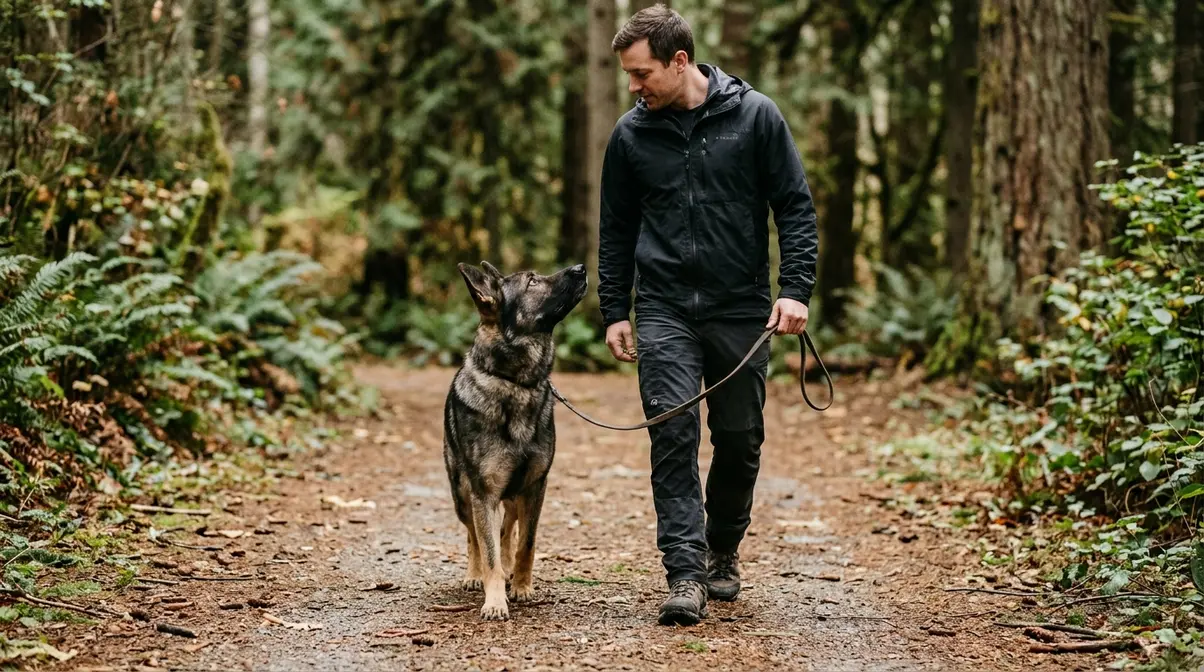
Yes, German Shepherds are among the breeds most commonly affected by separation anxiety. Their intense bond with their handler, high intelligence, and sensitivity to routine mean they notice every departure cue and can spiral into genuine panic when left alone. Understanding why this happens is the first step toward fixing it.
What Is Separation Anxiety in Dogs?
Separation anxiety is a genuine emotional panic response that occurs when a dog is left without its bonded person, not misbehavior, not spite, and not a sign your dog is badly trained. According to ASPCA guidance, the condition is defined by distress behaviors that happen specifically because of the owner’s absence, not for any other reason.
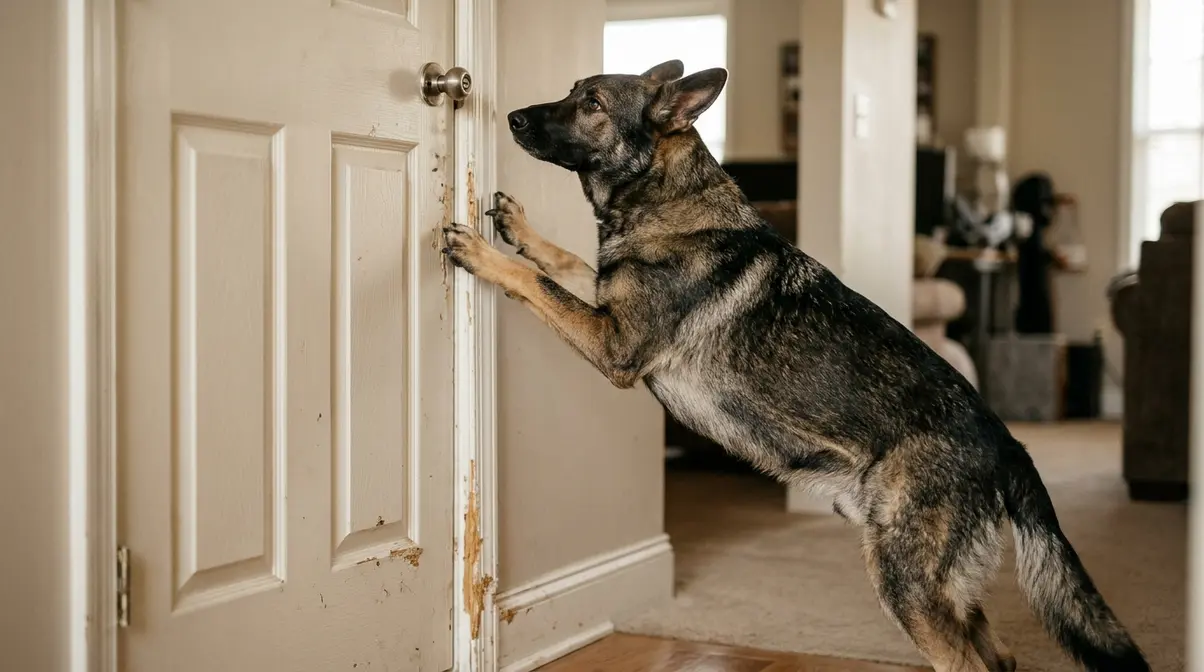
That distinction matters. A dog that chews the sofa while you’re watching TV is under-stimulated. A dog that chews only when left alone, targeting doors, window frames, and exit points, is panicking. The behavior looks similar on the surface; the cause is completely different. Understanding what to expect from a German Shepherd’s temperament helps frame why the breed is particularly prone to this kind of distress.
Separation anxiety is one of the most commonly reported behavior problems in dogs, according to VCA Hospitals, though exact prevalence figures vary across sources and should be confirmed with your vet. The key reframe: this is not a discipline problem. Treating it like one makes it worse.
Why Are German Shepherds So Prone to It?
German Shepherds weren’t bred to be house pets. They were developed for close, constant cooperation with a human handler, herding livestock, working alongside police and military units, performing search-and-rescue operations. That genetic drive to stay near “their person” is a feature of the breed, not a flaw. According to Petworks guidance, the GSD’s close attachment to its handler is a defining breed trait, a feature that makes separation particularly difficult for many dogs.
A German Shepherd with anxiety around departures isn’t being difficult. It’s responding to a genetic drive that was an asset in working environments but becomes a source of distress in a home where the owner leaves for hours at a time. Add high intelligence to that equation and you get a dog that reads its environment with precision. Your GSD isn’t just noticing when you leave, it’s cataloguing the cues that predict your departure. The moment you reach for your keys, the panting starts. Before you’ve put on your shoes, the pacing begins.
Some GSDs sit outside the bathroom door. Others follow their owner from room to room throughout the day, maintaining visual contact at all times. That level of vigilance is an asset on a working farm or a police unit. In a home where the owner leaves for eight hours a day, it becomes a source of genuine suffering. The intensity of the human-GSD bond is a direct risk factor: the stronger the attachment, the harder the separation.
What Triggers Separation Anxiety in German Shepherds?
Knowing the breed’s vulnerability helps, but knowing what triggers a specific episode helps you prevent it. Common triggers for separation anxiety in German Shepherds include:
- Sudden routine change: An owner who returns to the office after working from home, a family member who moves out, or a new baby that reshapes the household dynamic.
- Rehoming or shelter stays: A newly adopted GSD has lost its previous bonded person and is adjusting to a new environment at the same time. Each transition is a potential trigger.
- Lack of gradual alone-time practice: A puppy or adult dog that has never spent more than a few minutes alone has no framework for coping with longer absences.
- Loss of a companion animal: Dogs that have lived with another pet may struggle when that companion is no longer present.
The owner in the quote above, a 1-year-old GSD adopted two weeks prior, showing accidents and panic, is a textbook example of a rehoming trigger. According to All Shepherd Rescue, this pattern is common in newly placed German Shepherds, and it’s manageable with patience and consistent practice.
These triggers are common. The condition responds to structured training. Once you know the triggers, the next step is recognizing the signs, and telling them apart from ordinary boredom.
What Does German Shepherd Separation Anxiety Look Like?
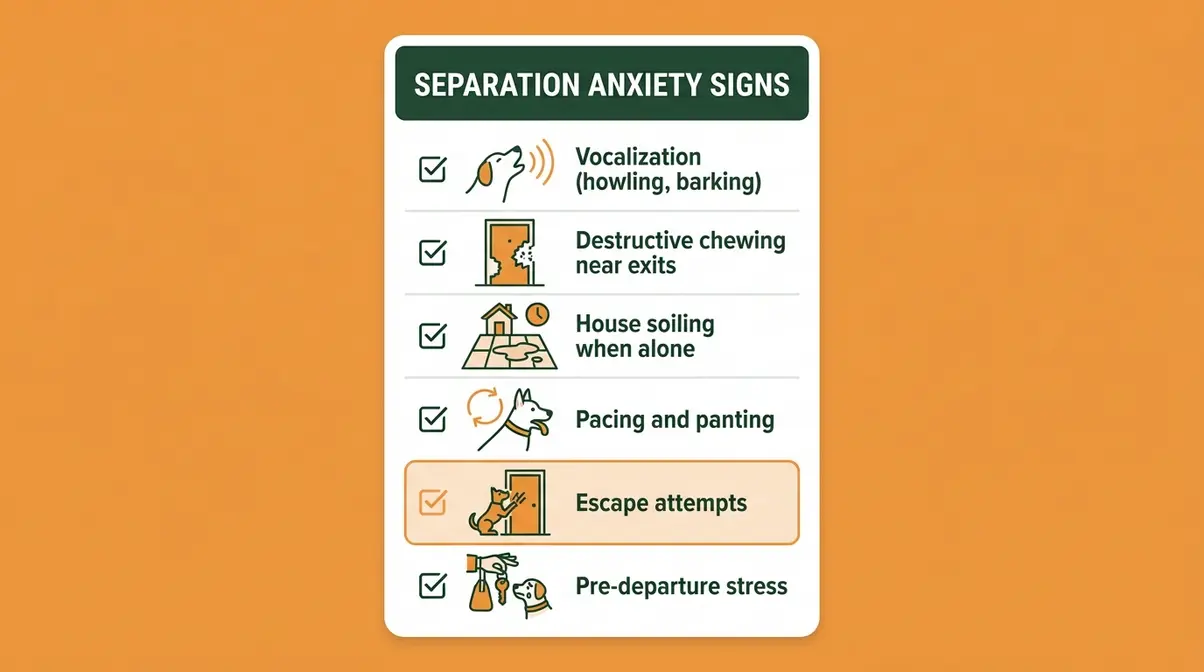
The most common German Shepherd separation anxiety symptoms are vocalization (howling, barking), destructive chewing near exits, house soiling in a trained dog, pacing and panting, and pre-departure stress, all starting within 20 to 45 minutes of your departure and stopping when you return. Boredom behaviors happen at any time, including when you are home.
German Shepherd Separation Anxiety Symptoms to Watch For
Knowing the signs helps you confirm what you’re dealing with, and knowing the reasons German Shepherds whine can help you distinguish anxiety-driven vocalization from other causes. According to VCA Hospitals, the clinical signs of separation anxiety include:
- Vocalization (german shepherd anxiety whining, howling, barking): Starts within 20 to 45 minutes of departure, directed at exits or windows.
- Destructive chewing: Focused on exit points, door frames, window sills, door handles, not random objects. This is distinct from puppy chewing.
- House soiling: Accidents in a house-trained dog, occurring only when alone. One of the most distressing signs for owners (“keeps having accidents in the house”).
- Pacing and panting: Repetitive movement near exits, excessive drooling, and visible physical stress.
- Escape attempts: Scratching at doors, windows, or crates. In severe cases, dogs injure themselves breaking out of crates or through windows.
- Pre-departure stress: Clinginess, trembling, or panting that begins when you pick up your keys or put on your shoes, before you’ve left.
A GSD that is calm all day while you work from home, then begins panting and pacing the moment you pick up your bag, is showing clear anxiety signals. The behavior is departure-linked, not random.
Separation Anxiety vs. Boredom: How to Tell the Difference
The single most reliable diagnostic cue is timing. Anxiety behaviors start within 20 to 45 minutes of your departure and stop when you return. Boredom behaviors happen at any time, including while you’re sitting in the next room.
Context matters just as much. Anxiety in German Shepherds is almost always departure-linked, the timing is the clearest diagnostic cue. A GSD that chews a shoe while you’re at work is showing anxiety signals. A GSD that chews a shoe while you’re watching TV is bored and under-stimulated. The table below, built from ASPCA criteria and VCA Hospitals guidance, gives you a quick reference:
| Behavior | Separation Anxiety | Boredom / Under-Stimulation |
|---|---|---|
| Timing | Starts within 20-45 min of departure | Happens at any time, including when owner is home |
| Vocalization | Howling, barking directed at exits | Occasional barking, not departure-linked |
| Chewing | Focused on exits (doors, windows) | Random objects, toys, furniture |
| House soiling | Only when alone, in a house-trained dog | Rare; more likely incomplete training |
| Pacing | Repetitive, near exits | Occasional, not exit-focused |
| Trigger | Owner’s absence | Lack of stimulation |
Criteria adapted from ASPCA and VCA Hospitals.
If the timing and context match the anxiety column, you’re dealing with separation anxiety, not a training gap or a bored dog.
When Do the Signs Start?
Most separation anxiety behaviors begin within the first 20 to 45 minutes after you leave. The tricky part: the behavior often stops before you return, so many owners don’t realize it’s happening at all.
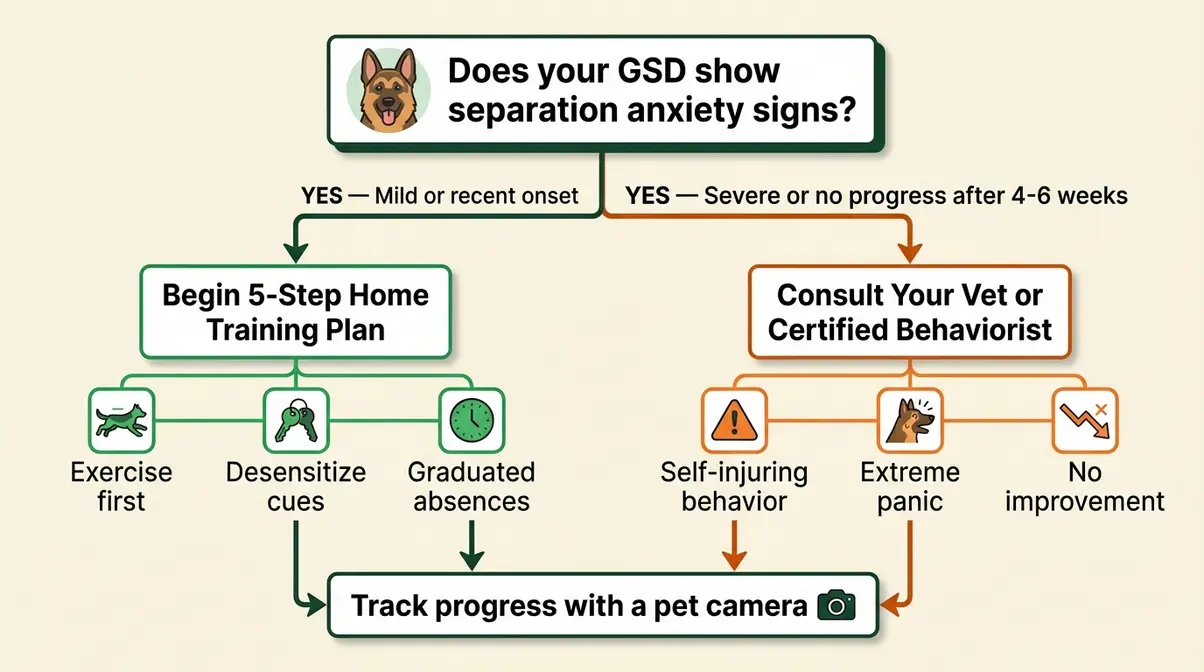
A pet camera is one of the most practical tools available. An owner who comes home to a destroyed door frame but never hears the howling often discovers, on camera, that the panic started 15 minutes after departure and lasted for an hour. That footage also tells you whether your training is working.
If the timing and context match the anxiety column above, the next question is whether your dog’s age or background puts them at higher risk.
Are Puppies and Rescue Dogs More at Risk?
Yes, both puppies and rescue dogs are at higher risk for separation anxiety, for different reasons. Puppies haven’t yet learned that being alone is safe. Rescue dogs have often experienced loss and are adjusting to a new environment at the same time. Both respond to the same training approach, though the starting point differs.
German Shepherd Puppy Separation Anxiety
Puppy howling when left alone is a distress call, not defiance. German shepherd puppy separation anxiety happens because the puppy has never learned that your departure always leads to your return, that being alone is temporary and safe. The howling is the puppy’s way of signaling distress.
The good news: puppies typically respond faster to gradual alone-time training than adult dogs do. They haven’t yet formed a deep, entrenched anxiety pattern. A 10-week-old GSD that howls for 30 minutes after being left in a crate for the first time is showing normal distress, not a permanent condition. With consistent, gradual practice, most puppies adjust within a few weeks.
The fix is the same as for adults: start with very short absences, return before the puppy shows stress, and build duration gradually. Consistency matters more than speed. If the howling continues beyond the first few weeks of gradual practice, or if your puppy shows signs of self-injury, a vet conversation is the right next step.
German Shepherd Rescue Separation Anxiety and the 3-3-3 Rule
Rescue German Shepherds often arrive with a history of loss, a previous bonded person, a shelter stay, or multiple rehomings. Each transition is a potential trigger for german shepherd rescue separation anxiety, because the dog is simultaneously grieving a lost bond and adjusting to unfamiliar surroundings.
A widely used framework in rescue communities is the 3-3-3 rule: a newly adopted dog needs roughly 3 days to decompress, 3 weeks to learn the household routine, and 3 months to feel truly at home. According to All Shepherd Rescue, this adjustment period is common and expected, separation anxiety during these phases is not a sign that something is wrong with your dog.
During the adjustment period, keep departures short, predictable, and calm. Don’t push the dog to be alone for long stretches in the first few weeks. The owner from the opening quote, two weeks in, severe anxiety, accidents in the house, is in the decompression phase. Patience and gradual practice are the path forward.
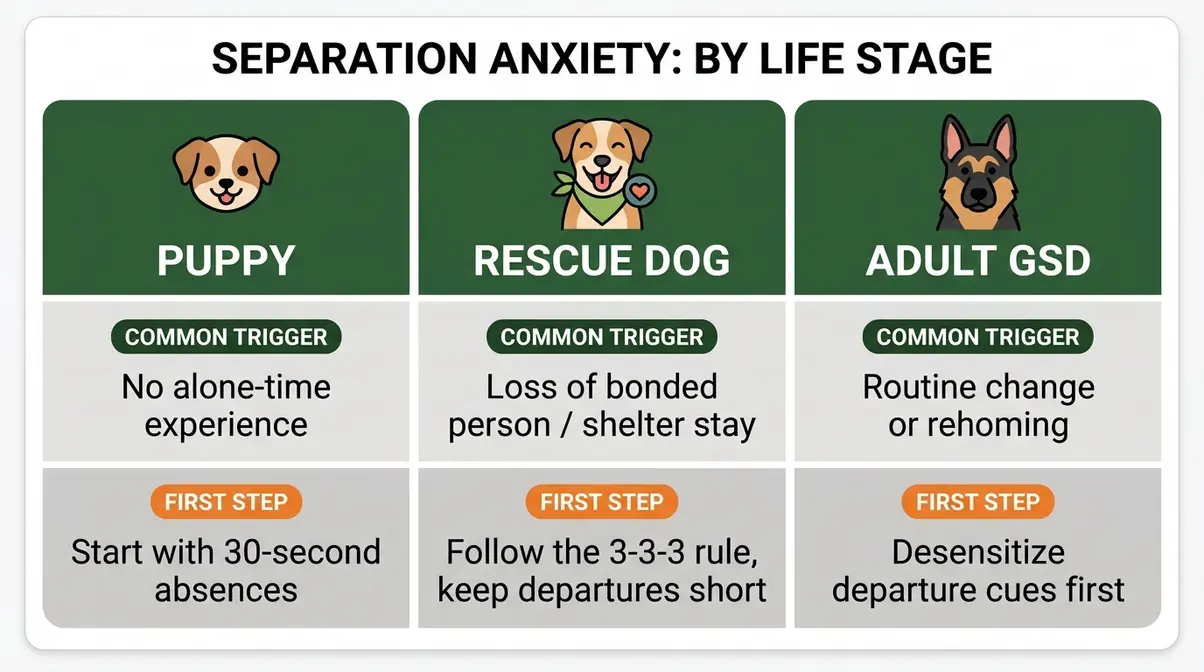
Whether your GSD is a puppy, a rescue, or an adult, the training approach is the same, and it starts with a graduated plan you can follow at home.
How to Train a German Shepherd with Separation Anxiety
The core approach to german shepherd separation anxiety training is graduated desensitization, not punishment, not “crying it out.” The goal isn’t to stop the behavior by force; it’s to change how your dog feels about being alone. That emotional shift happens through deliberate, patient practice, not correction.
The instinct is to let a dog work it out on its own. But research from ASPCA and VCA consistently shows that separation anxiety doesn’t fade without active training. Punishment makes it worse. The goal isn’t to stop the behavior, it’s to change the emotional response underneath it.
How to deal with German Shepherd separation anxiety comes down to five steps, each building on the last. The five steps are: (1) exercise and mental stimulation first, (2) desensitize departure cues, (3) build alone time gradually from 30 seconds, (4) keep departures and arrivals calm, and (5) use comfort aids as supplements. The pace is set by your dog’s comfort, not the calendar.
Estimated time: 4-8 weeks of consistent daily practice (varies by dog and severity).
- What you’ll need:
- A pet camera for monitoring progress
- Treat-stuffed puzzle toys (such as a Kong)
- An item of your unwashed clothing
- Adaptil pheromone diffuser or collar (optional)
Step 1, Exercise and Mental Stimulation First
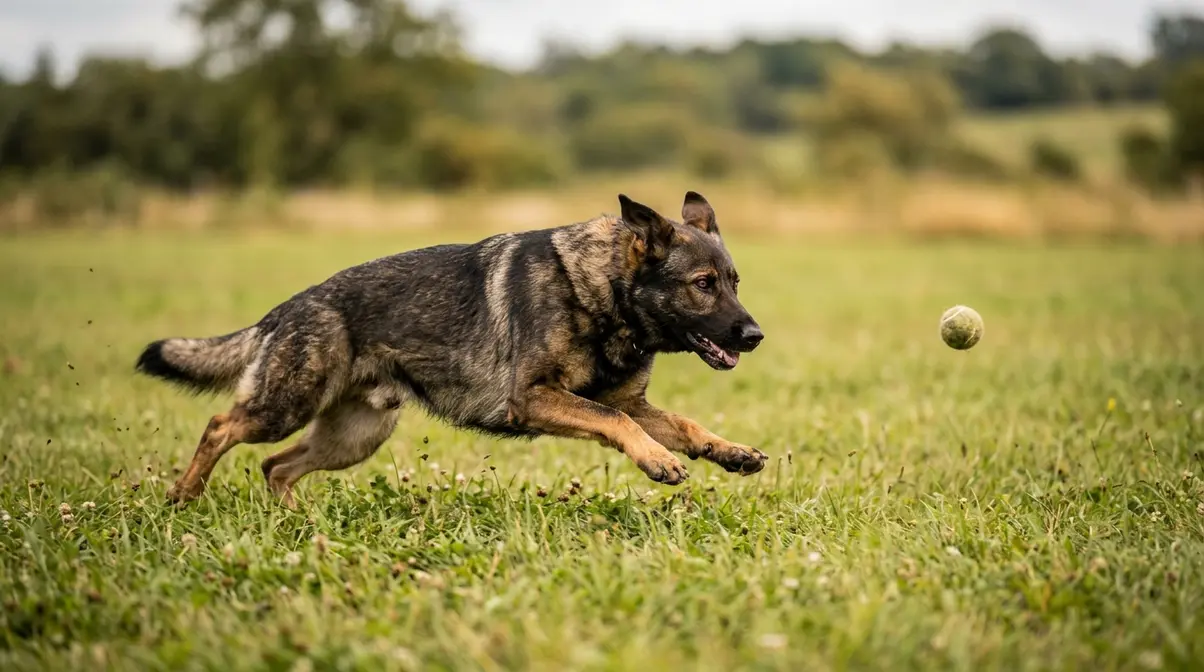
Before any planned departure, complete a 30-minute physical exercise session (fetch, off-leash run, or brisk walk) and a 10-minute mental stimulation activity (puzzle feeder, nose work, or a short obedience session). One of the most effective ways to help a German Shepherd with separation anxiety is to meet its physical and mental needs before any planned departure, a tired GSD is a calmer GSD.
German Shepherds need roughly 1.5 to 2 hours of vigorous physical activity daily, though individual needs vary by age and health status; confirm the right amount with your vet. According to AKC guidance, physical activity and mental stimulation are foundational for managing separation anxiety in dogs.
Mental stimulation matters as much as physical exercise. Puzzle feeders, nose work, obedience training sessions, and long sniff walks all tire a GSD’s brain in ways that a quick lap around the block doesn’t. A dog that has used its mind and body is significantly better positioned to settle when alone.
Be honest with yourself about this step: exercise alone won’t resolve separation anxiety, but skipping it means you’re starting every training session with a dog that’s already wound up. It’s a prerequisite, not a cure.
With exercise covered, the next step is to address the cues that trigger panic before you’ve even left the house.
Step 2, Desensitize Departure Cues
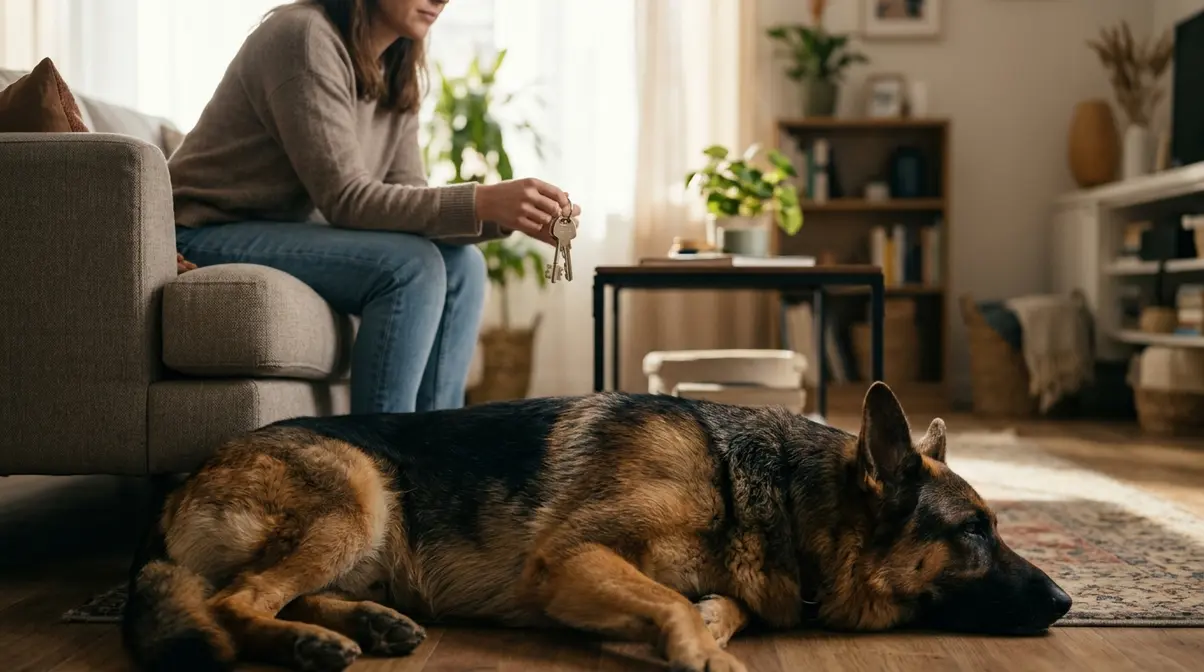
Here’s what surprises most owners: the anxiety often starts before you leave. Your GSD has learned that certain cues, picking up your keys, putting on your shoes, reaching for your bag, pulling on your coat, reliably predict your absence. By the time you open the front door, the dog is already panicking.
The fix is to break that association. According to Bark Busters, desensitizing departure cues is a core step in separation anxiety training. The technique is straightforward:
- Pick up your keys. Sit back down. Don’t leave.
- Put on your shoes. Watch TV for 10 minutes. Take them off.
- Pick up your bag. Set it on the counter. Stay home.
Repeat each cue multiple times a day, in short sessions, until your dog stops reacting. An owner who jingles their keys 20 times a day while staying home, within a week, the GSD stops panting at the sound of keys. That’s departure cue desensitization working in real time.
Departure cue desensitization is one of the most effective techniques for managing separation anxiety in German Shepherds because it addresses the panic before it starts, before you’ve even left the house. This process can take days or weeks, depending on how strongly the association is formed. The measure of progress isn’t time, it’s your dog’s response. When the cue produces no visible reaction, you’re ready for the next step.
Once departure cues are neutral, you can start building the time your dog spends alone, but the key is starting much smaller than you think.
Step 3, Build Alone Time Gradually
This is the most important step in the plan. The specific timing examples here are what forum threads and brand blogs don’t give you, and they matter.
Start with 30 seconds. Leave, return before your dog shows any stress, and reward calm behavior. That’s the foundation: your dog learns that departure always leads to return, and that being alone is temporary. According to Captain Calm, a graduated absence schedule is the backbone of effective separation anxiety desensitization.
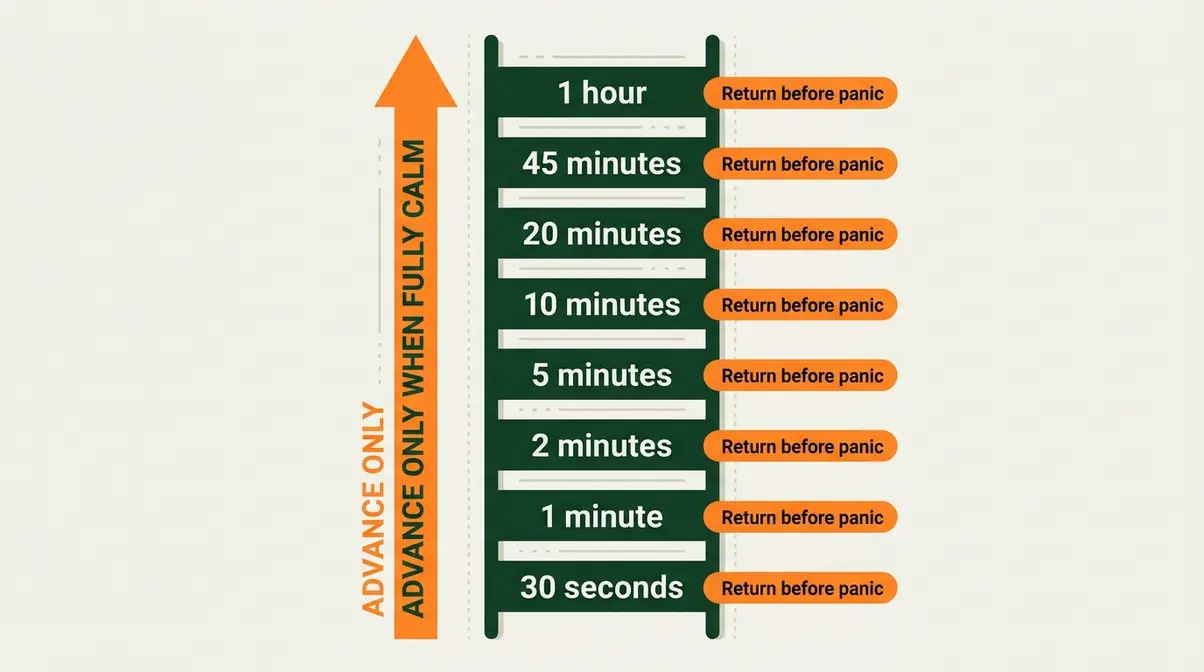
The progression might look like this:
- 30 seconds
- 1 minute
- 2 minutes
- 5 minutes
- 10 minutes
- 20 minutes
- 45 minutes
- 1 hour
Each step may take multiple sessions over several days. You advance only when your dog is fully calm at the current level, not when you think enough time has passed. If your dog shows stress before you return, you’ve moved too fast. Go back one step.
A pet camera is essential for monitoring this process. You can’t know whether your dog is calm unless you can see what’s happening. An owner who discovers on camera that the dog starts panting at the 4-minute mark knows immediately to drop back to 2-minute absences.
The “return before panic” rule is non-negotiable. Every time your dog panics and you return, the dog learns that panicking brings you back. Return before the stress starts, and you teach the opposite lesson: calm behavior is what makes you come home.
Day 1: 30-second absences, 10 repetitions. Day 3: 2-minute absences. Day 7: 5-minute absences. Day 14: 15-minute absences. Some dogs progress faster; others take longer. The pace is set by your dog’s comfort, not the calendar. How to stop German Shepherd separation anxiety isn’t about rushing, it’s about consistency.
How you leave and how you come home matters as much as how long you’re gone.
Step 4, Keep Departures and Arrivals Calm
Dramatic goodbyes, “I’ll miss you so much, be good!” followed by hugs and prolonged eye contact, tell your dog that departure is a significant event. That signal increases anticipatory anxiety before you’ve even reached the door.
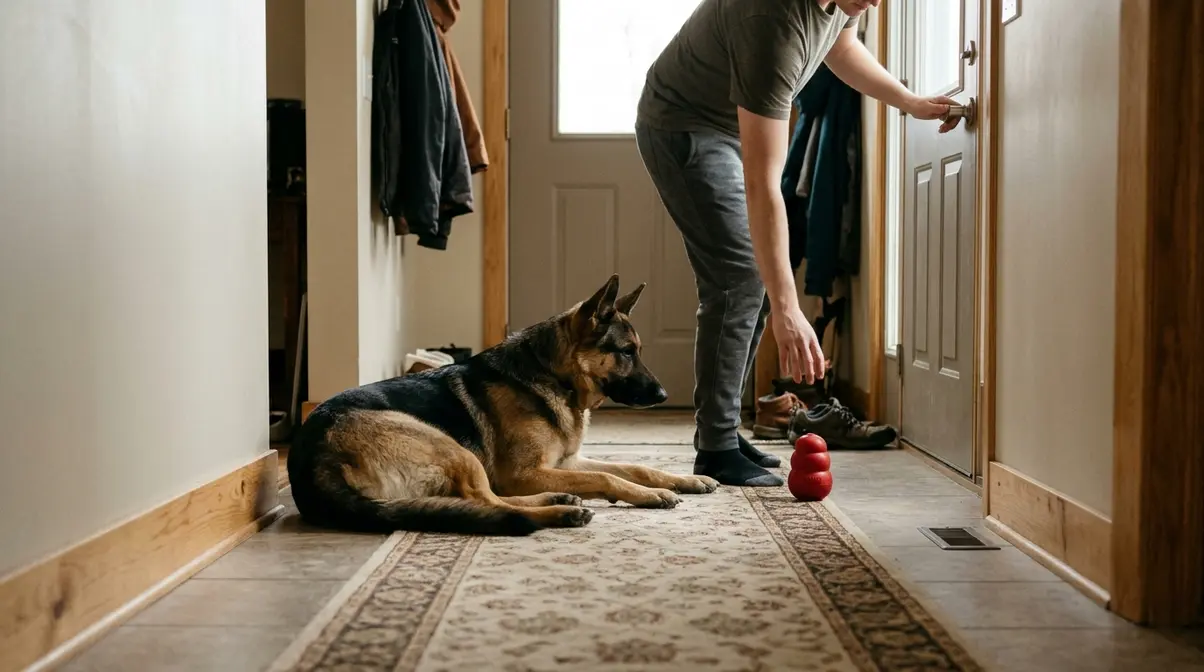
Keep goodbyes brief and matter-of-fact. A calm “see you later” and a treat-stuffed Kong by the door is enough. No extended petting, no apologetic tones. The goal is to communicate that leaving is unremarkable.
Arrivals work the same way. Don’t greet your dog with high excitement when you return, wait until they’re calm, then greet them quietly. This teaches your dog that your return is normal, not a dramatic rescue from crisis.
The safety note, and this is mandatory: Never punish your dog for accidents, destruction, or vocalization that happened while you were gone. The dog cannot connect punishment to behavior that occurred minutes or hours earlier. What punishment does do is increase fear, and fear is exactly what drives the anxiety. Scolding a dog that panicked while alone makes the next episode worse, not better. This applies whether the punishment is a raised voice, a shake of the scruff, or a timeout.
Alongside the training steps, a few comfort aids can help your dog feel safer when you’re not there.
Step 5, Comfort Aids That Help
These tools work as supplements to training, not replacements for it. None of them will resolve separation anxiety on their own, but combined with the graduated desensitization plan, they can reduce the intensity of the anxiety window. According to Petworks article, several practical comfort aids are widely used for anxious German Shepherds:
- An item of your clothing (unwashed): Your scent is calming. Leave a worn t-shirt in your dog’s bed. It’s free, simple, and consistently recommended.
- White noise or calm audio: A radio, a white noise machine, or purpose-made dog-calming music (such as “Through a Dog’s Ear”) reduces the contrast between “owner home” and “owner gone.” The silence of an empty house is itself a cue.
- Adaptil pheromone diffusers or collars (as of mid-2026): Adaptil uses a synthetic version of the dog-appeasing pheromone that a mother dog produces to calm her puppies. Some dogs respond well to it. Discuss with your vet before use, and don’t expect it to work in isolation. For dogs with moderate-to-severe anxiety, the Treatment section below covers when to escalate beyond comfort aids.
- Treat-stuffed puzzle toys: A frozen Kong given at departure occupies your dog for the first 10 to 15 minutes, the highest-anxiety window. By the time the Kong is empty, the acute panic phase has often passed.
Training and comfort aids work for most cases. But some German Shepherds need more support than a home training plan can provide.
When Should You Consider Treatment or Medication?
Consider professional support, including a conversation with your vet about german shepherd separation anxiety treatment options or medication, when your dog shows no progress after four to six weeks of consistent training, is injuring itself, or is experiencing extreme panic (vomiting, inability to settle, breaking through crates). Medication, when used, supports behavior modification rather than replacing it. Your vet is the right first call.
Calming Aids and Comfort Tools
If comfort aids introduced during training (see Step 5) are not sufficient, the following options are worth discussing with your vet. For mild cases, these non-prescription options are a reasonable first step in german shepherd anxiety treatment before escalating to medication or professional behaviorist support. The evidence for each varies, so treat them as tools to try rather than guaranteed solutions.
- Adaptil diffusers and collars (as of mid-2026): Synthetic dog-appeasing pheromone. Some dogs respond well; results vary. Discuss with your vet.
- Anxiety wraps (e.g., ThunderShirt, as of mid-2026): Gentle, constant pressure that some dogs find calming. Evidence is mixed, present as an option to try, not a guaranteed solution.
- Calming supplements (e.g., L-theanine, melatonin, as of mid-2026): Some vets recommend these for mild anxiety cases. Do not use any supplement without discussing dosage with your vet first.
According to VCA Hospitals, environmental management and calming aids are useful additions to a behavior modification plan for dogs with separation anxiety. A GSD with mild anxiety may respond well to an Adaptil collar, a frozen Kong, and white noise, without needing medication. For moderate to severe cases, especially when the dog is injuring itself or making no progress after weeks of training, a conversation with your vet is the right next step.
When to Talk to Your Vet About Medication
The threshold for medication is clear: no progress after four to six weeks of consistent training, self-injuring behavior (chewing paws, breaking teeth on crate bars), or extreme panic responses (drooling, vomiting, inability to settle at any point during your absence).
FDA-approved medications for canine anxiety exist, including fluoxetine and clomipramine, both of which have been reviewed by the U.S. Food and Drug Administration for use in dogs. This is not medical advice, and no dosage figures are appropriate here, your vet will determine the right option based on your dog’s individual health history. As of mid-2026, confirm current approval status and available options directly with your veterinarian.
German shepherd separation anxiety medication is typically prescribed as a bridge, it lowers the anxiety baseline enough that training can actually work. A dog in full panic cannot learn; medication creates the window for behavior modification to take hold. It’s a tool to support training, not a replacement for it.
A GSD that has been in training for six weeks with no improvement and is now chewing through the crate door is a case for a vet conversation, not more of the same home training.
Working with a Certified Behaviorist
If your vet recommends it, or if you want specialized support from the start, a certified applied animal behaviorist (CAAB) or a board-certified veterinary behaviorist (DACVB) is the appropriate professional for severe separation anxiety. These credentials are not the same as a general dog trainer, and the distinction matters for severe cases.
To find one: the Animal Behavior Society maintains a directory of CAABs, and the American College of Veterinary Behaviorists maintains a directory of DACVBs. According to Cornell University College of Veterinary Medicine, professional referral for severe separation anxiety is appropriate when home training and standard veterinary management haven’t produced progress.
What to expect from a behaviorist assessment: an initial evaluation, a customized behavior modification plan, and often coordination with your vet on medication if needed. The process is thorough, and it works. Seeking professional help isn’t a failure. For severe german shepherd anxiety treatment, it’s the right call.
Frequently Asked Questions
What Is Separation Anxiety in Dogs?
Separation anxiety is a genuine panic response that happens when a dog is separated from its bonded person, not misbehavior, not spite. Signs include excessive barking or howling, destructive chewing near exits, house soiling in a trained dog, pacing, panting, and clinginess before you leave. German Shepherds are especially prone because they’re intensely loyal, working-bred dogs that bond closely with their people. The condition is manageable with gradual training and, in severe cases, professional support.
Why Does My Puppy Howl When Left Alone?
Puppy howling when left alone is a classic sign of separation anxiety, a distress call, not a behavior problem. It often starts within 20 to 45 minutes of your departure and can come with pacing, drooling, or accidents. Big changes like rehoming or moving to a new home commonly trigger it. Rule out anxiety before assuming misbehavior, and start gradual alone-time practice as soon as possible.
Why Do I Worry About My Dog So Much?
Worry is a natural response when you share a deep bond with a dog that panics every time you leave. German Shepherds are bred to stay close to their people, which makes that bond intense, and the guilt of leaving a distressed dog is real. The reassuring part is that separation anxiety in German Shepherds is manageable with calm departures, gradual practice, and enough daily exercise. For severe cases, a vet or certified behaviorist can help.
Do Most Rescue Dogs Have Separation Anxiety?
Not every rescue dog develops separation anxiety, but a rescue history is a recognized risk factor. Past trauma, being rehomed, spending time in a shelter, or moving to a new home, can trigger panic when left alone. A newly adopted German Shepherd benefits from patience, a predictable routine, and gradual alone-time practice. Consult a vet or behaviorist if signs are severe or persistent.
How to Break a Dog from Having Separation Anxiety?
Change how your dog feels about being alone, not just what it does. Desensitize departure cues like keys and shoes, then build alone time gradually from 30 seconds to minutes, returning before panic starts. Keep goodbyes and homecomings calm, exercise your dog first, and never punish anxious behavior. For severe cases, consult a vet or certified applied animal behaviorist.
What Is the 3-3-3 Rule for Dogs with Anxiety?
The 3-3-3 rule is a widely used rescue framework for setting realistic expectations after adoption. It suggests a newly adopted dog needs roughly 3 days to decompress, 3 weeks to learn the household routine, and 3 months to feel truly at home. During all three phases, short, calm departures and gradual alone-time practice help reduce separation anxiety in German Shepherds. Verify the specific framework with your rescue organization or vet.
Which Dog Is Worst for Separation Anxiety?
No single breed is definitively “worst,” but German Shepherds are among the breeds most commonly reported with separation anxiety. Their intense loyalty, high intelligence, and working-dog genetics, bred for constant cooperation with a human handler, make them especially prone to distress when left alone. Deep bonding, high exercise needs, and a history of rehoming or routine change all raise the risk. The condition responds well to structured training.
Where to Rub a Dog for Anxiety?
Gentle, calm petting, especially around the ears, chest, and base of the tail, can help a mildly anxious dog settle, though the research on specific touch points for dog anxiety is limited. More reliably, grounded calming options include leaving an item of your clothing with the dog, playing white noise, and using Adaptil pheromone diffusers (as of mid-2026). Meeting exercise needs before departure is the most consistently effective first step. For severe anxiety, consult your vet rather than relying on touch alone.
Will My Dog Eventually Get Over Separation Anxiety?
Separation anxiety in dogs does not typically fade on its own, it requires active training. The research consistently points to gradual desensitization, calm departures, and enough daily exercise as the path forward. Progress depends on your dog’s history and the consistency of your training, some dogs improve in weeks, others take months. Punishment makes the fear worse; a vet or certified behaviorist can help in severe cases.
Should I Let My Dog Cry It Out with Separation Anxiety?
Letting an anxious dog panic alone is not the approach the evidence supports, separation anxiety is a panic response, and leaving it unaddressed increases fear. Build alone time in tiny increments instead, starting with 30 seconds, and return before your dog shows stress. Use a pet camera to monitor, and reward calm behavior when you return. Ask a vet or certified behaviorist for help if the panic is severe.
What Is the Best Anxiety Relief for Dogs?
No single remedy works for every dog, managing German Shepherd separation anxiety combines several steps. Start with 1.5 to 2 hours of vigorous physical and mental exercise, then use gradual desensitization and calm departures. Comfort aids, an item of your clothing, white noise, or Adaptil diffusers (as of mid-2026), can help as supplements. For severe cases, talk to your vet or a certified behaviorist about additional support.
How Long Does It Take to Break a Dog from Separation Anxiety?
There’s no fixed timeline, progress depends on your dog’s history, the severity of the anxiety, and the consistency of your training. The graduated approach moves from 30 seconds to 2 minutes, 5 minutes, and beyond, advancing only when your dog is fully calm at each level. Some dogs improve noticeably in 2 to 4 weeks; others take several months. The pace is set by your dog’s comfort, not the calendar.
Do German Shepherds Have Separation Anxiety?
Yes, German Shepherds are one of the breeds most commonly affected by separation anxiety, and their breed traits explain why. Bred for close cooperation with a human handler, GSDs form intense bonds with their people and can struggle deeply when left alone. Signs include howling, destructive chewing near exits, house soiling, and pacing that starts within 20 to 45 minutes of departure. The condition is manageable with structured training and, in severe cases, professional support.
Your Next Steps for a Calmer German Shepherd
German shepherd separation anxiety is a genuine panic response rooted in the breed’s intense bond with its people, not a discipline problem, not bad behavior. The path forward combines graduated desensitization (starting with 30-second absences and advancing only when your dog is fully calm), consistent daily exercise, and calm, low-key departures and arrivals. Change how your dog feels about being alone, and the behaviors follow.
Progress takes time, and some dogs need more support than a home plan can provide, that’s not a failure. If your GSD shows no improvement after four to six weeks of consistent training, or is injuring itself, a vet conversation is the right next step. For severe cases, a certified applied animal behaviorist (CAAB or DACVB) can build a customized plan that home training can’t replicate.
Start today: give your dog a longer exercise session before your next departure, leave a worn t-shirt in their bed, and set up a pet camera so you can see what’s actually happening when you’re gone. If signs are severe, self-injury, extreme panic, no progress, book a vet appointment this week. More German Shepherd behavior and training guides are available on petvr.com to support you at every step.
 Do German Shepherd Ears Stand Up Naturally? Yes