TL;DR. A West German show line German Shepherd is bred under the German SV system, which requires a dog to be at least 2 years old, pass an endurance test and a temperament test, earn at least “good” at a breed show, hold an IGP 1 working title, and have certified hips and elbows before it can be bred. Six of those seven leave a document. So ask for the paperwork. A sloped back is not the same thing as hip dysplasia, and only a graded X-ray tells you about the joint.
Quick question. Has a breeder ever told you their puppies are “West German show line, bred to strict German SV standards,” and you nodded along without really knowing what that meant?
You’re not alone, and it isn’t your fault. After all, search that phrase and almost everything you’ll read comes from a kennel. Naturally, that kennel is selling the dogs it’s describing. So the phrase gets used constantly, while what sits behind it almost never gets spelled out.
How we checked this. We analyzed the top ten Google results for this exact search on 11 August 2026. Seven were kennels selling the dogs they described. The rest were Reddit, Facebook and YouTube. We found no veterinary body and no kennel club anywhere on page one.
[ORIGINAL DATA] Source: DataForSEO live SERP pull, United States, English, 2026-08-11.
That’s why this article exists. Every requirement below is quoted from the SV’s US partner organisation, and every other number traces to a kennel club or veterinary body, logged in our source ledger with its retrieval date. Because we sell no puppies, we have nothing riding on the answer.
So let’s spell it out. The German system is real, it’s public, and it’s checkable. Once you know what it asks for, “bred to SV standards” stops being a slogan. Instead it becomes a claim you can test.
What is a West German show line German Shepherd?
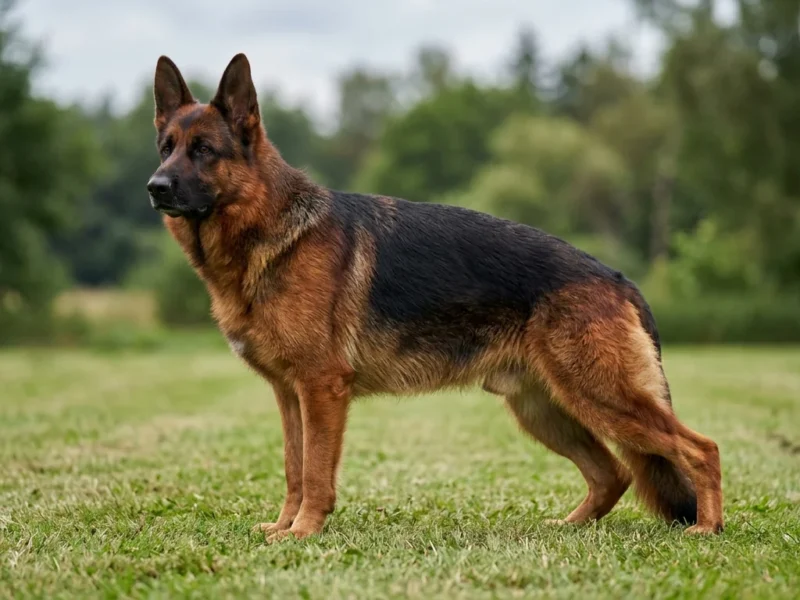
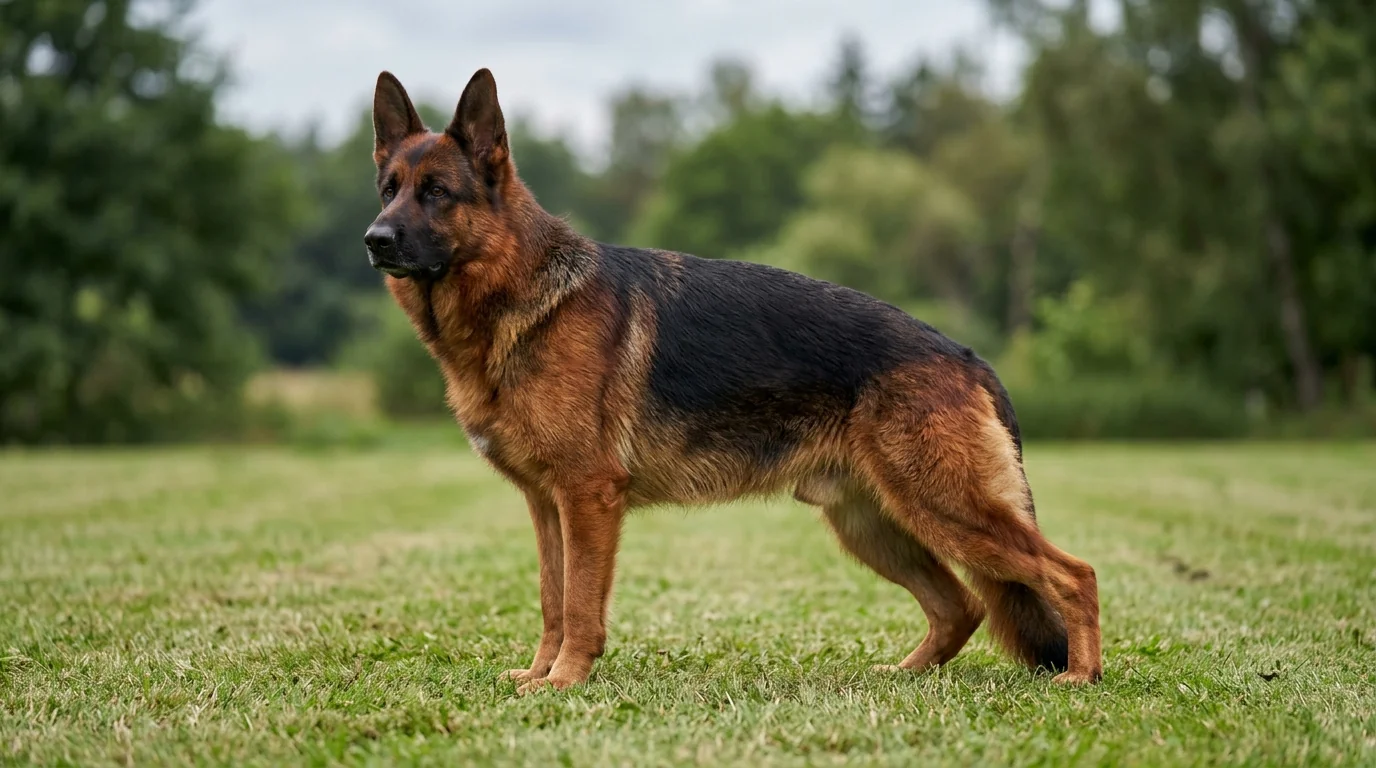
A West German show line German Shepherd is a dog bred in the conformation tradition of the German parent club. That club is the Verein für deutsche Schäferhunde, usually shortened to the SV, and it’s the breed’s original registry in Germany. Breeders here aim these dogs at the show ring. However, the same system also requires a working title, a temperament test and certified hips before any dog is approved for breeding.
Even so, that last part is the part people miss. In the German system, “show line” doesn’t mean “no work.” Instead it means the emphasis sits on conformation, while a floor of working ability and health testing stays mandatory.
The breed has been organised this way from the beginning. Specifically, the SV was founded in 1899. That was weeks after Max von Stephanitz bought a dog named Horand von Grafrath at a German dog show (American Kennel Club, breed history, retrieved 2026-08-11). Above all, von Stephanitz built the club around one idea. This was a working breed, and looks were never supposed to come first.
What “bred to SV standards” actually requires
First, here’s the part no sales page gives you. A breed survey is the German-system evaluation that approves a dog for breeding, and before a German Shepherd can be surveyed it has to clear every item below.
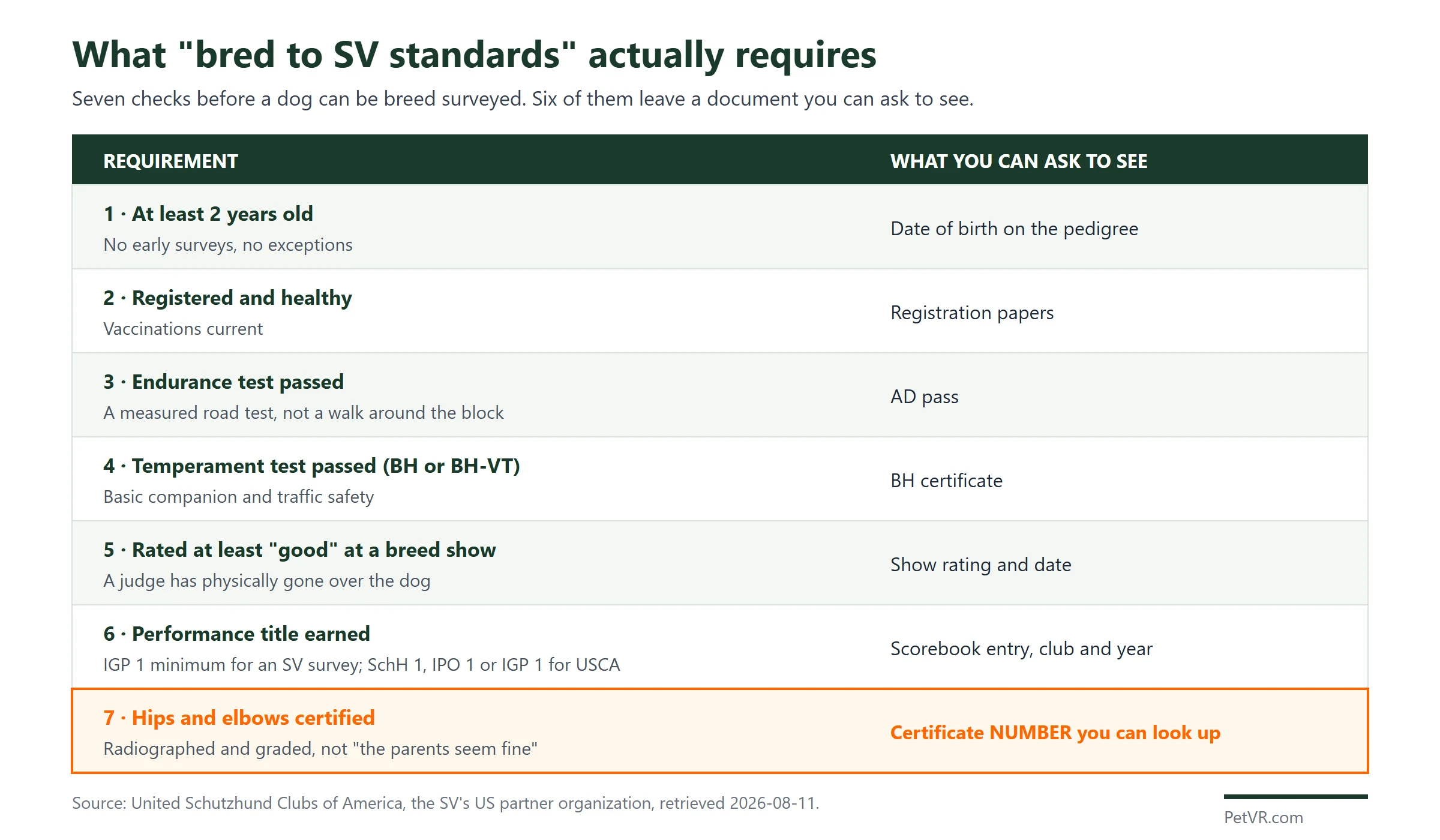
According to the United Schutzhund Clubs of America, the SV’s partner organisation in the United States, a dog must be (retrieved 2026-08-11):
- At least 2 years old. No early surveys, no exceptions.
- Registered and healthy, with vaccinations current.
- Passed an endurance test. In practice that’s a measured road test, not a walk around the block.
- Passed a temperament test. BH is the basic companion and traffic-safety test. Consequently, a dog that can’t hold itself together around traffic, strangers and other dogs doesn’t move on.
- Rated at least “good” at a breed show. In other words, a judge has physically gone over the dog.
- Earned a performance title. At minimum that’s IGP 1 for an SV survey, or SchH 1, IPO 1 or IGP 1 for a USCA survey. IGP is the modern name for what most people still call Schutzhund, a three-part sport covering tracking, obedience and protection.
- Certified hips and elbows. That means radiographed and graded, not “the parents seem fine.”
Now, read that list again with a buyer’s eye. Six of the seven items produce a document with a number or a title on it. That’s the whole point. Therefore a breeder working inside this system can hand you paperwork, while a breeder using the phrase as decoration cannot.
Those judges work from one written standard, FCI Standard N°166, which the USCA publishes in full (retrieved 2026-08-11). Similarly, it’s worth reading once, if only so you know the document exists.
West German show line vs American show line
In practice, these two get confused constantly. Still, they are not the same thing. Both are show lines, but they come from different registries with different requirements.
| West German show line | American show line | |
|---|---|---|
| Bred under | The German SV system | The AKC conformation system |
| Working title required to breed? | Yes. IGP 1 minimum for an SV breed survey | No such requirement |
| Temperament test required? | Yes. BH or BH-VT | Not required |
| Hip and elbow certification required? | Yes, to be breed surveyed | Strongly encouraged by good breeders, not a registry rule |
| Typical look | Strong red and black or black and tan pigment, substantial bone | Longer, lighter frame, often more rear angulation |
| Registerable with the AKC? | Yes | Yes |
Notably, that last row surprises people. Both are fully registerable, because AKC registration turns on the parents being AKC-registered dogs of the same breed (AKC litter registration requirements, retrieved 2026-08-11). Put simply, registration papers tell you a dog’s parentage. They tell you nothing about how it was bred or tested.
Meanwhile the third branch of this family, the dogs bred for the job rather than the ring, is covered in our working line German Shepherd guide. Similarly, the DDR German Shepherd is a fourth branch, from the former East Germany.
Are show line German Shepherds calmer?
Calmer than a working line, usually yes. However, calm, no.
That distinction matters more than anything else on this page, so let’s be precise. A West German show line dog is generally easier to live with than a high-drive working line dog. It’s more likely to settle in the house. Also, it’s less likely to need a job every single day to stay sane.
Nevertheless, it is still a German Shepherd. The American Kennel Club scores every breed on “Mental Stimulation Needs”. Denied the brain exercise they need, it warns, purpose-bred dogs “will create their own projects to keep their minds busy” (AKC breed profile, retrieved 2026-08-11). As a result, a bored show line will still shred your baseboards. It’ll just take slightly longer to get there.
Then remember what the survey asks for. A dog that earned IGP 1 did tracking, obedience and protection work. So “calmer” in this world means calm enough to pass a traffic test and still do the sport. It does not mean a dog that’s content with a short walk and a nap.
For a realistic picture of the energy curve across the whole breed, our guide on when German Shepherds actually calm down goes through it by age.
The sloped back, honestly
You’ve seen the photos. Likewise, you’ve probably seen the arguments too.
This is the most common criticism aimed at show lines, and it isn’t coming from nowhere. Notably, the single highest-ranking page for this search term belongs to a working line kennel. It describes show lines as having “the extremely sloped hips that we all look at and think, ‘hip dysplasia'”. That’s a competitor’s framing, so weigh it accordingly. Even so, plenty of people inside the breed say something similar.
Here’s the part that actually helps you, because most of this argument skips it.
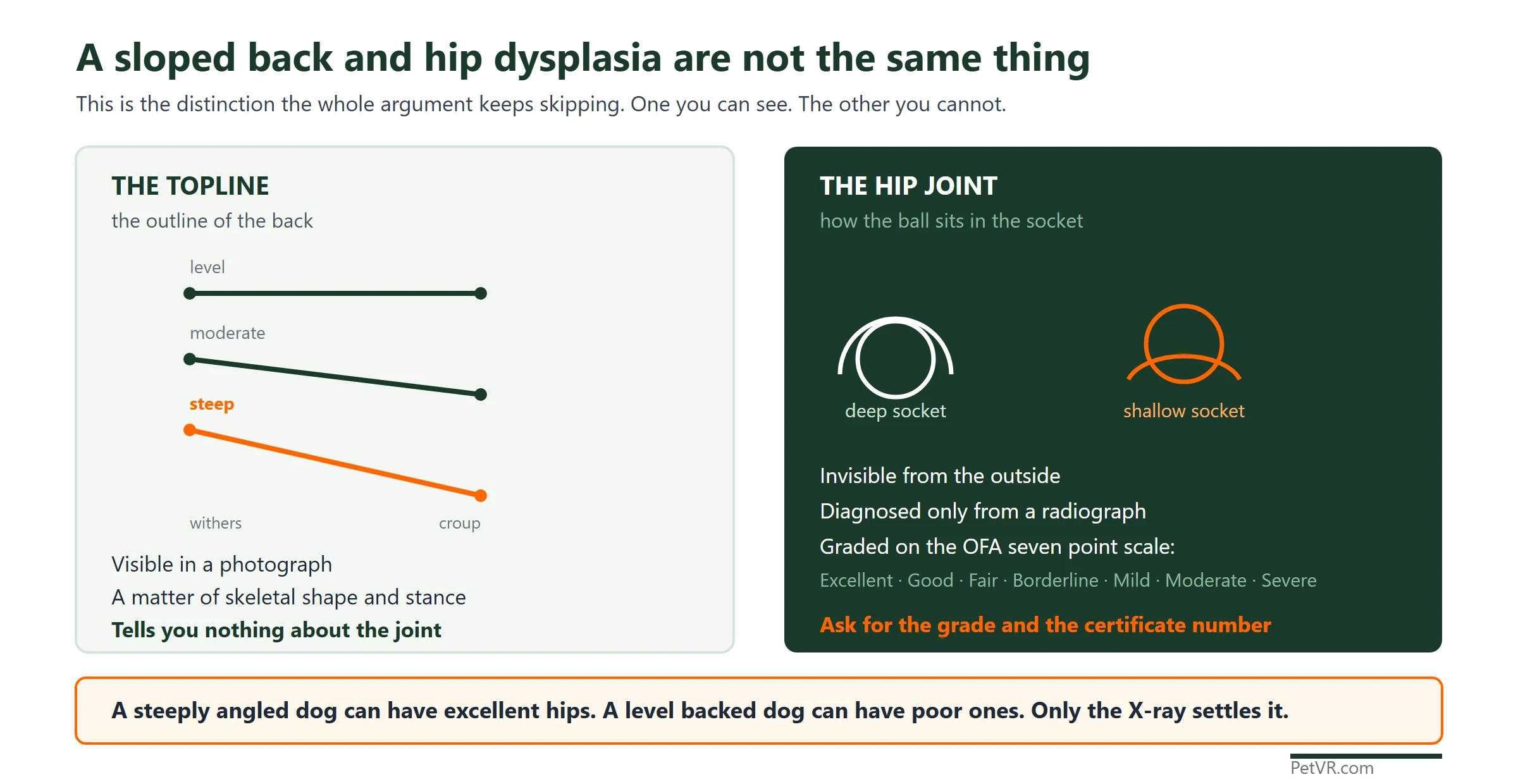
A sloped topline and hip dysplasia are two different things. The topline is the outline of a dog’s back, and it’s a matter of skeletal shape and how the dog is standing. By contrast, hip dysplasia is a malformation of the hip joint itself, and you cannot see it by looking at a dog. Instead a vet diagnoses it from a radiograph, and then grades it. The Orthopedic Foundation for Animals classifies hips into seven categories: Excellent, Good, Fair, Borderline, Mild, Moderate and Severe (OFA hip dysplasia grading, retrieved 2026-08-11).
Consequently, a steeply angled dog might have excellent hips, while a level-backed dog might have poor ones. The only way to know is the X-ray and the grade.
So what does this mean in practice? Don’t buy or reject a puppy based on the shape of its parents’ backs in a photograph. Ask for the hip and elbow grades instead, plus the certificate numbers so you can look them up. That works no matter which side of the slope argument you land on.
Why so many are red and black
Of course, walk into a room of West German show line dogs and you’ll notice the colour first. Typically that’s deep red or rich tan, a saturated black saddle, and strong pigment overall.
However, that’s a breeding preference within this line, not a rule about the breed. German Shepherds come in a wide range of colours and patterns, and pigment says nothing about health or temperament. Therefore, if a breeder prices a puppy higher purely on colour, that’s a sales decision rather than a quality signal.
Our guide to German Shepherd colours and coat patterns covers the full range, including the ones marketed as “rare.”
What drives the price
Meanwhile, you’ll see wildly different numbers quoted for these dogs. Still, we’re not going to publish a price range we can’t source. What we can do instead is show you what the money pays for, because it follows directly from the requirement list above.
Every item on that list costs the breeder something real:
- Titles take time. An IGP 1 means months to years of training, plus trial entry fees and travel.
- Health certification costs money per dog. Radiographs, sedation and submission fees, and the risk that a dog fails and never gets bred.
- Shows and tests cost money per dog. Entry fees, handler fees, travel again.
- Imports cost a lot. Shipping a dog or semen from Germany is not a small line item.
As a result, a breeder doing all of that genuinely has higher costs than one who bred two pretty dogs in a backyard. In short, that’s the honest case for a higher price.
That’s also why the paperwork matters so much. If a breeder charges import-line prices, then the titles and certifications should exist. Ask to see them.
How to verify a breeder’s claim
Finally, this is the section to screenshot. Every item here is checkable before you pay a deposit.
- Ask which registry the parents are surveyed under. SV, USCA or neither. “German lines” is not an answer, because a real answer names the system.
- Ask for the parents’ performance titles. IGP 1, IGP 2, IGP 3, SchH or IPO. Then ask which club, and what year.
- Ask for the hip and elbow certificate numbers, not a photo of a certificate. Numbers can be looked up.
- Ask whether the parents passed a BH. A breeder inside the system will know instantly what you mean.
- Ask for the breed show rating. Remember, the floor is at least “good.”
- Ask what happens if the dog develops a health problem. Get the contract and read it before you pay, not after.
- Notice whether the breeder asks you questions. Someone placing a dog into the right home asks about your household, your experience and your schedule. Someone moving inventory doesn’t.
If you’re still deciding which line you want, our guide to the 8 German Shepherd lines and types lays them out side by side.
Health and lifespan
West German show line dogs carry the same breed-wide health risks as any German Shepherd. Above all, these are the ones worth knowing about before you commit:
- Hip and elbow dysplasia. Above all, this is the reason certification exists. Our German Shepherd hip dysplasia article covers signs, grading and options in depth.
- Degenerative myelopathy. A progressive spinal-cord disease that causes gradual hind-leg weakness. Fortunately, responsible breeders test for it.
- Bloat, also called gastric dilatation-volvulus. A deep-chested-breed emergency. Therefore, learn the signs now, not during it.
- Exocrine pancreatic insufficiency. Again, more common in German Shepherds than in most breeds.
In short, expect a large deep-chested dog with a working heritage, and plan accordingly. That means joint-aware exercise while it’s growing, a sensible feeding routine, and a vet who knows the breed.
Veterinary disclaimer. This article is general information, not veterinary advice, and it cannot diagnose your dog. If you’re seeing symptoms, or weighing a health decision about a specific dog, talk to your licensed veterinarian. When something looks like an emergency, treat it as one and go.
Is a West German show line German Shepherd right for you?
It’s a good fit on three conditions. First, you want a German Shepherd with real structure and temperament testing behind it. Second, you value being able to verify what you bought. Third, you can give a large intelligent dog daily exercise plus something to think about.
Conversely, it’s a poor fit if you’re picturing a low-energy dog, because that isn’t this breed in any line. It’s also a poor fit if the paperwork doesn’t interest you. After all, the paperwork is the entire value of the system. If you’re not going to check it, then you’re paying a premium for a claim you never tested.
Finally, if you want more drive and a dog built for a job rather than a ring, read the working line guide before you decide. The two really are different dogs.
Final Thoughts
“West German show line” is a real category with a real system behind it. Specifically, that system asks for an age minimum, an endurance test and a temperament test. Then it asks for a show rating, a working title and certified hips, all before a dog is approved to breed. Above all, every one of those leaves a paper trail.
So here’s the one thing to take away. You don’t have to be an expert on German Shepherd structure to buy well. You just have to ask for the documents, and then pay attention to whether they actually arrive.
A breeder who’s doing this properly will be glad you asked.
Frequently asked questions
Are show line German Shepherds calmer than working lines? Usually yes, relative to a working line. They are generally easier to live with and more likely to settle indoors. They are not low-energy dogs, though. A dog that earned an IGP 1 did tracking, obedience and protection work.
How do I tell if my German Shepherd is working line or show line? Pedigree, not appearance. Look at the parents’ titles and the registry they were surveyed under. Colour and back shape are unreliable guides, because both vary widely inside every line.
Do West German show line German Shepherds have hip problems? The line as a whole is health tested, but an individual dog is only as good as its own grades. A sloped back tells you nothing about the joint. Ask for the hip and elbow grades and the certificate numbers.
Can a West German show line German Shepherd be registered with the AKC? Yes. AKC registration depends on the parents being AKC-registered dogs of the same breed, not on which line the dog comes from.
What does IGP 1 mean? IGP is the modern name for Schutzhund, a three-part sport covering tracking, obedience and protection. IGP 1 is the entry level, and it is the minimum working title for an SV breed survey.
 Working Line German Shepherd: The Honest Owner’s Guide