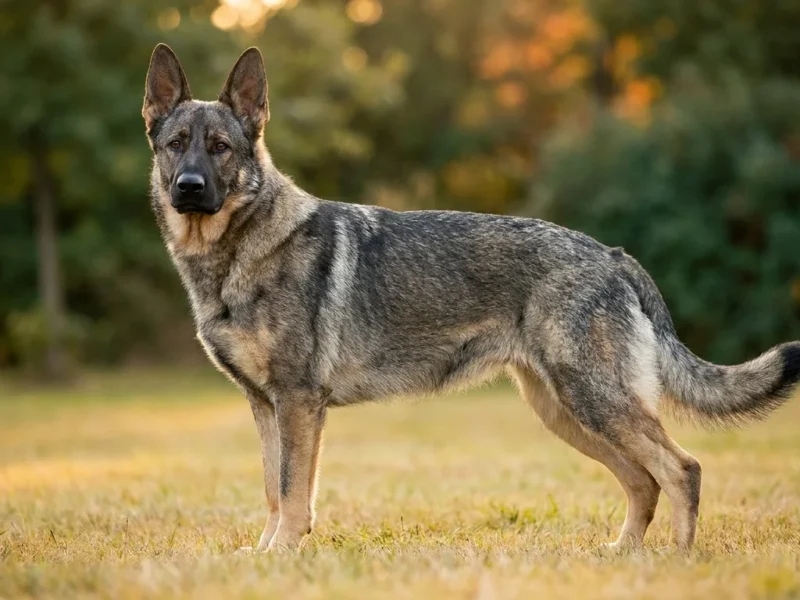
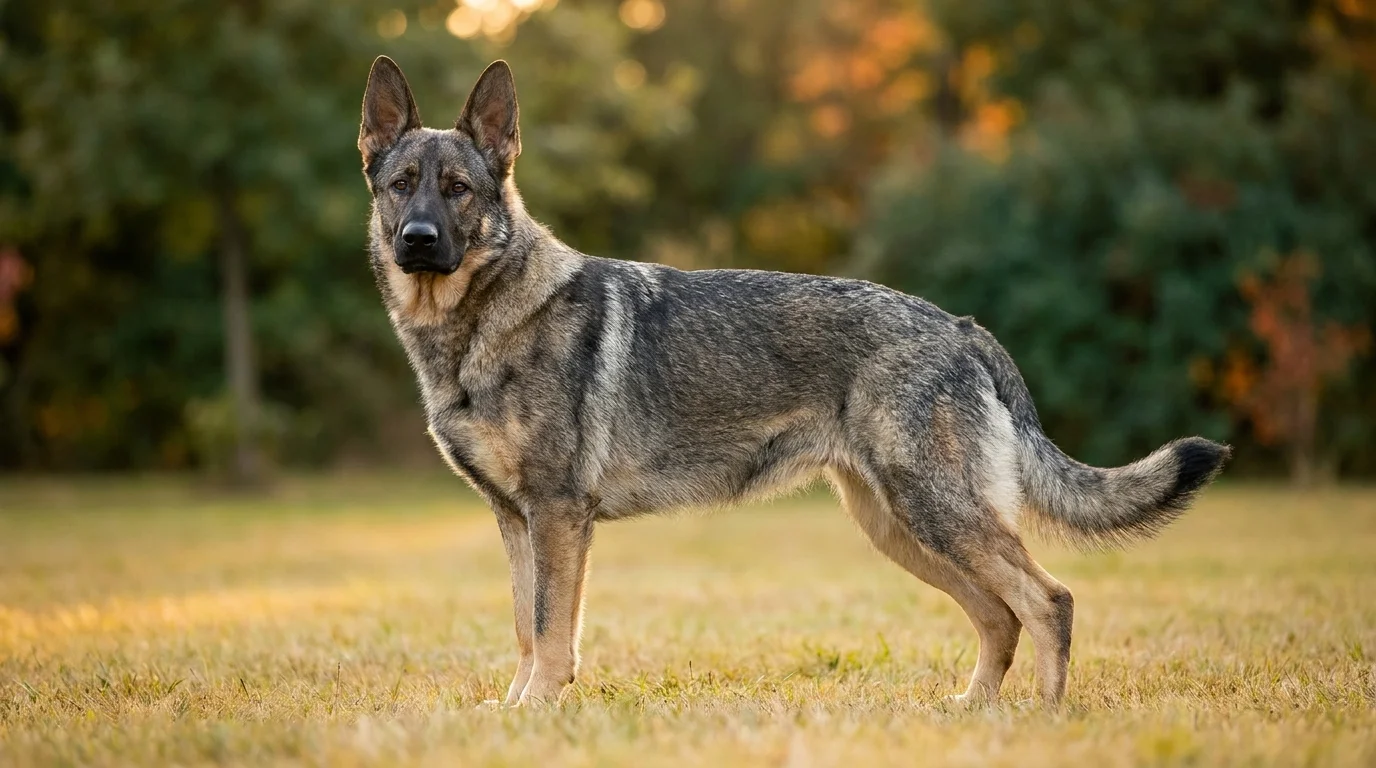
Have you seen a gray German Shepherd online and wondered whether the color’s even real, or whether the breeder charging a “silver” premium is running a scam? Short answer: yes, gray German Shepherds are purebred. However, they come in three genetically different flavors, and only one of them’s actually a problem in the show ring. So the label a breeder uses on a “gray” or “silver” puppy really does matter, and it isn’t the same thing across every kennel.
Most gray German Shepherds carry the agouti (sable) gene, which gives each hair a banded, wolf-like look. However, some are actually blue dilute, a separate recessive gene that turns black pigment steel-gray. Meanwhile, a third group marketed as “silver” is usually just a paler agouti sable. Under the American Kennel Club (AKC) breed standard, sable-based grays are permissible and can be shown. But blue is named as a serious fault, which stops a dog from competing in conformation but doesn’t stop it from being registered.
Here’s what “gray German Shepherd” actually means, how to tell one type from another, and what to look for if you’re thinking about buying one. We source every color-standard claim in this article from the AKC breed standard and every health claim from a licensed veterinary reference, and we cite each one in place.
| Purebred? | Yes. “Gray” is a coat description, not a separate breed. |
|---|---|
| Genetic source | Most often agouti / sable; some are blue dilute. |
| AKC show status | Sable-based grays are permissible. Blue dilute is a serious fault. |
| AKC registration | Yes, regardless of coat color. |
| Typical price (US) | Roughly $1,500 to $5,000+ from a reputable breeder, depending on region and lineage. |
| Coat change with age | Sable puppies often darken through the first two years; blue dilute stays steel-gray. |
What Does “Gray German Shepherd” Actually Mean?
If you ask ten German Shepherd owners what a “gray GSD” is, you’ll get at least three answers. That isn’t a failure of vocabulary. It’s a real reflection of the fact that several genes can make a dog’s coat look gray, and each one produces a slightly different look.
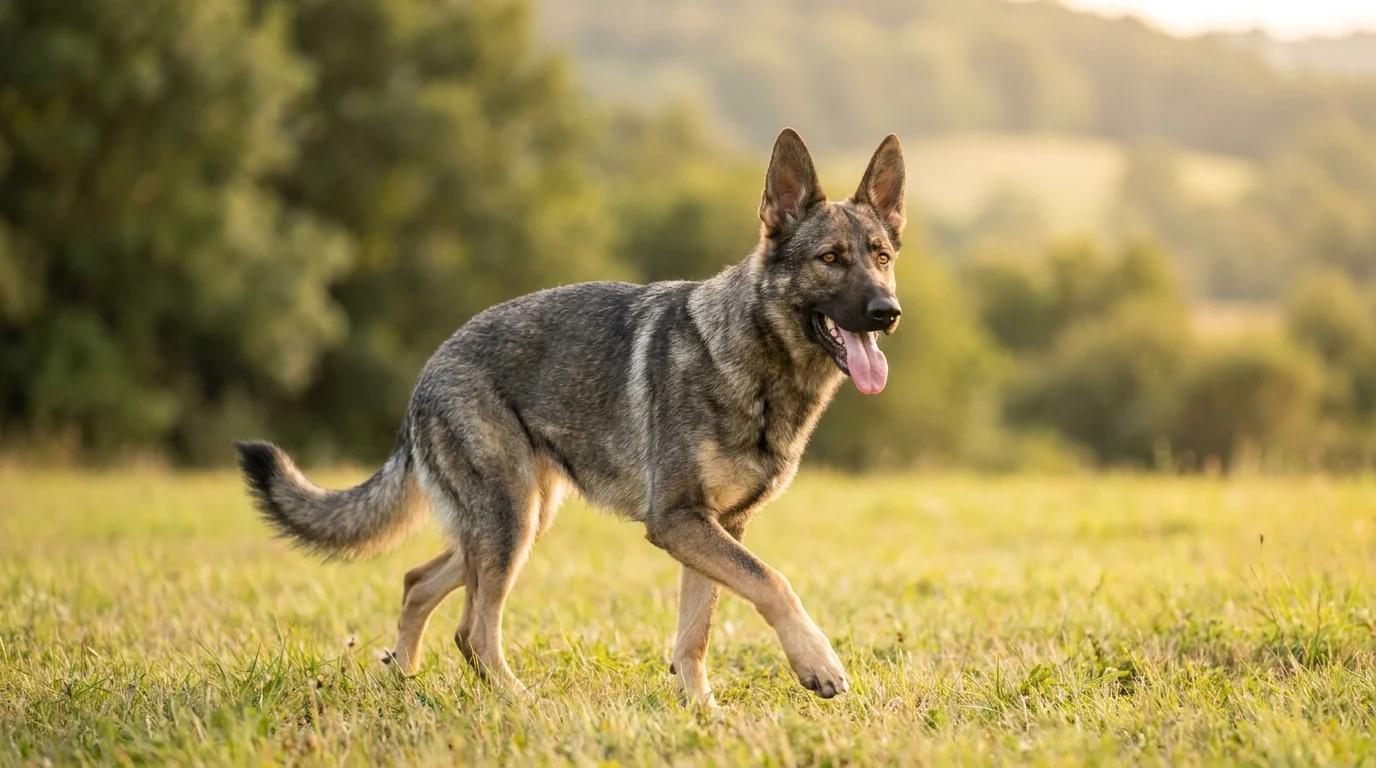
In short, “gray German Shepherd” is a coat description, not a separate breed and not an official color category. When breeders and owners use the word, they usually mean one of three things:
- An agouti / sable German Shepherd whose banded hairs read as wolf-gray or gray-and-tan.
- A silver sable, which is a paler version of the same agouti pattern.
- A blue dilute German Shepherd, whose black pigment has been diluted into a solid steel-gray.
All three are purebred. All three can be registered with the AKC if both parents are registered German Shepherds. However, only one of them shows up in the AKC breed standard as a problem the judges will penalize.
Meanwhile, the confusion gets worse because breeders lean on the words that sell. “Silver” and “wolf grey” both do more work at a premium price than “gray sable” does. As a result, you’ll see the same dog described three different ways on three different breeder sites.
The Three Ways a German Shepherd Ends Up Gray
Think of coat color in dogs as a stack of switches. Different genes control the pattern (banded or solid), the base color (black, tan, red), and whether that color gets diluted. In other words, a gray German Shepherd is what happens when a specific set of those switches ends up in a specific position. Below, we walk through each of the three switches most likely to be responsible.
Agouti / sable (the most common source)
The agouti gene (Aw at the A-locus) makes each hair band into multiple colors along its length: a black tip, a tan or gray middle, and a lighter base. Up close, a sable coat looks almost multi-toned. From a few feet away, however, it reads as wolf-gray, gray-and-tan, or “gray-brown,” depending on how dark the banding is.
Sable is the classic “wolf-looking” pattern in the breed. If you Google “wolf grey German Shepherd,” you’re mostly looking at gray sables. If your gray German Shepherd’s individual hairs have visible banding when you part the coat, that’s what you have.
For a deeper look at sable genetics and the full range of sable shades, read our companion guide on the sable German Shepherd.
Silver sable
Silver sable is a lighter, more washed-out version of agouti. Same gene, less pigment saturation. The banding is still there, but the overall coat reads as silver or pale gray with cream, especially on the flanks and belly. As a result, this is the coat most often sold as a “silver German Shepherd,” and it isn’t a different breed or a different color category. In short, it’s a sable with the volume turned down.
Blue dilute
Blue is a completely different mechanism. The dilution gene (dd at the D-locus) is a recessive change that turns black pigment into a solid, steel-gray color. Unlike a sable, a blue German Shepherd doesn’t have banded hairs. Instead, the dog’s uniformly gray, and the dilution shows in the paw pads and the nose too, which fade to gray or slate rather than staying black.
Blue is rare. It’s also the one gray-looking coat the AKC breed standard names by fault. In our companion piece, we cover the full picture, including the color-dilution alopecia risk, in the blue German Shepherd guide.
| Sable (agouti) | Silver sable | Blue dilute | |
|---|---|---|---|
| Gene | Aw at the A-locus | Aw at the A-locus, less pigment saturation | dd at the D-locus, recessive |
| Individual hair | Banded: black tip, tan or gray middle, lighter base | Banded, but paler throughout | One steel-gray shade root to tip, no banding |
| Overall look | Wolf-gray, gray-and-tan or gray-brown | Silver or pale gray with cream on flanks and belly | Uniform steel gray |
| Nose and paw pads | Black | Black | Gray or slate |
| How common | The most common source of a gray coat | A lighter version of the same pattern | Rare |
| AKC breed standard | An accepted color | An accepted color | The one gray-looking coat the standard names by fault |
How to tell them apart at a glance
- Sable / silver sable: part the coat and look at individual hairs. If they are banded (dark tip, lighter middle), you have a sable.
- Blue dilute: hairs are a single steel-gray shade root to tip. Nose and paw pads are gray or slate rather than black.
If you’re still not sure, a coat-color DNA panel from a reputable lab (Embark or UC Davis VGL, for example) will tell you exactly which switches your dog’s carrying.
Is a Gray German Shepherd Purebred, and Can It Be Registered?
This is the question that trips up almost every new owner, and it’s the one bad breeders exploit. So the answer’s worth stating plainly, because getting it wrong is what makes some buyers overpay by thousands.
In short, a gray German Shepherd whose parents are both AKC-registered German Shepherds is purebred and eligible for AKC registration. AKC registration turns on verified parentage, not coat color. That’s the same rule that applies to every other color the breed comes in.
However, whether the dog can be shown in the conformation ring is a different question. The AKC breed standard answers it directly.
Read the standard carefully and three things fall out in order:
- Sable-based grays (including silver sable) are covered by “most colors are permissible.” They aren’t called out as faulty. They can be shown.
- Blue dilute is a serious fault by name. A serious fault doesn’t disqualify the dog from the ring, but it will stop it from placing in a well-judged class. It doesn’t, however, block AKC registration.
- White is the only color the standard disqualifies. A white German Shepherd can’t compete in AKC conformation. It can still be registered.
So if a breeder tells you a blue or a liver or an isabella German Shepherd “cannot be registered with the AKC,” that’s factually wrong. Registration follows parentage. Meanwhile, what blue, liver, and isabella can’t do is win in the conformation ring, and that’s a separate thing.
What a Gray German Shepherd Looks Like at Each Life Stage
The “will my puppy stay gray?” question is one of the most common posts on German Shepherd forums. If your puppy’s a sable, the honest answer is that the coat will keep changing for a while. If your puppy’s a blue dilute, what you see is what you get.
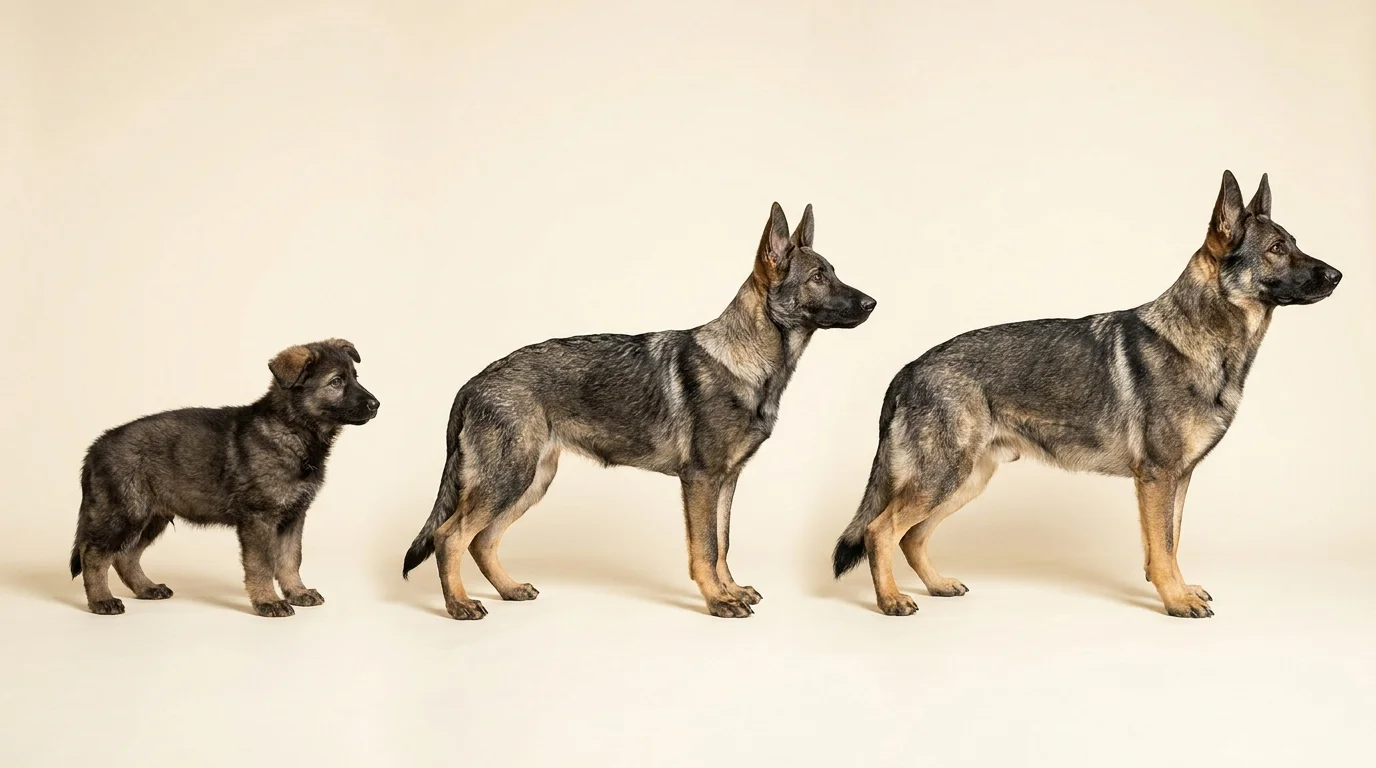
Puppy (birth to 8 weeks). Sable puppies are often born quite dark, with the banding not fully expressed yet. Blue puppies are steel-gray from day one, and the nose and pads give them away, gray rather than the usual black.
Adolescent (2 to 12 months). Sable coats start to settle. The banded pattern becomes clearer. A puppy that looked almost black at 6 weeks may look distinctly gray-and-tan by 6 months. Silver sables usually stay on the paler end of that range.
Adult (2 years and older). Sable coats can continue to darken slowly into full adulthood. Silver sables stay lighter than standard agouti. Blue dilute coats don’t change much once the dog is grown. They stay steel-gray, and the nose and paw pads keep their gray tone.
If you’re expecting an exact preview of your puppy’s adult look, ask the breeder for photos of both parents at similar life stages. That will tell you more than any generic timeline.
Read more: German Shepherd colors and patterns, the full color hub covering every recognized coat variant.
Are Gray German Shepherds Healthy?
Coat color, on its own, doesn’t make a German Shepherd more or less healthy. What matters is the breeding behind the dog. However, the dilute part of a blue coat is worth naming, because there’s one condition that shows up more often in dilute-coat dogs than in the rest of the breed.
First, sable-based grays (including silver sables) have no color-linked health issue known to the breed. They carry the same breed-standard risks any well-bred German Shepherd does. Hip and elbow dysplasia is the big one. In addition, degenerative myelopathy is linked to a mutation in the SOD1 gene, according to Embark Veterinary. In practice, a reputable breeder tests both parents for hip and elbow scores through the Orthopedic Foundation for Animals (OFA) and increasingly for the SOD1 DM marker.
Blue dilute, on the other hand, is different. VCA Animal Hospitals describes color dilution alopecia (CDA) as “a genetic, recessive, inherited condition that causes patches of hair thinning or loss and may also include flaky and/or itchy skin.” Furthermore, the condition is “most commonly seen in dogs with a blue or fawn coat” (VCA Animal Hospitals, retrieved 2026-08-11). Not every blue dog develops CDA. Still, it’s a real risk, and it’s worth asking a breeder of a blue-line dog whether either parent has skin or coat symptoms.
So if your gray German Shepherd’s starting to lose patches of coat, get itchy skin, or show any new symptom that concerns you, contact your veterinarian. A photo isn’t a diagnosis, and the internet isn’t a substitute for an exam.
How Much Does a Gray German Shepherd Cost, and How Do You Avoid a Rare-Color Scam?
Prices for a German Shepherd puppy vary heavily by region and by what you’re buying. In fact, Petworks reports a typical range from about $800 to $5,250 across the country, with the West Coast around $1,500 to $4,100 and elite bloodlines above $5,200 (Petworks, retrieved 2026-08-11). Working-line dogs and titled show-line dogs sit at the top of that range. Meanwhile, companion pups from reputable breeders sit in the middle.
A gray coat, by itself, shouldn’t add a lot to that price. Instead, what should add to it is the breeder’s health testing, the pedigree, and the dog’s intended purpose. So if you’re paying a “rare color” premium, ask what you’re actually paying for.
In practice, the rare-color scam tells usually show up in this order:
- First, the breeder calls “silver” or “gray” a separate breed or a distinct AKC color category. Both are wrong.
- Next, the premium is above a well-pedigreed working- or show-line puppy from a breeder who does health test.
- Then, no OFA hip and elbow scores for the parents. No SOD1 DM DNA test.
- Also, no willingness to show the parents in person or over video.
- Finally, vague answers about the parents’ pedigrees, or an unwillingness to name the sire and dam.
On the other hand, what a reputable breeder does show, without being asked twice:
- OFA (or PennHIP) evaluations for hip and elbow on both parents.
- DM (SOD1) DNA test results.
- Full pedigree, both sides, back at least three generations.
- Photos and video of the parents, and often the option to visit.
So a gray German Shepherd from a breeder who does all of that is worth the going rate for a healthy puppy from that region. Meanwhile, a gray German Shepherd from a breeder who leans on the color and skips the health testing isn’t.
Frequently Asked Questions
What are gray German Shepherds called? Most are called sable, silver sable, or (less accurately) wolf grey. The word “gray” is a description of what you see; sable is the pattern most of them actually carry.
What is the rarest German Shepherd color? True blue and isabella (a double-dilute liver) are among the rarest. Both are recessive, and both need two copies of the recessive gene to appear. Neither is more valuable in the ring than a well-bred standard color.
Do gray German Shepherds bark a lot? Coat color has nothing to do with vocalization. German Shepherds as a breed are alert and vocal, and how much yours barks comes down to individual temperament, training, and environment. Some gray sables are quiet; some blues never shut up. It isn’t the color.
Are gray and silver German Shepherds the same? Mostly yes. “Silver” is a marketing term for a paler agouti sable. Occasionally a breeder uses “silver” for a blue dilute, which is a different gene and a different appearance. Look at the individual hairs, and look at the nose and paw pads, to tell them apart.
Final Thoughts
In summary, a gray German Shepherd’s a purebred German Shepherd with a coat that reads as gray, silver, or wolf-toned. Most are gray because they carry the agouti sable pattern. A smaller number are blue dilute, which the AKC breed standard names as a serious fault but which doesn’t stop the dog from being registered. Finally, white’s the only color the standard disqualifies from the show ring, and even white dogs can be registered.
So if you’re buying, focus on the breeding rather than the color. Ask for OFA hip and elbow scores, a DM DNA test, and photos of the parents. A gray coat is a beautiful thing to look at, but it isn’t what makes a German Shepherd a good dog. What makes a German Shepherd a good dog is the same thing that has always mattered: a healthy pedigree, a stable temperament, and the time you’re willing to put in.
Curious how gray compares to the other coats in the breed? Our blue German Shepherd guide covers the dilute side in more depth, and the German Shepherd colors and patterns hub walks through every recognized color and pattern the breed comes in.

 Panda German Shepherd: The Rare KIT-Gene Coat Explained