
Panosteitis (Long Bone Disease) is a growth disorder that causes great pain to young dogs but vanishes with age. Different rate of growth of the bone plates is the culprit causing the discomfort. The bone growth stops once the dog reaches maturity. Hence, in adulthood, there’s no more pain experienced by large, big-boned dogs, for instance, German Shepherd dogs apart from Great Danes, Rottweilers, Golden Retrievers, Labradors,s and Dobermans. The incidence of Panosteitis is higher in males than females.
Usually, when the dog is between the age of 6 to 18 months, the growing pain affects the animal. In short, it is a juvenile disorder that automatically regresses with the onset of sexual maturity.
What causes it: the honest answer
Nobody knows.
VCA states plainly that “the underlying cause of panosteitis is unknown, but genetics, stress, infection, metabolism, or nutrition may be factors” (VCA Animal Hospitals, retrieved 2026-08-12).
That is worth stating because the internet is full of confident explanations, most often blaming protein levels or a particular food. Those are candidate factors, not established causes, and no diet change has been shown to switch pano off once it starts.
What this means practically: feed a sensible large-breed puppy diet and follow the feeding guide, but do not tear up your feeding routine chasing a cause. You did not do this, and you probably cannot undo it.
The pattern that gives it away
Three features together are close to diagnostic, and none of them requires equipment.
1. It arrives out of nowhere. VCA: “the lameness tends to occur very suddenly, spontaneously, and without a history of trauma” (retrieved 2026-08-12). No fall, no wrenched turn, no over-long walk. The dog was fine and then was not.
2. It moves. “The pain often shifts from leg to leg” (retrieved 2026-08-12). This is the feature owners find most alarming and it is actually the most reassuring one. Structural problems like a torn ligament or a joint lesion stay where they are. Pano wanders.
3. It comes in waves. “Each episode of lameness may last for a few days to weeks” (retrieved 2026-08-12). A dog can look completely recovered and then be lame again a fortnight later on a different leg.
The age fits too. VCA gives the usual range as “between 6 and 18 months of age”, with first symptoms possible as early as 2 months, and notes males seem affected more often than females (retrieved 2026-08-12).
Which bones. The pain comes from the shaft of the long bones rather than the joints. VCA describes it as “a painful inflammation of the outer surface or shaft of one or more long bones of the legs”, with the humerus most common, then the radius and ulna, the femur and the tibia (retrieved 2026-08-12). That distinction matters: a vet pressing along the middle of a bone and getting a reaction is looking at something different from a vet flexing a joint.
The short answer, before the worry sets in
Your young German Shepherd went lame overnight with no injury, and now the limp has moved to a different leg. That combination is frightening, and it is also the classic description of panosteitis.
Here is what matters most. Panosteitis is self-limiting. VCA states that “although this disease is self-limiting, and will spontaneously resolve, the condition is very painful during episodes” (VCA Animal Hospitals, retrieved 2026-08-12). It adds that the disease “should be completely resolved by the time the dog reaches 18-24 months of age”.
So your dog will outgrow this. What it needs from you in the meantime is pain relief and patience, not a search for permanent damage.
And this breed is the one it happens to most. Listing the predisposed breeds, VCA names “German shepherd (most common), Great Dane, golden retriever, Labrador retriever, rottweiler, Doberman pinscher, and basset hound” (retrieved 2026-08-12). If you own this breed and a young dog goes suddenly lame, pano deserves to be on the list early.
Signs that Says Panosteitis
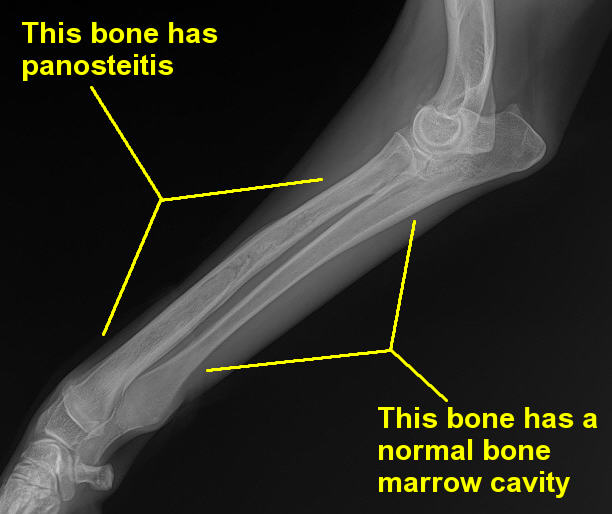
The pain causes a limp and more than one leg can get affected by Panosteitis (short name is Pano), which should not be considered a disease but a teething problem of body growth in canine breeds. The lameness is clinically described as ‘shifting lameness’ or ‘shifting pain disease’.
Generally, such dogs show signs of lethargy and appetite loss (since they remain depressed) combined with feverish body temperature or tonsillitis. Also evident is an increase in the white blood cell count. There is a noticeable reluctance to walk or exercise. The clinical symptoms of Panosteitis are periodic and reflect a waxing and waning pattern. The signs last either a few days or a few weeks and then disappear to resurface again.
More About Panosteitis
The key characteristic of Panosteitis is fatty bone marrow inflammation , the limb bones are the targets of Panosteitis. The long bone shafts which have a higher percentage of bone marrow face the brunt like the ulna, radius, femur, humerus, tibia, pelvic, and foot bones. The bone pain can be excruciating and might lead to lameness. The bone inflammation occurs because Pano leads to the degeneration of fat cells of bone marrow and certain structural changes like osteoblasts
The cause of Panosteitis is yet to be deciphered. The initial hypothesis point that some bacteria were responsible has been ruled out. There is a consideration that Pano is viral keeping in mind the symptoms of virus infection (fever, decreased white blood cell count, etc).
Whether or not Panosteitis is genetic, scientists are yet to determine. A connection is made to the genetic link since certain breeds of dogs are more affected than others. But the main reason behind Pano is seen as a diet that’s rich in protein and fat. So, the occurrence of Pano is more dependent on the nutritional aspects rather than the genetic or viral aspect.
How to Diagnose Pano?
Panosteitis goes away and hence it is not a matter of utter concern; only your little pup will have to undergo a passing phase of pain. It can be diagnosed by X-Ray and only a vet, specializing in canine orthopedics, can identify the disorder from the X-Ray plate.
Vet surgeons have found out that there is an increase in bone density in Panosteitis. In the later stages, the bones take on a patchy or mottled appearance, which returns to normalcy once the dog outgrows puppyhood.
Treatment of Pano
Never administer steroids to dogs afflicted with Pano. Painkillers come with side effects like irritation in the intestines. Most important of all feeding an appropriate diet to such dogs is crucial because food plays a vital role in their growth and skeletal development. Natural nutrition and exercise management are ideal ways to deal with Panosteitis.
Make a Stop to Growing Up Too Fast
Retard the process of growing up too fast , because that’s the reason behind Pano. Ideally, the growth rate should be slowed down in puppies affected by Panosteitis. Puppies who are not affected by any conditions should be offered good quality food with the right amount of protein, vitamins, carbohydrates, fats, and minerals. Homemade food with the right amount and types of ingredients is a great option. An all-natural diet is helpful in this regard. Even in home food, the number of bones should be kept to a minimum. Commercial dog foods can be given as recommended by your vet.
Treatment: manage the pain, wait out the disease
Because the condition resolves on its own, treatment is aimed squarely at comfort.
VCA describes it as “pain medications (analgesics) and/or anti-inflammatory drugs” (VCA, retrieved 2026-08-12).
Never reach for your own painkillers. Human anti-inflammatories, including ibuprofen and aspirin, are not safe substitutes and can cause serious harm. Get a prescription written for your dog’s weight.
Alongside medication, what helps during a flare:
- Shorter, gentler walks while a leg is sore. Lead walks rather than free running, and let the dog set the pace.
- Skip the high-impact stuff entirely during an episode. No repeated ball throwing, no stairs if you can avoid them, no jumping into the car.
- Soft bedding and traction. A painful young dog on a slippery floor is a fall waiting to happen.
- Keep the weight down. Every extra kilo is carried on legs that already hurt.
- Do not stop exercise altogether. A growing dog still needs movement. The goal is lower impact, not confinement.
- Keep a simple diary. Which leg, which dates, how bad. It helps your vet see the shifting pattern rather than take your word for it.
What else it could be
Shifting lameness in a young large-breed dog is fairly characteristic, but it is not proof, and the alternatives at this age are treated very differently.
| What you see | Points toward |
|---|---|
| Sudden lameness with no trauma, moving between legs, in waves, aged 6 to 18 months | Panosteitis |
| Lameness that stays on one leg, joint swollen or warm, aged 6 to 9 months | Osteochondritis dissecans |
| Front-leg lameness, stiffness after rest, often both sides | Elbow dysplasia |
| Difficulty rising, bunny-hopping, reluctance to jump | Hip dysplasia |
This is why the X-ray matters even though pano resolves by itself. VCA notes the vet “will suspect panosteitis if the dog shows pain when pressure is applied to the affected bone(s)”, and that “the diagnosis is confirmed by X-rays (radiographs), which usually show a characteristic increase in the density of the affected bones” (retrieved 2026-08-12). Confirming pano is also how you rule out the conditions that do not go away on their own.
For the wider picture on raising a large-breed puppy, see our German Shepherd care guide and choosing a German Shepherd puppy.
Living through it: what the next year looks like
Panosteitis is unusual among the things that go wrong with young dogs, because the hard part is psychological rather than clinical. You know it will end, and you still have to watch your dog hurt in the meantime.
Expect it to come back. This catches people out. The first episode settles, everyone relaxes, and three weeks later the dog is lame on a different leg. That is not a relapse or a treatment failure. VCA describes episodes lasting “a few days to weeks” and pain that shifts from leg to leg (VCA Animal Hospitals, retrieved 2026-08-12). Knowing that in advance turns a frightening second episode into an expected one.
Do not judge the diagnosis by the flares. Owners sometimes push for more investigation each time the lameness returns. If pano has been confirmed on X-ray and the pattern fits, the recurrence is the disease behaving normally.
Do go back if the pattern changes. Lameness that stops moving and settles permanently on one leg, a joint that becomes swollen, or a dog that stops improving between episodes are all reasons to re-examine rather than assume.
Protect the training, not just the legs. A young dog in pain that gets pushed through walks or classes can learn that certain activities hurt. Scaling back during a flare is not indulgence, it is avoiding a lasting association with something you want the dog to enjoy for the next decade.
Keep the end date in view. VCA puts full resolution at 18 to 24 months of age (retrieved 2026-08-12). For most owners reading this, that is months away rather than years, and there is no lasting damage waiting on the other side of it.
Questions worth asking your vet
- Have we X-rayed to confirm it? The changes in bone density are what distinguish pano from the conditions that do not resolve.
- Which bones are affected right now? Useful to track, and it tells you where to be gentle.
- What pain relief, at what dose, and for how long? Get it in writing, since you may need it again in a month.
- Can I have a repeat plan for the next flare? Ask whether you should re-consult each time or start the same medication.
- How much exercise during a flare, and how much between? Ask for something specific rather than “take it easy”.
- Is my puppy’s diet appropriate for a large breed? Bring the label and any supplements.
- What would make you want to look again? Agree the red flags now.
 Top 10 Best German Shepherd Breeders in Maryland (MD)