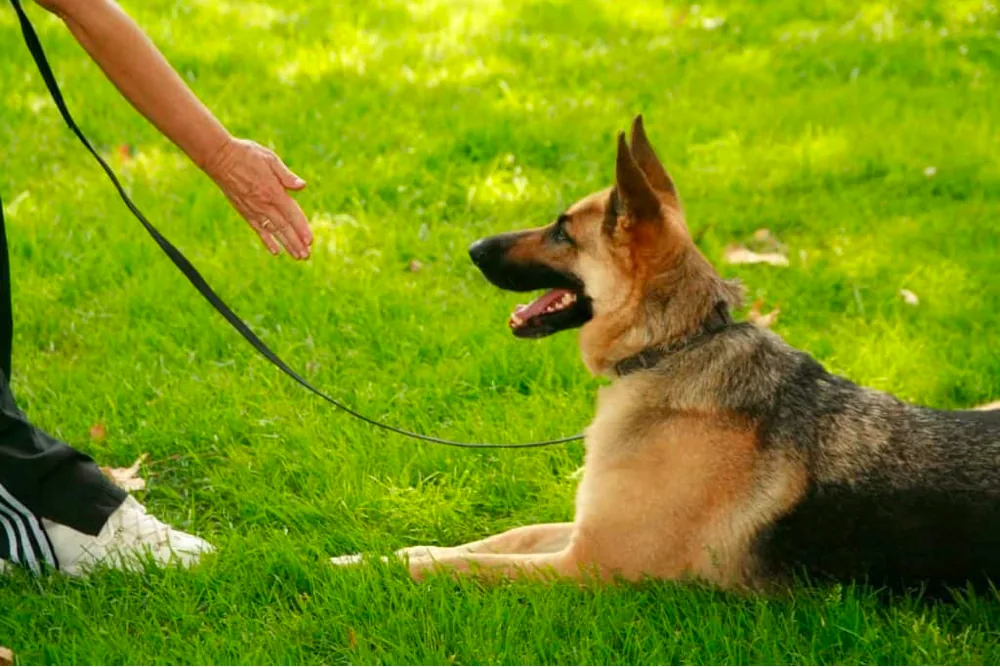
The down is the most useful cue you will teach a German Shepherd, and the one most often taught badly. A dog that will lie down and stay there is a dog you can take to a cafe, keep out from underfoot in a busy kitchen, and settle in a vet waiting room full of other dogs.
It is also the cue that most often turns into a wrestling match, because the traditional instructions tell you to push the dog into position. This page covers the method that works instead, on lead or off it, and what to do when your dog does the four things they all do.
The short version: lure the dog down with a treat in an L-shape, mark the moment the elbows touch the floor, pay while the dog is still down, and add the word only once the movement is reliable.
First, the thing not to do
Almost every older set of instructions for this exercise, including the version of this page that stood here until today, tells you to press the dog down between the shoulder blades while pulling the lead. Do not do that.
The American Kennel Club is explicit: “Never force your puppy into a down… that will likely have the opposite effect. Your dog will want to stand even more to resist the pressure” (Stephanie Gibeault, MSc, CPDT, American Kennel Club, updated 2026-03-12, retrieved 2026-08-13).
That resistance has a name. Push down on an animal and it pushes back, which is a reflex rather than a decision. So the harder you press, the more you are training the dog to brace against your hand. With a German Shepherd, an adult of which can outweigh the person doing the pressing, that is a contest nobody needs to start.
There is a second cost. Hands coming towards the shoulders and back stop being neutral. That matters later at the vet, at the groomer, and any time somebody needs to check the dog over.
Equipment: what you need, and what to leave in the shop
The old version of this page suggested a check chain, also sold as a choke chain, “assuming you know how to use it correctly”. Skip it.
The American Veterinary Society of Animal Behavior states that it “does not support the use of aversives in any context, regardless of the tools used or the trainer’s level of experience“, and recommends “that only reward-based training methods are used for all dog training” (AVSAB Humane Dog Training Position Statement, retrieved 2026-08-12). The “if used correctly” caveat is doing a lot of work in the old advice, and it is not a caveat AVSAB accepts.
What you actually need for this exercise is short:
- A flat collar or a Y-shaped harness. Either is fine. This is a stationary exercise, so the lead is only there for safety.
- Treats the dog genuinely wants, cut small. Twenty repetitions means twenty payments, so keep each one tiny.
- A marker. A clicker, or a short word such as “yes”, used at the exact moment the elbows touch the floor.
- A non-slip surface. A dog will not lie down comfortably on laminate it is sliding on. This is the most commonly missed reason a big dog refuses.
And it is worth knowing why reward-based work is the recommendation rather than the soft option. AVSAB cites Hiby and colleagues (2004), who found “obedience levels of dogs highest for dogs trained exclusively with reward-based methods and lowest for dogs trained exclusively with aversive-based methods” (AVSAB, 2021, retrieved 2026-08-12).
The method: luring, step by step
This is the AKC’s luring method, which is the standard approach and the one to start with.
- Start with the dog in a sit, on a comfortable surface, somewhere quiet.
- Hold a treat to the dog’s nose, then “bring the treat down between your puppy’s front paws… Continue moving the treat out along the ground away from your puppy. You are essentially making an ‘L’ shape” (AKC, retrieved 2026-08-13). Straight down, then forward along the floor.
- Mark the instant the elbows touch the floor. Click, or say “yes”. The timing of this marker is what the dog is actually learning from.
- Pay while the dog is still lying down, delivering the treat at floor level between the front paws. Feeding at head height teaches the dog to get up for its reward.
- Repeat five to eight times, then stop. Short sessions beat long ones.
Do not say “down” yet. At this stage the dog does not know what the movement is, so the word would attach to nothing.
Fading the treat out of your hand
This is the step people skip, and skipping it is why so many dogs will only lie down when they can see food.
The AKC sequence is a hand-over: “After several repetitions, begin to use a treat from your other hand as a reward so the lure no longer gets eaten. Finally, lure your puppy with an empty hand and reward with a treat from the opposite hand” (AKC, retrieved 2026-08-13).
So the sequence is:
- Treat in the luring hand, dog eats that treat.
- Treat still in the luring hand, but paid from the other hand.
- Luring hand empty, making the same L-shaped movement, paid from the other hand.
By step three the hand movement has become the signal. What was a bribe is now a hand cue, and that is a meaningful difference: a bribe has to be present before the dog decides, a cue does not.
Adding the word “down”
Only now does the verbal cue go on, and the order matters more than anything else on this page.
Say the word first, then make the hand movement. “Down”, short pause, hand signal, dog lies down, mark, pay. Said the other way round, the word arrives while the dog is already going down and carries no information.
After twenty or so pairings, try the word on its own and wait three full seconds. If the dog lies down, pay generously. If it does nothing, the word needs more pairings; help with the hand signal, and do not repeat the word over and over. A cue repeated five times teaches the dog that the fifth one is the real one.
Use one word and get the household using the same one. “Down”, “lie down” and “get down” are three different sounds to a dog.
The other way in: capturing
Some dogs, especially large deep-chested ones, find the lure awkward. There is a second method that needs no luring at all.
The AKC describes it as rewarding the behaviour the dog offers by itself: “whenever you see your puppy lying down, click and praise them”, and over time “your dog will start to lie down in front of you on purpose, hoping to earn a reward” (AKC, retrieved 2026-08-13).
Keep a jar of treats where the dog settles. Every time it lies down of its own accord, mark and pay. Once it is offering the down deliberately, add the word just before it happens.
Capturing is slower to get going and produces an unusually relaxed down, because the dog was already comfortable when it started. It is the better route for a dog that has previously been pushed into position and has learned to brace.
Timing: train a tired dog
One tip changes the success rate more than any other. The AKC: “Train when your puppy is tired. Don’t expect your puppy to willingly lie down when they’re full of energy” (AKC, retrieved 2026-08-13).
This matters more with this breed than most. Asking a fresh, under-exercised working-line German Shepherd to fold itself onto the floor and stay there is asking against the grain. After a walk or a training game, the same dog will offer it easily.
When it goes wrong
Nearly every failure at this exercise is one of six things.
| What you see | What to change |
|---|---|
| The dog follows the treat down but pops straight back up | You are paying a fraction of a second late. Mark the instant the elbows touch, then deliver the treat while the dog is still down. |
| The dog stands up instead of lying down | The lure is too high, or moving too fast. Take it slower, and keep it in contact with the floor as you draw it forward. |
| The dog will do it in the kitchen and nowhere else | Normal. The cue was learned with the kitchen attached to it. Rebuild it in each new room and outdoors, starting easy each time. |
| The dog lies down in a crouch, ready to spring up | Feed several treats in a row while the dog is still down, so staying down is what pays rather than getting up. |
| The dog refuses on hard or cold floors | Try a mat or a rug. Refusal is often about the surface, not the cue, and this is especially true of older dogs and lean, bony dogs. |
| An older dog suddenly stops lying down, or drops awkwardly | Stop training and book a vet check. Reluctance to lie down or get up is a pain sign before it is a training problem. |
What comes next
A down that works in a quiet room is a start, not a finished cue. The work that makes it useful in real life, holding it while you walk away, holding it for several minutes, and dropping on cue at a distance, is covered in our guide to the off-leash down, distance and duration.
For the wider training picture see training a German Shepherd and how reward-based training works. If you have read elsewhere that a dog refusing a cue is challenging your authority, our article on the pack-leader idea explains why that framing was dropped.
Disclaimer: PetVR shares general information based on our contributors’ firsthand experience with German Shepherds — it is not veterinary advice. Always consult a licensed veterinarian about your dog’s health, diet, or behavior. Read our full disclaimer.
 How to Potty Train a German Shepherd Puppy