
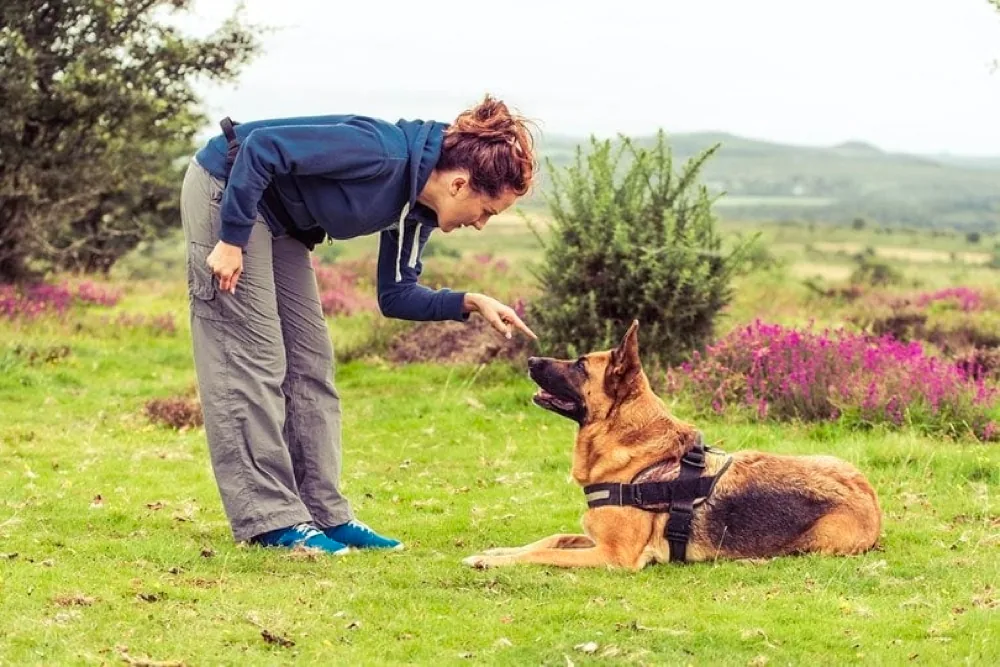
Teaching a German Shepherd to lie down in your kitchen takes an afternoon. Getting the same dog to drop and stay down off lead, at a distance, with a squirrel in view, is a different project, and it is the one worth doing.
The off-leash down is a safety cue. A dog that drops instantly at fifteen metres is a dog you can stop before it crosses a road or reaches another dog that does not want company. It is also, at that point, one of the few cues that can genuinely prevent an accident.
This page assumes the dog already lies down on cue in an easy setting. If it does not yet, start with teaching the down and come back.
First, the thing not to do
Almost every older set of instructions for this exercise, including the version of this page that stood here until today, tells you to press the dog down between the shoulder blades while pulling the lead. Do not do that.
The American Kennel Club is explicit: “Never force your puppy into a down… that will likely have the opposite effect. Your dog will want to stand even more to resist the pressure” (Stephanie Gibeault, MSc, CPDT, American Kennel Club, updated 2026-03-12, retrieved 2026-08-13).
That resistance has a name. Push down on an animal and it pushes back, which is a reflex rather than a decision. So the harder you press, the more you are training the dog to brace against your hand. With a German Shepherd, an adult of which can outweigh the person doing the pressing, that is a contest nobody needs to start.
There is a second cost. Hands coming towards the shoulders and back stop being neutral. That matters later at the vet, at the groomer, and any time somebody needs to check the dog over.
The three things you are adding, one at a time
The classic mistake is adding all three at once: asking the dog to drop, far away, for a long time, in a park. It fails, and it teaches the dog that the cue is optional.
| Variable | What it means | Built by |
|---|---|---|
| Duration | How long the dog stays down | Feeding repeatedly while the dog is still down, and building seconds slowly |
| Distance | How far away you are when you cue it, and how far you can then move | Half a step at a time, returning to the dog to pay rather than calling it up |
| Distraction | What else is happening | Deliberately staged, from mild to hard, never straight to the hardest |
Raise one at a time and drop the other two. Adding distance means going back to a short duration in a quiet place. This feels slow. It is still faster than rebuilding a cue the dog has learned to ignore.
Duration first
Duration is the cheapest to build and it makes the other two easier.
- Cue the down. The moment the elbows touch, mark and pay.
- Next repetition, wait two seconds before paying. Then five. Then ten.
- While the dog holds it, feed several treats in a row on the floor between the front paws. This is the mechanism: staying down is what pays, so there is no reason to get up.
- Add a release word, the same one every time, and use it to end every repetition. “Off you go” or “break”.
Vary how long you wait. A dog that gets released at exactly ten seconds every time starts counting, and will begin breaking at nine.
Then distance
Distance is where most people lose the behaviour, and always in the same way: they walk away, the dog follows, and they call it back and try again. The dog has just been paid, with attention, for following.
- Cue the down. Shift your weight backwards without moving your feet. Return, pay at floor level.
- One step back, immediately return, pay while the dog is still down.
- Two steps. Three. Increase in ones, and drop back several steps whenever the dog breaks twice in a row.
- Only once you can walk ten steps away and return, start walking around the dog rather than only backwards.
The rule that makes this work: go back to the dog to pay it. Never call the dog to you to reward a stay. Calling it out of position pays the getting-up, which is precisely the behaviour you are trying to remove.
Do this on a long line before you do it off lead. A long line is not a training tool here, it is a seat belt, and it means an early failure is inconvenient rather than dangerous.
The emergency down at a distance
This is the version worth having: a dog that drops where it stands, instantly, on one word.
It is trained separately from the polite household down, because it needs to be reflexive rather than considered.
- Give it its own cue. A distinct, loud, short word used for nothing else. Many people use “DROP”. Never use it casually.
- Pay it extravagantly, every single time. This cue is not on an intermittent schedule. Chicken, cheese, the good stuff, no exceptions.
- Start beside the dog, not at a distance, and build outward exactly as above.
- Practise it when nothing is happening. A cue only ever used in a crisis has never actually been trained.
- Never use it to end fun. If “DROP” reliably means the walk is over, it will get slower every week.
Be honest about what this cue can and cannot do. A dog in full chase, already at speed, is the hardest case there is, and no cue is a guarantee at that point. It is a very good tool for the seconds before the chase starts, which is where most accidents are actually prevented.
Adding distraction without wrecking the cue
Distraction gets staged deliberately, in an order you control.
- A person walking past at twenty metres.
- A person walking past at five metres.
- A dropped toy, at a distance, not moving.
- A family member jogging past.
- A calm, familiar dog at a distance.
- Only then, real-world environments.
If the dog fails twice at any level, the previous level was not solid. Go back one and pay more. Failure is information about the plan, not about the dog’s attitude.
One more thing worth naming, because the older advice on this site got it wrong: if the dog gets up, nothing bad happens. You reset and make the next repetition easier.
The version of this page that stood here until today told owners to let the dog know they were displeased when it broke position. That is the piece the evidence does not support. AVSAB “does not support the use of aversives in any context, regardless of the tools used or the trainer’s level of experience”, and states its position “is grounded in current scientific evidence, which consistently shows that aversive methods carry significant risks to animal welfare and the human-animal bond” (AVSAB Humane Dog Training Position Statement, retrieved 2026-08-12).
In practical terms a worried dog offers fewer behaviours, not more, which is the opposite of what you need during proofing.
When it goes wrong
Nearly every failure at this exercise is one of six things.
| What you see | What to change |
|---|---|
| The dog follows the treat down but pops straight back up | You are paying a fraction of a second late. Mark the instant the elbows touch, then deliver the treat while the dog is still down. |
| The dog stands up instead of lying down | The lure is too high, or moving too fast. Take it slower, and keep it in contact with the floor as you draw it forward. |
| The dog will do it in the kitchen and nowhere else | Normal. The cue was learned with the kitchen attached to it. Rebuild it in each new room and outdoors, starting easy each time. |
| The dog lies down in a crouch, ready to spring up | Feed several treats in a row while the dog is still down, so staying down is what pays rather than getting up. |
| The dog refuses on hard or cold floors | Try a mat or a rug. Refusal is often about the surface, not the cue, and this is especially true of older dogs and lean, bony dogs. |
| An older dog suddenly stops lying down, or drops awkwardly | Stop training and book a vet check. Reluctance to lie down or get up is a pain sign before it is a training problem. |
| The dog holds it perfectly at home and falls apart in the park | Expected. Rebuild all three variables from the beginning in each new environment. It gets faster every time. |
| The dog drops but creeps forward along the floor | You are paying late, or from too far forward. Deliver the treat between the front paws so there is nothing to creep towards. |
Before the lead comes off at all
A trained down is one of the conditions for off-lead work, not the whole of it. The others are worth stating plainly, because this is where the consequences stop being about training.
- Recall comes first. A dog that will not come back reliably should not be off lead in an unfenced space, however good its down is. The down is what you use when recall is the wrong answer, for example when calling the dog would bring it across a road.
- Know the local rules. Lead requirements vary by area and by season, and near livestock they are not advisory. Check before you assume a space is off-lead.
- Be honest about the individual dog. A German Shepherd with a strong chase response near roads, sheep or cyclists is a different risk calculation from the same dog in an enclosed field. The training does not change the environment.
- Use a long line during the transition. Fifteen metres of line gives you every benefit of distance work with none of the consequences of an early mistake.
None of this is a reason not to do the work. It is a reason to do it in the order that keeps the dog safe while you do.
How long this actually takes
Realistic expectations stop people quitting at the point the work starts paying.
A dog that already downs on cue will usually hold thirty seconds within a week or two of short daily sessions. Ten steps of distance takes a few weeks. A down that holds in a genuinely distracting place, with you out of sight, is a months-long project, and the emergency down is something you keep topping up for the life of the dog rather than finishing.
Two short sessions a day beat one long one, and both beat a heroic weekend. Five minutes is a session. If either of you is getting frustrated, the session ended two minutes ago.
Where this fits
A reliable down is one leg of off-lead freedom; recall is the other. The two are trained separately and used for different problems.
See teaching the down for the foundation, training a German Shepherd for the broader plan, and reward-based training for the mechanics behind marking and paying.
Disclaimer: PetVR shares general information based on our contributors’ firsthand experience with German Shepherds — it is not veterinary advice. Always consult a licensed veterinarian about your dog’s health, diet, or behavior. Read our full disclaimer.
 How to Train A German Shepherd Dog To Lie Down On-Leash