
The ‘COME’ command training is often known to be the most crucial obedience training. The training guides your dog from any serious danger as it calls your dog back to you in case you sense danger coming his way. Apart from making sure that your dog will run across every hurdle or danger to be back with you with the help of proper ‘come command’ training, this also provides much freedom and relief to the owner as well when he knows that the dog will come on command whenever the owner calls for him.
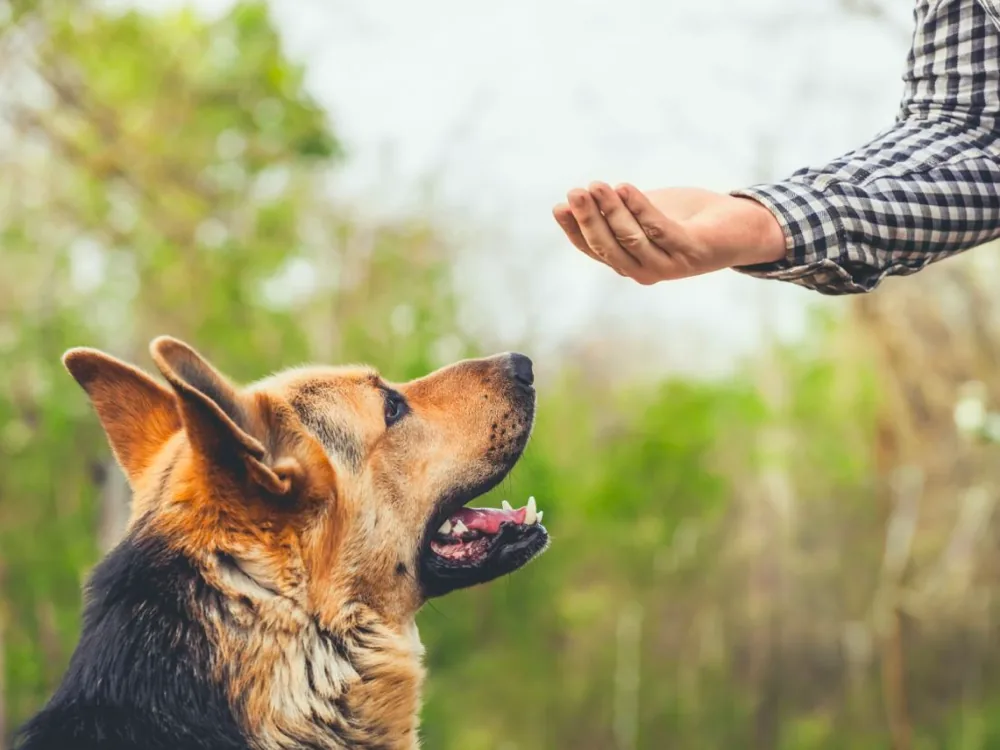
The training leaves the dog as well with an open space to explore and experiment as he wishes until he hears the owner’s ‘COME’ command, hence, the lesson is based on security, reassurance, and trust for both the dog and his owner. The ‘COME’ command simply means that the dog ought to come to the master despite of whatever is happening around him and in spite of anything that the dog is involved in, making the dog alert and ready to act on the call of his owner.
However, according to dog behaviorists, it is a rather difficult task to train a dog about the ‘COME’ command, especially for the breeds that love to chase and have a strong scent drive. Training on the ‘COME’ command has to thus take place from the very puppyhood and the owners should also know the major reasons why a dog fails to adopt this lesson, as keeping those points in mind will help the owner achieve the purpose of training without any fault on his part.
The most probable reason is that your dog does not even know the meaning of the word or the command ‘COME’ and hence feels confused about what to do.
In other cases, it may have happened that your dog got away without attending to your ‘COME’ command and he was not held accountable for the same hence he lacks reason or motivation to come to you on command.
Apart from these two reasons, it may also happen that your dog has found other options like chasing a squirrel or digging or chasing his favorite thing more interesting than coming to you.
Besides, your dog may not turn up to you on the ‘COME’ command as he was treated unexpectedly (was chained or leashed when he came to you or was taken for nail-trimming or other unpleasant treatment)or was punished (was pushed to the crate or to the kennel as he came) in the past when he came running to you on come command. The following tips can help you to train your dog to respond positively to come commands:
- Start this training from the very puppyhood and express your joy as your puppy follows you. Make responses and sounds and use words like ‘come’ to him to encourage him to follow you. As you help your puppy associate the word ‘come’ with running to you, from wherever he is, the lesson will get etched in his head.
- Make sure to let your dog associate the ‘COME’ command and come to you with a positive reward or a treat that you would be providing to him as soon as he comes to you at command. Your main motto is to make your dog happy about coming to you whenever its name is called and his trust and expectations are kept by you to nurture this positive habit in him.
- Use the ‘COME’ command along with calling your puppy by its name and reinforce this training throughout the day whenever you need to call his name, either for food, for poop, for walks and games, for playing ‘go fetch, to cuddle and pet him, etc.
- Remember never to call your dog on a come or name command which would require him to face something unpleasant like getting leashed, going to the orate, for nail-trimming, or for other punishments, as this will lead them to associate come command with something negative or punishing in nature. You should rather go and lift the dog in case you need him for other reasons to assure his overall well-being.
It would be futile if you end up punishing your dog for not coming to you, as this will both baffle him and make him sad toward you. Rather have patience and wait till he comes and if he does not repeat the come command training inside the indoors and give your dog enough pleasant motivation for coming to you by calling his name.
Recall builds on the basics, so start from a dependable sit if that is not solid yet.
Disclaimer: PetVR shares general information based on our contributors’ firsthand experience with German Shepherds — it is not veterinary advice. Always consult a licensed veterinarian about your dog’s health, diet, or behavior. Read our full disclaimer.
How dogs actually learn, and why the method matters
Before any specific exercise, it is worth knowing what the veterinary behaviour profession actually recommends, because the dog training industry is unregulated and advice varies wildly.
The American Veterinary Society of Animal Behavior is unambiguous: “based on current scientific evidence, AVSAB recommends that only reward-based training methods are used for all dog training, including the treatment of behavior problems” (AVSAB Humane Dog Training Position Statement, retrieved 2026-08-12).
This is not a soft preference. AVSAB states it “does not support the use of aversives in any context, regardless of the tools used or the trainer’s level of experience”, and that the position “is grounded in current scientific evidence, which consistently shows that aversive methods carry significant risks to animal welfare and the human-animal bond” (retrieved 2026-08-12).
And reward-based training is not merely kinder, it works better. AVSAB cites Hiby and colleagues (2004), who found “obedience levels of dogs highest for dogs trained exclusively with reward-based methods and lowest for dogs trained exclusively with aversive-based methods”. Mixed approaches, “often referred to as balanced in the dog training industry”, landed in between (AVSAB Position Statement on Humane Dog Training, 2021, retrieved 2026-08-12).
One misunderstanding worth heading off. AVSAB notes that “use of reward-based methods does not mean dogs are allowed to do anything they want” (retrieved 2026-08-12). Rules still exist. What changes is how you teach them.
Recall is the one that has to work
Every cue on this site is useful. This is the one that keeps a dog alive, so it deserves more care than the rest.
Rule one: never punish a dog that comes back. Not for taking a long time, not for what it did before it came. If returning to you ever predicts something unpleasant, recall degrades, and it degrades exactly when you need it.
Rule two: the recall word is sacred. Do not use it to end fun, to bring the dog in for a bath, or to get it into the car when it is having a wonderful time. Use a different word for those. Otherwise the cue comes to mean “the good part is over”.
Rule three: pay far more than you think is necessary. Recall competes with squirrels, other dogs and interesting smells. A piece of kibble is not a competitive offer. Use something extraordinary and reserve it for this.
Building it in stages
- Indoors, one metre, no distractions. Say the word once, and pay generously when the dog arrives.
- Add distance across the house, then between rooms so the dog has to actively find you.
- Move to the garden. Expect it to get worse when the environment changes. That is normal, not a setback.
- Use a long line outdoors. Five to ten metres, attached to a harness rather than a collar. It lets you practise in real environments without ever having a failure the dog gets rewarded for.
- Practise recalls that go nowhere. Call, reward, release back to play. If every recall ends the walk, the dog does the arithmetic quickly.
- Only drop the line when you are winning nine times out of ten at that level of distraction.
If your dog does not come back, do not repeat the word into the void. Run away in the opposite direction, or crouch down, or make an excited noise. Chasing a dog turns recall into a game of keep-away, and a German Shepherd is faster than you.
Attach the long line to a harness rather than a collar, so that a dog hitting the end of it at speed does not take the impact through its neck.
What is different about training this breed
German Shepherds are not harder to train than other dogs. In some ways they are easier, and that creates its own problems.
They learn fast, including the things you did not mean to teach. A dog that works out that barking makes you come outside has learned exactly as efficiently as one learning to sit. Be deliberate about what gets rewarded, including by accident.
They need the thinking as much as the walking. The AKC describes purpose-bred dogs as needing mental work, warning that without the brain exercise they need “they’ll create their own projects to keep their minds busy” (AKC breed profile, retrieved 2026-08-12). Five minutes of training is often worth more than another twenty minutes of walking.
They are big, and size changes the stakes. A behaviour that is charming in a 10 kg puppy is not charming in a 35 kg adult. Jumping up, mouthing and pulling are all much easier to prevent than to fix later.
They form strong attachments, which makes your attention a genuinely powerful reward and makes harsh handling land harder than it would with a less sensitive dog.
Session rules that make everything else work
- Short and often beats long and occasional. Three or four sessions of five minutes across a day will outperform one twenty-minute session, especially with a puppy.
- Finish while your dog still wants more. Ending on success is what makes a dog eager to start next time.
- Train before meals, not after. A hungry dog works for food. A full dog does not.
- Start somewhere boring. Your kitchen, no other dogs, no visitors. Add difficulty only once the behaviour is reliable.
- Change one thing at a time. Distance, duration, distraction. Raise one and drop the others.
- If it falls apart, make it easier. A dog that stops responding is usually telling you the step was too big, not that it is being stubborn.
- Keep your voice ordinary. Repeating a cue louder teaches the dog that the first six times do not count.
If you hire help, here is the filter
A German Shepherd is a large, powerful, clever dog, and getting good help early is money well spent. The difficulty is that anyone can call themselves a dog trainer.
AVSAB gives an unusually concrete screening rule: “if a trainer is observed using aversive training methods or if a trainer discusses out-dated ideas such as dominance, leader of the pack, or alpha theories, then clients should be advised against hiring them” (AVSAB Position Statement on Humane Dog Training, 2021, retrieved 2026-08-12).
That is a clean test you can apply in a five-minute phone call. Ask a prospective trainer how they would handle a dog that ignores a cue. If the answer involves showing the dog who is boss, keep looking.
Questions worth asking before you book:
- What happens when my dog gets it right? A reward-based trainer answers this immediately and specifically.
- What happens when my dog gets it wrong? The answer should involve making it easier, not making it unpleasant.
- What equipment do you use? Be cautious of anyone who leads with a tool rather than a plan.
- Can I watch a class before enrolling? A confident trainer says yes.
- What qualifications do you hold, and are you insured?

 How To Train A German Shepherd Dog To Lie Down Off-Leash