
Animals need to communicate with other species. Dogs are no exception… they have always been in need to communicate with their human companions and other pack members including other dogs, and humans. Language has arisen out of the need for us and our dogs to communicate with each other in order to maintain a balanced social relationship. German Shepherd Dog has been reckoned as the third most intelligent dog breed in the world according to Coren’s experiment on dog intelligence. Amongst the hundreds of dog breed existing on the planet, the German Shepherd Dog has been one of the most skillful communicators. Selective breeding has fine-tuned the breed to make it one of the most expert canine members insofar as expressing ‘emotions’, ‘desire’, ‘want’, ‘direction’, ‘intention’, and ‘excitement’ are concerned.
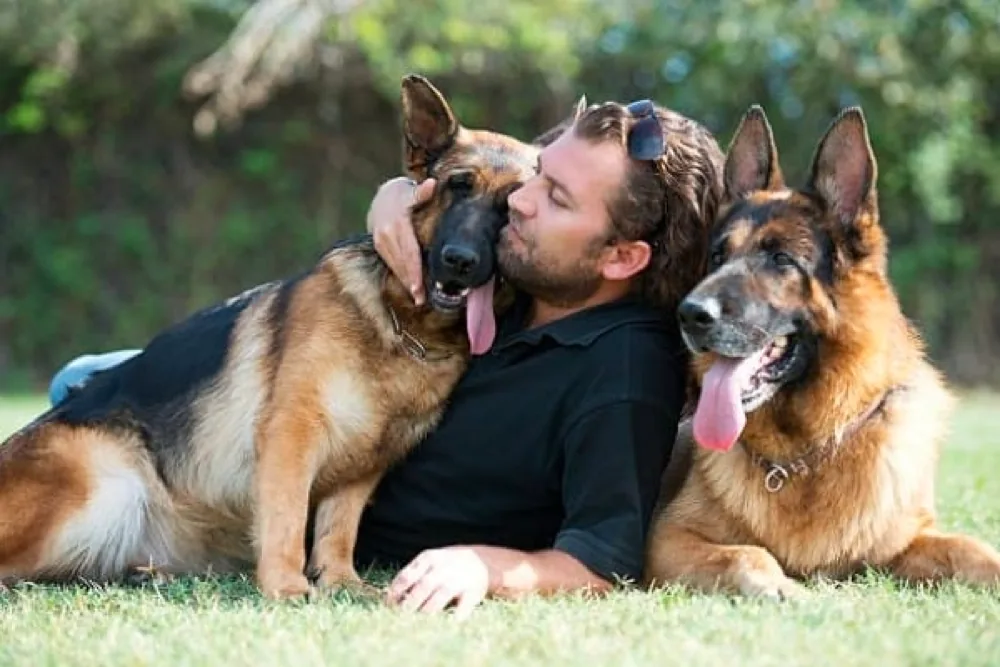
As in any other mammal German Shepherds usually communicates in three major forms while interpreting and expressing their emotions, intentions, and desire. These are:
- Body and facial movements
- Touch
- Vocal signals
Dogs , especially a breed as intelligent as German Shepherd Dogs tend to learn wide varieties of communicative human language that are required to maintain a balanced social lifestyle with their human partners. From the ages of weaning till its puberty a purebred German Shepherd Dog intensely learn a huge number of human languages and corresponding actions which helps his master and other pack members to communicate with him easily, provided the dog is kept under supervision and consistent communicative sessions by his human pack members.
 |
Body Language in German Shepherd Dogs
German Shepherd Dogs are usually keen to interact with the human members of the pack. Being one of the most efficient working dogs German Shepherds have tendencies to please their masters, having the willingness to go out to work for their owners. The fact that German Shepherds are enthusiastic communicators makes them one of the best working breeds in the world. Without being a good communicators, dogs cannot be expected to be perfect working partners. Their expressions and body languages are the salient factors to determine what’s running in their mind. The position of ears, the degree of openness of its eyes, the angle at which he holds his neck, the opening of the mouth, the showing of teeth, the tail carriage, the direction of stare, the way he looks, etc. are all unified and severally used to express his mood, fear, happiness, tension and weariness, intention and desire, submission or dominion.
What better signal can a dog give to show friendship than by waging its tail? Isn’t this alone a reason equivalent to a million reasons to condemn the docking of tails in certain other dog breeds? Tail docking has been banned and should remain banned forever. German Shepherd dogs communicate fairly well through body language. It is very important to notice the whole body of your GSD in detail and not just a part or parts of the body (for instance not just the tail or mouth or eyes or ears ) before you come up to a conclusion as to what your shepherd is trying to communicate. What appears to a novice’s eyes may be different from what actually the dog is trying to communicate. It is, hence recommended to study your German Shepherd Dog in more detail. Although German Shepherd Dogs have mastered the art of effective communication, still it is important to notice the overall gesture and body actions. There may be a set of seemingly stereotyped body actions and gestures for different meanings, and also seemingly the same meaning for different body languages. Remember, if you study your German Shepherd Dog well closely, you can understand how complex their communication system is with subtle differences in overall body language for every communication. Generalized theory for instance “folded ears means a signal of affection and friendliness” does not hold equally good in all situations. German Shepherds may wag their tails not only to convey messages of Excitement or Happiness or Anticipation for something good or playfulness or Friendliness but may also to convey messages of Uncertainty or Anxiety, which may not be always a wise idea for people out of their pack to approach the dog. It is highly recommended that you should study the entire set of dogs’ body language to understand what exactly is your German Shepherd Dog trying to communicate. A conclusion should be reached by analyzing the combination of body language!
German Shepherd’s Communication to Show Mood
This has always been the most important thing to understand for owners of large dogs like German Shepherds, Mastiffs, Rotties, Dobermans, Great Danes, etc. Until you master determining how your German Shepherd Dog will be communicating with you to express his state of mind, you cannot be a good owner. A lack of knowledge in this regard may jeopardize your life! As in the case of wolves and certain other dog breeds, German Shepherds tend to stand upright, holding their tail high, may be more or less parallel to the ground or carried even higher, head held high, with ears perfectly erect with firmness to prove his power while signaling an assertive mood or an encounter. While on the other hand, when a dog approaches a higher ranking member or psychologically and physically stronger specimen, it will carry his head low, body dropped lower than the level of back, ears not erected and tail dropped down, to signal that it means no harm and would like the situation to de-escalate. A dog approaching another may also withdraw its lips in what behaviourists call a submissive grin, and may roll onto its back to expose the underbelly. These are appeasement signals, not statements about rank.
German Shepherds Communication Through Scent
Many dogs including German Shepherds also communicate by using the indirect language of visual marks as well as pheromones. The count of vomeronasal cells in pure-breed German Shepherd Dogs is much more than in most dog breeds. They can efficiently track scent marks that have been there in the environment for a long period of time. German Shepherd Dogs can impart messages for a long time even after another dog has left a particular area. Disposition of glandular secretion, feces, and urine that give a specific odor signature to each and every dog is used as one of the strongest scent signals used for marking territory.
The urine of a particular dog contains a huge number of information about the particular dog. The urine smells different in different situations, depending much on the age, mental and physical health, gender, emotional state of the dog, and even if a female dog is in heat.
Females , especially in heat leave signals for other dogs by leaving a small quantity of urine in different places as scent marking. Males are no exception. As a part of their signaling behavior, males tend to urinate in smaller quantities at different spots. This is a scent-marking behavior that starts almost at the age of puberty in males.
Touch communication by German Shepherd Dogs
German Shepherd Dogs’ intelligence and their eagerness to stay in contact with their owners and handlers have brought them closer to humans than many other dog breeds in the world. The way they communicate with their human pack members through touch is inspirational. When your Shepherd touches you, it sends some signals through it. Touch may be loving, or maybe to make you understand that he is hungry. They interpret their feel of disapproval through firm touches. Touch is one of the most powerful modes of communication for all dog breeds, but mostly for a highly intelligent breeds like German Shepherds that can make things understand easily through touches.
Vocal communication by German Shepherd Dogs
Alike any other dog breed, for German Shepherd Dogs, vocal communication is another strongest mode of communicating with other members of the pack. Vocal signals are delivered in cases when they understand that the distance is too long or the situation is too inappropriate for delivering other signals of communication. An instance of an inappropriate situation may be darkness, night, or maybe a blind dog, or maybe a situation when the dog is in an enclosed room or when the dog is far away from the other members of the pack. German Shepherd Dogs, like any other dog breed, will vocally communicate through barks, whines, growls, howls, or cries. The other dog, perceives the vocal signal and roughly pinpoints the direction and distance of the delivery of signals, and tends to respond back. Having evolved from wolves, dogs deliver barks much similar to the barks of wolves. At maturity, German Shepherd Dogs usually develop much stronger barks than wolves and tend to develop a widely varied repertoire of vocal signals, which makes it easier for the other pack members, including owners and handlers to understand what their dogs want to say. This is probably another reason that most people love living with German Shepherd Dogs.
Many dog breeds are too noisy, while some are too calm. German Shepherd Dog is certainly above the average, having the ability to deliver loud barks. German Shepherd Dog is a working breed with an inherent protective instinct. Types of barks in German Shepherd Dogs are almost as varied as the types of work they can perform. Growling barks are delivered by males while guarding their territory, whereas normal loud barks with different vocal texture are delivered while in play, and again the different vocal texture is noticed during the attack.
Some signals have their own explanations, and whining in particular is worth reading separately.
Disclaimer: PetVR shares general information based on our contributors’ firsthand experience with German Shepherds — it is not veterinary advice. Always consult a licensed veterinarian about your dog’s health, diet, or behavior. Read our full disclaimer.
Why this article no longer talks about rank or dominance
If you have read about German Shepherds anywhere else, you will have met the idea that dogs are constantly working out who outranks whom, and that a misbehaving dog is making a bid for the top spot. That framing is out of date, and the veterinary behaviour profession has said so explicitly.
The American Veterinary Society of Animal Behavior opens its position statement on the subject like this: “AVSAB is concerned with the recent re-emergence of dominance theory and forcing dogs and other animals into submission as a means of preventing and correcting behavior problems. For decades, some traditional animal training has relied on dominance theory and has assumed that animals misbehave primarily because they are striving for higher rank. This idea often leads trainers to believe that force or coercion must be used to modify these undesirable behaviors. In the last several decades, our understanding of dominance theory and of the behavior of domesticated animals and their wild counterparts has grown considerably, leading to updated views” (AVSAB Position Statement on the Use of Dominance Theory in Behavior Modification of Animals, quoted in full by the Purdue University Center for Animal Welfare Science, retrieved 2026-08-12).
This matters practically, not just semantically. If you believe your dog is challenging you for status, the logical response is to win the challenge, and that is how owners end up pinning, scruffing and staring down a large, powerful dog. If you understand instead that the dog is frightened, over-aroused, under-exercised or simply never taught what to do, the logical response is completely different, and it works.
So where the older version of this page used the language of rank and submission, it has been rewritten. Not to be gentler, but to be accurate.
What those postures actually mean
The lowered body, tucked tail, flattened ears and rolled-over belly are real and worth learning. What they are for is where the old explanation went wrong.
These are not rank signals sent to a superior. They are appeasement and distance-increasing signals: the dog is communicating “I am not a threat, please stop”. They are how dogs avoid conflict rather than how they negotiate a hierarchy.
Read that way, the practical advice changes completely:
- A dog showing you its belly is not conceding a contest. It may be inviting a scratch, or it may be trying to defuse something it finds frightening. Context and the rest of the body tell you which.
- Lip-licking, yawning, turning the head away and a hard blink are the quiet early signals. They usually appear long before a growl, and they are the ones worth acting on.
- A growl is information, not insubordination. Punishing a growl removes the warning without changing the feeling underneath it, which is how you end up with a dog that bites without warning. Thank the growl and change the situation.
- A wagging tail is arousal, not necessarily friendliness. Height and stiffness matter more than movement.
- Whale eye, the white crescent showing as a dog holds its head still and swivels its eyes, is a dog that wants out of a situation.
None of this requires you to be anyone’s leader. It requires you to notice what your dog is telling you and to give it a way out.
If you hire help, here is the filter
A German Shepherd is a large, powerful, clever dog, and getting good help early is money well spent. The difficulty is that anyone can call themselves a dog trainer.
AVSAB gives an unusually concrete screening rule: “if a trainer is observed using aversive training methods or if a trainer discusses out-dated ideas such as dominance, leader of the pack, or alpha theories, then clients should be advised against hiring them” (AVSAB Position Statement on Humane Dog Training, 2021, retrieved 2026-08-12).
That is a clean test you can apply in a five-minute phone call. Ask a prospective trainer how they would handle a dog that ignores a cue. If the answer involves showing the dog who is boss, keep looking.
Questions worth asking before you book:
- What happens when my dog gets it right? A reward-based trainer answers this immediately and specifically.
- What happens when my dog gets it wrong? The answer should involve making it easier, not making it unpleasant.
- What equipment do you use? Be cautious of anyone who leads with a tool rather than a plan.
- Can I watch a class before enrolling? A confident trainer says yes.
- What qualifications do you hold, and are you insured?

 How to Socialize Your German Shepherd Puppy