
German Shepherd or Alsatian Dog is one of the most Versatility canine breeds in the world – this is beyond all controversies! A well-bred German Shepherd Dog is his master’s truest companion, although not all shepherds are equally versatile. If bred scientifically a German Shepherd puppy will grow up with all the desirable and mandatory instincts that would make it a true type of royal dog and a perfect protective companion of his owner.
While working on the development projects of making a true type of working dog, Captain Max Von Stephanitz emphasized more on the working ability of the breed, rather than the look. Insofar its capability as a protective working dog is concerned it is mandatory to have the basic instincts of a GSD. Here are the Basic Instincts of well-bred German Shepherd Dogs that are genetically inherited by a puppy from a dam and sire. The idea of selective breeding comes to play its role here. Responsible breeders try to retain the basic instinct of the breed through planned and scientific breed programs. Breeding scientifically will result in near-to-perfect progenitors. Remember no dog is a 100% perfect dog in this world.
The Basic Instincts of a “well-bred” Alsatian dog have been broadly categorized into two categories, viz. Critical/vital Instincts and General Instincts. Both these types of instincts in Alsatian or German Shepherds are of utmost importance and aspiring breeders must keep in forefront of their mind the importance of retaining them in progenitors while breeding German Shepherd Dogs.
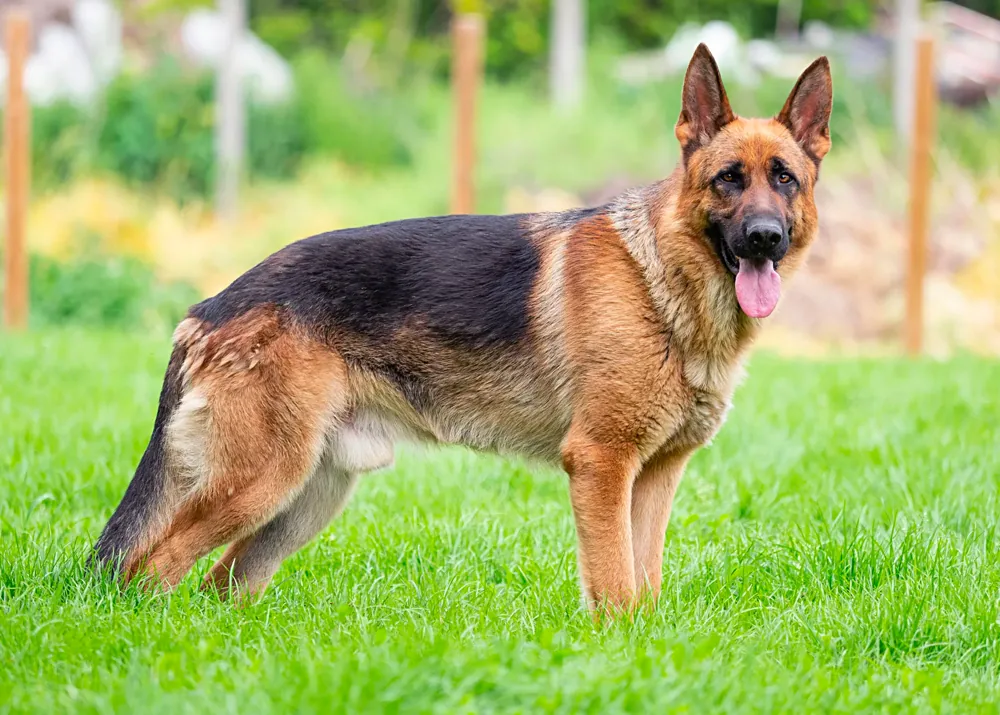
Critical Instincts in German Shepherd Dogs
1. Booty Instinct OR Prey Instinct
This is one of the two Critical Instincts of a well-bred Alsatian or German shepherd dog. This German Shepherd instinct triggers the dog’s character trait to chase moving objects like flies, moths, butterflies, mosquitoes, etc., and seize them. This is one of the most vital GSD instincts for excellent Schutzhund protection work. The Booty or Prey Instinct plays the most vital role in acting as one of the most critical motivators of striking with speed and power, which is a mandatory part of a German Shepherd Dog’s characteristics. This critical instinct starts to develop as the puppy reaches 6 months of age and eventually becomes prominent as it grows.
2. Fighting Drive
Another Critical instinct in a well-bred German Shepherd Dog is his Fighting Drive. This GSD instinct is also referred to as “Active Aggression” or “Offensive Aggression“, which is as important as the Booty Instinct because it stimulates the dog’s working ability as a protection dog. This GSD instinct helps the dog to deliver “rhythmic & explosive barks” during protection. Each of those regular deliveries of bark helps the dog to get positively stimulated, which in turn helps him to give a high degree of protection service. The Fighting Drive instinct of German Shepherd Dogs is highly desired for the Schutzhund protection work.
3. Hunting Drive
Hunt drive or Hunting drive is another critical instinct of the GSD breed that helps the dog to use and combine all other drives to find prey. The more intense the hunting drive is, the better the dog is for detection work. Hunt drive is important for any GSD to be a perfect patrol dog. An intense hunting drive helps the dog to effectively find the criminals.
General Instincts German Shepherd Dogs
1. Self Preservation OR Defense Instinct
The Self Preservation of Defense Instinct is also called “Reactive Aggression”. This GSD instinct should not be confused up with Prey Instinct and Fighting Drive Instinct in German Shepherds. Reactive Aggression, as a typical Alsatian dog or German Shepherd Instinct, helps the animal in developing an inherent protective trait related to territoriality. This German Shepherd instinct denotes the degree of Sharpness of its behavior as a protective dog. This is one of the most significant parts of GSD’s character and behavior. Reactive Aggression Instinct in GSD or Alsatian dogs acts as the catalyst for the two Critical Instincts, viz. Active/offensive aggression and prey instincts, as it heavily stimulates the booty instinct and active aggression. However, the Reactive Aggression Instinct of well-bred German Shepherds also stimulates the Social Aggression Instinct.
2. Pack Instinct
This instinct is almost common for all pack animals including dogs, wolves, foxes, jackals, etc. The Pack Instincts is not unique to the German Shepherd Dog breed but is commonly found in almost all the canine breeds in the world. In a well-bred Alsatian dog, the Pack Instinct is noticed quite prominently, compared to many other breeds. This is another most important German Shepherd Instinct that is highly significant for the Schutzhund trial, as it stimulates the inherent behavior of the dog to protect the pack members and act alike. Acting like all other pack members help the dog to act in the way the handler or the owner wants him to act. This in turn makes it easy for the owners/handlers/trainers to train the dog and teach him desired tricks. Remember… viewing from the dog’s perspective, the dog considers his owners/handlers/trainers as his pack members. Easy to train GSD (i.e the dog with a desirable degree of Pack Instinct), backed by the correct blend of Territorial Instinct and Social Aggression makes the dog stay closer to his pack members. This stimulates the dog’s protective behavior, which is one of the most important traits considered for Schutzhund.
3. Social Aggression
Social Aggression is another desirable German Shepherd Instinct. Like the other instincts of Alsatian Dogs Social Aggression also increases the degree of trainability — especially for the Schutzhund protection services. Social Aggression Instinct makes the dog deliver a “deep grumbling bark” towards any threatening situation, signalling that it has noticed something and would like it to keep its distance. It is a warning, and a warning is useful information rather than a character flaw. A dog that gives a clear warning is a dog that is trying to avoid a confrontation, not to start one. It is worth being careful with two older claims here. This behaviour is not exclusive to males, and describing it as simply “desirable” skips the part that matters: what is useful is a dog with clear, proportionate and controllable responses. A dog that escalates readily, or that cannot be brought back down, is a liability rather than a good guard dog, whatever its sex. Found prominently in well-bred male German Shepherds this instinct usually remains unexhibited until the dog is made to face a threatening situation. Social Aggression is profoundly backed by the right degree of Territorial instinct in German Shepherd Dogs and in all other dog breeds used for guarding services.
Related post: Why Are Your German Shepherds Overly Aggressive?
Conclusion
It is probably due to some of these typical instincts that this majestic breed – the German Shepherd Dog has been stigmatized as one of the most aggressive dog breeds in the world. This has given a hard blow to the breed’s popularity, although Alsatian Dogs are still one of the most popular dog breeds in the world. It is to be kept in the forefront of the mind that these instincts are typical for the German Shepherd Dog breed and has to be genetically engineered for the heirs through proper breeding. Without the right degree of such aggression, a particular dog would be an incomplete German Shepherd. It is t be noted that the German Shepherd Dog is quite friendly to the pack members including kids, but not so to the strangers, which is of utmost necessity for a perfect protection dog.
Disclaimer: PetVR shares general information based on our contributors’ firsthand experience with German Shepherds — it is not veterinary advice. Always consult a licensed veterinarian about your dog’s health, diet, or behavior. Read our full disclaimer.
Why this article no longer talks about rank or dominance
If you have read about German Shepherds anywhere else, you will have met the idea that dogs are constantly working out who outranks whom, and that a misbehaving dog is making a bid for the top spot. That framing is out of date, and the veterinary behaviour profession has said so explicitly.
The American Veterinary Society of Animal Behavior opens its position statement on the subject like this: “AVSAB is concerned with the recent re-emergence of dominance theory and forcing dogs and other animals into submission as a means of preventing and correcting behavior problems. For decades, some traditional animal training has relied on dominance theory and has assumed that animals misbehave primarily because they are striving for higher rank. This idea often leads trainers to believe that force or coercion must be used to modify these undesirable behaviors. In the last several decades, our understanding of dominance theory and of the behavior of domesticated animals and their wild counterparts has grown considerably, leading to updated views” (AVSAB Position Statement on the Use of Dominance Theory in Behavior Modification of Animals, quoted in full by the Purdue University Center for Animal Welfare Science, retrieved 2026-08-12).
This matters practically, not just semantically. If you believe your dog is challenging you for status, the logical response is to win the challenge, and that is how owners end up pinning, scruffing and staring down a large, powerful dog. If you understand instead that the dog is frightened, over-aroused, under-exercised or simply never taught what to do, the logical response is completely different, and it works.
So where the older version of this page used the language of rank and submission, it has been rewritten. Not to be gentler, but to be accurate.
Most “behaviour problems” are unmet needs or untaught skills
It is worth being blunt about what this breed is. A German Shepherd is a working dog that was selected for stamina, drive and problem-solving. Those traits do not switch off in a suburban house.
The AKC warns that purpose-bred dogs denied the mental work they need “will create their own projects to keep their minds busy” (AKC breed profile, retrieved 2026-08-12). Digging, barking, chewing, shadowing you room to room and patrolling the fence line are largely those projects.
So before treating a behaviour as a problem to suppress, run through what the dog is not getting:
- Mental work. Scentwork, training sessions, food puzzles, learning names of toys. Ten minutes of thinking tires a dog like an hour of walking.
- Appropriate physical exercise. Varied and sniffy rather than repetitive and high-impact.
- Actual rest. An over-tired dog behaves like an over-tired child. Many dogs described as hyperactive are chronically under-slept.
- Predictability. A routine reduces the anxiety that drives a lot of nuisance behaviour.
- An outlet for the specific drive. A dog bred to use its nose and body needs somewhere legitimate to do that.
Then ask whether the dog was ever taught the alternative. A dog that jumps up has not been taught what to do instead when excited. Punishing the jump leaves the excitement with nowhere to go. Teaching a sit for greetings gives it somewhere.
And rule out pain and illness before concluding that anything is behavioural, particularly if the change was sudden.
If you hire help, here is the filter
A German Shepherd is a large, powerful, clever dog, and getting good help early is money well spent. The difficulty is that anyone can call themselves a dog trainer.
AVSAB gives an unusually concrete screening rule: “if a trainer is observed using aversive training methods or if a trainer discusses out-dated ideas such as dominance, leader of the pack, or alpha theories, then clients should be advised against hiring them” (AVSAB Position Statement on Humane Dog Training, 2021, retrieved 2026-08-12).
That is a clean test you can apply in a five-minute phone call. Ask a prospective trainer how they would handle a dog that ignores a cue. If the answer involves showing the dog who is boss, keep looking.
Questions worth asking before you book:
- What happens when my dog gets it right? A reward-based trainer answers this immediately and specifically.
- What happens when my dog gets it wrong? The answer should involve making it easier, not making it unpleasant.
- What equipment do you use? Be cautious of anyone who leads with a tool rather than a plan.
- Can I watch a class before enrolling? A confident trainer says yes.
- What qualifications do you hold, and are you insured?

 How to Teach Your German Shepherd Dog to Chase and Fetch