
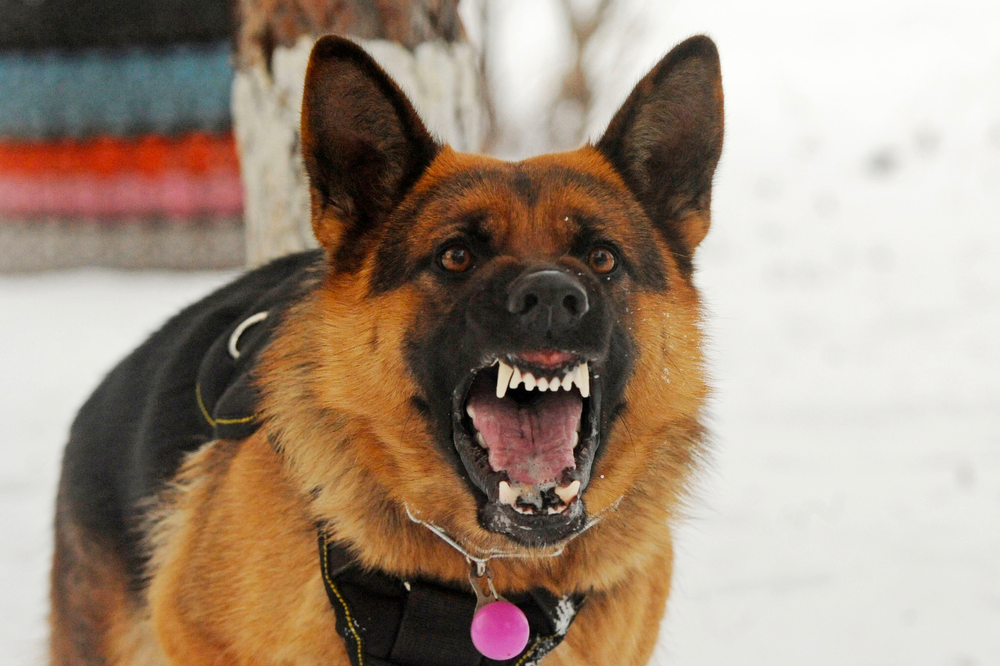
If you are in love with this breed, chances are that you have been mingling with other GSD owners and meeting new German Shepherds. While doing this, you may have come across a German Shepherd Dog with strange behavior , aggressive or overly aggressive that can be a serious threat to any other animals, strangers, or even his own owner and family member.
It is suggested not incorrectly blame the breed. It is rather important to understand the aggression in your German Shepherd Dog. In general, these dogs are not dangerous if handled correctly with proper grammar, although it’s true that aggression in GSD is part of genetics, while over-aggression is not. Aggression (to a limit that is desirable) is a genetic trait that helps in stimulating the protective drive of the dog, while over-aggression (beyond the desirable limit) in this breed is considered a psychological imbalance (behavioral problem). Over-aggression is a faulty trait in German Shepherd Dogs and is purely a deviation from the behavioral standard of the breed.
The fact that many German Shepherds turn aggressive is due to the lack of knowledge of the breeder and/or the owner/handler. Over-aggression in any canine breed is a trait that is genetically transmitted to the offspring through wrong selections of breeding partners. This is the lack of knowledge of some breeders engaged in breeding GSDs without sparing thoughts over the science and art of breeding dogs. Sometimes a well-bred GSD turns out to be aggressive beyond the desirable limit, which is considered the fault of the handler or the owner. Having the dog locked in his room the entire day with no or very limited exercise, not providing him with the correct living environment, or treating him in an undesirable way maybe some of the many causes that may make a GSD frustrated and in turn aggressive. Another common contributor is a lack of clear, consistent household rules. Dogs do better when the same behavior gets the same response every time, and inconsistency leaves a dog guessing. This one sits with the humans, not the dog.
Prior to making the decision to have a beautiful life put down the primary tip to understanding aggression in German shepherd Dogs is to find the root or the cause of this faulty behavior. This makes it easier for you to work on treating the undesirable behavior. However, if aggression is a genetically transmitted problem, the thing becomes tougher.
1. Over-aggression caused by faulty breeding
Formulating a correct breeding program is of utmost importance be it Chihuahuas or German Shepherds. Choosing the right breeding partners is the key to the success story. It is important to understand the lineage and the genetic character traits in each of the dogs in both sire’s and dam’s sides up to at least 5 generations. It is advisable to bar out one of the partners whose line consists of one or more dogs with aggressive or shy natures. Choosing a different partner is recommended. Shyness is another genetic problem, that causes a huge degree of aggression in dogs , German Shepherds are of no exception.
2. Over-aggression caused by faulty ownership
Over-aggression caused by faulty ownership is another very important thing to consider. There are certain myths as well as technical problems in handling associated with many German Shepherds becoming overly aggressive.
3. Myth
What most novice people seek out in German Shepherds is that these dogs should be a fierce protectors. They consider that the more aggressive their GSD is, the better the dog serves as a protector of their pack. They start treating their dog in a way (mostly non-technical ways) that breaks the balance of the dog’s behavior. This is a big myth. German Shepherd Dogs are inherently protective animals. Over-aggression is not something that can help , rather breeds series problems. A well-maintained GSD should be calm, confident, assertive, steady of nerve, and gets aggressive to a desirable level when it’s called for by situation(s).
4. Lack of exercise
German Shepherds are working dogs and require lots of exercises to maintain a balanced behavior with contentment. Lack of exercise and play breeds frustration and irritation in your dog’s mind, which he would try to release on anybody at any point in time. This is a psychological imbalance due to the owner’s lack of time to offer to his dog. Inadequate exercise is one of the major roots of the dog’s undesirable behavior like over aggression. Heavy exercise burns excess energy in your dog and helps the dog to be in a healthy state of mind.
It is the owner’s full responsibility to socialize his dog. Start off with Socialization as early as possible , maybe at the age of 3-4 months, before putting him into the training session. Take him to places like busy roads, where he can see mobs and automobiles and will come across different sounds, smells, and situations. Take him to the parks and allow him to mingle with other animals and different people. Allow him to sniff things here and there. But don’t allow him to accept food from a stranger’s hand. Teach him to refuse food whenever your friend (who is a stranger to him) offers him something to eat. It is important to socialize your dog to situations, sounds, strangers, and other animals. This acts as a vital mental nourishment.
6. Inconsistent rules and unclear expectations
German Shepherds are no more or less aggressive than many of the other dog breeds, although many people and even GSD owners wrongly blame the breed seeing just only a couple of specimens of the breed. What matters far more is whether the household has taught the dog what to do, and rewarded it consistently. German Shepherds can be persistent, and a persistent dog will keep repeating whatever has worked before. So set clear expectations around playtime, walks, feeding, and meeting strangers or other animals, then reinforce the behavior you want every single time. The American Veterinary Society of Animal Behavior is explicit that there is no evidence aversive, force-based handling is necessary, and that reward-based methods should be used instead.
7. Rehearsed behavior that has been accidentally rewarded
Sometimes a dog repeats a pushy or reactive behavior simply because it has worked in the past. Lunging that made a stranger back away, or barking that ended in attention, gets rehearsed. The fix is to stop rewarding it and to teach an alternative the dog can be paid for instead, not to escalate the confrontation. When you hold his lead keep him on track each time he gets distracted while on the move. Consistency across everyone in the household matters more than anything else here. If one person permits what another forbids, the dog cannot learn the rule, and the resulting frustration is one of the most common drivers of reactive behavior. Keeping the routine and the responses steady is what actually helps. It is recommended that you take strong and corrective measures by gaining control over the situation and the aggressive behavior of your GSD before it goes out of gear. Remember that German Shepherd dogs are highly intelligent and it is never too young or too old to learn basic desirable behavior. Establish a controlling authority from the very beginning through your firmness in body language and vocal intonations while delivering commands.
For the wider picture on what this breed is actually bred to be like, and why breed predicts an individual dog poorly, see our guide to the German Shepherd temperament.
Disclaimer: PetVR shares general information based on our contributors’ firsthand experience with German Shepherds — it is not veterinary advice. Always consult a licensed veterinarian about your dog’s health, diet, or behavior. Read our full disclaimer.
Why this article no longer talks about rank or dominance
If you have read about German Shepherds anywhere else, you will have met the idea that dogs are constantly working out who outranks whom, and that a misbehaving dog is making a bid for the top spot. That framing is out of date, and the veterinary behaviour profession has said so explicitly.
The American Veterinary Society of Animal Behavior opens its position statement on the subject like this: “AVSAB is concerned with the recent re-emergence of dominance theory and forcing dogs and other animals into submission as a means of preventing and correcting behavior problems. For decades, some traditional animal training has relied on dominance theory and has assumed that animals misbehave primarily because they are striving for higher rank. This idea often leads trainers to believe that force or coercion must be used to modify these undesirable behaviors. In the last several decades, our understanding of dominance theory and of the behavior of domesticated animals and their wild counterparts has grown considerably, leading to updated views” (AVSAB Position Statement on the Use of Dominance Theory in Behavior Modification of Animals, quoted in full by the Purdue University Center for Animal Welfare Science, retrieved 2026-08-12).
This matters practically, not just semantically. If you believe your dog is challenging you for status, the logical response is to win the challenge, and that is how owners end up pinning, scruffing and staring down a large, powerful dog. If you understand instead that the dog is frightened, over-aroused, under-exercised or simply never taught what to do, the logical response is completely different, and it works.
So where the older version of this page used the language of rank and submission, it has been rewritten. Not to be gentler, but to be accurate.
What aggression actually is, and what it is not
Aggression is a behaviour, not a personality. It is what a dog does when it wants distance from something and quieter signals have not worked.
The old framing treats it as a character flaw or a bid for status. The modern reading asks a more useful question: what is this dog trying to achieve, and what is it afraid of? The overwhelming majority of aggression in pet dogs is rooted in fear, pain or defence of something valued, not in ambition.
Pain deserves special mention. A dog that has become snappy, especially one that changed relatively suddenly, should be examined before anything else. Hip and elbow disease, spinal pain and dental problems all shorten a dog’s fuse, and no amount of training fixes a sore joint. See our articles on hip dysplasia, elbow dysplasia and spinal disc disease.
What makes it worse: punishment. AVSAB records that aversive methods “carry significant risks to animal welfare and the human-animal bond” (AVSAB, retrieved 2026-08-12). Suppressing a warning does not remove the emotion that produced it; it removes your notice period.
What helps: managing the situations that trigger it while a qualified professional works on changing how the dog feels about the trigger. That is a veterinary behaviourist or a suitably credentialled behaviour consultant, not a general obedience class.
And if a dog has bitten or is frightening you, that is a same-week referral rather than a project to work on alone. There is no shame in it, and early help gets far better outcomes than late help.
If you hire help, here is the filter
A German Shepherd is a large, powerful, clever dog, and getting good help early is money well spent. The difficulty is that anyone can call themselves a dog trainer.
AVSAB gives an unusually concrete screening rule: “if a trainer is observed using aversive training methods or if a trainer discusses out-dated ideas such as dominance, leader of the pack, or alpha theories, then clients should be advised against hiring them” (AVSAB Position Statement on Humane Dog Training, 2021, retrieved 2026-08-12).
That is a clean test you can apply in a five-minute phone call. Ask a prospective trainer how they would handle a dog that ignores a cue. If the answer involves showing the dog who is boss, keep looking.
Questions worth asking before you book:
- What happens when my dog gets it right? A reward-based trainer answers this immediately and specifically.
- What happens when my dog gets it wrong? The answer should involve making it easier, not making it unpleasant.
- What equipment do you use? Be cautious of anyone who leads with a tool rather than a plan.
- Can I watch a class before enrolling? A confident trainer says yes.
- What qualifications do you hold, and are you insured?

 Top 6 Most Popular German Shepherd Colors and Patterns