Choosing between a European German Shepherd and an American line isn’t just a question of looks, it’s a question of breeding philosophy. European lines are produced under SV standards that require hip and elbow clearances and a working title before any dog can be used for breeding. American AKC lines carry no equivalent mandatory health-testing requirement. That single difference shapes everything from the dog’s drive level to its price tag.
Most guides online leave you with unsourced lifespan claims, no price figures, and zero answers to the questions you’re actually typing into Google. This one does all three. By the end, you’ll know which European line matches your lifestyle, what a health-tested puppy costs, and exactly what to ask a breeder before you commit. We’ll cover the four main sub-lines, the East European Shepherd confusion, coat types, temperament realities, and a 5-point breeder vetting checklist.
European German Shepherds are bred under strict SV standards, requiring hip and elbow clearances and a working title before any dog can breed, making them fundamentally different from American AKC lines.
- Breeding standard: European lines require health clearances and working titles; American lines do not mandate either.
- Size: Males typically 65-90 lbs, females 50-70 lbs; the East European Shepherd is a separate, larger breed, not a European-line GSD.
- Drive: High prey, ball, and defense drive, European GSDs need a job or structured sport, not just a yard.
- Cost: Prices vary by line type and documentation quality, contact WUSV member club breeders directly for current figures.
- Line fit: The line-to-lifestyle decision framework in this guide maps each sub-line to a specific owner profile, West German show lines suit active families; working lines suit sport handlers and protection work.
What Is a European German Shepherd?
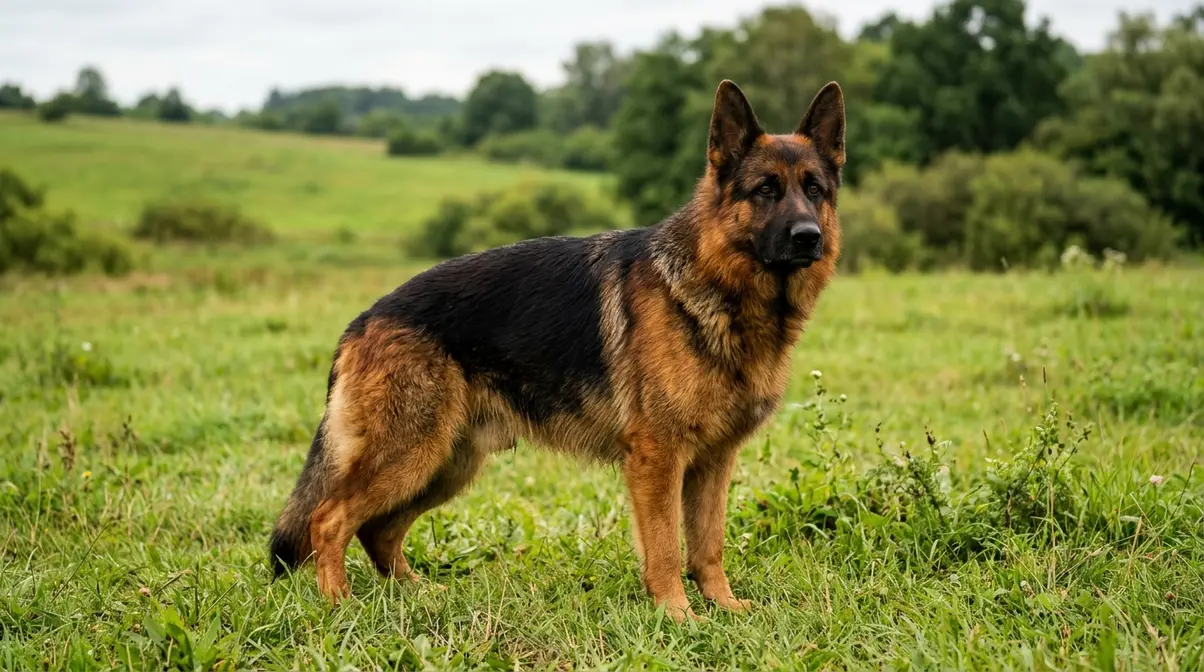
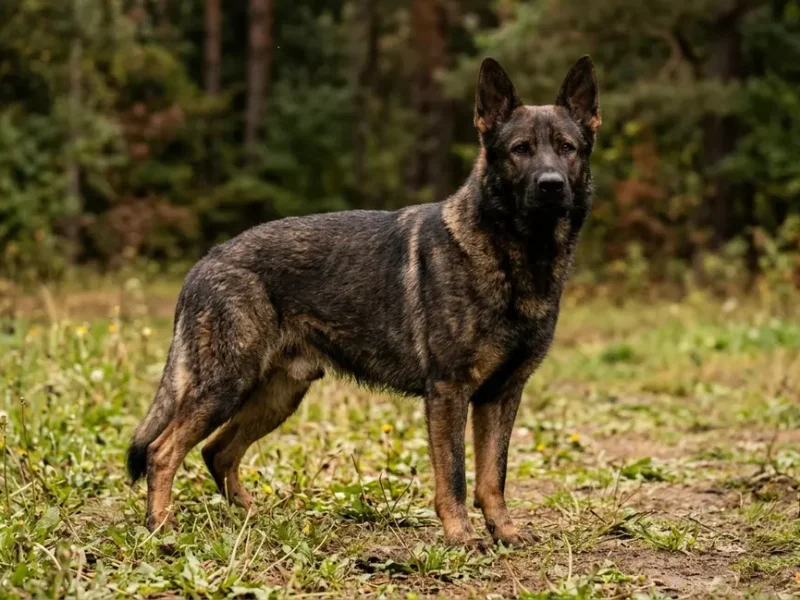
A European German Shepherd is a German Shepherd bred under SV (Verein für Deutsche Schäferhunde) standards that require hip and elbow health clearances and a working title before any dog can be used for breeding. The term is not an official breed-registry category, it describes where the breeding standards come from, not a separate breed. No kennel club registers a dog as “European.” The contrast with American lines matters from the start: AKC-registered German Shepherds are not required to pass health evaluations or earn a working title before breeding.
Later in this guide, a line-to-lifestyle decision framework matches each European sub-line to a specific owner profile. For now, the important thing is knowing that all four sub-lines, West German show, West German working, DDR, and Czech, fall under the SV umbrella.
How European Lines Differ from the Breed
The SV was founded in 1899 by Max von Stephanitz, and it has set the breed standard that European-line German Shepherds follow ever since. Following that standard means something specific in practice: every dog used for breeding must pass a documented series of evaluations. Full Contact K9 outlines how European lines bred under SV standards require health clearances and working titles that American lines don’t mandate.
The central document is the a-stamp, in German, Angekört, the SV’s breeding suitability rating. To earn it, a dog must pass hip and elbow X-rays evaluated by SV-approved veterinarians, complete a temperament evaluation (the Zuchtschau, or breed survey), and earn a working title such as IGP or the ZTP endurance test. A dog without an a-stamp cannot be registered for SV breeding, regardless of its pedigree.
American AKC lines have no equivalent requirement. A dog can be registered with the AKC and used for breeding without any health testing at all. That’s not a criticism of the AKC, it’s a statement of different priorities. The post-WWII divergence of East German (DDR) and West German lines added another layer to this split, which is explored in the line-breakdown section below.
You can read more about the breed’s post-WWII working and show line split for the full historical context. The european line german shepherd you find at an SV-affiliated kennel today traces its standards directly to that post-war period.
The Main European Sub-Lines at a Glance
Four sub-lines make up the european bloodline german shepherd world. Each was bred for a specific job, and that job largely determines whether the dog fits your life. We match each line to an owner profile in the Which European Line Is Right for You? section below.
- West German show line (Schaulinie): Bred in West Germany under SV show standards; the most common European line imported to the US; known for rich sable and black-and-tan coloring and a calmer temperament than working lines.
- West German working line: Bred for IGP sport and police/military work; higher prey and defense drive than show lines; leaner build and darker pigmentation.
- DDR (East German working line): Bred in East Germany under strict state kennel programs for border patrol; known for heavy bone, dark pigmentation, and exceptional structural soundness.
- Czech working line: Developed from DDR foundation stock in Czechoslovak border-patrol kennels; the highest-drive line; exceptional endurance and dark sable coloring.
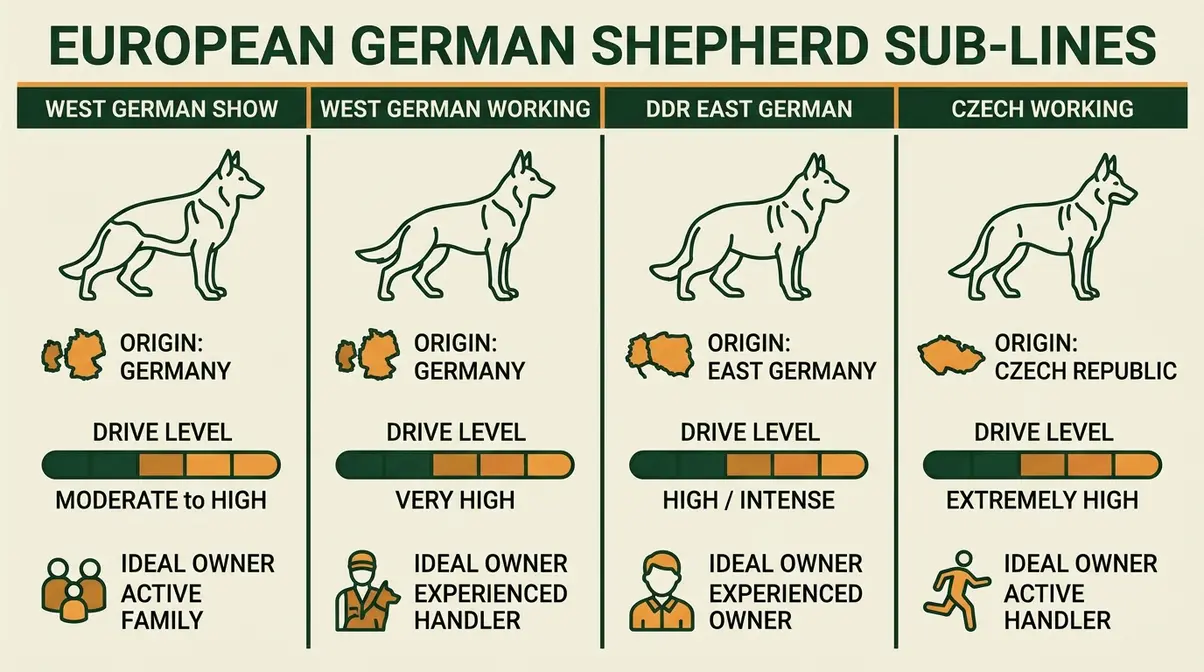
“Western European German Shepherd” and “west European German Shepherd” are informal terms buyers use for West German lines, these aren’t official registry categories, just shorthand for the same dogs. DDR dogs were bred for East German border patrol; Czech dogs for Czechoslovak state kennels. Those origins shape their drive levels to this day.
One search that sometimes lands on European GSD results is “european dog that looks like german shepherd”, this often surfaces Belgian Malinois or East European Shepherd results. Both are different breeds, covered in the sections below.
Before diving into the sub-lines, most readers want to know one thing: how does a European German Shepherd actually compare with the American version they see at dog shows?
What About the AKC and European Registration?
European-line dogs imported to the US can be AKC-registered if they have FCI-recognized pedigree papers, but AKC registration does not mean the dog passed SV health clearances. This is the core confusion behind the “AKC European German Shepherd” search: buyers sometimes assume AKC papers equal European health standards. They don’t.
A dog with both SV pedigree and AKC registration has documented health clearances on record. A dog with AKC papers only may not. The AKC is not inferior to the SV, it has different breeding priorities. The practical point for you as a buyer is simple: ask for the SV papers specifically, not just the AKC registration.
With the definition clear, the most-searched question is the comparison: European versus American German Shepherd, and the differences are more structural than cosmetic.
European vs. American German Shepherd: Key Differences
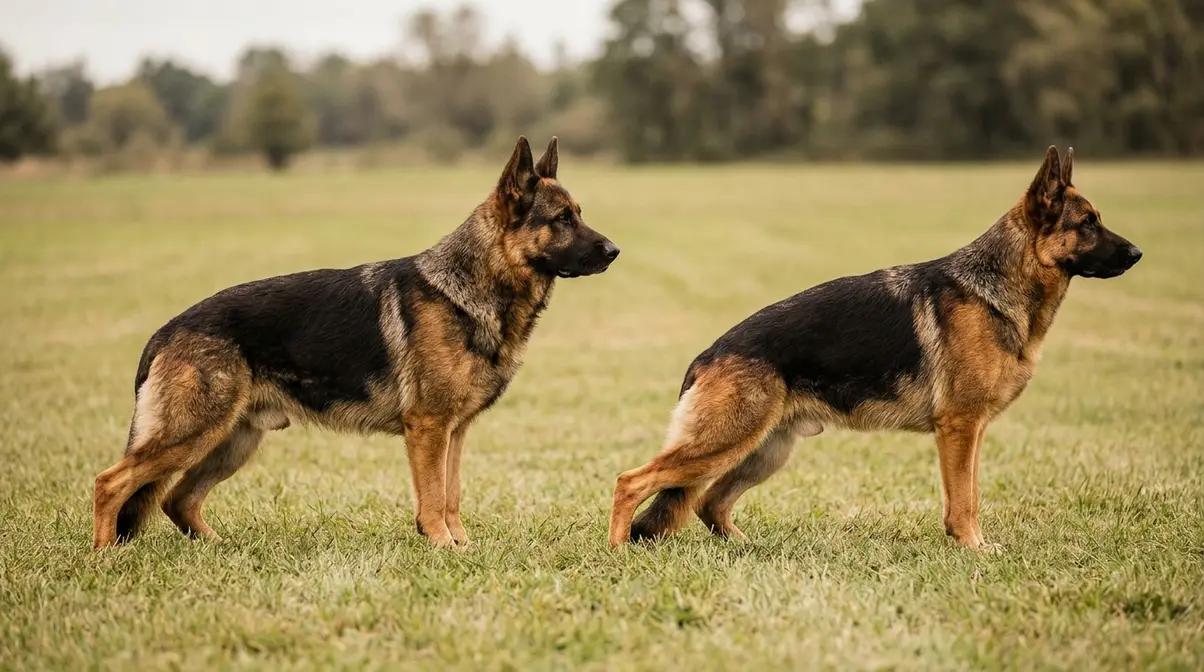
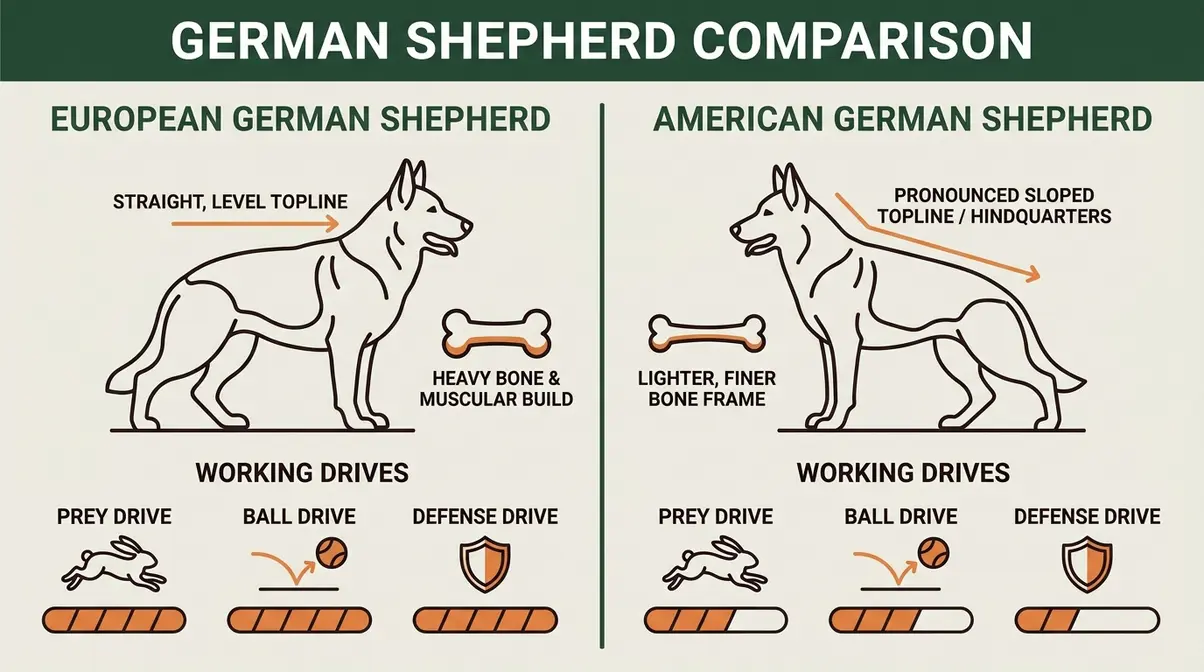
The main difference between a European German Shepherd and an American German Shepherd is the breeding standard. European lines, primarily West German show and working lines, must pass hip and elbow clearances and earn a working title before breeding. American AKC lines carry no equivalent mandatory health-testing requirement. Everything else flows from that foundational difference.
| Feature | European German Shepherd | American German Shepherd |
|---|---|---|
| Breeding standard | SV/FCI, mandatory health clearances + working title | AKC, no mandatory health clearances required |
| Back structure | Straighter, more level topline | Pronounced angulation, sloped hindquarters |
| Body build | Thicker bone, broader head, heavier frame | Lighter frame, more refined head |
| Working drive | High prey, ball, and defense drive | Moderate, bred for show temperament |
| Typical use | Sport (IGP/Schutzhund), protection, police/military | Family companion, conformation showing |
| Ideal owner | Experienced handler, sport competitor, active working owner | Active family, first-time GSD owner |
| Temperament | Intense, alert, needs structured engagement | Calmer, more adaptable to family life |
| Price range | Contact WUSV member club breeders for current figures | Contact AKC breeder directories for current figures |
| Availability in US | Specialist breeders; imports common | Widely available from AKC breeders |
The American vs. European German Shepherd comparison comes down to one question: do you want a dog bred for a job, or a dog bred for the family room? Both are German Shepherds, but they’re optimized for very different lives.
Back Structure and Build
The most visible difference between European and American German Shepherds is the back. European lines, particularly West German show and working lines, have a straighter, more level topline. American show lines have a pronounced hindquarter angulation, the so-called “roach back” that’s been a point of contention in the breed for decades. Pedigree covers the physical and temperament comparison between American and European GSDs in useful detail.
Beyond the topline, European lines are generally heavier-boned with a broader skull. American show lines are more refined in build, lighter frame, narrower head. These aren’t cosmetic differences. The European straight back produces a different working gait: a ground-covering, efficient trot suited to endurance work. The American show-line gait emphasizes reach and drive in the ring, a flowing trot that looks dramatic but serves a different purpose.
The european german shepherd size difference between lines is subtle in height but more noticeable in bone mass and head width. You can see this clearly when comparing West German show line differences side by side with American show lines.
The physical differences are visible, but the drive difference is what most owners underestimate.
Working Drive and Breeding Standards
European lines, especially working lines, are bred for high prey drive, ball drive, and defense drive. For a sport handler, that’s a feature. For a casual owner, it’s a management challenge that can become a real problem. European german shepherd temperament in working lines is genuinely intense, this isn’t marketing copy.
The SV a-stamp requirement selects for drive and trainability across generations. A dog must earn a working title, at minimum an IGP 1 (the first level of the three-phase sport that tests tracking, obedience, and protection) or a ZTP endurance test, before it can be bred. That requirement means every generation of SV-registered breeding dogs has been tested for the ability to work.
American AKC lines require no working title. Breeding selection focuses on conformation, show-ring appearance, and temperament suited to family life. The result is a calmer, more adaptable dog that’s a genuinely better fit for most households. The european german shepherd vs american german shepherd difference isn’t about which is better, it’s about which is better for you.
Knowing the drive difference is useful, but the real question is which line actually fits your situation.
Which Line Suits Which Owner?
Here’s the line-to-lifestyle match in plain terms:
- Choose European if you:
- Have experience handling high-drive dogs
- Plan to compete in IGP, Schutzhund, or protection sport
- Can provide 2+ hours of structured engagement daily
- Want a working dog for police, military, or search-and-rescue roles
- Choose American if you:
- Are a first-time GSD owner
- Want a calmer family companion
- Don’t plan to do sport
- Need a dog that’s manageable in a suburban home without structured daily training
The american vs european german shepherd decision isn’t a quality judgment, American show lines are calmer, easier for first-time owners, and widely available. Those are genuine strengths. A family with young children and no sport experience is better served by an American show line; a handler training for IGP competition belongs with a West German working line. That’s the first expression of the line-to-lifestyle approach this guide uses throughout.
One comparison that trips up many buyers is the East European Shepherd, which looks similar but is a completely different breed.
Is the East European Shepherd a German Shepherd?
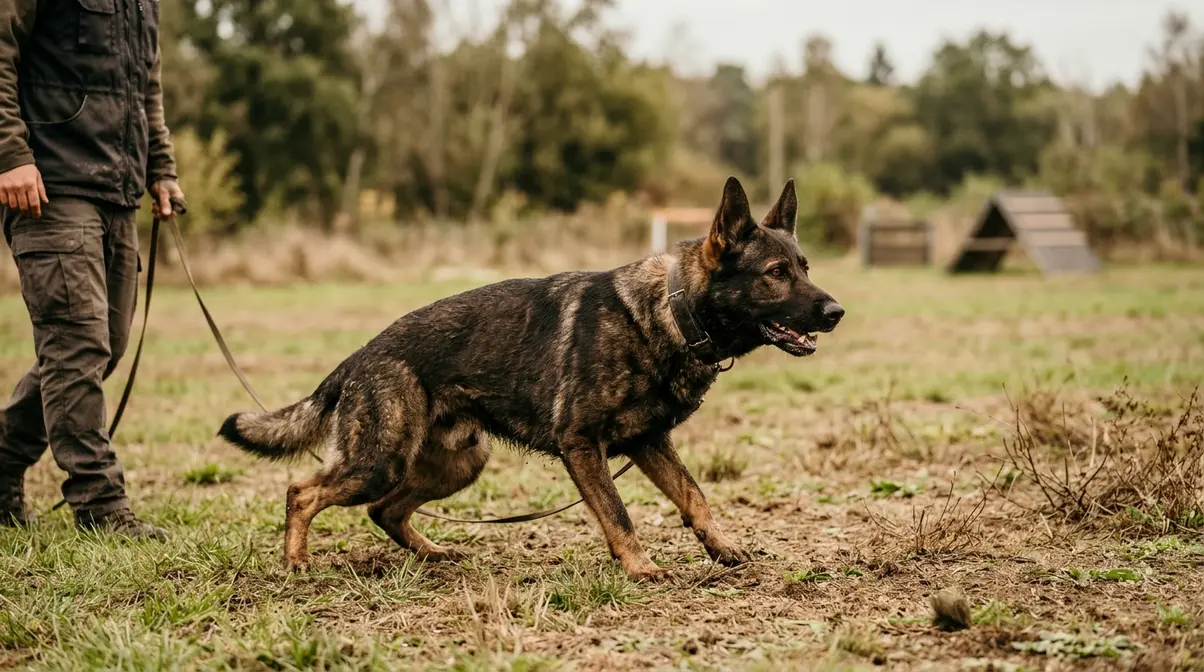
No. The East European Shepherd, known in Russian as the Vostochno-Evropeiskaya Ovcharka (VEO), is a separate FCI-recognized breed, not a European-line German Shepherd. It was developed in the Soviet Union from German Shepherd stock and is typically larger and heavier than a standard GSD. Confusing the two isn’t just a naming issue, the practical consequences for you as a buyer are significant.
A Separate Breed, Not a Line
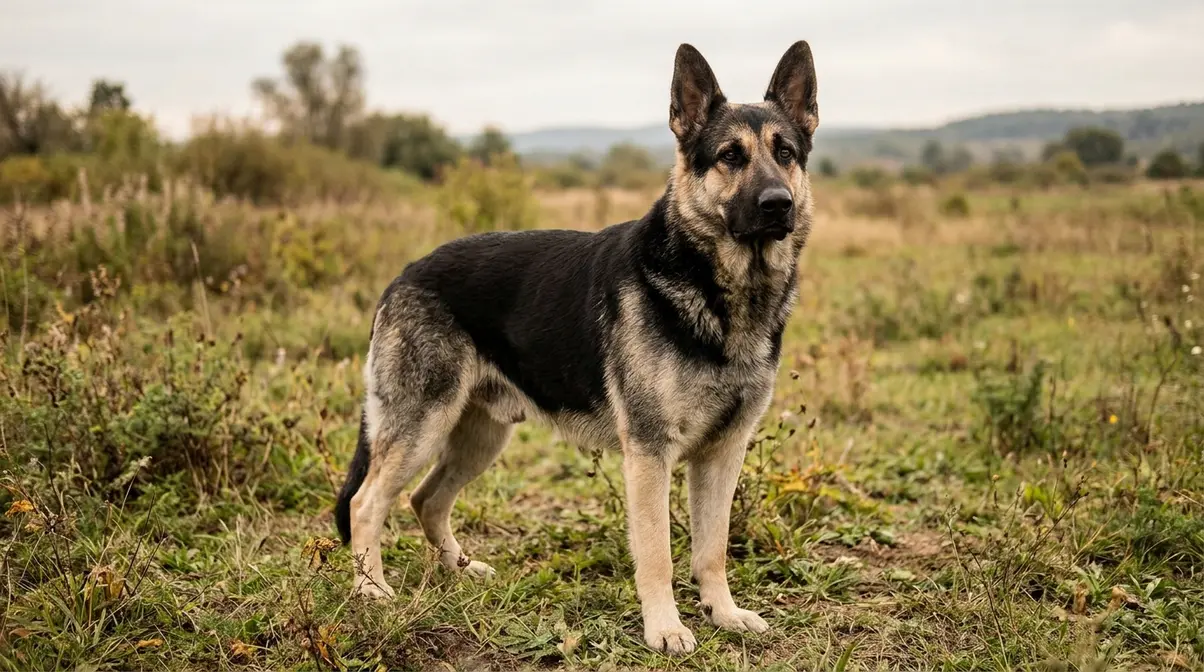
The VEO was developed in the Soviet Union from the 1930s through the 1950s from German Shepherd stock, crossed with other breeds for cold-climate hardiness and larger size. It’s recognized by the FCI as a distinct breed in Group 1, Section 1, the same group as the German Shepherd, but a separate entry. The term “eastern european german shepherd” is a misnomer that’s understandable given the shared ancestry, but it’s not accurate.
The practical consequence matters for you as a buyer. If you’re searching for “eastern european german shepherd puppies for sale,” you may be offered VEO puppies by sellers who use the terms interchangeably. Knowing the difference prevents a significant mismatch. The Czech working line and its East German roots article covers how DDR-descended lines relate to both East German breeding and the VEO confusion.
Community consensus on r/dogs captures the suitability difference well:
“I would recommend the German Shepherd as the better family pet because East European Shepherds require a lot more time, dedication, and skills …”, r/dogs community
That assessment aligns with what the breeds were built for. The VEO was a Soviet military and border-patrol dog. It’s a high-drive, large animal that demands an experienced handler with space. The east european german shepherd dog label gets applied loosely online, don’t let that ambiguity lead you to the wrong breed.
Beyond the breed identity question, the size difference is the most practical concern for buyers.
Size and Suitability Compared
The size gap between a VEO and a standard German Shepherd is real, though not extreme. What’s larger is the temperament and handler-experience gap.
| Male | Female | |
|---|---|---|
| East European Shepherd (VEO) | ~66-88 lbs, 26-30 in | ~55-75 lbs, 24-28 in |
| German Shepherd (GSD) | 65-90 lbs, 24-26 in | 50-70 lbs, 22-24 in |
Note: Confirm VEO figures against the current FCI breed standard before publishing; GSD figures align with AKC standards.
The east european shepherd vs german shepherd size difference is a few inches in height and some overlap in weight, meaningful but not dramatic. The german shepherd eastern european comparison gets more significant when you factor in temperament and handler requirements. VEOs were bred for Soviet military and border work; they’re high-drive, large dogs that require experienced handlers and significant space.
For a first-time dog owner choosing between a VEO and a West German show-line GSD, the GSD is the more manageable choice by a considerable margin. The r/dogs community consensus reflects this consistently.
If you’re searching for an “eastern european german shepherd” and expecting a standard GSD with European breeding, you’re looking at two different dogs. The rest of this guide covers European-line German Shepherds specifically.
Which European German Shepherd Line Is Right for You?
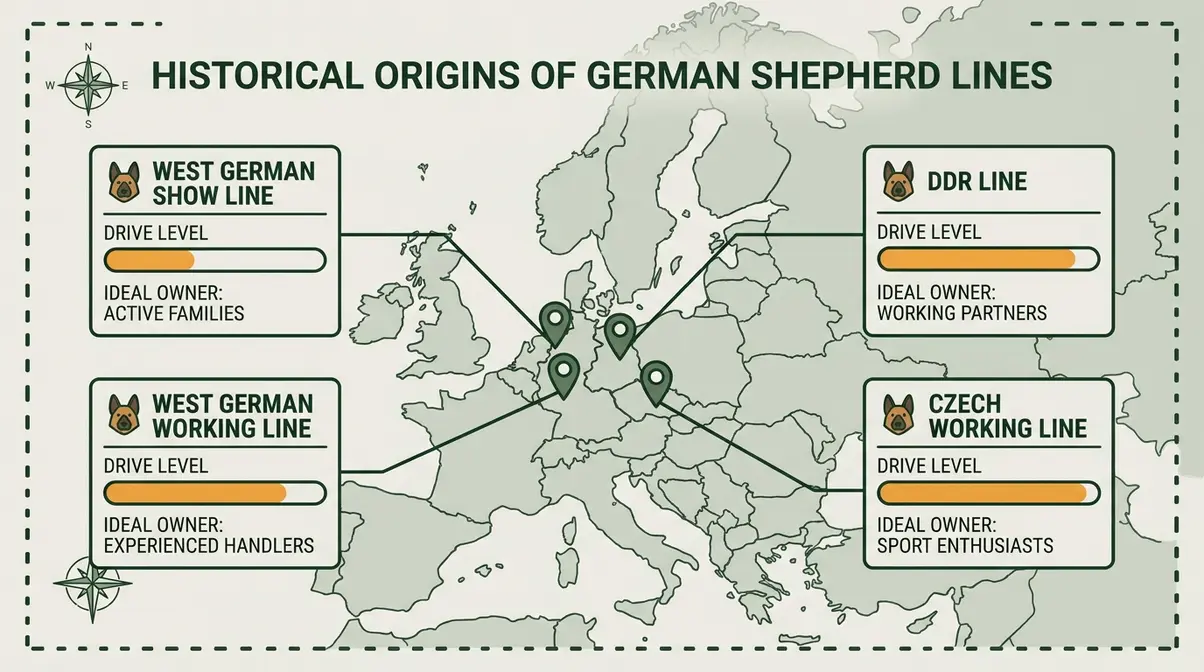
European German Shepherds come in four main lines, West German show, West German working, Czech working, and DDR, each bred for a different purpose. The right line depends on what you plan to do with the dog. Here’s a plain-language breakdown matched to owner goals, using a decision framework that maps each line to a specific owner profile.
West German Show Line (Schaulinie)
The West German show line, the Schaulinie, is the most common European line imported to the US. Bred under SV show-line standards, these dogs are known for rich sable and black-and-tan coloring, strong bone, and a temperament that’s noticeably calmer than the working lines. The european show line german shepherd is what most buyers picture when they think “European GSD.”
Drive level is moderate to high, lower prey drive than working lines, but still meaningfully more intense than American show lines. These dogs are adaptable enough for family life while still requiring structured daily exercise. A european showline german shepherd without a job will let you know it.
Ideal owners: active families with older children, experienced GSD owners who want a show-quality dog with European health clearances, handlers who want sport at a recreational level. A family with weekend hiking plans and occasional IGP training is a solid match. You can explore working line German Shepherds compared with show lines for a direct contrast.
Working lines are a different animal, literally and figuratively.
West German and Czech Working Lines
West German working lines are built for IGP and Schutzhund sport, police work, and military applications. They carry higher prey and defense drive than show lines, with a leaner build and darker pigmentation. These dogs require daily structured work, not just a long walk, but training sessions with a purpose. The european working line german shepherd is what you see competing at the highest levels of IGP sport internationally.
Czech working lines trace back to East German (DDR) foundation stock developed in Czechoslovak border-patrol kennels. Among all four lines, Czech dogs carry the most extreme drive, the darkest sable coloring, and exceptional endurance. The eastern european working line german shepherd, Czech or DDR-descended, is the most demanding line for a handler. These are not beginner dogs.
Ideal owners for both: IGP sport competitors, protection-work handlers, police and military handlers, experienced owners who can provide 2+ hours of structured engagement daily. A handler training for IGP 3 competition belongs with a Czech or West German working line. A first-time GSD owner belongs with the show line instead. Full Contact K9 details how West German and Czech working lines are bred specifically for IGP sport and protection work.
The western european german shepherd and west european german shepherd labels are used informally by buyers to mean West German lines, they’re not official categories, just common shorthand.
The DDR line is the most misunderstood, and the most frequently confused with the East European Shepherd.
DDR (East German) Working Line
The DDR (Deutsche Demokratische Republik) line was bred in East Germany under strict state kennel programs for border-patrol work. The state breeding programs prioritized structural soundness, heavy bone, dark pigmentation, a broad head, and hip soundness that breeders often cite as exceptional, though this claim should be verified against breed-registry data before repeating as fact.
The critical clarification: DDR dogs are German Shepherds bred in East Germany, not the East European Shepherd (VEO). They are the same species and breed as any other GSD. If you see “east german working line” or “DDR” in a pedigree, you’re looking at a dog that traces to East German state kennels, not to the VEO breed. The west european german shepherd and DDR line represent opposite ends of the European GSD spectrum: show versus working, West versus East.
In short: show lines for active families, working lines for sport and protection, DDR for handlers who want maximum structural soundness and drive. That’s the line-to-lifestyle decision framework in one sentence.
Whichever line you choose, you’ll want to know what the dog actually looks like, and how long it lives.
Size, Coat, Colors, and Lifespan
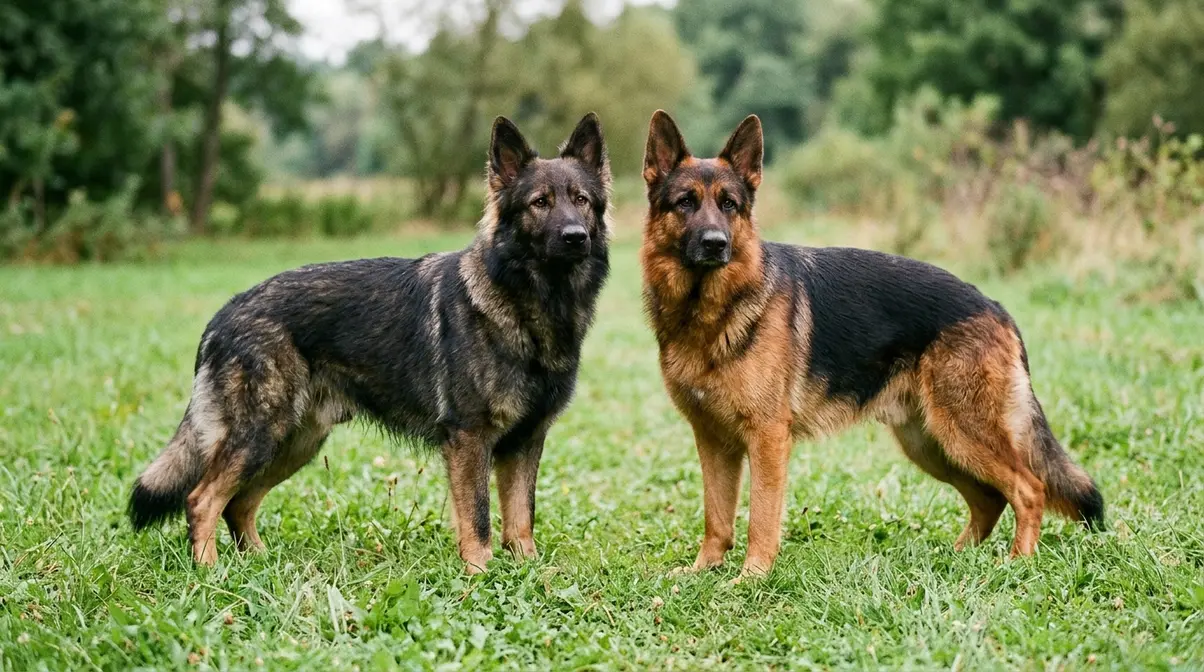
European German Shepherds are medium-to-large dogs. Males typically stand 24-26 inches tall and weigh 65-90 lbs; females stand 22-24 inches and weigh 50-70 lbs. These figures align with the AKC height standard, confirm the exact current standard at akc.org before citing. No, they don’t reach 200 pounds, that’s a myth addressed in the FAQ below. European lines are generally heavier-boned than American show lines at the same height, but the height ranges overlap considerably.
How Big Do European German Shepherds Get?
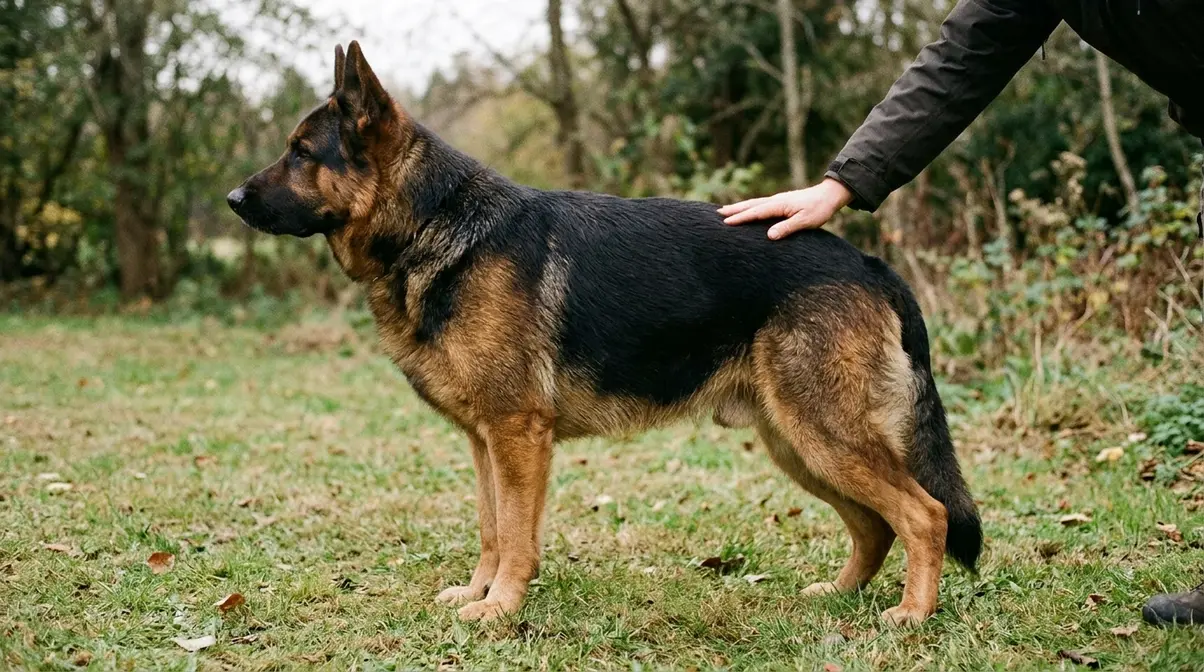
European german shepherd size and weight fall within a well-documented range. Males run 24-26 inches at the shoulder and 65-90 lbs; females run 22-24 inches and 50-70 lbs. European lines tend toward the heavier end of that weight range due to thicker bone and broader skull structure, a West German working-line male at 85 lbs is not unusual.
| Male | Female | |
|---|---|---|
| Height | 24-26 in | 22-24 in |
| Weight | 65-90 lbs | 50-70 lbs |
| European vs. American build | Heavier bone, broader head | Similar height, heavier frame |
All figures based on AKC and SV breed standards, verify current figures at akc.org and sv-sch.de before publishing.
The european german shepherd weight chart above covers the standard range. For typical adult height and weight ranges for male and female German Shepherds across growth stages, see PetVR’s German Shepherd growth chart.
The “200-pound German Shepherd” question comes up often enough to address directly: standard GSDs don’t reach 200 lbs. The largest healthy individuals may reach 90-100 lbs. The East European Shepherd is larger but still well under 200 lbs. A 200-lb dog claiming to be a German Shepherd is almost certainly a mixed breed or a misidentified animal.
Size is one thing, coat type and color are what most buyers notice first.
Coat Types, Colors, and Shedding
European German Shepherds come in two coat types: the stock coat (a medium-length double coat, the breed standard) and the long coat (a longer outer coat accepted in SV show lines since 2011, confirm the exact date with the current SV standard). Both are double-coated. Both shed heavily. The coat type affects grooming time; it doesn’t change drive or temperament.
- Colors in European lines include:
- Sable, the most common color in working lines; ranges from light gold-sable to rich dark sable
- Black-and-tan, the most common in show lines; the classic GSD look
- Solid black, accepted in both show and working lines; a european german shepherd black or black european german shepherd is a standard-color dog, not a rare variant
- Blue, a dilute gene producing a blue-grey coat; rare and not preferred in SV breed standards (confirm current SV stance before publishing)
A buyer looking for a long haired european german shepherd should know that the long coat is accepted in SV show lines and has been for over a decade. The european long haired german shepherd requires more grooming, daily brushing during blowout seasons, more frequent baths, but isn’t a fundamentally different dog. European german shepherd long haired variants appear most often in West German show lines.
On shedding: yes, German Shepherds shed a lot. European GSDs shed year-round and blow their undercoat twice a year, spring and fall. During blowout season, daily brushing is necessary. This is not a hypoallergenic breed, and no amount of coat conditioning changes that reality. For a full breakdown of GSD coat types and grooming guide, PetVR’s coat guide covers each in detail.
The coat is manageable with the right routine, but the lifespan question is what most buyers want answered before they commit.
Lifespan and the Gait Difference
European German Shepherds typically live 10-12 years. VetCompass research conducted at the Royal Veterinary College (RVC) reports a median lifespan of 10.3 years for German Shepherd Dogs overall, females to a median of 11.1 years, males to 9.7 years (Springer Nature / BMC Canine Medicine, 2017; accessed 2026). European breeders who follow SV health standards attribute their lines’ longevity to mandatory hip and elbow clearances, though no controlled comparative study has confirmed this. You can review GSD lifespan veterinary research for the full breakdown.
European-line breeders often cite 10-12 years; American-line breeders often cite 7-10 years. The difference is attributed to breeding standards, the SV’s mandatory health clearances are thought to reduce the prevalence of severe structural and genetic issues, but this hasn’t been proven by controlled comparative studies.
On european german shepherd gait: European working lines move with a ground-covering, four-beat trot built for endurance. The topline stays level throughout the stride, distributing load evenly across the hindquarters rather than concentrating stress at the lumbosacral junction. American show lines move with a flying trot, a two-beat diagonal gait that emphasizes rear-leg extension and produces the characteristic sweeping, dramatic appearance valued in the conformation ring. The European working trot is associated with lower joint stress over sustained work distances, which is why SV breed standards specify a level topline as a structural requirement. Buyers who plan to work their dog in IGP or search-and-rescue will notice the difference in endurance over a long day.
One health concern worth flagging here: degenerative myelopathy (DM), a late-onset progressive spinal cord degeneration, is reported in German Shepherd Dogs. A 2014 PubMed study on degenerative myelopathy identified it as a condition affecting the breed, DM genetic testing is discussed further in the breeder vetting section.
Size and lifespan tell you what to expect physically, temperament tells you what to expect every day.
What Is the European German Shepherd’s Temperament?
European German Shepherds, especially working lines, are high-drive dogs with strong prey, ball, and defense drives. They’re loyal and trainable, but they need a job. An unspent European GSD will invent its own job, and you won’t like the job it invents.
High Drive: What It Means Day to Day
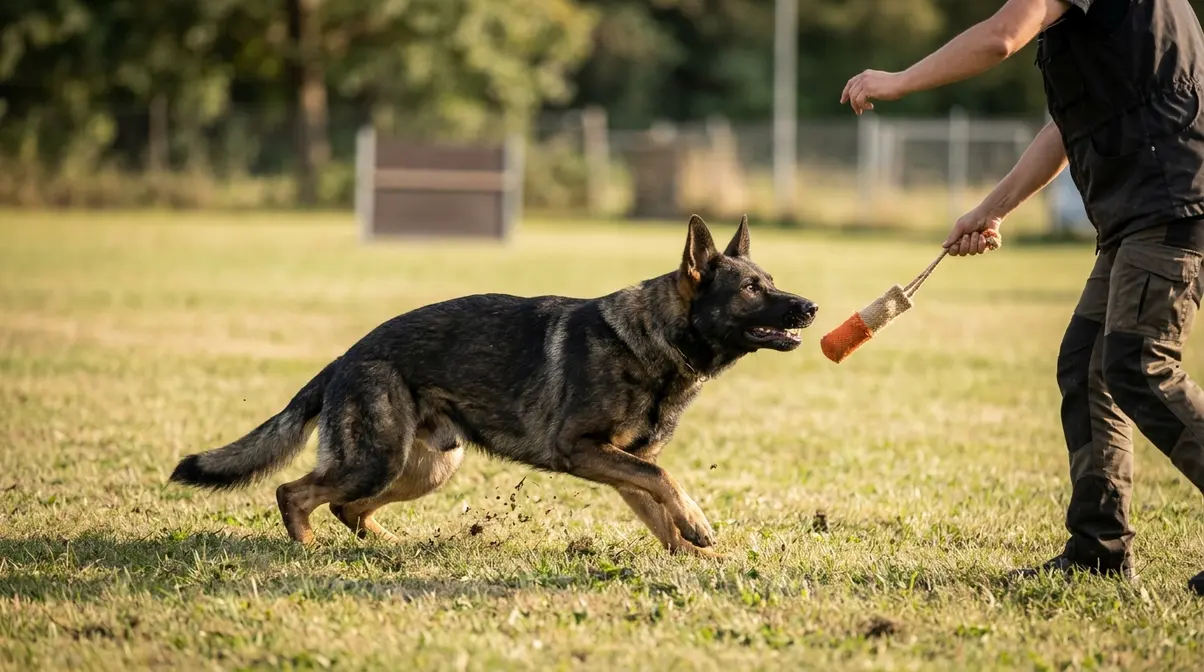
Here’s the honest picture. A West German working-line puppy arrives in your home and immediately starts cataloguing everything that moves. That’s prey drive, the instinct to chase, grab, and shake, and in a working-line GSD, it’s intense and constant. Squirrels, bikes, children running across the yard: all of it triggers the same hardwired response. This drive is the foundation of IGP tracking and bite work. It’s also why a working-line GSD in an under-stimulating home becomes a problem dog fast.
Ball drive is the second piece. Working-line dogs often develop an obsessive toy focus that’s extremely useful for training, you can build almost any behavior on a ball reward, but it can become compulsive if not channeled. Some working-line dogs will fixate on a ball to the exclusion of eating, resting, or paying attention to anything else.
Defense drive, the instinct to protect territory and handler, is the third component. In a properly trained dog, it’s controlled and directed. In an untrained dog with no structured outlet, it can manifest as reactive behavior toward strangers, fence-running, and escalating alarm responses. European german shepherd temperament in working lines is not a casual management challenge.
The contrast is concrete. A working-line GSD left alone in a yard for 8 hours: pacing, fence-running, barking, or destroying landscaping. That same dog given 2 hours of IGP training daily: calm, settled, and genuinely pleasant to live with. The dog isn’t different, the management is. For a fuller picture of German Shepherd temperament in everyday life, PetVR covers it across all lines.
Drive level is the main reason the family-dog question is more complicated for European lines than for American ones.
Are European German Shepherds Good Family Dogs?
The direct answer: it depends on the line and the family, but not in a vague way. A West German show-line dog with proper training and 90 minutes of structured daily exercise is a manageable, loyal family member for an experienced household. A Czech working-line dog in a house with toddlers, no sport outlet, and a first-time owner is a mismatch that usually ends badly for both the dog and the family.
European GSDs suit experienced handlers, sport competitors, or active working owners best. American show lines are more appropriate for most families, and that’s not a knock on European lines, it’s an honest suitability assessment. The r/dogs community reflects consistent consensus that European GSDs, particularly working lines, require more time, dedication, and handler skill than most family situations provide.
West German show line + experienced family with older children + 90 minutes of daily structured exercise = a good match. Czech working line + first-time owner + suburban yard = a predictable problem.
Beyond family fit, buyers often have specific questions about gender, bonding, and scent, here are the short answers.
Gender, Bonding, and Scent
Three quick answers before the full FAQ treatment:
- Boy vs. girl GSD: Males are typically larger and more dominant; females mature faster and are often easier to train in the early months. In European working lines, both sexes are used equally in IGP and protection work. For a full side-by-side comparison, see male and female GSD differences.
- How to tell if a GSD likes you: Look for a tail held at body height, soft eye contact, leaning against you, and following you from room to room. Full answer in the FAQ.
- How far can a GSD smell: Research suggests dogs can detect scents at concentrations roughly 100,000 times lower than humans can; trained GSDs have tracked targets at distances exceeding a mile in ideal conditions. Verify this figure from a canine olfaction study before publishing.
One comparison that surprises buyers is the European Doberman, a breed that shares working-dog heritage with the GSD but is a very different animal.
European Doberman vs. German Shepherd
The European Dobermann (FCI standard) and the German Shepherd are both high-drive working breeds, but they’re built differently and suited to different handlers. The European Dobermann, heavier and more muscular than the American Doberman Pinscher, is leaner and more agile than a German Shepherd; the GSD is heavier-boned with higher versatility across tracking, protection, and herding work.
Build and Drive Compared
The FCI-standard European Dobermann runs approximately 66-88 lbs and is bred primarily for personal protection and sport. Its drive profile is more defense-oriented than a GSD’s, strong protective instinct, less prey-drive versatility. German Shepherds run 65-90 lbs and cover a wider range of working disciplines: tracking, protection, herding, search-and-rescue. The GSD’s prey drive is generally higher than most Dobermanns’.
For a handler who wants a personal protection dog with less shedding and a more compact drive profile, the European Dobermann is worth serious consideration. For a handler who wants versatility across sport disciplines, IGP, search-and-rescue, scent detection, the GSD is the more adaptable tool. Neither is superior; they’re optimized for different jobs. Confirm FCI Dobermann weight figures at fci.be before publishing.
The mix question comes up often, here’s the short answer.
What About a European Doberman-German Shepherd Mix?
A European Doberman-German Shepherd mix is not a recognized breed. It’s a mixed-breed dog that could inherit traits from either parent in unpredictable combinations. In theory, you could get the GSD’s high prey drive combined with the Dobermann’s strong defense drive in a single animal, a high-management combination that demands significant handler experience.
The european doberman german shepherd mix query is curiosity-driven for most buyers, not a real purchase path. If you’re drawn to both breeds, the more useful question is which purebred line matches your lifestyle, and the line-to-lifestyle framework in the Which European German Shepherd Line Is Right for You? section gives you that answer directly.
Once you’ve decided on a line, the next question is always the same: how much does a European German Shepherd cost?
How Much Does a European German Shepherd Cost?
European German Shepherd puppies from health-tested, working-titled parents are a significant investment. What you’re paying for, at any price from a reputable SV-standard breeder, is documented proof that the breeding dogs passed health clearances and earned working titles. Prices vary by line type, documentation quality, and whether the dog is US-bred or imported. Contact WUSV member club breeders directly for current figures before you budget.
Price Ranges and What Drives Them
The european german shepherd price varies by line type and documentation quality. Rather than publish figures that shift with the market, here’s what drives cost at each tier, so you know what you’re paying for when you get a quote:
- West German show line: The most widely available European line in the US; expect to pay a premium over American show lines for the SV health clearances and working title documentation.
- West German/Czech working line: Higher demand from sport and protection handlers drives prices above show-line levels; elite sport-titled parents command the top of the range.
- Imported dog with SV pedigree: Import logistics, shipping, health certificate, microchip, and customs, add meaningful cost on top of the puppy price itself. Contact a reputable import agent for a current all-in estimate.
- Euro pricing context: European breeders price puppies in euros; the german shepherd puppy price euro context matters if you’re importing directly. Add shipping, health certificates, and customs costs on top of the base price.
The european german shepherd cost drivers are specific:
- Health clearances, hip and elbow X-rays evaluated by OFA (US equivalent) or SV-approved veterinarians
- Working titles, IGP, ZTP, or AD endurance test for at least one parent
- Breed survey (Zuchtschau), the SV physical and temperament evaluation
- Import logistics, shipping, health certificate, microchip, and import permit (if required by your state)
What a lower price usually means: no health clearances, no working titles, and “European bloodline” marketing without SV documentation. A suspiciously cheap “European GSD” puppy is almost certainly not from a health-tested, SV-standard breeding. European german shepherd for sale listings at unusually low prices are a red flag, whether from a breeder, broker, or import agent. Price varies significantly by seller type; a reputable breeder, a broker, and an import agent operate very differently.
One PAA question that comes up alongside price is the Belgian German Shepherd, here’s the short answer.
How Much Does a Belgian German Shepherd Cost?
“Belgian German Shepherd” isn’t a recognized breed name. The search likely refers to one of two things: the Belgian Malinois (a separate breed frequently confused with the GSD, especially in protection-dog contexts) or a German Shepherd with Belgian working-line ancestry.
Belgian Malinois puppies from working-line breeders vary significantly in price, elite sport or protection Malinois command the highest figures. Verify current pricing with named breeders and contact WUSV or NVBK member clubs for current figures before budgeting. If you mean a GSD with Belgian working-line ancestry, the price follows the same drivers as any European working-line GSD, contact WUSV member club breeders for current quotes.
The breed confusion matters practically: a buyer searching “Belgian German Shepherd cost” may be comparing two very different animals. Clarify which breed you mean before getting a price quote.
Knowing the price is useful, but knowing how to evaluate a breeder is what protects you from paying that price for the wrong dog.
How to Vet a European German Shepherd Breeder
The best European German Shepherd breeders, whether West German show line, working line, or import, share one thing: documented proof that their breeding dogs passed health clearances and earned working titles. Here’s what to ask for before you commit.
What SV-Standard Breeders Must Prove
SV breeding requirements (verify current standards at sv-sch.de) include hip and elbow X-rays evaluated by SV-approved veterinarians, the a-stamp (Angekört, the breeding suitability rating), the Zuchtschau (breed survey, a physical and temperament evaluation), and a working title of at minimum IGP 1 or ZTP/AD endurance test. Any breeder calling their program “european german shepherd breeders” or “european working line german shepherd breeders” should be able to produce documentation for all of these.
One health clearance that deserves specific attention is DM genetic testing. Degenerative myelopathy (DM) is an autosomal recessive disease caused by a mutation in exon 2 of the SOD1 gene. A 2023 molecular surveillance study on DM genetics confirmed DM’s genetic basis and the role of SOD1 testing in responsible breeding programs. Responsible breeders test both parents for the SOD1 mutation to reduce DM risk in offspring.
What “top european german shepherd breeders” actually means isn’t a ranking, it’s a set of documented standards. Any breeder who meets SV requirements is breeding to the same standard. Eastern european german shepherd breeders who work with DDR lines follow the same SV checklist as West German show-line breeders.
Here’s a checklist you can use with any breeder, European import or domestic.
A 5-Point Breeder Vetting Checklist
- Request the parents’ SV pedigree papers, not just AKC registration. SV papers confirm European bloodline registration and document the breeding lineage. West German show line breeders and working-line breeders alike should have these on file.
- Ask for hip and elbow clearance certificates, OFA (the US equivalent) or SV-evaluated X-rays for both parents. Ask for the actual scores, not just “they were cleared.” A good score is a specific number, not a verbal assurance.
- Confirm a working title for at least one parent, IGP 1 minimum, or ZTP/AD endurance test. Ask to see the title certificate. A title certificate has a date, a judge’s name, and a score, a verbal claim does not.
- Ask about DM genetic testing, request the SOD1 test results for both parents. A PMC neurologist survey on DM diagnosis found that SOD1 genetic testing should be used to support a diagnosis of degenerative myelopathy in German Shepherd Dogs, making it a reasonable clearance to request from any GSD breeder.
- Visit the kennel or request a video call, see the dogs in their environment. A reputable breeder will welcome this. A broker or puppy mill will not.
If a breeder can’t produce all five items, that doesn’t automatically make them disreputable, but it does mean you’re not getting a fully documented SV-standard dog, regardless of what they call it.
If you’re considering an imported dog rather than a US-bred puppy, there are a few additional steps.
Importing a European German Shepherd
Importing a european import german shepherd adds complexity and cost, but it often means stronger SV documentation than you’ll find from domestic breeders. The import process requires SV pedigree papers, a health certificate from a USDA-accredited veterinarian, an ISO-standard microchip, rabies vaccination, and an import permit if required by your state. Import logistics typically add meaningful cost to the puppy price, verify current figures with an import agent before budgeting.
The trade-off is real: imported dogs often have more complete SV documentation, but you can’t meet the dog before purchase. Working with a reputable import agent versus buying directly from a European breeder are both valid paths, ask for references either way.
WUSV member clubs in Canada, including breeders in BC, follow the same SV standards as US-based clubs. European german shepherd breeders canada and european german shepherd breeders bc are reachable through WUSV member club directories, the same starting point as any other country.
With a breeder vetted and a budget set, the final step is finding the right puppy.
European German Shepherd Puppies for Sale
The best starting point for finding european german shepherd puppies for sale, or a european german shepherd for sale at any stage, is a breeder affiliated with a WUSV member club. In the US, the German Shepherd Dog Club of America Working Dog Association (GSDCA-WDA) and the United Schutzhund Clubs of America (USCA) maintain breeder directories of SV-affiliated breeders. Verify current club names and directory availability at their respective websites before relying on this guidance.
Where to Find European-Line Puppies
The WUSV (World Union of German Shepherd Dog Clubs) maintains member clubs in most countries, and those clubs maintain breeder directories of SV-standard kennels. Searching “european german shepherd puppies for sale near me” through a WUSV club directory is consistently more reliable than a general classified-ad search.
Location-specific guidance: breeders in California, Texas, BC, NJ, and Canada are all reachable through WUSV directories. The search terms “european german shepherd breeders near me” or “european german shepherd puppies for sale near me” are best used as starting phrases, then verify any result against the 5-point checklist above.
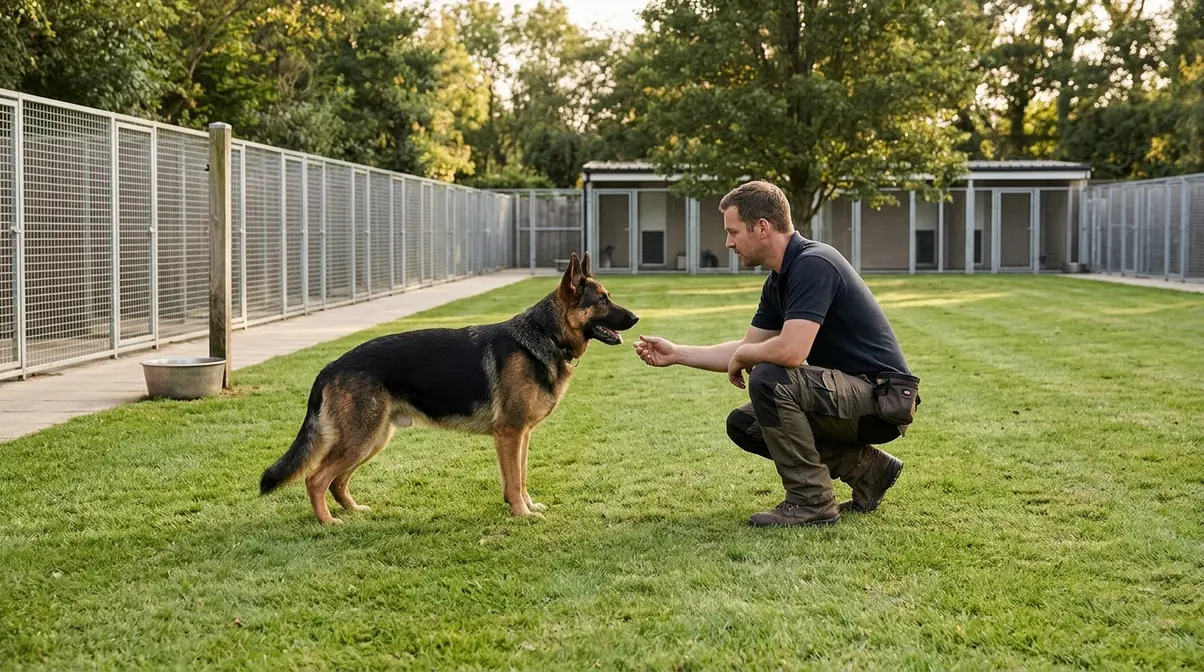
What to expect from a reputable breeder: a waiting list of 6-18 months for health-tested litters is normal. You’ll fill out a puppy questionnaire, and you’ll sign a contract that includes a health guarantee. A breeder with puppies available immediately and no questionnaire is worth scrutinizing closely.
Eastern european german shepherd for sale and western european german shepherd for sale searches refer to different line types, DDR and Czech lines for the former, West German lines for the latter, but all are findable through WUSV directories using the same process.
If you’re open to a broader search, including sable, West German, or American-line puppies, here’s what to know.
Sable, West German, and American-Line Puppies
Sable is a coat color, not a line. Sable german shepherd puppies for sale appear in both West German show and working lines, sable coloring is especially common in working lines, but show-line sables exist too. A buyer searching for a sable GSD should filter by line type after confirming the color preference.
West german shepherd puppies for sale refers to West German show or working line puppies, European-line dogs bred to SV standards. These are the most common European-line puppies available in the US. The demand is high enough that waiting lists are standard at reputable kennels.
American german shepherd puppies are AKC-registered dogs from American show lines. Lower drive, more widely available, and better suited to first-time owners, a legitimate choice if the European drive level is more than your lifestyle supports. If you landed here searching “german shepherd puppies for sale” and you’re not sure which line you want, the line-to-lifestyle framework in the Which European Line Is Right for You? section is the right place to start.
Eastern european german shepherd puppies and european german shepherd missouri searches follow the same WUSV-directory starting point, line type and location vary, but the verification process doesn’t.
Before you contact any breeder or seller, know the red flags that separate a reputable source from a puppy mill.
Red Flags When Buying a Puppy
Watch for these specific warning signs:
- No SV pedigree papers, only AKC registration
- No hip or elbow clearance certificates for either parent
- No working title for either parent
- Puppies available immediately with no waiting list or questionnaire
- Seller unwilling to let you visit the kennel or video-call
- Price significantly below market rate for the claimed line type
A “trained european german shepherd for sale” listing, an adult dog sold with protection or sport training, is a legitimate option, not automatically a red flag. Trained adults often come from serious working programs. Verify the training documentation and health clearances just as you would for a puppy.
A buyer offered a “european german shepherd” puppy at a suspiciously low price with no documentation is almost certainly not looking at a health-tested, SV-standard dog, regardless of what the seller calls it.
The most common questions buyers have, from shedding to gender to scent, are answered below.
Frequently Asked Questions
Are German Shepherds 200 pounds?
No, German Shepherds do not reach 200 pounds. Standard German Shepherds stand 22-26 inches tall and weigh 50-90 lbs; even the largest males rarely exceed 100 lbs in healthy condition. The East European Shepherd, a separate and larger breed, may weigh 10-20 lbs more than a standard GSD, still well under 200 lbs. A 200-lb dog being described as a German Shepherd is almost certainly a mixed breed or a misidentified animal.
Do German Shepherd dogs shed a lot?
Yes, German Shepherds are heavy shedders year-round. They have a dense double coat that sheds continuously and blows out heavily twice a year, in spring and fall; during blowout season, daily brushing is necessary to manage the volume. European lines, including long-haired variants, shed at the same rate as American lines, coat length affects grooming time, not shedding volume. If shedding is a dealbreaker, a German Shepherd, European or American, is not the right breed.
Is it better to have a boy or girl German Shepherd?
Neither is universally better, the right choice depends on your goals and experience. Male German Shepherds are typically larger, more dominant, and slower to mature; females are smaller, mature faster, and are often easier to train in the early months. In European working lines, both sexes perform equally in IGP sport and protection work. For most family situations, the individual dog’s temperament and training history matter more than sex.
How far can a German Shepherd smell you?
German Shepherds can detect scents at concentrations roughly 100,000 times lower than humans can. In ideal conditions, low wind, moist ground, trained scent-detection dogs have tracked targets at distances exceeding a mile; the exact range depends on wind, terrain, and the dog’s training level. German Shepherds are among the most commonly used breeds for scent detection work precisely because of this capability. An untrained GSD still has exceptional scent ability, it just won’t use it in a controlled way.
How to tell if a German Shepherd likes you?
A German Shepherd that likes you will show it through body language, not just tail wagging. Look for a tail held at body height (not tucked), soft eye contact, leaning against you, following you from room to room, and bringing you toys without being asked. A GSD that stiffens, avoids eye contact, or tucks its tail around you is uncomfortable, not just aloof. European working-line dogs may be more reserved with strangers but intensely bonded to their handler once trust is established.
What is the smelliest breed of dog?
Hounds, particularly Bloodhounds, Basset Hounds, and Beagles, are generally considered the smelliest dog breeds. These breeds have more active sebaceous glands and skin folds that trap odor; German Shepherds, including European lines, are not typically ranked among the smelliest breeds. A GSD that smells strongly usually has an underlying cause, ear infection, skin condition, or dental disease, rather than a breed-specific odor. Regular grooming and veterinary check-ups keep most German Shepherds odor-neutral.
What is the difference between a European and an American German Shepherd?
European German Shepherds are bred under SV standards that require hip and elbow clearances and a working title before breeding; American lines follow AKC standards that mandate neither. Physically, European lines typically have a straighter back, thicker bone, and a broader head; American show lines have more pronounced hindquarter angulation. European lines carry higher working drive; American lines are calmer and more adaptable for family life. Both are the same breed, the difference is breeding philosophy and the selection pressure applied over generations.
Where is the best place to buy a German Shepherd puppy?
Start with breeders affiliated with WUSV member clubs, in the US, the GSDCA-WDA and USCA maintain directories of SV-standard breeders. Under SV rules, breeding dogs must pass hip and elbow health clearances, a temperament evaluation, and earn a working title such as IGP or ZTP before they can be registered for breeding. Ask any breeder to show the parents’ SV pedigree papers, hip and elbow clearance certificates, and working title certificates. A reputable breeder will welcome the questions; a puppy mill or broker will not.
Conclusion
For buyers who want a dog bred to a documented health and working standard, a European German Shepherd, particularly a West German show or working line, is a compelling choice. VetCompass research puts the median GSD lifespan at 10.3 years; European breeders who follow SV standards add hip and elbow clearances and working titles to that foundation. The right line depends on your lifestyle, and this guide’s line-to-lifestyle decision framework maps that match directly.
The core insight is simple: show lines for active families, working lines for sport and protection, DDR for maximum structural soundness and drive. Get the line right and you get a dog that fits your life. Get it wrong and you have a high-drive dog in the wrong hands, a situation that’s hard on the owner and harder on the dog.
Your next step: use the full 5-point breeder vetting checklist in this guide to evaluate any breeder you contact. Ask for the parents’ SV pedigree papers, hip and elbow clearance certificates, working title documentation, DM (SOD1) genetic test results, and a kennel visit or video call. If a breeder can’t produce all five, keep looking. PetVR’s guides on German Shepherd temperament and working line versus show line cover the next decisions you’ll face once you’ve found your breeder.
 How Strong Is a German Shepherd? Bite Force & Speed