When a dog becomes old, it faces a lot of health problems and sclerosis is regarded as one of the banes. Sclerosis, also called Lenticular or Nuclear sclerosis is common among middle-aged dogs and canine senior citizens. A bluish haze develops in the lens of the dogs that are usually between 6-8 years old. This is an ophthalmic disease that is associated with the aging of dogs and is often found in mid-aged to old-age German Shepherds. The cloudiness observed in the eyes of the pupil of the dog getting discolored makes it clear that it is suffering from lenticular or nuclear sclerosis. This has nothing to do with arteries or blood flow. The lens keeps producing new fibres throughout life, but the lens itself does not get bigger. So as new fibres are laid down on the outer rings, the older fibres in the centre get compressed. That compression hardens the core and gives it the cloudy grey-blue look you can see (VCA Animal Hospitals, retrieved 2026-08-12).
Sclerosis or cataract: what actually separates them
Both look like cloudiness. That is where the similarity ends.
| Nuclear sclerosis | Cataract | |
|---|---|---|
| Appearance | Even blue-grey haze, in the centre of the lens, usually both eyes symmetrically | White and opaque, can be any part of the lens, often uneven |
| Effect on vision | Not significantly affected | Blocks light reaching the retina, causes diminished vision |
| Cause | Normal lifelong compression of lens fibres | Disease process, sometimes inherited or diabetic |
| Treatment | None needed | May need surgical removal if vision is impaired |
| Urgency | Mention at the next routine visit | Worth a proper eye examination |
The test a vet uses is simple and it is the reason you cannot settle this at home. PetMD describes it: with an ophthalmoscope, “light from the ophthalmoscope will readily pass through the lens. The retina and the fundus (structures in the back of your pup’s eye) will be visible through the hardened lens” (retrieved 2026-08-12). A cataract blocks that light.
In other words, the vet is not judging the colour. They are looking to see whether they can still see through it. You cannot do that with a phone torch, and photographs are especially misleading because flash changes how the lens looks.
First, the short answer
You noticed a blue-grey haze in your older dog’s eyes and went looking for what it means. Here is the answer before the detail.
Nuclear sclerosis is a normal ageing change, it is not painful, and it barely affects sight. It is not a cataract, and it does not need treating.
It is also extremely common. PetMD reports that lenticular sclerosis “is very common, affecting about half of dogs age 10 and older,” and that “nearly all dogs over the age of 13 have hardened lenses” (PetMD, retrieved 2026-08-12).
So if your German Shepherd is over ten and both eyes have gone slightly cloudy in the same way at the same time, you are most likely looking at the ordinary thing rather than the frightening one. The rest of this page is about telling them apart properly.
Symptoms of Sclerosis
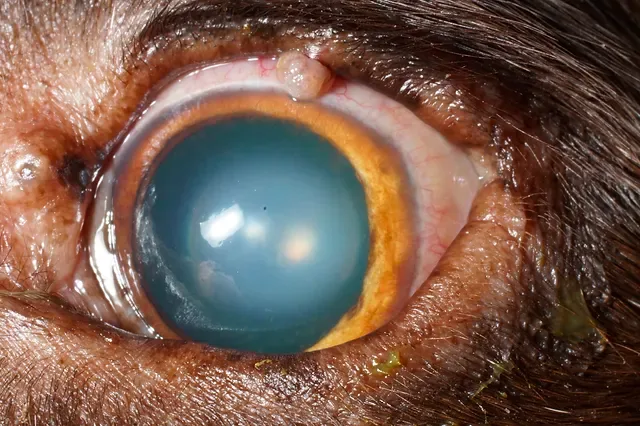
The discoloration of the eyes of an aging dog shows the first sign of this disease. The pupil from pitch-black turns grayish or blue in color. This happens because the small blood vessels of the lenses get thick-walled, causing a disruption in the smooth flow of blood.
How does Sclerosis happen?
With age, physical degeneration starts and the lens of the dogs also gets sturdy. Lens fibers are produced throughout a lifespan but the size of the lens does not increase with age. The new fibers form layers and the retina of the dog’s eyes decrease in size for making a place for the new layers. The nucleus of the eye with the composition of the oldest layers gets hard.
Is Sclerosis happens only in GSD?
No. lenticular or nuclear sclerosis or simply sclerosis can be found in all dogs , especially when they get old. German Shepherd Dogs are no exception. Sclerosis is actually the hardening of the lenses
Is it a threat to visual impairment?
Studies have shown that sclerosis which is commonly found in old dogs, does not cause any pain. In most cases it barely affects sight at all. VCA puts it plainly: “Vision does not appear to be significantly affected in dogs diagnosed with lenticular sclerosis” (retrieved 2026-08-12). That is exactly what separates it from a cataract, which is white and opaque, blocks light from reaching the retina, and does cause diminished vision. If your dog is genuinely bumping into things or losing confidence in dim light, that points to something else, such as a cataract, retinal disease or glaucoma, and it needs a vet examination rather than reassurance. Not all pets who are detected with sclerosis suffer from sight problems until they have become very old. However, it is desired that pet owners should take good care of their dogs.
How to know if is it sclerosis or cataract?
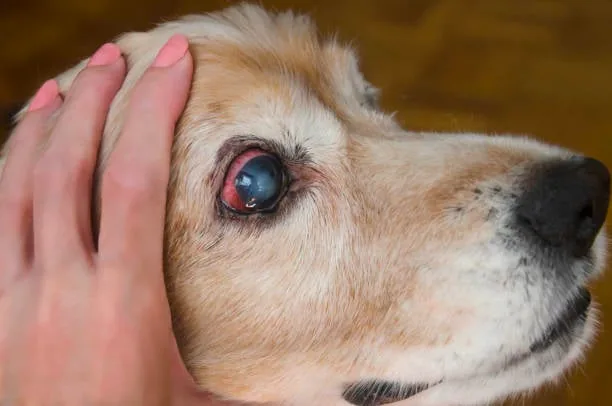
A middle-aged dog may suffer from sclerosis, but it does not necessarily mean that it is suffering from cataracts. Though cataracts and sclerosis are related, they do not share a causal relationship. Some dogs like the well-built German Shepherds, who have been detected with sclerosis when they are middle-aged do suffer from senile cataracts when they become very old. A cataract is a medical condition where the ability of light penetration to the retina gets reduced, affecting vision. It is good to take adequate precautions when you are able to diagnose that your dog is inflicted with sclerosis. It is very necessary to bank only on experienced and expert veterinarians who use some special equipment and minute inspection to examine the condition of the dog’s eye to make the right diagnosis.
Treatment of Sclerosis
Though sclerosis is one of the most common problems that dogs are plagued with during old age, there are no two ways about changing the course of things apart from proper home care. Theoretically, no determined course of action has been prescribed by the doctors since sclerosis does not often lead to graver consequences like visual impairment. A dog is likely to face visual problems with age, but if a dog is suffering from sclerosis, the disease does not tend to destroy the lens of the dog. However, for vision enhancement of your GSD or any dog, your vet may suggest you administer eye drops and vitamins.
Does it change how your dog sees?
Barely. VCA states that “vision does not appear to be significantly affected in dogs diagnosed with lenticular sclerosis” (VCA Animal Hospitals, retrieved 2026-08-12).
PetMD offers the most useful comparison an owner will read on this: affected dogs “should be able to see just fine,” though they “may have some changes in their depth perception (like middle-aged adults needing reading glasses)” (retrieved 2026-08-12).
That analogy is worth holding onto. A middle-aged person needing reading glasses has not lost their sight. They have lost a little precision at close range. In a dog that might show up as slight hesitation before a jump onto the sofa in dim light, and nothing else.
Practically: keep the furniture where it is, leave a light on at night, and do not start treating your dog as visually impaired because its eyes changed colour.
When cloudy eyes are NOT this
This is the part that makes the reassurance safe to give. Nuclear sclerosis is harmless, so anything that does not match it deserves a look.
Book an appointment if you see any of these:
- Only one eye. Sclerosis is an ageing change in both lenses, so a one-sided change is a different question.
- White and dense rather than blue-grey. That description fits a cataract.
- Redness, squinting, pawing at the eye, or discharge. Sclerosis is painless. Pain means something else, and eyes are time-sensitive.
- Genuinely bumping into things, losing confidence in familiar rooms, or being reluctant to move in low light.
- A rapid change. Sclerosis appears over years. Anything that arrives over weeks is not this.
- Drinking and urinating much more than usual alongside the cloudiness. Cataracts can develop quickly in diabetic dogs, so that combination is worth mentioning specifically.
Treatment: there is none, and none is needed
PetMD is blunt about it: “There is no treatment for lenticular sclerosis in dogs” (retrieved 2026-08-12). VCA agrees that treatment is not necessary.
So be sceptical of eye drops or supplements marketed as clearing cloudy eyes in older dogs. There is nothing to clear. The lens is denser because your dog has been alive a long time, and that is not a fault to correct.
What is worth doing is a proper eye check at the annual senior visit, so that if something else ever does develop, somebody has a baseline to compare against.
Related reading
If your older German Shepherd is showing other changes, our care guide covers senior health monitoring. For the eye condition that genuinely does threaten sight in this breed, see pannus, or chronic superficial keratitis, which is immune-mediated and needs lifelong treatment. And if the worry is hind-leg weakness rather than eyes, read degenerative myelopathy.
Why the lens goes cloudy in the first place
It helps to picture what the lens is. It is a clear, flexible structure sitting behind the pupil, and its job is to focus light onto the retina at the back of the eye.
Here is the part that explains everything else on this page. The lens keeps making new fibres for the whole of your dog’s life, but it never gets any bigger. New fibres are laid down on the outside, so the older ones are pushed inward and packed tighter and tighter.
After a decade of that, the core of the lens is dense enough to scatter light rather than pass all of it straight through. Scattered light is what you are seeing as a blue-grey haze. Nothing is diseased. The lens has simply been doing its job for a long time.
This is also why it appears in both eyes at once and progresses so slowly that owners often cannot say when it started. Both lenses have been ageing at the same rate.
Is this a German Shepherd problem specifically?
No, and that is worth saying plainly because a breed-specific article can imply otherwise.
Nuclear sclerosis is an ageing change that happens in dogs generally, not a German Shepherd condition. PetMD puts the figures at about half of dogs aged 10 and over, and nearly all dogs over 13 (PetMD, retrieved 2026-08-12). Your German Shepherd is getting it because it is getting older, not because of its breed.
What IS worth knowing as a German Shepherd owner is the other eye condition this breed genuinely is predisposed to, which is pannus. That one is immune-mediated, it does threaten sight, and it needs treating for life. Two cloudy-looking eyes in a German Shepherd are usually the harmless thing, but they are worth having somebody qualified confirm which one you are looking at.
What to do next
- Do not panic, and do not buy drops. There is no treatment because none is needed.
- Note when you first noticed it. A rough date is useful to a vet, because speed of onset is one of the things that separates this from a cataract.
- Mention it at the next routine appointment rather than booking an emergency. A senior wellness visit is the natural place.
- Ask for the ophthalmoscope check specifically. Ask whether light passes through the lens and whether the retina is visible. That is the question that separates sclerosis from a cataract.
- Re-read the red flags above. One eye only, white and dense, pain, rapid change, or increased drinking and urinating all move this up the priority list.
- Adjust the house a little, not a lot. Keep furniture where it is, add a night light, and give an older dog a moment before it jumps.
That is genuinely the whole job. For most owners reading this, the correct outcome is relief and a note in the diary for the next check-up.
 Osteochondritis Dissecans (OCD) in German Shepherds