
Immensely important! Your 2-month-old cutie pie is going to grow into a strong, powerful, and sturdy German Shepherd Dog. He will be one of the most intelligent members of your family too, and his superb degree of intelligence will challenge you in every field of your life. German Shepherd , especially adult males are naturally quite dominating and stubborn and need to be handled with firmness. The boldness and confidence in his personality and his territorial and protective instincts can be serious threats to any kind of stranger. Moreover, being a herding or a guardian dog breed, GSD may not be necessarily friendly with other dogs outside of his own pack. Proper socialization and obedience training will make life both easier and happier for you and your German Shepherd Dog.
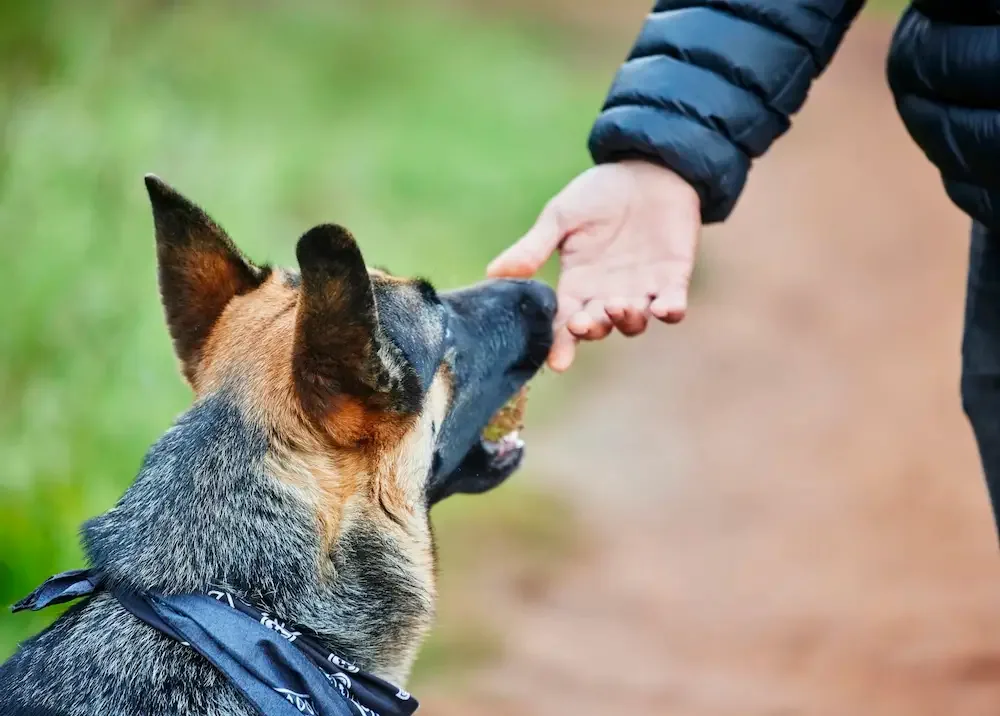
The secret of the success story build a good dog-owner relationship. Consistency across everyone in the household matters more than anything else. Helping your GSD gain confidence, and trust you is another tip to successful training. Your German Shepherd learns household rules from what actually happens, not from who claims authority. If the same behavior earns the same response from every person in the home, the rules become clear quickly. Reward-based training is what veterinary behavior bodies recommend, and it is what holds up in practice.
Some of the best-ever German Shepherd training tips
- Start training as early as possible , for instance at the age of 4 to 5 months.
- Start training with socializing him to situations, smells, sounds, incidences, strangers, and other animals. This is the building block for the actual obedience training.
- Yelling, hitting, punishing, and threatening him will worsen up the situation.
- As the prime GSD training tips, it is advisable to spend quality time with your GSD puppy to develop the bonding that would help him to interact with you in the actual training session.
- Consistency with training commands is as important as praising him when he does what is desired.
- Praise ensures your GSD puppy identifies what is expected of him and what isn’t.
Be Patient: Training Should be a Fun Session Both For You And Your Dog
Dog training is a time-consuming process. If you are a short-tempered person who looses their cool and patience too quickly, you are advised not to experiment with your German Shepherd puppy. By making haste you will mess up with everything. Chances are there that your puppy may build a distrust for you in his mind and he can never be a good companion of yours. Forcing your puppy digest all training commands at a time is a fool’s task. Choose one , usually start with the command “SIT”. Work with it until it gets completely easy. Then switch off to another command… carry on practicing for the “SIT” exercise. Don’t expect too much from your puppy. Not all German Shepherds are fast learners. Expecting gains within a short spell of time is impossible.
Training should be a really enjoyable session for you and your dog. Remember, the training session won’t be of any practical benefit if it’s not a fun time for your dog. Your dog should know that he would be getting his favorite tidbits if he can please you in the fun session. 90% of the battle ends here!
You might want to read:
- How to Become A Professional Dog Trainer: 8 Simple Steps to Take
- How to Train Your German Shepherd Puppy
- How To Train Your German Shepherd Dog
- Positive Motivation Dog Training Technique With Corrective Measures
- How to Teach Your German Shepherd Dog to Chase and Fetch
Disclaimer: PetVR shares general information based on our contributors’ firsthand experience with German Shepherds — it is not veterinary advice. Always consult a licensed veterinarian about your dog’s health, diet, or behavior. Read our full disclaimer.
How dogs actually learn, and why the method matters
Before any specific exercise, it is worth knowing what the veterinary behaviour profession actually recommends, because the dog training industry is unregulated and advice varies wildly.
The American Veterinary Society of Animal Behavior is unambiguous: “based on current scientific evidence, AVSAB recommends that only reward-based training methods are used for all dog training, including the treatment of behavior problems” (AVSAB Humane Dog Training Position Statement, retrieved 2026-08-12).
This is not a soft preference. AVSAB states it “does not support the use of aversives in any context, regardless of the tools used or the trainer’s level of experience”, and that the position “is grounded in current scientific evidence, which consistently shows that aversive methods carry significant risks to animal welfare and the human-animal bond” (retrieved 2026-08-12).
And reward-based training is not merely kinder, it works better. AVSAB cites Hiby and colleagues (2004), who found “obedience levels of dogs highest for dogs trained exclusively with reward-based methods and lowest for dogs trained exclusively with aversive-based methods”. Mixed approaches, “often referred to as balanced in the dog training industry”, landed in between (AVSAB Position Statement on Humane Dog Training, 2021, retrieved 2026-08-12).
One misunderstanding worth heading off. AVSAB notes that “use of reward-based methods does not mean dogs are allowed to do anything they want” (retrieved 2026-08-12). Rules still exist. What changes is how you teach them.
Why training matters more in this breed than most
Training a small dog badly produces an annoying small dog. Training a 35 kg working breed badly produces something else.
Size makes ordinary problems serious. Pulling on the lead is a nuisance in a terrier and a genuine risk to your shoulder and to the dog in a German Shepherd. A dog that jumps up in greeting can knock over a child or an older person without meaning any harm at all.
Intelligence needs direction. The AKC warns that purpose-bred dogs denied the mental work they need “will create their own projects to keep their minds busy” (AKC breed profile, retrieved 2026-08-12). Training is not an optional extra for this breed; it is where the brain goes.
Training is welfare, not obedience for its own sake. A dog that can be recalled gets more off-lead freedom. A dog that tolerates handling has easier, less frightening vet visits. A dog that can settle can come more places with you. Every one of those is a larger life.
And it protects the relationship. Most dogs surrendered to rescue are given up for behaviour, not health. The training you do in the first year is the best insurance available that this dog stays your dog.
What to prioritise, in order
- Socialisation, first and most urgent. Careful, positive exposure to people, surfaces, sounds and handling while the puppy is young. This window does not reopen.
- Handling and consent. Paws, ears, mouth, nails, being held still. Do it now, in small friendly doses, and every vet visit for the next decade is easier.
- Recall. The one that keeps the dog alive.
- Loose-lead walking. Start before the dog outweighs your ability to hold it.
- Sit and settle. The building blocks for polite greetings and calm in busy places.
- Alone time. Teach it deliberately and gradually, before it is ever tested by a full working day.
- House training. Mostly routine and supervision rather than training.
Notice that only two of those are traditional obedience cues. The rest is about a dog that copes with the world, which is what actually determines how good life is for both of you.
What is different about training this breed
German Shepherds are not harder to train than other dogs. In some ways they are easier, and that creates its own problems.
They learn fast, including the things you did not mean to teach. A dog that works out that barking makes you come outside has learned exactly as efficiently as one learning to sit. Be deliberate about what gets rewarded, including by accident.
They need the thinking as much as the walking. The AKC describes purpose-bred dogs as needing mental work, warning that without the brain exercise they need “they’ll create their own projects to keep their minds busy” (AKC breed profile, retrieved 2026-08-12). Five minutes of training is often worth more than another twenty minutes of walking.
They are big, and size changes the stakes. A behaviour that is charming in a 10 kg puppy is not charming in a 35 kg adult. Jumping up, mouthing and pulling are all much easier to prevent than to fix later.
They form strong attachments, which makes your attention a genuinely powerful reward and makes harsh handling land harder than it would with a less sensitive dog.
Session rules that make everything else work
- Short and often beats long and occasional. Three or four sessions of five minutes across a day will outperform one twenty-minute session, especially with a puppy.
- Finish while your dog still wants more. Ending on success is what makes a dog eager to start next time.
- Train before meals, not after. A hungry dog works for food. A full dog does not.
- Start somewhere boring. Your kitchen, no other dogs, no visitors. Add difficulty only once the behaviour is reliable.
- Change one thing at a time. Distance, duration, distraction. Raise one and drop the others.
- If it falls apart, make it easier. A dog that stops responding is usually telling you the step was too big, not that it is being stubborn.
- Keep your voice ordinary. Repeating a cue louder teaches the dog that the first six times do not count.
If you hire help, here is the filter
A German Shepherd is a large, powerful, clever dog, and getting good help early is money well spent. The difficulty is that anyone can call themselves a dog trainer.
AVSAB gives an unusually concrete screening rule: “if a trainer is observed using aversive training methods or if a trainer discusses out-dated ideas such as dominance, leader of the pack, or alpha theories, then clients should be advised against hiring them” (AVSAB Position Statement on Humane Dog Training, 2021, retrieved 2026-08-12).
That is a clean test you can apply in a five-minute phone call. Ask a prospective trainer how they would handle a dog that ignores a cue. If the answer involves showing the dog who is boss, keep looking.
Questions worth asking before you book:
- What happens when my dog gets it right? A reward-based trainer answers this immediately and specifically.
- What happens when my dog gets it wrong? The answer should involve making it easier, not making it unpleasant.
- What equipment do you use? Be cautious of anyone who leads with a tool rather than a plan.
- Can I watch a class before enrolling? A confident trainer says yes.
- What qualifications do you hold, and are you insured?
 How to Train Your German Shepherd Puppy