
If your German Shepherd Dog is eating grass, he is certainly not the only dog on the Earth that exhibits this kind of strange behavior. There are many schools of thought and theories as to why German Shepherds eat grass, but there’s no proven and confirmed conclusion as to why they eat grass. Dogs, irrespective of breed, gender and age eat grass at some point in time.
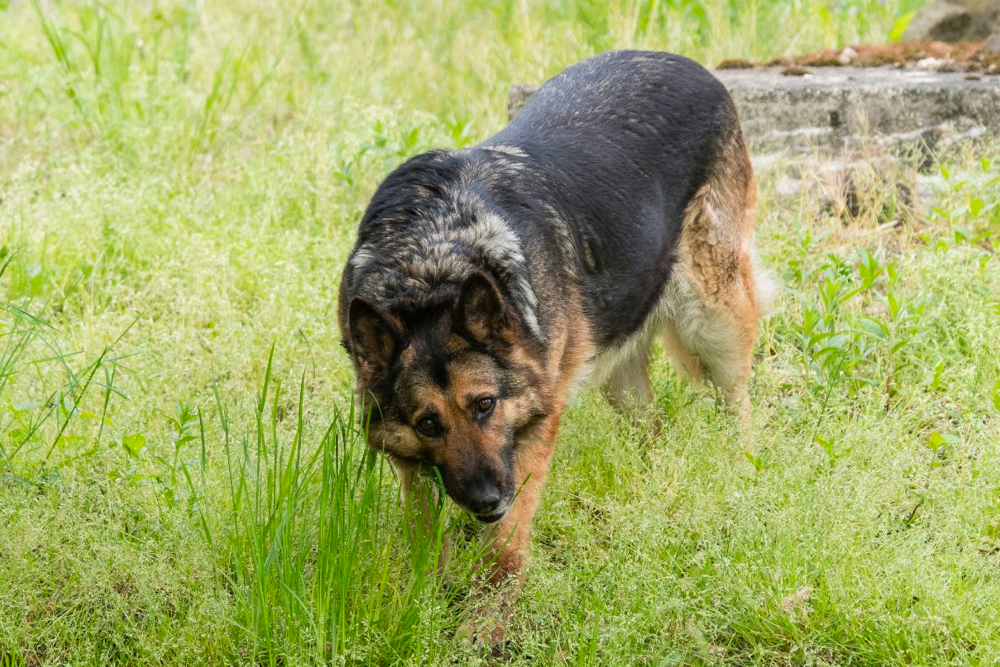
Veterinary researchers have been pounding on the mystery of dogs eating grass. Dr. Benjamin Hart, DVM, Ph.D., has studied animal behavior for over 50 years and according to him one of the questions he is hit with most frequently from dog owners is: “Why does my dog eat grass?” Researchers have carried out a study on dogs eating grass. A number of 49 dogs were exposed to vegetation and grassland. It was observed that around 39 out of 49 dogs had consumed plants at some point in time. It noticed that the grass was preferred more than other plants by most of the dogs. Now the question is: Why Do Dogs Eat Grass?
This behavior that is characterized by knowingly eating things by a species that are not their food is called “Pica”. If your German shepherd Dog or any other dog or mongrel is eating grass, this is a kind of pica, a behavior that is not necessarily fatal or harmful, as long as your garden is free from poisonous pants along with the grass that your dog can accidentally ingest.
There are different reasons but none of them have been scientifically proven and confirmed. Some of the probable reasons that many canine experts have laid down are as follows:
1. Settling their stomach
Those there in the veterinary profession would clearly say that your GSD eats grass because he has a natural instinct to use grass as a medicinal herb, whenever they feel irritation or ache inside their stomach. Some people (especially those directly or indirectly related to the veterinary profession) believe that dogs , irrespective of breed , eat grass and then vomit in order to settle their stomach.
2. Controversy
Many dogs, most of the time, do not vomit after eating grass. This goes a long way to prove that grass is not used by dogs to vomit in order to settle their stomach. Moreover, in a survey it has been noticed that grass eating and vomiting do not always go together… nor grass eating and illness are always associated. In the study of clients and veterinary students, it was observed that 18% of the clients’ dogs that ate grass vomited after eating. On the other hand, 9% of the dogs owned by the veterinary students showed some symptoms of illness before eating grass.
3. Nutritional deficiency
Some experts consider that dogs eat grass because of nutritional deficiencies in their regular diet. Since dogs are not purely carnivorous they need plant fibers as a part of their diet. Some dogs eat grass probably because their food doesn’t meet their requirement of veg nutrition which they try to compensate for by eating grass.
4. Controversy
Many dogs that are fed purely non-commercial food, without any vegetables also eat grass. Homemade food usually consists of meat, eggs, fruits, veggies, etc. that are quite nutritious. Many dogs that are given enough vegetables of different types also eat grass. Moreover, if it’s a question of nutritional benefits, there wouldn’t have any reason for some dogs to vomit after eating grass.
5. Natural instinct
Grass eating habit of dogs is a natural instinct. Their ancestors used to eat small amounts of grass and plant nutrients as a part of their natural diet indirectly by eating the intestines of herbivorous prey for instance deer, goat, sheep, etc. This is considered as the instinctual craving for the roughage or minerals or fiber present in the vegetation
6. They love to eat grass
Some canine experts conclude that dogs love to eat grass because they like the taste. Grass and plants or weeds contain a vegetable sap that sometimes tastes sweet. Your German Shepherds probably like eating grass because of the taste.
We do not have any solid explanation as to why dogs eat grass. There are different schools of thought and theoretical statements and beliefs. Researchers have been burning their midnight oil to come up with a rock-solid reason for dogs’ grass-eating habits. Now the question is: Is there anything to be worried about? Dog’s grass-eating habit doesn’t always cause alarm. Dogs usually do not eat grass excessively. If you notice your GSD eating grass in the excessive quantity you should consult your vet instantly. Grass eating by dogs is something not to be worried about as long as your lawn is not treated with poisonous substances like fertilizers, pesticides, herbicides, or any other chemical components.
Odd habits often sit alongside other ones, and the behavior problems owners run into most covers what else tends to show up.
Disclaimer: PetVR shares general information based on our contributors’ firsthand experience with German Shepherds — it is not veterinary advice. Always consult a licensed veterinarian about your dog’s health, diet, or behavior. Read our full disclaimer.
What the research actually found
Almost every article on this subject repeats the same explanation: dogs eat grass to make themselves sick. It has been studied, and that is not what the data shows.
A peer-reviewed study of plant eating in dogs surveyed owners systematically and then ran a much larger internet survey (Sueda KLC, Hart BL, Cliff KD. Characterisation of plant eating in dogs. Applied Animal Behaviour Science, 2008, retrieved 2026-08-12). The findings:
- 79% of owners whose dogs had daily access to plants reported their dog ate grass or other plants. Grass was by far the most common.
- Only 9% reported their dog frequently appeared ill before eating plants.
- Only 22% reported their dog frequently vomited afterwards.
- No relationship was found between sex, neuter status, breed group or diet type and how often or what dogs grazed.
- Younger dogs ate plants more often and were less likely to look ill beforehand or vomit afterwards.
The authors conclude that the findings “support the perspective that plant eating is a normal behaviour of domestic dogs” (retrieved 2026-08-12).
Read the second and third points together and the popular theory falls apart. If grazing were a self-medication strategy, sick-looking dogs should be the ones eating grass and vomiting should reliably follow. Neither is what owners actually observe.
Note also the diet finding. There was no signal that dogs on any particular diet, or with less fibre, grazed more. So “he must be missing something in his food” is not supported either, and changing food to stop grass eating is unlikely to achieve anything.
So why does your dog do it?
Once illness and diet are set aside, the least exciting explanation is the one left standing: many dogs simply like it. Owners often notice their dog is selective, going for young, moist, long-stemmed grass rather than whatever is nearest, which is the behaviour of an animal choosing a food it enjoys rather than one taking medicine.
The 2008 study also raises the possibility that grazing is an inherited behaviour from wild ancestors, where fibrous plant material passing through the gut may have helped carry intestinal parasites out (retrieved 2026-08-12). That remains a hypothesis rather than an established mechanism, and we are flagging it as such rather than presenting it as the answer.
What this means for you: a German Shepherd that grazes occasionally, looks well, and gets on with its day needs no intervention at all.
When grass eating IS worth a vet visit
Normal does not mean always harmless. Take it seriously when:
- It has become frantic or compulsive. A dog that grazes constantly, or that seems driven rather than casual, is different from one having a nibble.
- Your dog looks unwell before eating. The study found dogs that appeared ill beforehand were more likely to vomit afterwards, so illness tends to come before the grass, not from it.
- Vomiting is regular rather than occasional.
- It appeared suddenly in an adult dog that never used to do it.
- Anything else has changed: appetite, weight, stool, energy.
In those cases the grass is a symptom rather than the problem. Our article on digestive tract disorders in German Shepherds covers what to bring to the appointment, and exocrine pancreatic insufficiency is the breed-linked cause of chronic digestive trouble worth knowing by name.
The real risk is not the grass
The grass itself is rarely the danger. What is on it can be.
- Lawn treatments. Herbicides, fertilisers and pesticides are the genuine hazard, and they are invisible. Know what goes on your own lawn and be cautious about treated verges and parks.
- Slug and snail bait is highly toxic and turns up in gardens.
- Toxic plants growing among the grass. A dog that grazes indiscriminately will eventually meet one.
- Grass awns. Barbed seed heads from long dry grass can work into paws, ears and noses, and they migrate.
- Parasite exposure from ground where other dogs have toileted.
So the sensible response is not to stop a normal behaviour. It is to be deliberate about where your dog grazes.

 Are German Shepherds Aggressive?