
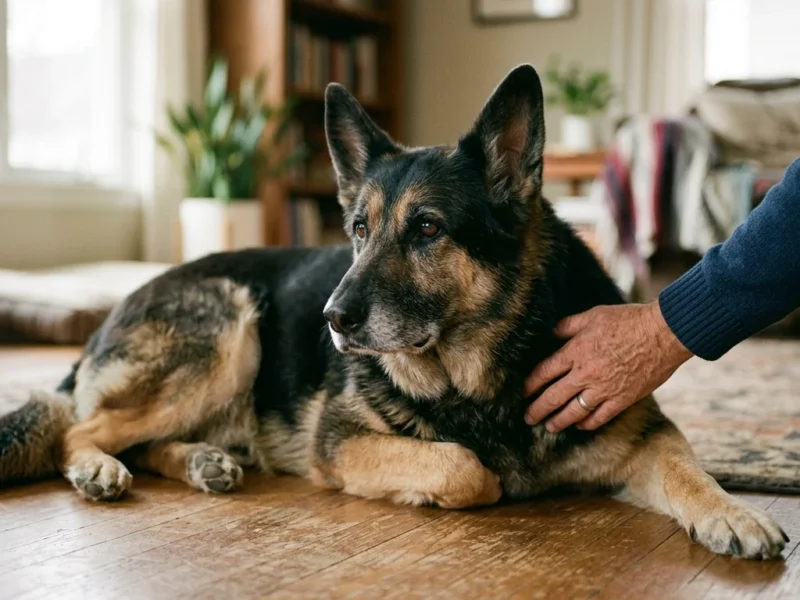
Quick question, has your vet used the word “hemangiosarcoma” this week? If so, you’re probably reading this at midnight, scared, and trying to decide about surgery in the next few hours. Take a breath. You’re in the right place, and you deserve straight answers. Moreover, we’ve written this specifically for German Shepherd owners, because most articles on this cancer are generic-dog and skip the breed-level context you actually need.
Here’s the honest short version. Hemangiosarcoma is an aggressive cancer of the cells that line blood vessels. Even with the best treatment, less than 10 percent of dogs are alive one year after diagnosis (Cornell Riney Canine Health Center, retrieved 2026-08-11). This article walks you through the signs, the emergency red flags, how it’s diagnosed, what the survival numbers actually look like, and the real-life treatment choices in front of you. In addition, we cover a common question about the “2/3 rule” your vet may still quote, and what the newer 2024 and 2025 data show instead.
One quick note before we start. This is educational, not veterinary advice. Additionally, we’re not veterinarians. Instead, our approach is to source every clinical claim from a veterinary school, peer-reviewed journal, or the AKC Canine Health Foundation; those sources are named at the point of each claim in the article. Please call your vet about your specific dog.

What is hemangiosarcoma?
Hemangiosarcoma is a cancer of the cells that line the inside of blood vessels. These lining cells are called endothelial cells, and they exist everywhere in the body. As a result, the tumor can form almost anywhere. However, in dogs it shows up most often in the spleen, the heart, the liver, and the skin, per Cornell’s Riney Canine Health Center (retrieved 2026-08-11). Because the tumor is made of blood vessels, it fills with blood. Therefore, when a mass ruptures, the bleeding is fast and often internal.
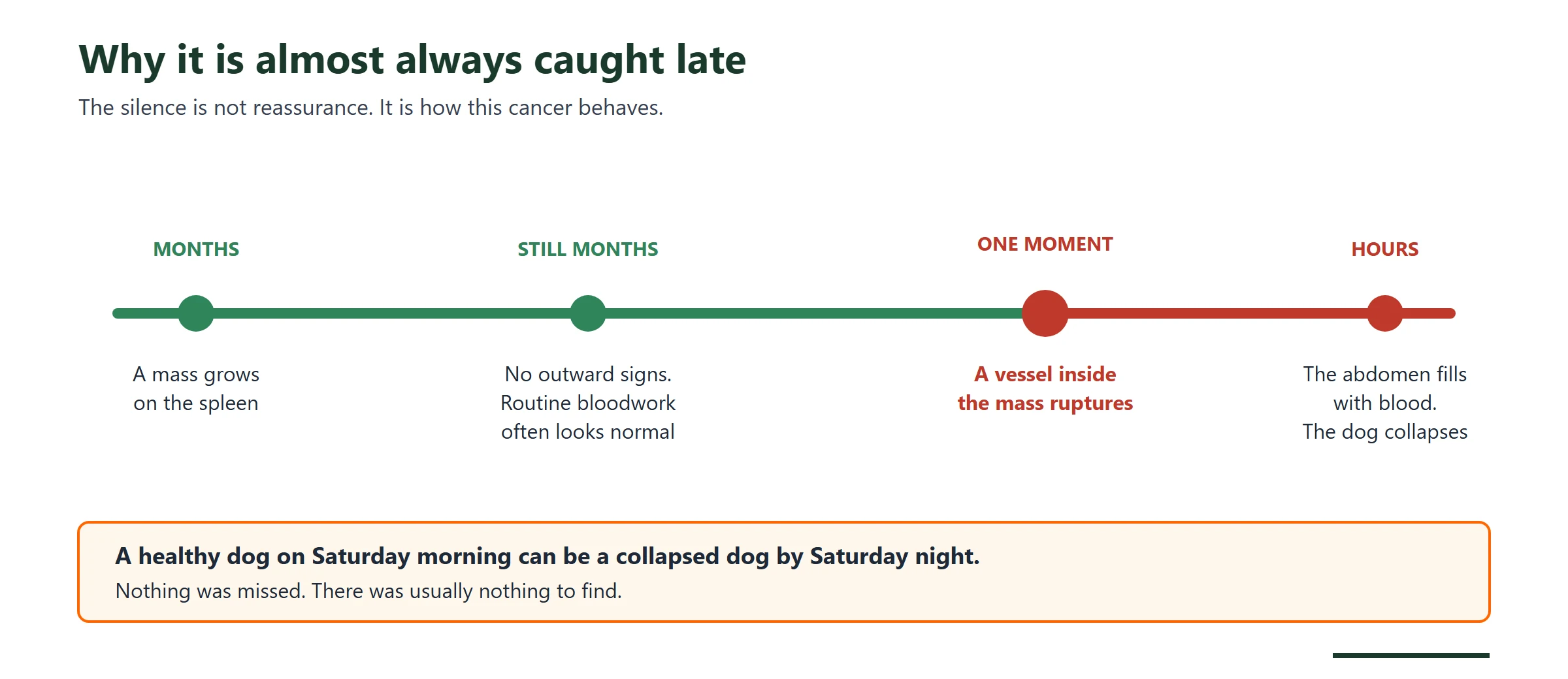
The problem with this cancer is how quietly it grows. To begin, a tumor on the spleen can sit there for months without a single outward sign. Then a small blood vessel inside the mass ruptures. Suddenly, the belly fills with blood, and what looked like a healthy dog on Saturday morning is a collapsed dog by Saturday night. That’s the pattern owners describe most often, and it’s what makes hemangiosarcoma so hard on families. In other words, the first warning many owners get is not a warning at all. It’s a crisis.
For context, the AKC Canine Health Foundation (retrieved 2026-08-11) estimates hemangiosarcoma accounts for 5 to 7 percent of all tumors seen in dogs. That’s a striking number for a single cancer. Overall, that puts it in the same league as many of the better-known canine cancers, but with a much shorter warning window.
Why are German Shepherds on the high-risk list?
German Shepherds are named specifically as a high-risk breed for hemangiosarcoma. In fact, they appear on the high-risk list published by Cornell, the AKC Canine Health Foundation, and the CSU Flint Animal Cancer Center (all retrieved 2026-08-11). Onset in the breed is typically after age six.
Here’s the honest limit of what’s known. To begin, Golden Retrievers have a widely cited lifetime risk of 1 in 5 per AKC CHF, and that number gets repeated a lot. However, no equivalent lifetime-risk percentage has been published for German Shepherds. In other words, anyone who quotes you a specific “X percent of GSDs will get this” figure is making it up. What we do know is that the breed sits in the same high-risk cluster as Goldens, Boxers, and a handful of others. Notably, the age pattern is consistent: onset is unusual before six, then it climbs steeply.
Meanwhile, research is active. Purina Pro Club (retrieved 2026-08-11) profiles Dr. Cheryl London at Tufts University. She received a $168,857 three-year grant with the Broad Institute to study genetic drivers of the disease in German Shepherds. The work is ongoing, so a clean answer on why the breed carries this risk doesn’t exist yet.
What are the early signs owners actually see?
The early signs are the ones you’d almost dismiss. Cornell lists lethargy, exercise intolerance, and decreased appetite as the most common early complaints. None of them scream cancer.
That’s the cruel part. To begin, your dog is a little slower on the walk. Then they skip breakfast one morning, but eat fine the next. In addition, their gums might look a bit paler than usual. Meanwhile, they seem tired in a way that’s hard to put your finger on. Any of these on their own is a maybe. However, in a German Shepherd over six, taken together, they’re worth a vet visit this week rather than next month.
If your gut is telling you something is off, listen to it. Instead of waiting, ask your vet for a physical exam that includes a belly palpation. And don’t be shy about requesting bloodwork. A subtle drop in red blood cells can be the first hint that a mass has been quietly bleeding for a while.
What does the emergency presentation look like?
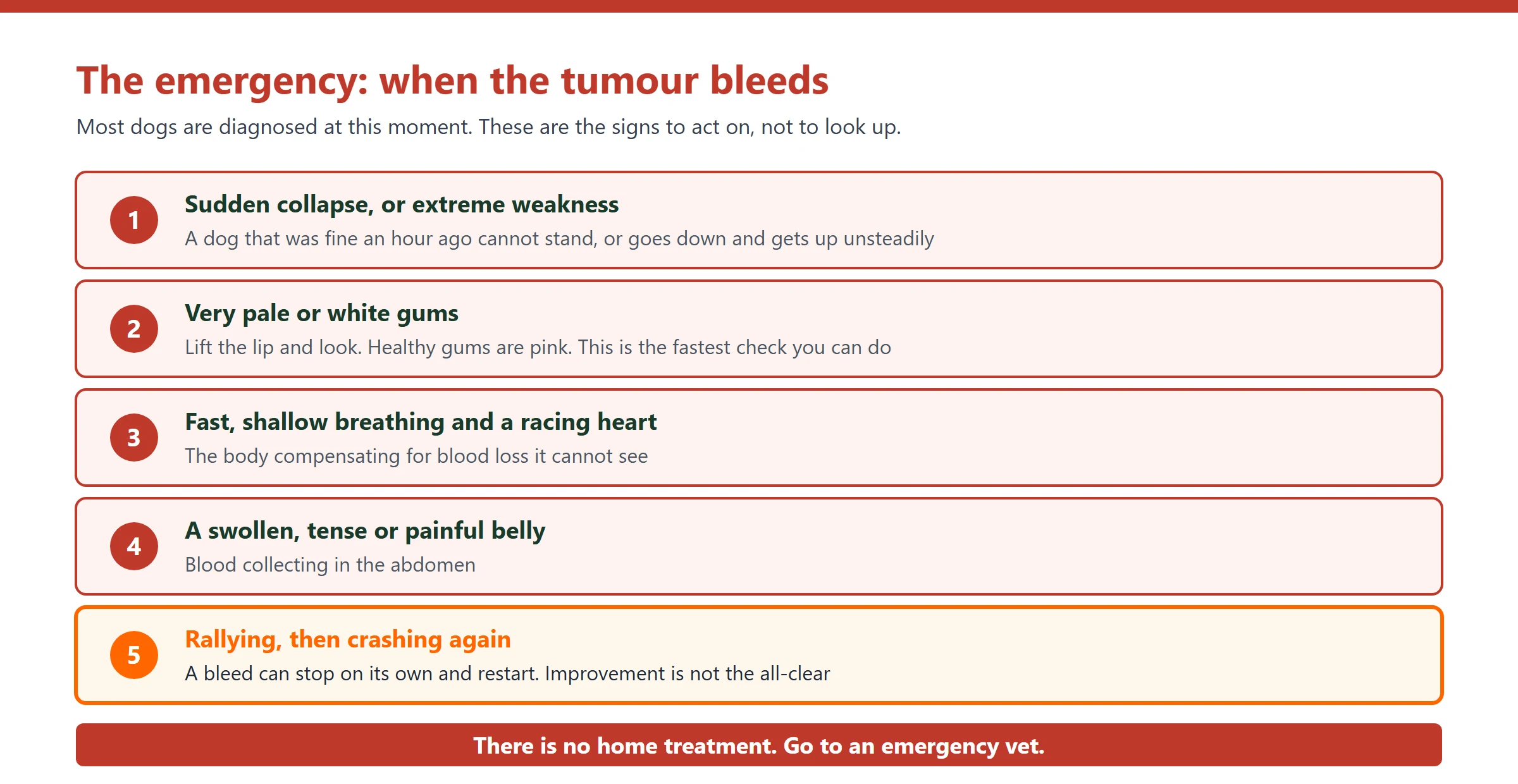
The emergency presentation is the one you can’t miss. A splenic hemangiosarcoma can rupture with no warning. As a result, the dog goes from “seems tired” to “won’t get up” in a matter of hours. Cornell names collapse, pale gums, and difficult or rapid breathing as the classic triad.
Go to the emergency vet right now if you see any of these:
- Sudden collapse or profound weakness, even if your dog recovers a minute later
- Very pale, white, or gray gums
- A visibly distended or hard belly
- Rapid, shallow, or labored breathing
- Cold paws and ears with a fast, weak pulse
These are shock signs. A ruptured splenic tumor causes internal bleeding, and time matters. Therefore, don’t wait for your regular vet to open in the morning. If your dog collapsed and then “seemed fine,” they are not fine. That was a bleed that stopped on its own. The next one may not.
Worried about other GSD-specific conditions on top of this? Our hub post The 18 Most Common Health Issues in German Shepherd Dogs covers hemangiosarcoma as 1 of 18 diseases we cover in depth. Meanwhile, if you’re specifically worried about mass-bleeding emergencies in senior GSDs, our post on German Shepherd hip dysplasia covers a common non-cancer cause of hind-end weakness that can be confused with it in the early hours.
How is hemangiosarcoma diagnosed?
Diagnosis usually starts with an abdominal ultrasound. From there, it moves to imaging of the chest and heart before any decision about surgery. Cornell is clear that a definitive answer requires tissue analysis after the mass is removed. That’s because a needle sample of a blood-filled tumor is risky and often unrevealing.
Your vet is looking for two things. In particular, is there a mass, and where? Second, has it already spread? Chest X-rays and an echocardiogram of the heart are standard, because hemangiosarcoma likes to metastasize to the lungs and the right atrium. Metastasis is the spread of cancer cells from the primary tumor to distant sites, and it’s the reason survival depends so heavily on catching disease early. Additionally, bloodwork rounds out the picture. Typically it shows anemia, which is a low red blood cell count often caused by internal bleeding, plus abnormalities in clotting.
Here’s how the common tools compare:
| Diagnostic | What it shows | When it’s used |
|---|---|---|
| Abdominal ultrasound | Splenic, liver, or abdominal masses; free fluid (blood) in the belly | First-line when a mass or internal bleed is suspected |
| Chest radiographs (X-rays) | Lung metastases; fluid around the heart | Before surgery, to check spread |
| Echocardiogram | Tumors on the right atrium of the heart; pericardial effusion | Before surgery, and whenever cardiac HSA is on the table |
| Complete blood count + clotting panel | Anemia, low platelets, clotting problems | Every case |
| Cytology (needle sample) | Rarely diagnostic for HSA; risk of bleeding | Usually skipped for splenic masses |
| Surgical biopsy / histopathology | The only definitive diagnosis | After the mass is removed at surgery |
What is the “2/3 rule” and does it still hold up?
The old teaching your vet may still quote is the “double two-thirds rule.” In short, it says roughly two-thirds of splenic masses are malignant, and roughly two-thirds of those are hemangiosarcoma. However, newer data suggests the real numbers are lower. From our research into the recent veterinary oncology literature, two peer-reviewed studies now contradict the folk figure.
For example, Cleveland and colleagues, published in PLOS One in 2024 (retrieved 2026-08-11), looked at 182 splenectomies performed between 2017 and 2021. They found hemangiosarcoma in 32.4 percent of cases, not two-thirds. Similarly, a 2025 prospective study of 345 dogs with ruptured splenic tumors (retrieved 2026-08-11) concluded that “benign lesions are more common than previously reported.” From our analysis of both studies, the pattern is clear: modern data lowers the hemangiosarcoma probability for a given splenic mass, and it lifts the odds a mass could be benign.
Why does this matter to you? Because a splenic mass on ultrasound is not an automatic hemangiosarcoma diagnosis. It’s a serious finding that warrants surgery for many dogs. However, the odds of it being benign are meaningfully better than the old rule suggests. So ask your vet what they’re seeing on imaging, not just what the mass could turn out to be. Also worth noting: a benign splenic hematoma is a common non-cancerous finding that can mimic hemangiosarcoma on ultrasound, and only histopathology after surgery can tell the two apart.
What is the prognosis and how long do dogs actually live?
The honest answer is that hemangiosarcoma has one of the toughest prognoses in veterinary oncology. Specifically, Cornell reports an average survival of about two months without treatment. With surgery plus chemotherapy, the median rises to four to six months. Overall, less than 10 percent of dogs are alive one year after diagnosis. That’s the number to hold onto. Not zero, but small. Treatment buys time, quality of life, and often another good season with your dog. However, it rarely buys years. Anyone who promises you it will is not being straight with you. In fact, the AKC Canine Health Foundation puts the medians even more starkly: surgery alone runs about 90 days, and surgery plus chemotherapy about 180 days. Meanwhile, CSU’s Flint Animal Cancer Center reports a similar 5 to 7 months with the combination treatment.
Different tumor locations behave differently, too. For instance, cardiac hemangiosarcoma is generally rougher than splenic, and the median with treatment is shorter. Here are the ranges from the major sources, side by side:
| Scenario | Typical median survival | Source |
|---|---|---|
| No treatment (splenic) | ~2 months | Cornell Riney Canine Health Center |
| Surgery (splenectomy) alone | ~90 days | AKC Canine Health Foundation |
| Surgery + chemotherapy | ~180 days (about 4-6 months) | AKC CHF; Cornell |
| Surgery + chemotherapy (secondary framing) | Approximately 5-7 months | CSU Flint Animal Cancer Center |
| Splenic HSA (with treatment) | 2-12 months | Metro Paws Animal Hospital |
| Cardiac HSA (with treatment) | 3-6 months | Metro Paws Animal Hospital |
| Hepatic HSA (with treatment) | 4-6 months | Metro Paws Animal Hospital |
| Alive at one year (any treatment) | Less than 10 percent | Cornell; CSU Flint |
What are the treatment options and how do you decide?
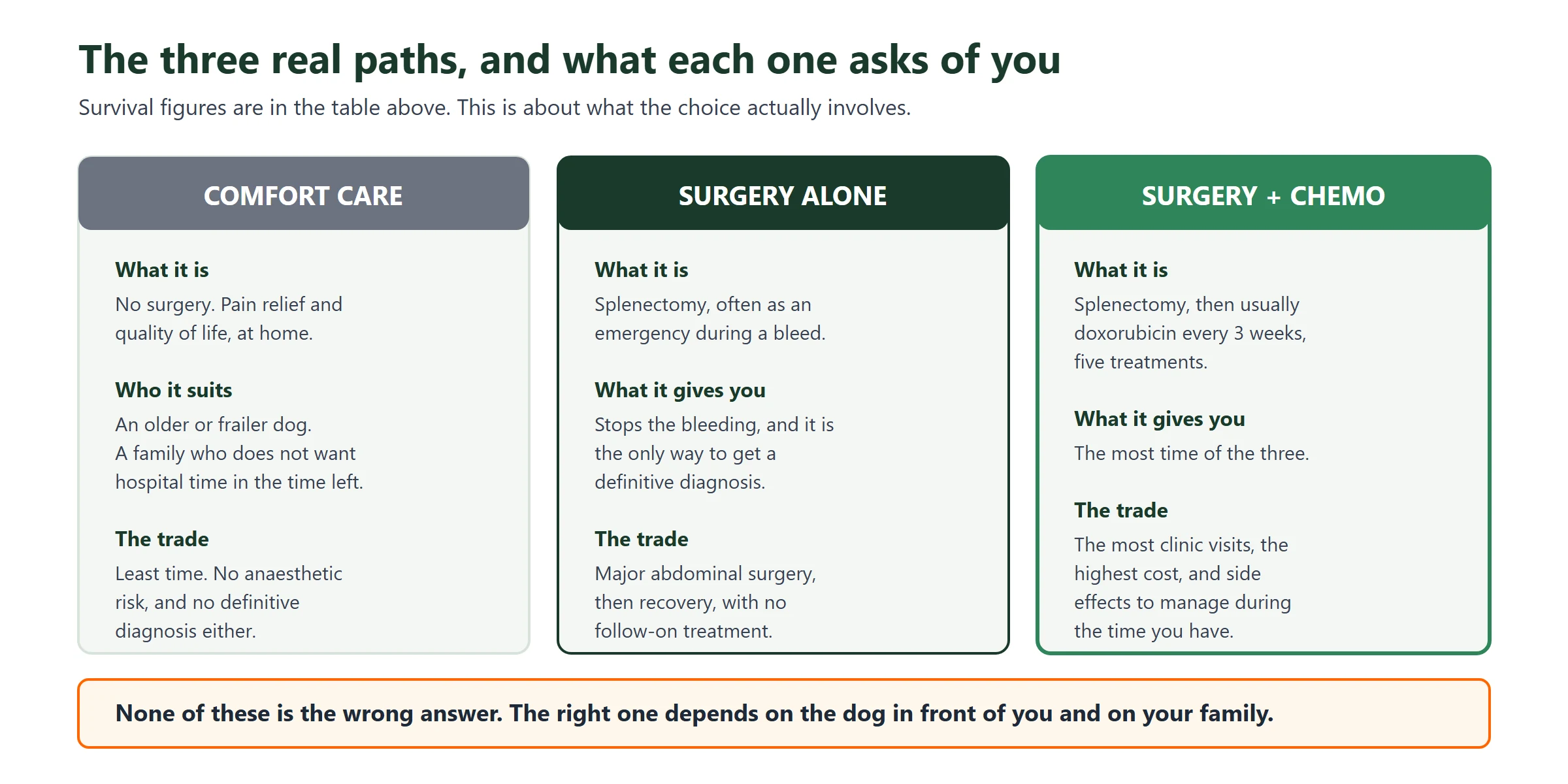
There are three real paths: splenectomy alone, splenectomy plus chemotherapy, and comfort care. To begin, the standard chemotherapy protocol per Cornell is doxorubicin every three weeks for five treatments. Doxorubicin is a cytotoxic chemotherapy drug given by IV infusion, and it’s the workhorse of canine hemangiosarcoma protocols. In addition, Cornell mentions Yunnan Baiyao and I’m-Yunity as adjuncts some owners choose to explore with their oncologist. Yunnan Baiyao is a Chinese herbal formula sometimes used to help clotting in bleeding tumors, and I’m-Yunity is a turkey-tail mushroom extract studied for possible immune support.
The decision isn’t only medical. Instead, it’s about your dog’s age, other health issues, your family’s finances, and what quality of life looks like for a big senior dog after abdominal surgery. There isn’t one right answer, and there isn’t a wrong one either. In practice, most families weigh two questions: how many extra good months does surgery-plus-chemo realistically buy for THIS dog, and what does that stretch of time cost in vet visits, side effects, and money?
| Option | What it does | Pros | Cons / considerations |
|---|---|---|---|
| Splenectomy alone | Removes the primary tumor and stops the bleeding | Immediately fixes the crisis; buys ~90 days on average (AKC CHF) | Doesn’t treat microscopic spread; recovery is a real surgery for a senior dog |
| Splenectomy + chemotherapy (doxorubicin q3wk × 5) | Surgery + adjuvant chemo aimed at slowing metastasis | Extends median survival to about 4-6 months (Cornell) | Higher cost; ~15 weeks of oncology visits; typical side effects (nausea, low white cells) |
| Palliative / comfort care | No surgery; focus on pain control and quality of life | No hospital stay, no surgical recovery; keeps your dog home | Average survival is about 2 months without treatment (Cornell); risk of a fatal bleed at home |
Talk this through with your vet or, ideally, a veterinary oncologist. Ask about your specific dog’s ultrasound findings, chest imaging, and general health. The right choice for a fit nine-year-old is not the right choice for a fragile thirteen-year-old, and both are valid.
What are the final stages of hemangiosarcoma?
The final stages usually involve profound weakness, refusal of food and water, and often a repeat bleed. Dogs frequently seek out a quiet place, breathe more rapidly, and show pale or gray gums. Per Cornell, a splenic tumor that has ruptured can cause collapse, shock, and death within hours if left untreated.
You may also see your dog stop enjoying the things they’ve always loved. To begin, walks get shorter, then stop. Meals get pickier, then get refused. There can be a distant look in the eyes that’s hard to describe until you’ve seen it. None of this is failure on your part. This is the disease.
This is a fair moment to talk to your vet about hospice care, home euthanasia services, and what a peaceful ending looks like. Your dog’s comfort is the goal now. Choosing to let them go while they still have a shred of dignity is a kindness, not a defeat.
What can you do while your dog is well?
You can be watchful without being panicked. To begin, schedule a senior wellness exam every six months once your German Shepherd turns seven. Similarly, ask your vet whether an abdominal ultrasound at that visit makes sense for your dog. Bloodwork twice a year picks up the anemia that a slow-bleeding mass can cause. None of this guarantees early catch, but it stacks the deck a little.
Meanwhile, know the emergency signs cold: collapse, pale gums, distended belly, difficult breathing. If you see any of them, go to the ER. Don’t try to talk yourself out of it.
Beyond that, live the good years with your dog. Long walks, warm meals, the sun on the porch. Yes, hemangiosarcoma is a real risk in this breed, but it isn’t a certainty. Your German Shepherd’s day-to-day life doesn’t need to be shadowed by it.
Frequently Asked Questions
What is the life expectancy of a dog with hemangiosarcoma?
The honest answer is short. Cornell reports an average survival of about two months without treatment, four to six months with surgery plus chemotherapy, and less than 10 percent of dogs alive one year after diagnosis. Tumor location matters: Metro Paws cites 2-12 months for splenic HSA, 3-6 months for cardiac HSA, and 4-6 months for hepatic HSA with treatment.
What are the symptoms of hemangiosarcoma in German Shepherds?
Early signs are non-specific: lethargy, exercise intolerance, and decreased appetite, per Cornell. The emergency presentation is more obvious and includes sudden collapse, very pale gums, a distended belly, and rapid or difficult breathing. Those signs usually mean a tumor has ruptured and is bleeding internally. Go to the ER immediately, even if your dog seems to recover on their own.
What are the final stages of hemangiosarcoma?
The final stages typically include profound weakness, refusal of food and water, pale or gray gums, and often a repeat internal bleed. Per Cornell, a rupture can cause collapse and death within hours. This is a fair time to discuss hospice care, home euthanasia, and comfort-focused choices with your vet.
What is the 2/3 rule for hemangiosarcoma in dogs?
The old teaching held that two-thirds of splenic masses are malignant and two-thirds of those are hemangiosarcoma. Newer evidence is more optimistic. Cleveland and colleagues, PLOS One 2024, reviewed 182 splenectomies from 2017-2021 and found hemangiosarcoma in 32.4 percent of cases. A 2025 prospective study of 345 dogs with ruptured splenic tumors concluded benign lesions are more common than previously reported.
Final Thoughts
If you’re facing this diagnosis right now, the most important thing to hold onto is this: a good decision is a decision that fits your dog, your family, and the honest numbers. It isn’t the one that sounds bravest on paper. Splenectomy plus chemotherapy can buy meaningful extra months. Comfort care can be the kindest choice for a fragile senior. Both are love.
Whatever you choose, please call your vet or a veterinary oncologist before acting on anything you read here. And if you want to understand the wider health picture for the breed, hemangiosarcoma is 1 of 18 diseases we cover in depth in our hub post, The 18 Most Common Health Issues in German Shepherd Dogs.
Written by Rachel Baxley for PetVR.com. Learn more about us or contact the editorial team. Every clinical claim in this article was reviewed against a named veterinary school, peer-reviewed journal, or the AKC Canine Health Foundation; no first-person clinical experience is asserted. Sources retrieved 2026-08-11.

 West German Show Line German Shepherd: SV Rules Explained