
Dogs are at their best form when they are provided enough positive outlet for their pent-up energies and enthusiasm. A dog suffering from boredom may show several negative behavioral signs which is undesirable for both the dog and his owner. Games and activities of various kinds are the best way to keep your german shepherd dog engaged, and the same also imbibe wit, presence of mind, sensitivity, and intelligence.
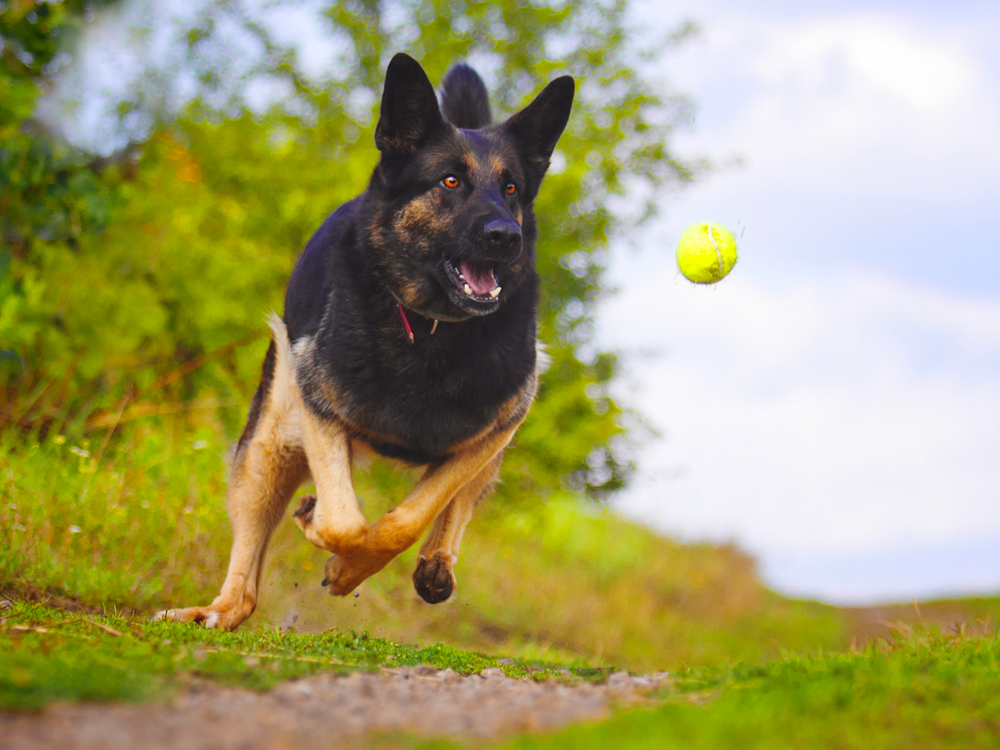
Playing fetch is one of the most effective forms of exercise (both mental and physical) for your dog. This game ‘go and fetch’ is one of the most popular interactive games amongst german shepherd and their masters and the same is known to be a wonderful way to build a strong and healthy dog-owner relationship. The game provides a healthy outlet for the dog to satisfy its prey drive and at the same time, it gives him an opportunity to chase, something that a dog loves to do at any time. However, it is up to you to teach your dog the right way of going after an object and fetching it for you.
The best time to teach this game is the very puppyhood when your puppy is brewing with fresh enthusiasm and has begun to understand your messages and indications to him. As a puppy, he would be able to retain whatever lessons are taught to him and hence the skills would only improve when he grows up to be an adult dog. The game of ‘go fetch has a process and the owner should be slow and steady in teaching the rules and ways of this game to his puppy. The keyword lies in repetitive and positive reinforcement techniques. The following is a step-wise way to teach this game to your young canine companion:
- To start with, choose a small and comparatively empty room (or with fewer distractions). Now, take a dog toy or a ball in one hand and a piece of dog food as a reward in your other hand. Ask you to settle down facing you and see him develop an interest in the toy in your hand. Then, toss the toy/ball at a small distance from you and encourage your dog to get it and pounce on it. Now ask your dog to give the toy back to you and use the treat in your other hand to use as bait for getting the object back from him. Reward him for successfully doing the task as this will motivate the dog to continue the game.
- The next level of teaching the game would be to add a word or gratitude like ‘thanks’ along with the treat and a pat on his back, whenever your puppy fetches you the thing you ask him to. This will help the puppy associate the word ‘thanks’ with positive fetching activity. He also realizes that his fetching the right thing at his owner’s order is getting him praise and his owner’s attention.
- With progression, add the word ‘get it’ or ‘fetch it’ can also be used to indicate your dog chasing the thing and fetching it for you. As your puppy grows up and learns the tricks of chasing the object and fetching it for you, try to make him run a little farther than before and do this by throwing the object farther or at a good distance away from you and seeing him enthusiastically fetch it for you.
- Make sure you involve yourself completely in this game and encourage him with equal motivation with which he chases the object for you. This game on repetition would transform into bait itself, as your dog will grow his fondness for the same and this will let you do without any treatment for the dog.
On positively repeating this game, you would be rewarded with a happy, energetic, and enthusiastic german shepherd who is ever ready to fetch and drop anything that you ask him to. However, be careful not to ask him to fetch any harmful or poisonous or small animal, etc, which would ruin or tarnish the real fun and objective of this game.
Fetch is also a bonding exercise, and strengthening that bond makes every other cue easier.
Disclaimer: PetVR shares general information based on our contributors’ firsthand experience with German Shepherds — it is not veterinary advice. Always consult a licensed veterinarian about your dog’s health, diet, or behavior. Read our full disclaimer.
How dogs actually learn, and why the method matters
Before any specific exercise, it is worth knowing what the veterinary behaviour profession actually recommends, because the dog training industry is unregulated and advice varies wildly.
The American Veterinary Society of Animal Behavior is unambiguous: “based on current scientific evidence, AVSAB recommends that only reward-based training methods are used for all dog training, including the treatment of behavior problems” (AVSAB Humane Dog Training Position Statement, retrieved 2026-08-12).
This is not a soft preference. AVSAB states it “does not support the use of aversives in any context, regardless of the tools used or the trainer’s level of experience”, and that the position “is grounded in current scientific evidence, which consistently shows that aversive methods carry significant risks to animal welfare and the human-animal bond” (retrieved 2026-08-12).
And reward-based training is not merely kinder, it works better. AVSAB cites Hiby and colleagues (2004), who found “obedience levels of dogs highest for dogs trained exclusively with reward-based methods and lowest for dogs trained exclusively with aversive-based methods”. Mixed approaches, “often referred to as balanced in the dog training industry”, landed in between (AVSAB Position Statement on Humane Dog Training, 2021, retrieved 2026-08-12).
One misunderstanding worth heading off. AVSAB notes that “use of reward-based methods does not mean dogs are allowed to do anything they want” (retrieved 2026-08-12). Rules still exist. What changes is how you teach them.
Building fetch in four pieces
Fetch is not one behaviour, it is four joined together: chase it, pick it up, bring it back, give it up. Most fetch problems are one broken piece, so it helps to know which.
- Chase. Most German Shepherds arrive with this installed. Roll the toy along the ground rather than throwing it high; low movement triggers the chase and spares the joints.
- Pick up. Reward any mouth contact at first. Some dogs chase happily and then stand over the toy, and rewarding the grab is what fixes that.
- Return. The most common failure, and usually caused by the human. Do not walk towards the dog, and do not chase it. Move backwards and make yourself interesting, because a dog that is followed learns that keeping the toy starts a great game.
- Release. Teach a swap rather than a wrestle. Offer a second identical toy or a treat, say “drop”, and reward the release. Prising a toy out of a large dog’s mouth teaches it to hold tighter.
Fetch and joints: the part nobody mentions
Fetch is high-impact, repetitive and self-reinforcing, which is a risky combination in a large breed prone to joint disease.
The problem is not the running, it is the hard stops and the twisting turns, repeated dozens of times in a session, often on grass that is slippery or uneven. In a growing puppy those forces land on joints that are still forming.
- Roll it, do not launch it. Low throws remove the leaping and the sharp landing.
- Keep sessions short. Ten good retrieves, then something else. A German Shepherd will keep going long past the point where it should stop.
- Avoid ball launchers for young dogs. They produce distances and speeds no dog would choose for itself.
- Watch the surface. Wet grass and hard turns are where injuries happen.
- Do not throw down slopes. Descending at speed loads the front legs hardest.
If your dog is limping after fetch, or stiff the next morning, that is information rather than bad luck. Our articles on osteochondritis dissecans, elbow dysplasia and panosteitis cover the three conditions that most often turn up in young dogs of this breed.
What is different about training this breed
German Shepherds are not harder to train than other dogs. In some ways they are easier, and that creates its own problems.
They learn fast, including the things you did not mean to teach. A dog that works out that barking makes you come outside has learned exactly as efficiently as one learning to sit. Be deliberate about what gets rewarded, including by accident.
They need the thinking as much as the walking. The AKC describes purpose-bred dogs as needing mental work, warning that without the brain exercise they need “they’ll create their own projects to keep their minds busy” (AKC breed profile, retrieved 2026-08-12). Five minutes of training is often worth more than another twenty minutes of walking.
They are big, and size changes the stakes. A behaviour that is charming in a 10 kg puppy is not charming in a 35 kg adult. Jumping up, mouthing and pulling are all much easier to prevent than to fix later.
They form strong attachments, which makes your attention a genuinely powerful reward and makes harsh handling land harder than it would with a less sensitive dog.
Session rules that make everything else work
- Short and often beats long and occasional. Three or four sessions of five minutes across a day will outperform one twenty-minute session, especially with a puppy.
- Finish while your dog still wants more. Ending on success is what makes a dog eager to start next time.
- Train before meals, not after. A hungry dog works for food. A full dog does not.
- Start somewhere boring. Your kitchen, no other dogs, no visitors. Add difficulty only once the behaviour is reliable.
- Change one thing at a time. Distance, duration, distraction. Raise one and drop the others.
- If it falls apart, make it easier. A dog that stops responding is usually telling you the step was too big, not that it is being stubborn.
- Keep your voice ordinary. Repeating a cue louder teaches the dog that the first six times do not count.
If you hire help, here is the filter
A German Shepherd is a large, powerful, clever dog, and getting good help early is money well spent. The difficulty is that anyone can call themselves a dog trainer.
AVSAB gives an unusually concrete screening rule: “if a trainer is observed using aversive training methods or if a trainer discusses out-dated ideas such as dominance, leader of the pack, or alpha theories, then clients should be advised against hiring them” (AVSAB Position Statement on Humane Dog Training, 2021, retrieved 2026-08-12).
That is a clean test you can apply in a five-minute phone call. Ask a prospective trainer how they would handle a dog that ignores a cue. If the answer involves showing the dog who is boss, keep looking.
Questions worth asking before you book:
- What happens when my dog gets it right? A reward-based trainer answers this immediately and specifically.
- What happens when my dog gets it wrong? The answer should involve making it easier, not making it unpleasant.
- What equipment do you use? Be cautious of anyone who leads with a tool rather than a plan.
- Can I watch a class before enrolling? A confident trainer says yes.
- What qualifications do you hold, and are you insured?

 14 Major Behavioral Problems That Your German Shepherd May Exhibit